The Arizona desert held its breath. 20 arrows drawn, waiting. The man in the river didn't move. Couldn't move. Water dripping from his shirt, hands raised, boots somewhere on the bank behind him.
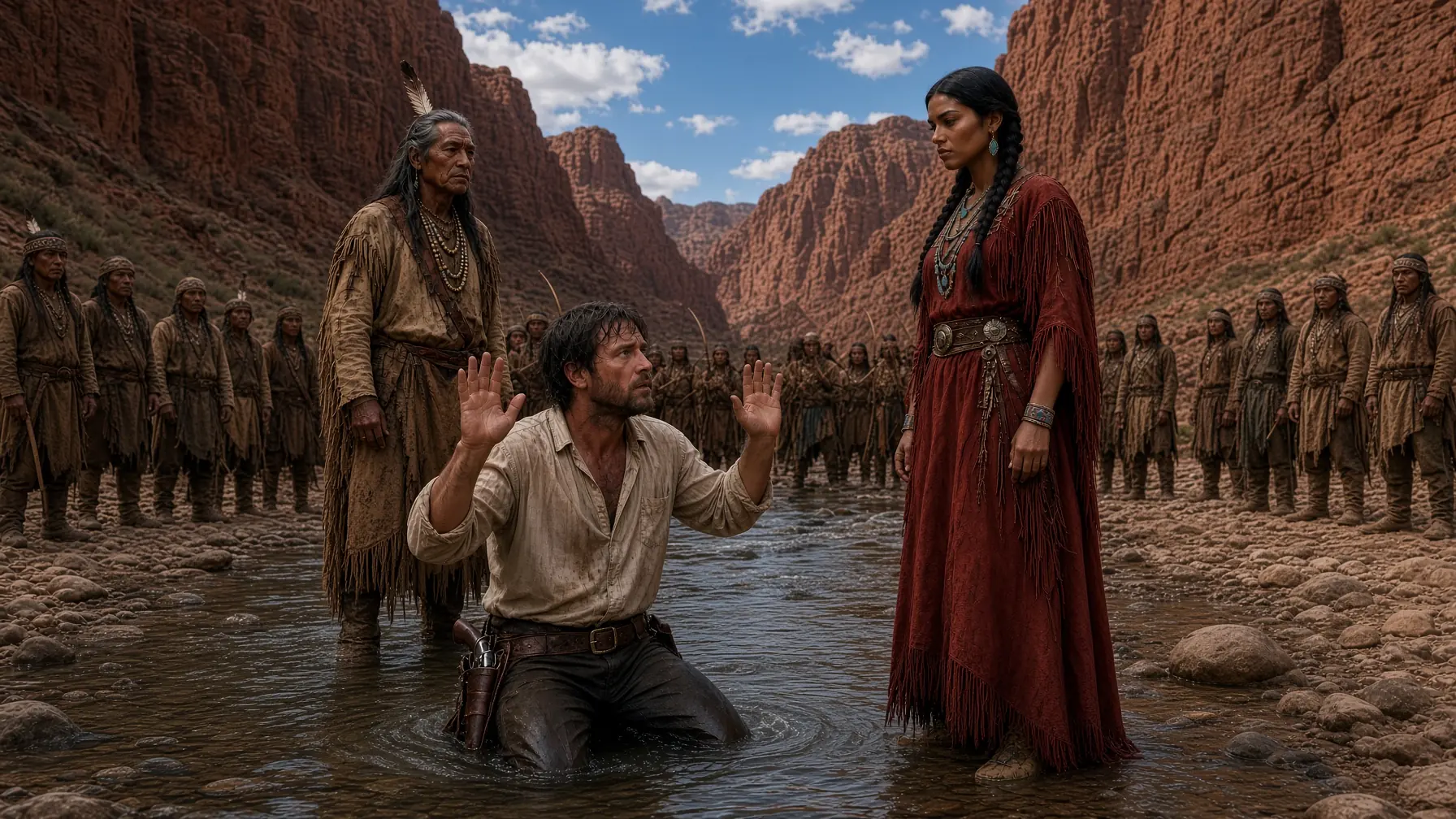
He had ridden six days to find water. He had found something else entirely. From the rocks, a voice, old, certain, the kind of voice that had never needed to be loud to be obeyed. You have just stepped into the oldest promise our people keep. Silence.
Then from somewhere deeper in the canyon. Footsteps. A woman's footsteps. Deliberate. Unhurried.
The warriors parted without being asked. She stopped at the river's edge and looked at the soaking wet stranger with an expression that was not welcome and not hostility. It was something far more dangerous. It was judgment. Seth Callaway had not slept in a real bed since March.
He knew this because he had been counting, not on purpose. The counting started the night he signed the papers on the New Mexico property and handed the key to a man named Aldis Briggs, who had no relation to anyone Seth wanted to think about. And the key made a sound when it hit the wood of the desk, a small hollow knock, and Seth walked out into the cold air of the April evening, and stood in the road for a long time without walking in any direction at all. Six weeks since March. 43 nights on hard ground or harder cots in towns that smelled like sawdust and cattle and other men's desperation.
And one night three days back where he hadn't slept at all. That one he didn't count. He was a rancher without a ranch, which was not a thing he had ever planned to be. He had been a rancher since he was 21 years old, since his father shook his hand on the east pasture of their spread outside Santa Fe, and said the land was his now, said at the way men of that generation said things dry and without ceremony, looking at a fence post instead of a son's face. Seth had taken that handshake and turned it into 600 acres of working land, a herd that peaked at 180 head, a house with real glass windows, and a woman named Ruth, who called the horses by individual names that she made up herself, and that the horses seemed improbably to actually respond to.
Ruth named his best breeding stallion Gerald. Gerald the horse had been sold at auction for $42 to a buyer from Colorado. Seth had watched Gerald load into a stranger's trailer and had felt something that was not grief exactly, but lived in the same county as grief and shared some of its roads. The land was gone now. The herd was scattered across three states.
Gerald was in Colorado, and Ruth was in the ground outside of Simmeron under a white stone marker with her name and the year she was born and the year she was not. And below that, because Seth had paid extra and the stone cutter had been patient, with him a second line that read, "And the child she carried. " He didn't visit the stone before he left. He told himself this was because he had already said goodbye. He knew this was not entirely the truth. The fuller truth was that he could not stand in front of that stone and then ride away from it because riding away from it felt like a thing that could not be taken back.
And he was not ready for things that could not be taken back. So he left at 4:00 in the morning while the town was still dark. Red had been standing at the post outside the boarding house, patient as always, ears forward, and Seth had bridled him without a lamp, and they had ridden south without looking back at the town, because looking back was a habit Seth was attempting to break, even if he had not yet succeeded. He had a map. He should explain about the map.
The map was purchased in Santa Fe from a land agent named Corbett, who wore a hat two sizes too large, and spoke with the rapid enthusiasm of a man who had decided that confidence could substitute for accuracy. Corbett spread the map on the counter and traced a route into Arizona territory with his thumb, describing water sources and established trails and fertile valley land that was, according to Corbett, practically waiting to be claimed by the right man with the right vision. Seth was not a gullible person. He had been buying and selling land and cattle for 13 years, and he understood the difference between a fair deal and a convenient story. But he was also a person who needed in that particular week to have somewhere to go.
And Corbett's map showed somewhere to go. So Seth paid $3 and folded the map into his coat pocket and did not examine it too closely until he was already three days into Arizona territory and the trail Corbett had described with such thumbtraced confidence had disappeared entirely into a landscape of red rock formations that bore no resemblance to anything on the paper. By day five, he had begun to lose faith in Corbett as a professional. By day six, he had stopped consulting the map and started consulting Red. Red was a chestnut quarter horse, 1four years old, with a white blaze on his forehead and the kind of disposition that made other horses seem neurotic.
Seth had raised him from a foal on the New Mexico property. Red had lived through two droughts, one flash flood, a fire in the south pasture, and the particular sustained grief of the last two years. And he had absorbed all of it with the same equable attention he gave to everything, ears swiveling, nostrils working, feet finding solid ground, even when the ground was not offering much to work with. On the sixth day, Red stopped, not because he was tired. The horse's ears went forward and then turned sideways, which was the specific ear configuration that Seth had learned over 1four years meant the horse was processing something Seth's own senses had not yet reached.
Seth dropped the reins to the saddle horn, which was his way of telling Red to make the decision. And Red turned 40° to the left and walked toward a wall of rock that looked to Seth's eyes like a wall of rock. But Red found the gap. It was narrow, barely shoulder width for the horse. The rock walls rose on both sides to 20 or 30 feet, and the temperature dropped inside the passage by 10°, which after six days in open desert sun felt like stepping into a church.
The passage turned twice and then opened. Seth had seen beautiful places in his life. He had grown up in New Mexico, which was not a state that apologized for its landscape. He had ridden into mountain valleys in Colorado, with snow still on the peaks in June, and meadows so green they looked constructed. He had seen the Rio Grande at sunset, from a high point on his own land, the water going amber, and then copper and then dark.
None of it had stopped him the way this did. The river was maybe 10 yardss across and running clear over a bed of smooth, dark stone. The banks on both sides were thick with grass, the kind of grass that grew where water never failed, deep-rooted and improbably vivid against the surrounding red desert. Cottonwood trees lined the West Bank with their pale bark and their shimmering leaves catching the light. Wildflowers grew in patches along the waterline, yellow and purple, and a particular burnt orange that Seth could not name.
The whole basin was walled by rock on three sides and open only to the south where the canyon widened into the desert. And the effect was of a place that had been keeping itself hidden. There was no sign anyone had been here. No fire ring, no cut wood, no bootprints in the bank mud. Seth climbed down from red and tied him loosely at the bank and let him drink.
He knelt upstream from the horse and put his hands in the water and drank himself. And the water was cold in a way. That water from a canteen warmed by six days of desert sun was never cold, and it tasted like nothing, which was exactly what good water tasted like. He sat back on his heels and looked around once more. His habit from years of working land was to read a place before trusting it.
He read this place and found nothing to distrust. No recent tracks, no smell of smoke, no sound except the water moving over stone and the cottonwoods moving in a small wind that didn't quite reach ground level. He took off his boots. He left his hat on the bank with his coat. He walked into the river with his clothes on because after six days in the desert, the clothes needed the water as much as he did, and the cold hit him at the ankles and then the knees and then the hips as the riverbed shelved gradually deeper.
And when the water reached his chest, he stopped and stood still for a moment and then let himself sink backward until he was floating on his back with his ears submerged and the sky above him a deep hard blue without a single cloud. For the first time since March, his mind went quiet. Not peaceful, not at rest, just quiet. The way a room goes quiet when someone stops speaking in the middle of a sentence and you realize they are not going to finish it. He was thinking of nothing.
He was not thinking of Ruth. He was not thinking of the stone marker outside Simmeron or the ranch papers or Corbett's useless map or the next thing or the thing after that. He was floating in cold water in a hidden canyon in Arizona. And he was not thinking of anything at all, which was in its way the first thing that had felt like mercy in 2 years. Then he heard it.
The sound was specific and unmistakable to anyone who had spent time in country where people carried bows, the creak of a stave bending under tension, then the dry whisper of a nocked arrow settling against its rest. Seth had heard this sound twice in his life, both times on the Texas frontier 20 miles south of Amarillo when he was 23 and working cattle for a man named Crenshaw. And his body remembered the sound even before his mind processed it. He opened his eyes. He did not sit up fast.
Fast movements were the wrong answer. And some part of him knew this before he had time to think it through. He came upright slowly, hands rising to shoulder height, palms forward, water sheeting off his shirt. 20 Apache warriors stood on the banks and the rocks above the banks in a semicircle that covered every direction except the rock wall behind him. They had been there, he understood, since before he had taken off his boots.