The train came screaming into Red Willow Station like a wounded animal.
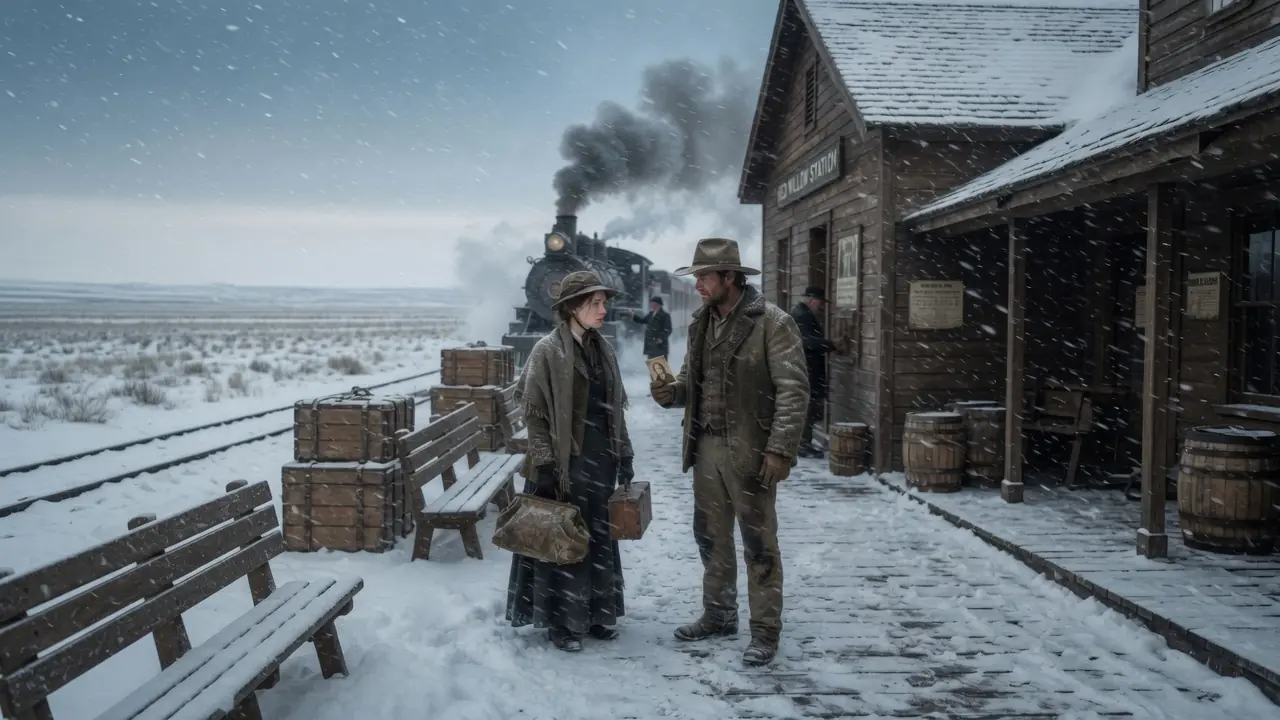
Black smoke rolled across the pale Wyoming sky, and the iron wheels shrieked against the frozen rails. Snow blew sideways across the platform, sharp as ground glass, catching in the collars of coats and the hems of traveling dresses.
Caleb Rourke stood beneath the station awning with his hat pulled low and his hands buried deep in the pockets of his sheepskin coat.
He had not wanted to be there.
There were fences down on the north pasture, a water trough frozen solid near the lower barn, and two hundred head of cattle that needed watching before the next storm came over the ridge. Riding six miles into town to fetch another man’s bride was not how he had planned to spend his afternoon.
But Samuel Pike had asked.
Samuel was not just a neighbor. He was the closest thing Caleb had to family left in the territory. They had ridden together after the war, survived a cattle drive through Kansas, buried men together, and once shared one can of peaches between them when a blizzard pinned them in a line shack for three days.
So when Samuel said he had business with the land agent and could not meet the afternoon train, Caleb had agreed.
“Just fetch her from the station,” Samuel had said, clapping him on the shoulder. “Bring her to the ranch. Her name is Miss Rose Bellamy. Pretty little thing. Nineteen. Yellow hair. Blue eyes. Looks like springtime, Jake. You’ll know her.”
Caleb had not bothered to correct him for calling him Jake, a habit Samuel had never been able to break from the trail days.
He had only taken the photograph.
Miss Rose Bellamy had stared up from the card with a soft, sweet face. Golden curls. Wide eyes. Lace collar. A girl too delicate-looking for wind, cattle, and Wyoming winters.
Caleb had looked at the photograph and thought Samuel was a fool.
But men were often fools when loneliness got cold enough.
Now he watched passengers spill from the train: miners with bedrolls, a mother clutching two children, a drummer with a valise, an old man coughing into a handkerchief, three young women traveling together beneath fashionable hats.
No golden curls.
No lace collar.
No springtime.
Then, from the last passenger car, a woman stepped down carefully onto the snowy platform.
She wore a plain dark dress beneath a worn traveling coat. A gray shawl covered her shoulders. Her hat was sensible, not pretty, and tied beneath her chin with ribbon faded by too much use. She carried one carpet bag and a small wooden case, both old enough to have belonged to someone before her.
She was not nineteen.
She was perhaps thirty.
Maybe older, though hardship had a way of adding years where time had not.
Her brown hair was pinned severely at the back of her neck. A few strands had escaped and clung damply to her cheek. Her face was pale from travel, fine-boned but tired, with shadows beneath her eyes and a mouth that looked as though it had learned not to ask for much.
But she stood straight.
That was what Caleb noticed first.
The wind pushed at her. The snow stung her face. People jostled around her. Still, she stood straight, holding her bag with both hands, looking across the platform with quiet, controlled uncertainty.
Their eyes met.
Hers were hazel, not blue. Clear, watchful, and lonelier than any woman’s eyes had a right to be after crossing half a country alone.
Then she looked away.
Caleb waited for the girl from the photograph to appear behind her.
The conductor shouted.
The stationmaster waved his arm.
The train gave another mournful whistle.
No golden-haired girl stepped down.
Caleb muttered under his breath and crossed the platform.
“Ma’am,” he said, touching the brim of his hat. “You waiting for someone?”
The woman turned toward him. Her voice was soft, educated, and steady despite the cold.
“Yes. I am to be met by Mr. Samuel Pike.”
Caleb felt the first twist of trouble in his gut.
“You are Miss Bellamy?”
Color rose in her cheeks.
“Miss Abigail Bellamy,” she said. “Rose’s elder sister.”
Caleb stared at her.
The wind blew snow between them.
“Where is Rose?”
Abigail’s fingers tightened around the carpet bag.
“She could not come.”
“Could not?”
“She chose not to.”
His jaw set.
“Samuel paid passage for Rose Bellamy.”
“I know.”
“He has been expecting Rose Bellamy.”
“I know that too.”
“And you came instead.”
“Yes.”
The word was small, but it did not break.
Caleb removed his hat, rubbed one hand over his hair, and put the hat back on.
“Ma’am, this is not a small misunderstanding.”
“I did not imagine it would be.”
“Samuel sent me to fetch his bride.”
“I understand.”
“No,” Caleb said, harsher than he intended. “I do not think you do.”
For the first time, pain flickered across her face. Not surprise. She had expected cruelty, perhaps. Or rejection. But expectation did not make a blow painless.
“Mr. Pike is not here?” she asked.
“No. He sent me.”
“And you are?”
“Caleb Rourke. I own the next ranch east of his.”
She nodded once.
“Then perhaps you will take me to him, Mr. Rourke. I have traveled a very long way to face whatever must be faced.”
Instead, they sounded exhausted.
Caleb looked at her thin shawl, her pale lips, her trembling hands. Whatever she had done, whatever deceit had brought her to Wyoming, she was standing in a storm with no one else coming for her.
He reached for her carpet bag.
She hesitated.
“I can carry it.”
“I know.”
He took it anyway.
“My wagon is this way.”
The ride from Red Willow Station to Samuel’s ranch was slow and bitterly cold.
Abigail sat beside Caleb on the wagon bench, wrapped in the heavy blanket he had taken from beneath the seat. Snow collected along the brim of his hat and melted into the dark wool of her shawl. The horses lowered their heads into the wind and pulled steadily through the white road.
For several miles, neither spoke.
The land stretched wide and merciless around them, all snow-covered grass, dark fence lines, low hills, and gray sky. Abigail looked out at it with an expression Caleb could not read.
Not fear exactly.
Recognition, perhaps.
As if she had arrived at the edge of the world and found it no harsher than the place she had left.
At last she said, “You must think badly of me.”
Caleb kept his eyes on the road.
“I think I do not know enough yet.”
“That is kinder than most would be.”
“I have not been accused of kindness often.”
“No?”
“Not by anyone who knows me well.”
A faint breath left her. Not quite a laugh.
“I suppose I should explain.”
“That belongs to you and Samuel.”
“You are the man who came for me. You deserve something better than silence.”
Caleb said nothing.
So she began.
“My sister Rose was the one who answered Mr. Pike’s advertisement. Our father died last spring. He had been ill for years, and his medicines left debts we could not pay. We lost the house in Concord. I found work as a seamstress when I could, but it was never enough.”
Her voice remained calm, but Caleb heard the effort beneath it.
“Rose is beautiful. Everyone has always told her so. She is young and romantic and believes the world is cruel only because it has not yet been introduced properly.”
Caleb glanced at her.
“And you?”
“I believe the world knows exactly what it is doing.”
This time, he almost smiled.
She looked down at her gloved hands.
“When Rose began writing to Mr. Pike, she treated it like a story. A handsome rancher in the West. A new life. A wedding by spring. She read his letters aloud to me and laughed over the idea of learning to make biscuits.”
“Samuel cannot make biscuits either,” Caleb said.
Abigail looked surprised.
Then, despite herself, smiled faintly.
“Two weeks before she was meant to leave, Rose met a young lawyer’s clerk in Boston. Mr. Thomas Hale. He was poor, but he adored her. She came to me crying that she could not marry a stranger in Wyoming when she had given her heart elsewhere.”
“So you offered to take her place.”
“No.”
The answer came quickly.
Caleb looked at her.
Abigail’s eyes were on the road ahead.
“At first, I told her she must write the truth. She refused. She was afraid Mr. Pike would demand repayment of the passage. She was afraid people would call her dishonorable. She was afraid Thomas would leave if he knew she had arranged to marry someone else.”
“And you?”
“I was tired.”
The simplicity of it landed harder than tears would have.
“I was tired of debts. Tired of landlords. Tired of pretending there would be work next week when I knew there might not be. Tired of being thirty-one and useful only when someone needed mending done cheaply.”
The wind moved around them.
“So I wrote to Mr. Pike.”
Caleb frowned.
“As Rose?”
“No. As myself. I told him the truth. That Rose could not come. That I would be willing to come in her place if he wished to consider me.”
Caleb’s hands tightened on the reins.
“Samuel never mentioned another letter.”
Abigail closed her eyes briefly.
“I feared so.”
“He showed everyone Rose’s photograph.”
“Yes,” she whispered.
“He was expecting her.”
“Yes.”
“Then why come?”
She looked at him then.
Because I had already sold nearly everything we owned to pay what remained of the fare. Because Rose had married Thomas that morning. Because the room I rented was gone. Because I had no home to return to and no reason to believe staying would leave me less humiliated than going.”
She swallowed.
“And because some small, foolish part of me hoped a man lonely enough to write for a wife might be merciful enough to accept a woman who could work.”
Caleb had no answer.
He understood many kinds of desperation. He had seen men drink it, fight it, run from it, and die under it. But he had not often heard it spoken so plainly.
The last ridge before Samuel’s ranch rose in front of them.
Beyond it, a low house appeared, smoke rising from the chimney. The barn stood dark against the snow. A few cattle clustered near a fence line. Two ranch hands paused from hauling hay to watch the wagon approach.
Abigail straightened.
The blanket slipped slightly from her shoulders.
Caleb looked at her.
“Whatever happens,” he said, “keep your chin up.”
Her mouth trembled once, then steadied.
“I have had practice.”
Samuel Pike came out of the house smiling.
The smile died before he reached the porch steps.
He was a broad man with sandy hair, a weather-reddened face, and the easy charm of someone who liked a room until the room refused to please him. Caleb had seen him laugh through storms, fights, and broken bones. He had also seen Samuel turn mean when pride took a hit.
Right then, pride hit hard.
Samuel stopped at the edge of the porch, staring at Abigail.
“Where is Rose?”
Abigail climbed down before Caleb could help her. She stood in the snow with both hands clasped before her.
“I am Abigail Bellamy. Rose’s sister.”
Samuel’s face darkened.
“I can see you are not Rose.”
“She could not come.”
“She could not?”
His voice sharpened.
“Or she would not?”
Abigail held his gaze.
“She married another man.”
The ranch hands went still.
Samuel looked at Caleb.
“You knew this?”
“I knew on the way from the station.”
Samuel laughed once, without humor.
“You brought her here anyway?”
“She was standing in the snow.”
“I paid for Rose.”
Abigail flinched, but did not lower her head.
“I wrote to you, Mr. Pike. I told you the truth. If the letter did not reach you—”
“No letter reached me.”
“I am sorry.”
“Sorry?”
Samuel stepped off the porch.
“I waited months for a pretty young bride, and you climb off that train with a carpet bag and an apology?”
“Samuel,” Caleb said quietly.
Samuel ignored him.
His eyes swept Abigail from her plain hat to her worn boots.
“You are what, thirty-five?”
“Thirty-one.”
“Thirty-one,” he repeated, as though the number itself insulted him. “And you thought I would just take the old sister because the young one found better prospects?”
Color drained from Abigail’s face.
Caleb stepped closer.
“That is enough.”
Samuel turned on him.
“No, it is not. This woman came here under false pretenses.”
“She says she wrote you.”
“She came because she had nowhere else to go.”
“Yes,” Abigail said quietly.
The honesty seemed to strike the yard harder than denial would have.
Samuel’s mouth twisted.
“At least you admit it.”
“I came because I hoped I might be useful. I can sew, cook, keep accounts, help with chickens, preserve food, tend sickness if needed. I did not expect affection, Mr. Pike. Only consideration.”
“I did not ask for a housekeeper.”
“No.”
His eyes narrowed.
“I asked for a wife young enough to give me sons.”
One of the hands looked away.
Another stared at the ground.
Abigail stood very still.
The wind tugged at her shawl.
For a moment, Caleb saw not only the woman in front of him but the miles behind her: the train smoke, the lost house, the little sister saved, the letter that never arrived, the last foolish hope dying in a stranger’s yard.
Samuel said, “I will not be made a joke in Red Willow because some dried-up seamstress thought herself a substitute bride.”
Caleb moved before he thought.
He stepped between them.
“Say another word like that and you will regret it.”
Samuel stared at him.
The yard went silent.
“You threatening me over her?”
“I am warning you because we were friends.”
Samuel’s face flushed.
“You want her, then? Take her. She looks more your sort anyhow.”
The words were meant to shame them both.
Caleb turned to Abigail.
Her eyes were bright, but the tears had not fallen.
He respected her for that.
He hated that she had needed such practice.
“My ranch has a spare room,” he said. “You can stay there until you decide what comes next.”
Samuel barked a laugh.
“Of course. Saint Caleb of the broken women.”
Caleb picked up Abigail’s bag.
“Get in the wagon, ma’am.”
Abigail hesitated only a moment.
Then she climbed in.
As Caleb turned the wagon, Samuel called after them, “Do not expect me to pay for her keep!”
Caleb did not look back.
“I never did.”
They rode away through the snow, leaving laughter behind them.
Abigail kept her face turned forward.
Only when Samuel’s ranch vanished behind the ridge did she press one hand over her mouth and close her eyes.
Caleb said nothing.
Some pain needed silence more than comfort.
He drove on toward his own ranch, a smaller spread tucked below the red bluffs east of town. It was not grand, but it was honest. A low main house, a barn, a bunkhouse, a smokehouse, corrals, and a small stone shed that had once been used by a married hand before fever took his wife.
The place looked lonely in winter.
Caleb had long ago stopped minding.
When they arrived, an old ranch hand named Amos came from the barn, squinting at the wagon.
“Boss?”
“This is Miss Bellamy,” Caleb said. “She will take the back room in the house tonight. Tomorrow we will make arrangements for the stone cabin.”
Amos looked once at Abigail, then at the bag, then back at Caleb.
He was too old and too wise to ask questions in the yard.
“Yes, sir.”
The back room was small, with a narrow bed, a washstand, a braided rug, and a window facing the cottonwoods. Caleb built up the fire in the main room and set a kettle on the stove.
Abigail stood near the doorway, still holding herself too straight.
“I cannot stay in your house,” she said.
“You can tonight.”
“It is improper.”
“It is colder than propriety.”
A faint, startled laugh escaped her.
Caleb looked over his shoulder.
It was the first unguarded sound he had heard from her.
He liked it more than was wise.
He turned back to the stove.
“Tomorrow, Amos and I will ready the stone cabin. It has a stove. Roof does not leak unless the rain comes sideways.”
“That is generous.”
“It is practical.”
“Mr. Rourke.”
He faced her.
“I will not take charity.”
“I did not offer any.”
She lifted her chin.
“If I stay, I work.”
He studied her.
The firelight softened the lines of exhaustion on her face. Without the storm at her back, she looked less old than simply worn thin by too many years of being strong for others.
“Can you cook?” he asked.
“Yes.”
“Can you keep accounts?”
“Yes.”
“Can you mend saddle blankets?”
“I can learn.”
“Can you tolerate men who smell like cattle and argue about beans?”
“I have survived Boston boarding houses. I expect I can survive ranch hands.”
This time, Caleb smiled.
“All right, Miss Bellamy. We will discuss wages tomorrow.”
Her eyes widened.
“Wages?”
“Work gets paid here.”
For the first time since the station, her face changed fully.
Not happiness.
Not relief exactly.
Something smaller and more fragile.
Respect received after too long without it.
“Thank you,” she said.
The next morning, Abigail was awake before dawn.
Caleb found her in the kitchen with sleeves rolled up, coffee boiling, biscuits in the oven, and a skillet of salt pork already crackling on the stove.
Amos stood near the doorway holding a cup, looking mildly alarmed.
“She started before I could stop her,” he said.
“I did not know anyone intended to stop me,” Abigail replied.
Caleb leaned against the doorframe.
“You sleep?”
“A little.”
“That means no.”
“It means enough.”
The ranch hands came in from morning chores stamping snow from their boots. There were four of them besides Amos: Red, a quiet man with a limp; Willie, barely twenty and still growing into his wrists; Boone, a widower with sad eyes; and Carter Finch, who smiled too often and too sharply.
They ate quickly.
Ranch men always did.
But after the first bite of biscuits, Willie looked up.
“Ma’am, these are better than Amos’s.”
Amos grunted.
“They are not better. They are different.”
“They are better,” Red said.
Abigail’s mouth curved faintly.
Carter leaned back in his chair.
“So you are the bride that was not?”
The room cooled.
Abigail’s hand stilled on the coffeepot.
Caleb looked at Carter.
“She is Miss Bellamy.”
Carter shrugged.
“Just asking.”
“No,” Caleb said. “You were not.”
The warning held.
Carter looked down at his plate.
Abigail continued pouring coffee.
Her hand did not shake.
That impressed Caleb more than if she had snapped back.
As days passed, Abigail made herself part of the ranch not by asking permission but by becoming necessary.
She cleaned the kitchen shelves, sorted the accounts Caleb had been avoiding since October, mended six shirts, patched three saddle blankets, reorganized the pantry, and discovered that Amos had been hiding sugar from himself in three separate jars.
She moved into the stone cabin by the fourth day.
It was small and drafty, but she treated it as if it were a palace. She scrubbed the floor, hung her shawl over the chair, placed her wooden case beneath the bed, and set one folded paper on the windowsill.
Caleb noticed it when he brought firewood.
A photograph.
A young girl with golden curls.
Rose.
Abigail saw him see it.
“My sister,” she said.
“She looks like her picture.”
“Yes.”
“Do you miss her?”
Abigail looked at the photograph for a long moment.
“I miss who she was before fear made her selfish.”
Caleb set the firewood near the stove.
“You came anyway.”
“She is my sister.”
“That does not answer everything.”
“No,” Abigail said. “But it answers enough.”
He understood that more than he wished to.
Family rarely made sense. It simply reached into a person and pulled.
By the second week, Red Willow knew everything.
Or thought it did.
At the general store, women looked Abigail over while pretending to examine fabric. Men lowered their voices when Caleb entered. Someone had already turned the story into something uglier: the old sister tricked the rancher; Caleb stole Samuel’s bride; Abigail had come west to catch whatever man would have her.
Gossip was a weed.
It grew fastest in poor soil.
Caleb tried to shield her from it.
Abigail refused shielding.
When the storekeeper’s wife said, “It must be difficult, coming all this way and not being what was wanted,” Abigail looked at her calmly.
“Yes,” she said. “But I have found being wanted by the wrong person is no great prize either.”
The woman had no answer.
Caleb, standing behind Abigail with a sack of flour over one shoulder, nearly dropped it from the effort of not laughing.
Outside the store, he said, “You handled that well.”
“I have had many years to practice disappointing people politely.”
“You did not disappoint me.”
The words came out before he had decided to say them.
Abigail stopped on the boardwalk.
The wind moved between them.
Then she looked away.
“That is kind of you to say.”
“I did not say it to be kind.”
That made her quiet.
He did not press.
A man learned patience from cattle, storms, and grief. Caleb had known all three.
Carter Finch became the first real trouble.
He did his work well enough, but resentment sat in him like bad whiskey. He disliked Abigail because Caleb treated her with respect. He disliked Caleb because respect for her made his own meanness look small.
One afternoon, while Caleb and Amos were repairing fence on the east pasture, Abigail went to the barn for feed. Carter found her there alone.
“You know,” he said from the doorway, “folks say you must be clever.”
Abigail lifted the sack of grain with effort.
“Do they?”
“Clever enough to miss one man and land at another’s place.”
She straightened slowly.
“Move aside, Mr. Finch.”
He did not.
“I am just saying, a woman in your position ought to be friendly. Grateful, even.”
“My position?”
“Unwanted.”
The word landed.
He knew it did.
His smile widened.
Abigail’s face went very still.
“My position, Mr. Finch, is employed by your employer. If you have difficulty understanding that, I suggest you ask Mr. Rourke to explain it slowly.”
Carter stepped closer.
“I do not need Rourke explaining anything to me.”
A sound came from outside.
The barn door opened wider.
Caleb stood there.
His face was calm in the way thunderclouds are calm before they split.
“Carter.”
The man turned.
“Boss.”
“Pack your things.”
Carter laughed once.
“You firing me over some woman?”
“No. I am firing you because I warned you once, and you were foolish enough to think I would warn you twice.”
Carter’s face flushed.
“You will regret picking her side.”
Caleb stepped into the barn.
“There are not two sides on my land. There is decency, and there is the road. Choose quickly before I choose for you.”
Carter looked from him to Abigail, spat near the door, and stormed out.
Abigail stood with both hands gripping the grain sack.
“You did not have to do that.”
“Yes, I did.”
“I have dealt with men like him before.”
Caleb’s voice softened.
“I know. That is part of what angers me.”
She looked at him then.
Something unspoken passed between them.
Not gratitude.
Not yet love.
Something more dangerous than either.
Recognition.
That evening, Abigail left a folded shirt on the porch rail of Caleb’s house. He had torn the sleeve weeks before and forgotten it. The repair was so fine he had to search for the seam.
Beside it sat a small loaf of molasses bread wrapped in cloth.
He carried both to her cabin.
She opened the door with her hair loose over one shoulder, the lamplight behind her turning the brown strands warm.
“You do not have to mend my clothes,” he said.
“You do not have to carry my firewood.”
“That is different.”
“How?”
He had no answer.
She smiled faintly.
“I thought so.”
He held up the bread.
“And this?”
“You looked tired.”
“I always look tired.”
“Then perhaps you always need bread.”
He laughed softly.
Her eyes warmed.
For a moment, the little cabin felt smaller than it was.
Caleb realized he was standing too close.
He stepped back.
“Good night, Miss Bellamy.”
“Good night, Mr. Rourke.”
But as he walked back across the yard under a sky full of hard winter stars, he knew something had shifted.
The ranch did not feel quite so empty anymore.
Spring came slowly.
Snow melted from the low hills and ran in silver lines through the gullies. Mud replaced ice. The cattle grew restless. Green appeared reluctantly, like a secret the land had not meant to share.
With spring came Samuel Pike.
He rode in one morning with his coat open, his hat low, and anger riding with him.
Caleb was shoeing a horse near the barn when he saw him. Abigail stood at the kitchen doorway with a bowl of dough in her hands.
Samuel dismounted hard.
“You have made me a laughingstock.”
Caleb set down the horse’s hoof.
“You managed most of that yourself.”
Samuel’s mouth twisted.
“Town says she is living here like your wife.”
Abigail came down from the porch before Caleb could answer.
“I live in the stone cabin, Mr. Pike. I work for wages. If the town cannot distinguish employment from marriage, perhaps it needs better schooling.”
Samuel glared at her.
“You think you are clever.”
“No,” Abigail said. “I think you are angry because I did not disappear after you tried to shame me.”
Caleb looked at her.
So did Samuel.
“You lied to me,” Samuel said.
“I wrote the truth. You did not receive it. That is unfortunate, but it is not a lie.”
“You came anyway.”
“Yes.”
“Why?”
For the first time, Abigail’s composure cracked.
“Because I was hungry,” she said. “Because my sister was crying in a wedding dress she wanted and could not afford. Because our father’s debts swallowed everything but one carpet bag and a photograph. Because I thought even a stranger might offer more mercy than the world I already knew.”
The yard went quiet.
Samuel looked away first.
But pride came back quickly.
“You still were not what I paid for.”
Caleb stepped forward.
“She was never a purchase.”
Samuel’s eyes cut to him.
“You always did like lost causes.”
“Better than cruel ones.”
For a moment, it seemed Samuel might swing at him.
Caleb almost wished he would.
Instead, Samuel spat into the mud.
“Keep her, then.”
Abigail’s chin rose.
“I am not his to keep.”
That stopped both men.
She looked at Caleb, then Samuel.
“I am here because I choose to work here. If I leave, that will be my choice too. I did not cross half the country merely to become property under a different name.”
Caleb felt the words land in him deep.
Samuel said nothing more.
He mounted and rode away.
That night, Caleb sat on his porch long after supper.
Abigail came from the cabin with two cups of coffee.
She handed him one without asking.
He accepted it.
“You were right today,” he said.
“About what?”
“You are not mine to keep.”
She sat on the other end of the porch bench.
“No.”
“I would not want you that way.”
Her hands tightened around her cup.
“How would you want me, Mr. Rourke?”
The question was quiet.
The night seemed to still around it.
Caleb looked out across the dark yard.
“Free,” he said at last. “And choosing.”
Abigail did not answer.
But she remained beside him until the coffee cooled.
The storm came in late April.
Not snow this time.
Rain.
Hard, slanting rain that turned the yard into black mud and made the creek rise faster than any of them expected. By dusk, water was cutting across the lower pasture. By nightfall, the footbridge near the cottonwoods had gone under.
Caleb and the men worked by lantern light, moving horses to higher ground and securing anything the flood might take.
Abigail stayed in the kitchen at first, heating coffee, wrapping bandages, packing bread and salt pork in case the men got trapped away from the house.
Then Willie came running from the barn, white-faced.
“Boss! The little heifer is caught near the lower wash!”
Caleb grabbed a rope and ran.
Abigail followed before anyone could stop her.
The rain hit like nails. Lanterns swung wildly in the wind. The creek had swollen into a churning brown force, ripping branches from the bank. A young heifer bawled near the wash, trapped by a broken fence rail and rising water.
Caleb tied the rope around his waist.
“No,” Abigail shouted over the rain.
He looked back.
“There is no time.”
“The bank will give way.”
“I know.”
He moved toward the wash.
The mud slipped under his boots. Amos and Red held the rope. Willie cried out as the heifer struggled.
Then the bank cracked.
Caleb went down hard, sliding toward the water.
Abigail moved.
Later, Caleb would remember only pieces: her skirt dragging in mud, her hands grabbing the loose end of the fence rope, her voice cutting through the storm with command sharp enough to obey.
“Pull left! Not back! Left!”
The men shifted.
The rope tightened.
Caleb caught a root with one hand and the heifer’s halter with the other.
Abigail waded into mud nearly to her knees, bracing the fence rope around a post.
“Now!” she shouted.
The men pulled.
Caleb, the heifer, and half the broken fence came out of the wash in one terrible, muddy surge.
They collapsed on higher ground.
For a moment, no one moved.
Then the heifer stumbled upright and bawled indignantly.
Willie started laughing first.
Then Red.
Then Amos.
Caleb rolled onto his back in the mud and looked at Abigail standing above him, soaked through, hair plastered to her face, eyes blazing.
“You could have been killed,” he said.
“So could you.”
“You came after me.”
“You looked like you needed assistance.”
He stared at her.
Then he laughed.
Not because it was funny.
Because he had never seen anything more magnificent than Abigail Bellamy covered in mud, furious, alive, and unwilling to admit she had just saved him.
After the storm, the ranch changed.
Not because anyone spoke of it, but because everyone had seen what she was.
Not the wrong sister.
Not the unwanted woman.
Not Samuel Pike’s embarrassment.
Abigail became the woman who had stood in a flood and ordered cowhands around until their boss crawled out of a wash alive.
Even Amos, who praised no one easily, said at breakfast the next morning, “Miss Bellamy has good sense under pressure.”
From Amos, that was poetry.
Caleb fell in love with her sometime after that.
Or perhaps he only admitted it after that.
The truth was, it had begun at the station when she stood alone in the snow and refused to collapse. It had grown in the kitchen, in the cabin doorway, in the general store, in the barn, on the porch with cooling coffee.
Love, Caleb discovered, did not always arrive like lightning.
Sometimes it came like spring on the plains.
Slow.
Reluctant.
Then suddenly everywhere.
He did not speak of it quickly.
Abigail deserved more than a lonely rancher mistaking gratitude for devotion. She deserved choice, time, and a world that did not corner her into accepting the first shelter offered.
So he waited.
Until one June evening, when wildflowers had come up along the fence lines and the cattle moved lazily beneath the red bluffs, he found her outside the stone cabin planting beans in a small patch of turned earth.
She sat back on her heels when he approached.
“I was thinking of leaving,” she said before he could speak.
The words struck him hard.
He forced himself to remain still.
“Where?”
“Helena, perhaps. Or Cheyenne. I could find work as a seamstress. Maybe keep books for a store.”
“You could.”
She studied him.
“You would let me go?”
His throat tightened.
“Yes.”
“Without argument?”
“No,” he said. “I expect there would be some argument. But I would still hitch the wagon.”
Her eyes softened.
“Why?”
“Because you are not mine to keep.”
She looked down at the earth on her hands.
“I wanted to know if you meant that.”
“I did.”
“And if I stayed?”
He could barely breathe.
“That would be your choice.”
“And yours?”
“My choice has been made for some time.”
She looked up.
He took off his hat.
A man ought to have his hat off for certain truths.
“I love you, Abigail. Not because you came here needing shelter. Not because you work hard or saved my fool life in a flood. Though both are true. I love you because you are the strongest, steadiest woman I have ever known. Because you make this land feel less lonely. Because when you walk into a room, I find myself grateful to be in it.”
Her eyes filled.
He stepped no closer.
“I am not asking because you have nowhere else to go. I am asking because if you choose to stay, I would spend the rest of my life trying to be worthy of that choice.”
For a long moment, she said nothing.
Then she stood.
“There is something you should know.”
He braced himself.
“When I came west, I thought I was too old to be wanted.”
His chest hurt.
“You are not.”
“I thought I could be useful, and perhaps that would be enough.”
“It is not enough.”
“No,” she whispered. “It is not.”
She stepped toward him.
“I do not want to be kept, Caleb Rourke.”
“I know.”
“I do not want to be chosen because I am convenient.”
“You are the least convenient woman I have ever met.”
A watery laugh escaped her.
He smiled.
She reached for his hand.
“But I would like to choose you.”
The words moved through him like sunrise.
He closed his fingers around hers.
Gently.
As if holding something earned too late and valued too deeply.
Two months later, Samuel Pike came again.
This time, he came without anger.
He rode in slowly, dismounted near the barn, and removed his hat when Abigail stepped onto the porch.
“Miss Bellamy,” he said.
Caleb stood nearby, silent.
Samuel shifted his weight.
“I owe you an apology.”
Abigail looked at him.
“Yes.”
He winced.
“I was cruel. I was humiliated and made it your burden. That was wrong.”
“Yes.”
Caleb nearly smiled.
Samuel swallowed.
“I heard you and Caleb are to marry.”
“We are.”
“I hope he treats you well.”
“He does.”
Samuel nodded.
Then, after a long pause, said, “Rose wrote me.”
Abigail’s face changed.
“She did?”
“She apologized. Said you saved her life by taking her place. Said I ought to know the kind of woman I turned away.”
Abigail looked toward the hills.
“And now you know?”
Samuel’s face was lined with regret.
“Too late.”
“Yes,” she said softly. “But perhaps not too late to become better than you were.”
He looked at her then.
It was more mercy than he deserved.
He seemed to know it.
He bowed his head and rode away.
The wedding took place in September beneath the cottonwoods near the creek.
Not in a church.
Not with society watching.
Just the ranch hands, Amos standing like an old general, Willie wiping his eyes and denying it, Red holding the horses, and a traveling preacher who forgot Caleb’s name twice before getting it right.
Abigail wore a simple cream dress she had sewn herself. No veil. No borrowed lace. Her hair was pinned back with a comb Rose had sent from Boston in a small parcel with a letter full of tears and apologies.
Caleb wore his best coat and looked at Abigail as though the whole territory had narrowed to her face.
When the preacher asked if anyone objected, Amos said, “They better not.”
Everyone laughed.
Even Abigail.
Especially Abigail.
Caleb took her hands.
They were not soft hands.
They were working hands.
Mended, burned, scratched, strong.
The finest hands he had ever held.
“I came here as the wrong sister,” she said to him later, as lanterns were lit and supper was laid out under the trees.
Caleb shook his head.
“No.”
She looked at him.
“You came by the wrong man,” he said. “That is all.”
Her smile trembled.
“And found the right one?”
“I am hoping so.”
She touched his cheek.
“You did.”
Years passed.
The ranch grew.
So did the bean patch outside the stone cabin, which Abigail refused to remove even after she moved into the main house. She kept the cabin as a sewing room, then a schoolroom when ranch children from neighboring spreads began riding over twice a week so she could teach them letters and sums.
Rose visited once with her husband and baby. She cried when she saw Abigail. Abigail let her. Then she made tea, because forgiveness sometimes required something warm to hold.
Samuel eventually married a widow from town with three children and more sense than he deserved. He became quieter. Kinder. Less interested in photographs and more interested in being the sort of man who could sit with regret without turning it into cruelty.
And Caleb?
Caleb never again believed that what arrived unexpectedly was necessarily a mistake.
On winter mornings, when the train whistle carried faintly across the plains from Red Willow Station, he would sometimes pause in the yard and look toward the west.
Abigail would find him there and know exactly what he was thinking.
“You are remembering the day you came to fetch another man’s bride,” she would say.
He would take her hand.
“No,” he would answer. “I am remembering the day the right woman got off the wrong train.”
And every time, Abigail would smile as if she had once crossed two thousand miles of fear, shame, snow, and uncertainty only to discover that home had been waiting in a place no one had intended for her.
Because sometimes the world sends a person where she is expected.
And sometimes, by mercy or mistake, it sends her where she belongs.