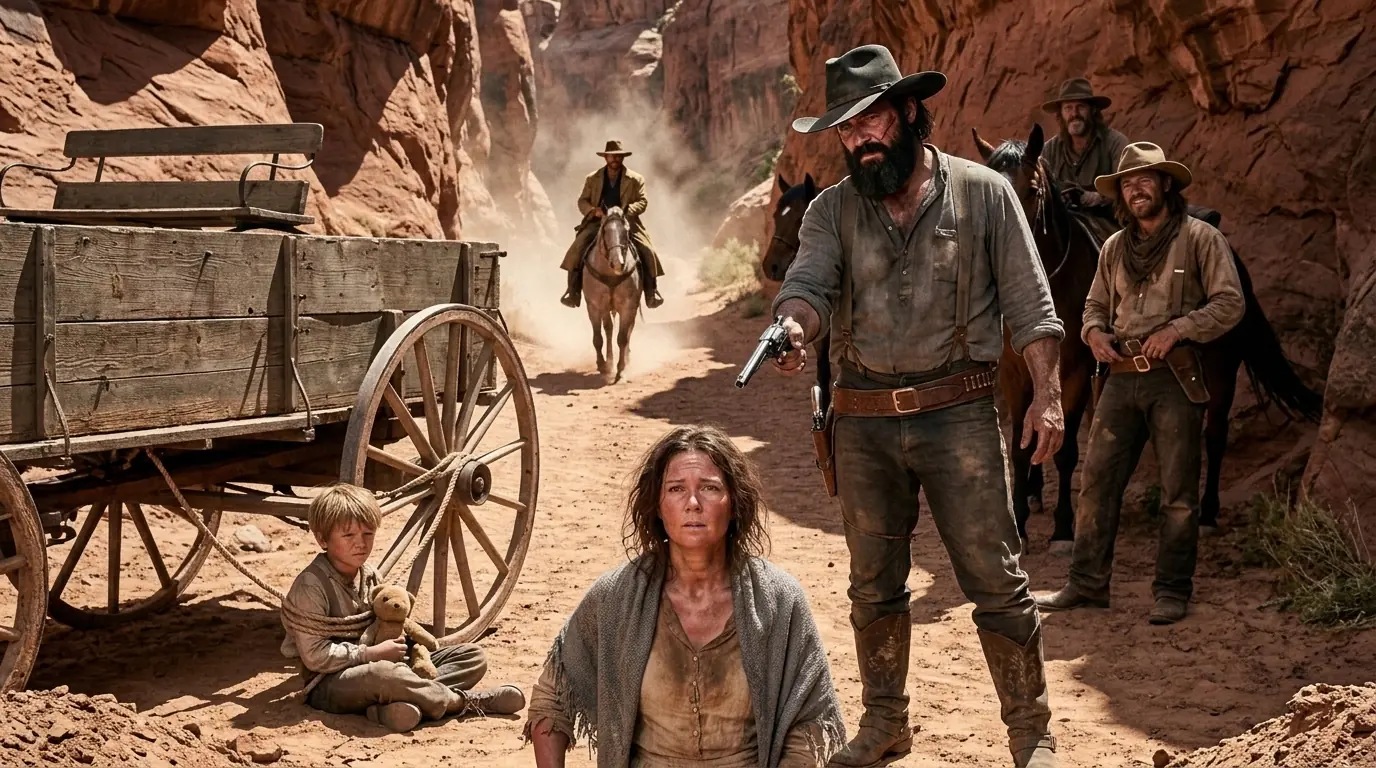
The shovel scraped against the baked earth with a sound that did not belong to the living.
Miriam Calder had been digging for nearly two hours under a New Mexico sun that felt less like weather and more like punishment. Her palms had split open long ago. Blood made the wooden handle slick, and every time she drove the rusted blade into the hard caliche soil, pain climbed her arms like fire.
Fifteen yards away, her six-year-old son Jonah sat tied to the wheel of a buckboard wagon.
He had stopped crying.
That frightened her more than the guns.
Children cry when they still believe someone might answer. Jonah’s silence meant he had already begun learning what men with rifles could do to the world. His little face was streaked with dust, his lips cracked from thirst, his eyes fixed on his mother as if looking away might make her disappear.
“Dig deeper, Mrs. Calder.”
Luther Pike’s voice rolled across the canyon, thick with tobacco and amusement.
He sat on a dun horse with a rifle across his lap, broad as a barn door, scarred from eyebrow to jaw, his shirt dark with sweat. He was the kind of man people stepped around in saloons, not because he was important, but because important men paid him to become trouble on their behalf.
Behind him waited three others.
Clem Rusk, thin and twitchy, with a revolver he drew too often. Owen Vale, a quiet sharpshooter with eyes pale enough to look dead already. And a tracker named Moss Larkin, who smelled of whiskey, dust, and old animal hides.
They worked for Silas Vane.
Everyone in Red Basin knew that name.
Silas Vane owned cattle, banks, judges, sheriffs, and half the men who claimed to be honest only because no one had paid them enough to prove otherwise. His ranch stretched across miles of dry country, but dry land was not enough. He wanted water. He wanted every spring, every creek bed, every claim that touched the basin.
And Miriam Calder’s husband had refused him.
Thomas Calder had been a quiet man until the day Vane’s riders came with a purchase paper and a threat hidden beneath polite words. The Calder homestead sat above the only year-round spring between Red Basin and the old military road. Thomas had read the offer once, folded it, and handed it back.
“My land is not for sale,” he said.
Three weeks later, Miriam found him dead on the porch.
Shot in the back.
His blood had run between the floorboards while Jonah screamed from inside the house.
The sheriff called it a robbery.
Miriam knew better.
Thomas had been keeping records. Ledgers. Names. Bribe payments. Stolen cattle brands. Letters proving Silas Vane had forced widows, immigrants, and small ranchers off land with forged deeds and hired guns. Thomas told Miriam that if anything happened to him, she was to take Jonah and ride for Fort Stanton, where a federal marshal would know what to do.
She tried.
Vane’s men caught her before sunrise.
Now she stood inside a grave she had dug with her own bleeding hands.
The pit was long enough for her.
Long enough for Jonah too.
“Please,” Miriam whispered, leaning against the shovel because her legs had begun to tremble. “Take the deed. Take the spring. Tell Vane he won. Just let my boy go.”
Pike spat into the dirt.
“You keep talking like land is the reason we rode all this way.”
“It is the reason.”
“No,” Pike said. “The land was the beginning. That husband of yours made it complicated when he started writing things down.”
Miriam’s throat tightened.
“He was telling the truth.”
“Truth,” Pike said, as if the word tasted foolish. “Truth is what survives after men like Mr. Vane decide which papers get burned.”
Clem Rusk laughed.
Owen Vale did not.
He watched the canyon mouth.
Miriam looked toward Jonah.
“Let him go,” she said again. “He doesn’t know where anything is hidden.”
Pike’s face went flat.
“He knows faces.”
“He is six.”
“He’ll grow.”
The words struck her harder than any hand could have.
Jonah understood enough to begin crying again.
“Mama?”
Miriam turned toward him, trying to smile.
It broke before it reached her mouth.
“Close your eyes, baby,” she said. “Think about the creek behind the house. Think about the minnows.”
Jonah shook his head.
“I want to go home.”
Miriam closed her eyes for one second.
Home was gone.
The house was likely burned by now. The barn stripped. The spring fenced. The neighbors frightened into silence or bribed into forgetting. The only thing left of Thomas Calder’s fight was whatever paper had survived long enough to reach the right hands.
If it had reached them.
If anybody was coming.
Pike dismounted slowly.
“That’s deep enough.”
Miriam’s fingers tightened around the shovel.
Her body begged to collapse, but pride held her upright for one last moment. She would not die on her knees if she could help it. She would not let Jonah’s last memory be his mother folded like broken cloth before men who deserved no such satisfaction.
Pike drew his revolver.
“Stand at the edge.”
Miriam turned toward Jonah.
“Look at me, sweetheart.”
Jonah sobbed.
“Look at me.”
He did.
She forced calm into her face.
“Mama loves you more than the whole sky.”
Pike raised the gun.
Then Owen Vale spoke.
“Luther.”
Pike did not lower the revolver.
“What?”
Owen nodded toward the canyon mouth.
“Rider.”
Everyone turned.
At first, Miriam saw only heat.
The desert shimmered in the distance, the kind of silver trembling that made stone look like water and ghosts look possible. Then the shape appeared. A lone horse moving through the glare, slow and steady, carrying a man in a dust-colored coat.
He did not hurry.
He did not hide.
He rode straight toward four armed men, one open grave, and a woman waiting to die.
Clem Rusk shifted in his saddle.
“Who in hell is that?”
Pike squinted.
“Probably some drifter who wants to die thirsty.”
The rider came closer.
He rode a large roan horse streaked with sweat and white foam at the bit. A weathered duster hung from his shoulders. His hat was pulled low, the brim shadowing most of his face. Twin revolvers sat tied down at his thighs, their grips worn smooth from use rather than show.
He stopped twenty paces away.
The horse snorted.
Dust moved between them.
For a long moment, nobody spoke.
The stranger looked first at Miriam.
Then at Jonah.
Then at the grave.
Then at Pike’s revolver.
His face gave nothing away.
“You lost?” Pike called.
The stranger shifted the cigarillo from one side of his mouth to the other.
“No.”
“This is private land.”
“Looks like murder ground to me.”
Clem Rusk’s hand drifted toward his gun.
Pike smiled.
“You got a name, drifter?”
The stranger let the silence stretch.
“Harlan Vale.”
Owen Vale’s head snapped up.
Pike glanced at him.
“You know him?”
Owen’s face had gone pale.
“I know stories.”
Harlan Vale swung down from the saddle.
His boots hit the dirt softly.
He was older than Miriam first thought, maybe late forties, maybe older, with gray in his beard and lines carved deep around his eyes. He had the look of a man who had survived too many places that should have killed him and come away carrying pieces of each one.
Pike laughed.
“You rode into the wrong canyon, Vale.”
Harlan looked at the open grave.
“I was thinking the same thing about you.”
Pike lifted his rifle.
“You want to say that with both hands higher?”
Harlan’s hands rested loose near his belt.
“I came looking for Luther Pike.”
“Well,” Pike said, grinning, “you found him.”
“Yes.”
“Now what?”
Harlan’s eyes moved to Jonah, tied to the wagon.
“Now you untie the boy.”
Clem Rusk laughed too loudly.
Pike’s grin widened.
“You don’t give orders here.”
“No,” Harlan said. “I give chances.”
The canyon seemed to shrink around the sentence.
Pike’s face reddened.
“Kill him.”
Clem went for his revolver first.
He never cleared leather.
Harlan’s right hand moved so fast Miriam saw only the result. A gunshot cracked through the canyon, sharp and final. Clem Rusk fell backward off his horse with a round hole above his left eye and surprise still on his face.
Owen Vale raised his rifle.
Harlan’s left Colt was already out.
Two shots.
The first shattered Owen’s rifle stock into splinters. The second struck him just under the collarbone and dropped him into the dust before he could scream.
Moss Larkin lunged for the wagon, reaching for Jonah as if the child could become a shield.
Harlan turned without looking hurried.
One shot struck Moss in the thigh.
Another tore through his shoulder and spun him into the dirt beside the wheel. He lay there howling, one hand clawing at the ground, the other useless beneath him.
Less than four seconds had passed.
Pike stood frozen, revolver half-lifted.
Harlan’s guns pointed at his chest.
“Drop it.”
Pike stared at him.
“Drop it,” Harlan repeated.
The revolver slipped from Pike’s hand and hit the dirt.
Miriam was still holding the shovel.
She did not remember choosing to keep it.
Harlan walked past Pike like the man had already become part of the landscape. He approached the wagon, pulled a Bowie knife from inside his coat, and cut Jonah’s ropes with two clean strokes.
The boy launched himself across the dirt.
“Mama!”
Miriam dropped the shovel and fell to her knees just in time to catch him.
Pain tore through her hands when she wrapped her arms around him, but she did not care. She held him to her chest, buried her face in his hair, and sobbed so hard she could not speak.
Harlan stood over them for one moment.
Then turned back to Pike.
“You were going to bury a child.”
Pike tried to steady his breathing.
“Vane gave the order.”
“That supposed to make it lighter?”
Pike swallowed.
“You don’t understand who you’re crossing. Silas Vane owns this basin. He owns the sheriff, the judge, the land office, half the territorial council. He eats supper with men who can make you disappear on paper.”
Harlan picked up the shovel and examined the blood on the handle.
“Paper is why I’m here.”
Pike’s eyes narrowed.
Harlan reached into his coat and pulled out a folded document wrapped in oilcloth and stained dark at one corner.
“Thomas Calder sent a rider east with copies.”
Miriam lifted her head.
“What?”
Harlan glanced at her.
“He made it farther than Vane thought.”
Her breath caught.
“Did he reach Fort Stanton?”
“No,” Harlan said. “But he reached a man who could.”
He unfolded the paper.
“Sworn statement. Names. Dates. Bribes. Kill orders. Deeds forged through the land office. Water claims stolen from widows and small ranchers. It names Silas Vane, Luther Pike, Judge Alton Creel, Sheriff Wade Rourke, and seven men wearing respectable coats over dirty hands.”
Pike’s face slackened.
“Who has it?”
“Federal Marshal Amos Reed.”
That name moved through the canyon like thunder rolling too close.
Amos Reed was not a town marshal.
He was a deputy U.S. marshal out of Fort Smith, known from Texas to Indian Territory as a man who would ride two hundred miles for a warrant and three hundred if the outlaw thought distance made him safe. He did not drink with cattle kings. He did not smile at bribes. He had dragged killers out of counties where local sheriffs swore they had never seen them.
Pike understood immediately.
If Reed had the ledgers, Vane’s money could not hold the roof up forever.
“You’re one of Reed’s men,” Pike whispered.
Harlan shook his head.
“Reed brings men in for court.”
“And you?”
Harlan looked at the grave.
“I bring consequences.”
The word did something to Pike.
It emptied him.
“What do you want?”
Harlan pointed to the shovel.
“Pick it up.”
Pike stared.
“What?”
“You heard me.”
Pike looked at Miriam, then the pit, then the bodies in the dust.
“You’re making me dig?”
“You started the hole.”
Pike’s voice cracked.
“You said I could live if I dropped the gun.”
“No,” Harlan said. “I told you to drop the gun.”
Pike moved slowly toward the shovel.
His hands shook as he picked it up.
The handle was slick with Miriam’s blood, and he grimaced when he felt it. That small expression made something cold pass through Miriam. He had been willing to murder her son, but her blood on the handle disgusted him.
“Dig,” Harlan said.
Pike drove the shovel into the hard ground.
The sun climbed higher.
The work that had nearly killed Miriam now bent Pike’s back under the same heat. Sweat ran down his face. His shirt stuck to his body. His breathing grew ragged. Harlan did not hurry him. He stood with one hand near his gun and watched as the enforcer widened the pit meant for mother and child.
Miriam held Jonah and drank from the canteen Harlan handed her.
The water tasted like dust, leather, and mercy.
“Who are you really?” she asked.
Harlan did not look away from Pike.
“A man Vane should have killed cleaner.”
Miriam waited.
He said nothing more.
But later, she would learn pieces.
Harlan Vale had once owned land near Lincoln County. His younger brother refused to sell a spring to Silas Vane’s first partner. The partner sent riders. The riders burned the house with Harlan’s brother inside it. Harlan had spent years afterward becoming the kind of man who could follow violence back to its source.
He was not a marshal.
Not an outlaw either, though wanted posters in two counties claimed otherwise.
He was what happened when law arrived too late and grief learned to shoot.
Pike dug until the pit could hold four men.
Then Harlan ordered him to drag the bodies in.
Clem first.
Then Owen.
Then Moss, who had stopped moving sometime during the digging.
Pike rolled each man into the grave while Jonah hid his face against Miriam’s dress. When the last body fell in, Pike stood panting at the edge, his face gray beneath the sweat.
“I did it,” he said. “I did what you asked.”
Harlan nodded.
“So you did.”
Pike swallowed.
“I can help you get inside Vane’s ranch. He keeps a locked office under the east stairs. Money. Ledgers. Deeds. I know where everything is.”
Harlan’s eyes narrowed.
“Do you?”
“Yes. I can get you through the north wash after dark. Past the first guard post. I can testify. I can give Reed what he needs.”
Miriam looked up sharply.
Pike was lying about his courage.
But maybe not about the office.
Harlan studied him for a long moment.
Then holstered one gun.
“You’ll ride ahead of me.”
Pike blinked.
“What?”
“You want to live? Then you help end him.”
Pike nodded too fast.
“Yes. Yes, I’ll help.”
Harlan stepped close.
“But if you run, if you shout, if you twitch wrong near that boy or his mother, I’ll bury you standing up.”
Pike believed him.
Miriam climbed into the buckboard with Jonah.
Harlan gave her a leather pouch heavy with coins and a second folded paper.
“Stage station north of the Cimarron,” he said. “Don’t go back to town. Don’t trust Sheriff Rourke. Don’t stop for anyone wearing Vane’s brand.”
“What is this?”
“Copy of the affidavit. Marshal Reed has the ledgers. You have this. If one truth dies, another rides.”
Miriam clutched the paper.
“What about you?”
Harlan looked toward the west, where Vane’s empire waited beyond the low ridge.
“I’m going to make noise.”
“That is not a plan.”
“It’s enough of one for today.”
Jonah leaned over the wagon seat.
“Mister?”
Harlan looked at him.
“Are you a good man?”
The question hung there.
Harlan’s face changed, not much, but enough.
“No,” he said softly. “But I’m standing in front of bad ones.”
Miriam took the reins.
“Harlan.”
He turned.
“Thank you.”
He tipped his hat once.
“Get your boy safe.”
Then he mounted his roan, pointed his gun at Pike, and rode west.
The grave remained open behind them.
Harlan wanted it found.
He wanted every rider wearing Silas Vane’s brand to see what happened when the dirt began taking their own.
By sundown, Miriam reached the stage station at Cimarron Crossing.
The station keeper, an old Black cavalry veteran named Josiah Bell, took one look at her hands, Jonah’s rope burns, and the fear in her face, then locked the door behind them.
“Vane’s men?” he asked.
She nodded.
He said nothing else.
He brought water, clean cloth, bread, and a rifle, then sent his youngest boy to the telegraph station with a message addressed to Deputy U.S. Marshal Amos Reed.
Package alive.
Affidavit safe.
Vane moving.
Send law.
At almost the same hour, Harlan Vale rode into the hills north of Vane’s main ranch with Luther Pike in front of him.
The ranch was called Black Mesa.
It sat behind timber gates, stone walls, rifle towers, corrals, and more arrogance than any one house should be allowed to hold. Lanterns burned in the windows. Cattle lowed beyond the pens. Men moved along the perimeter with shotguns, confident because money had taught them confidence long before wisdom could.
Pike led Harlan through the north wash.
A narrow cut in the land.
Dry most of the year.
Guarded poorly because men with empires always believe the front gate is where danger must introduce itself.
Harlan rode behind him in silence.
At the first guard post, Pike tried to raise one hand.
Not much.
Just enough.
Harlan’s gun appeared against the back of his neck.
“Don’t.”
Pike lowered the hand.
The guard stepped from the shadows.
“Luther? Thought you were—”
Harlan shot the lantern out beside him.
Darkness swallowed the post.
The guard reached for his rifle, but Pike, terrified of being killed first, slammed the butt of the shovel into the man’s jaw. The guard dropped without firing a shot.
Harlan looked at Pike.
“Maybe you want to live after all.”
Pike said nothing.
They entered the house through a cellar door under the kitchen.
The cook saw them first, an older Mexican woman holding a pan of cornbread. Her eyes went to Harlan’s guns, then Pike’s ruined face, then the blood on the shovel.
Harlan put one finger to his lips.
She looked toward the dining room, where laughter and men’s voices rolled over the sound of glasses.
Then she stepped aside.
“In the office,” she whispered. “He’s with the sheriff.”
Harlan nodded.
Pike led the way to the east stairs.
The locked office door stood beneath them, exactly where he said it would be. Harlan used Pike’s key ring and opened it. Inside were shelves, a rolltop desk, a safe, and framed maps of the basin marked in red ink.
Water.
Land.
Claims.
Every theft dressed up in handwriting.
Harlan found ledgers in the safe, along with deeds, bank notes, letters from Judge Creel, and a list of men paid after “removal work.” Beside Thomas Calder’s name was a small check mark.
Harlan stared at it for a long moment.
Then gathered everything into a grain sack.
Pike watched from the doorway, sweating.
“You got what you came for.”
“Not all of it.”
A voice sounded from behind them.
“No,” Silas Vane said. “He certainly has not.”
Vane stood in the hallway wearing a black coat, white shirt, and a gold watch chain that caught the lantern light. He was sixty, silver-haired, clean-shaven, and smooth in the way snakes are smooth before they move. Sheriff Wade Rourke stood beside him with a shotgun. Behind them were six armed riders.
Pike’s face collapsed.
“I brought him like you said,” Pike blurted.
Harlan looked at him.
Pike would not meet his eyes.
“I’m sorry,” Pike whispered.
Vane smiled.
“No, Luther. You’re practical. That is why you have lasted so long.”
Harlan stood still, grain sack in one hand.
“You send a man to dig a child’s grave, and you call him practical.”
Vane’s smile thinned.
“You must be Harlan Vale.”
“I am.”
“I was told you were dead.”
“People keep hoping.”
Sheriff Rourke lifted the shotgun.
“Drop the bag and the irons.”
Harlan glanced at Pike.
Pike stepped away from him.
The betrayal should have mattered.
It did not.
Harlan had expected it from the moment Pike offered help too easily.
He dropped the grain sack.
But not his guns.
The cook chose that moment to throw the pan of cornbread into the lantern.
Oil, flame, and hot grease exploded across the hallway.
Men shouted.
The shotgun fired into the ceiling.
Harlan moved.
Two Colts came out in the light and smoke.
He shot the sheriff first.
Not dead.
In the shoulder, hard enough to drop the shotgun and fold the man against the wall.
Then two riders at the back.
Then the lantern chain.
The hallway plunged into flashing shadows as fire spread across the rug.
Pike ran.
Vane ran too, but not far.
Harlan grabbed the grain sack, kicked the office door wider, and pulled the rolltop desk down to block one side of the hall. Bullets tore through the wood. He fired back through gaps and moved toward the kitchen, where the cook had already opened the rear door.
“Go,” she snapped.
“You should leave.”
“I been leaving this house for twelve years,” she said. “Tonight I finally know it.”
They ran into the yard as flames licked the east wall.
Outside, Vane’s men shouted from the corrals.
Harlan whistled once.
The roan came out of the darkness like thunder.
He threw the grain sack over the saddle and swung up just as a bullet tore through the edge of his duster. The cook ran toward the bunkhouse yelling for the other servants to get out before the house burned around them.
Harlan saw Vane crossing the yard toward the stable.
He spurred the horse after him.
Vane turned with a small derringer in his hand.
Harlan shot it from his grip.
The cattle baron screamed and clutched his hand.
For the first time all night, all year, maybe all his life, Silas Vane looked common.
Just an old man in dust with blood on his sleeve.
Harlan rode close and looked down at him.
“You killed Thomas Calder.”
“I killed many men,” Vane said through clenched teeth. “You’ll have to be more specific.”
Harlan’s face did not change.
“You stole the basin.”
“I built it.”
“On graves.”
Vane’s eyes shifted toward the burning house.
“You think papers matter? I have judges.”
“Not federal ones.”
That was when the sound came from the east.
Hooves.
Many of them.
Then a voice from the dark.
“United States Marshals! Drop your weapons!”
Deputy U.S. Marshal Amos Reed rode into Black Mesa with twelve men behind him.
He was older than Harlan, Black, broad through the shoulders, with a badge catching moonlight and a rifle held steady in one hand. His men spread across the yard with the discipline of people who had not come to ask permission.
Vane stared.
“No.”
Harlan looked toward Reed.
“You’re late.”
Reed looked at the burning wall, the wounded sheriff, the scattered gunmen, the bleeding cattle baron, and the grain sack tied to Harlan’s saddle.
“Looks like you started without me.”
“You said paperwork.”
“I said don’t murder everybody before I get here.”
“Most of them are breathing.”
Reed sighed.
“That is not the comfort you think it is.”
Then he turned to Vane.
“Silas Vane, you are under arrest on federal charges of conspiracy, land fraud, murder for hire, obstruction of lawful claims, bribery of territorial officers, and anything else I find in that sack.”
Vane tried to straighten.
“You cannot arrest me on my own property.”
Marshal Reed smiled once.
“This land is disputed by federal claim. Might not be yours much longer.”
Vane’s face twisted.
“You people think you can take what I built?”
Reed leaned from the saddle.
“No. We are taking back what you stole.”
By dawn, Black Mesa belonged to the law.
Sheriff Rourke was in irons.
Judge Creel was arrested two days later trying to board a westbound stage with a carpetbag full of cash.
Luther Pike was found hiding in a hayloft before sunrise, still clutching the bloody shovel like a curse he could not put down. He begged Harlan not to let Reed take him. Harlan did not answer. Reed did.
“You should be grateful,” the marshal said. “A court is more mercy than you gave Mrs. Calder.”
Pike cried all the way to the wagon.
Miriam arrived at Fort Stanton with Jonah under military protection.
Her hands were bandaged.
Her son slept for seventeen hours straight in a cot beneath a real roof. When he woke, the first thing he asked was whether the bad men had found them.
Miriam told him no.
Then she told him something she needed to believe.
“They won’t.”
Three weeks later, the federal hearing began in Santa Fe.
Silas Vane entered the courtroom in a black suit, his wounded hand wrapped in clean linen, his face arranged into insulted dignity. He had three attorneys, two bankers, and enough former friends watching from the gallery to prove that power attracts loyalty only until subpoenas arrive.
Miriam testified first.
She described Thomas’s murder.
The night she fled.
The canyon.
The grave.
Jonah tied to the wagon.
Luther Pike ordering her to dig deeper.
Her voice shook only once, when the prosecutor asked what Pike said about her son.
She looked at the jury.
“He said boys grow.”
Nobody in the room moved.
The cook from Black Mesa testified next.
Her name was Rosa Alvarez. She had kept hidden letters for six years, written by workers beaten for trying to leave Vane’s ranch. She told the court about the office under the east stairs. About Vane’s ledgers. About the sheriff arriving after midnight to drink whiskey and collect envelopes.
Marshal Reed laid out the documents.
The ledgers spoke in numbers.
Numbers are cold.
That is why juries often trust them.
Payments to Pike.
Payments to Sheriff Rourke.
Payments to Judge Creel.
Payments after the deaths of landowners who refused to sell.
Thomas Calder’s sworn statement tied it all together. His handwriting identified dates, meetings, false claims, names, and routes used by Vane’s men. One copy had reached Reed. One had reached Miriam. One had been found in Vane’s own safe with a note reading: Burn when confirmed.
Vane never took the stand.
Men like him rarely do when truth has found paper.
The verdict came after six hours.
Guilty.
On conspiracy.
On land fraud.
On bribery.
On murder for hire.
On obstruction.
Silas Vane was sentenced to hang for the murders he ordered and to forfeiture of land obtained through fraud. Sheriff Rourke received twenty-five years in federal prison. Judge Creel died awaiting trial after discovering prison food did not respect his former office. Pike turned evidence late, but not late enough to save himself from the gallows.
Miriam did not attend Pike’s execution.
She had already watched enough holes opened in the earth.
The Calder spring was returned to her.
Not easily.
Nothing good returned easily in that country.
There were petitions, challenges, threats, and one midnight attempt by Vane loyalists to burn the barn before soldiers from Fort Stanton rode them down. But the federal court confirmed the title, and the spring flowed under Miriam’s name.
Red Basin changed after that.
Small ranchers came forward with claims they had been afraid to speak.
Widows produced deeds hidden in flour barrels.
Mexican families from the lower flats brought baptismal records, old maps, and witness statements proving they had lived beside the water long before Vane’s men drew new boundaries.
Marshal Reed stayed long enough to make the arrests stick.
Then rode out before anyone could build a statue.
Harlan Vale disappeared sooner.
Miriam asked about him at the fort.
Reed found her standing near the corral one morning, watching Jonah feed oats to a cavalry horse.
“You’re looking for the ghost,” he said.
“He saved my son.”
“Yes.”
“Where did he go?”
Reed looked west.
“Toward another man who thinks money makes him bulletproof.”
“Is he law?”
“No.”
“Is he justice?”
Reed thought about that.
“Sometimes justice wears a badge. Sometimes it arrives before the badge can get there. I don’t always approve of the second kind.”
“But you used him.”
Reed met her eyes.
“I let a consequence ride where the law was too slow.”
Miriam looked toward the desert.
“Will he survive?”
Reed smiled sadly.
“Men like Harlan don’t survive the way other people do. They continue.”
A year later, Miriam rebuilt the homestead.
Not the old house.
That had burned the week after her capture, just as she feared.
She built a new one closer to the spring, with thick adobe walls, a deep porch, and a bedroom where Jonah could sleep without seeing the door from his bed. Neighbors came to help. Some out of guilt. Some out of gratitude. Some because Vane’s fall had reminded them what kind of people they wanted to be before fear trained it out of them.
Miriam kept Thomas’s ledgers in a locked trunk.
Beside them, she kept the shovel.
Not because she wanted to remember the grave.
Because she refused to forget who had been forced to dig it.
Years later, Jonah would ask her why she kept such an ugly thing in the house.
She would take it down, run her fingers over the dark stains in the wood, and tell him the truth in pieces he could carry.
“That shovel was meant to bury us,” she said. “Instead, it helped bury the men who thought they owned our lives.”
When Jonah was twelve, a rider came through Red Basin with a roan horse and a dust-colored coat.
He did not stop at the house.
He only paused on the ridge at sunset.
Miriam saw him from the porch.
So did Jonah.
The rider lifted one hand.
Miriam lifted hers back.
Then Harlan Vale turned and rode into the red light without asking for thanks, supper, shelter, forgiveness, or a name anyone could put on a church record.
Jonah watched until the rider vanished.
“Was that him?”
“Yes.”
“The ghost?”
Miriam nodded.
Jonah stood quietly for a while.
Then asked, “Was he a good man?”
Miriam thought of the canyon.
The gun smoke.
The open grave.
The water canteen.
The way Harlan looked at Jonah before saying he was not good, only standing in front of bad.
“I think,” she said slowly, “he was a man who had lost too much to be gentle with evil.”
Jonah accepted that.
Children understand certain truths better than adults expect.
The Sweetwater case became famous in territorial papers.
They wrote about Silas Vane, the cattle baron brought down by ledgers and federal law. They wrote about Marshal Amos Reed, who crossed jurisdictions and ignored bribes until a whole conspiracy collapsed. They wrote about Judge Creel, Sheriff Rourke, Luther Pike, forged deeds, hidden bribes, and the armed empire that had been built around one stolen spring.
They wrote very little about Miriam Calder’s hands.
That bothered her most.
Because every legal victory, every newspaper headline, every speech about justice began with those hands bleeding around a shovel handle while her son cried from a wagon wheel.
So when people came later and asked her what saved Red Basin, she never started with Harlan Vale.
She never started with Marshal Reed.
She never even started with Thomas’s ledgers.
She started with the grave.
“I was told to dig,” she would say. “So I dug. And while I dug, I prayed that my son would live long enough to remember my face. That is where the story begins.”
Then she would tell them about Thomas writing by lantern light because he believed truth needed copies.
She would tell them about the rider who carried the ledgers east.
She would tell them about the marshal who followed paper across country.
She would tell them about the stranger who came out of the heat when the law was still miles behind.
She would tell them that empires do not fall because one man is brave.
They fall because one woman survives long enough to testify.
Because one husband writes names down.
Because one marshal refuses a bribe.
Because one witness keeps a copy.
Because one child lives.
Because one shovel meant for a grave is left standing in a house as proof that fear did not get the last word.
On quiet evenings, Miriam sat on the porch and watched Jonah run near the spring.
The water caught sunlight and broke it into pieces.
Sometimes the sound of the creek reminded her of the canyon silence before Harlan arrived. Sometimes a shovel scraping dirt would make her hands ache even years after the wounds had healed. Sometimes she woke in the dark, certain she could hear Pike telling her to dig deeper.
But then she would hear Jonah breathing in the next room.
Alive.
Growing.
Remembering more creek than grave.
And that was enough to bring her back.
The land healed slowly.
People did too.
The grave in the canyon remained open for months before rain finally softened the edges. No marker was placed there. No preacher said words. Coyotes and weather did what men refused to do honestly.
But travelers began avoiding that canyon after dark.
They said it was haunted.
They said a roan horse sometimes appeared in the heat haze, carrying a man in a dust-colored coat.
They said if you listened close enough near the old wash, you could hear a shovel scraping against hard earth.
Miriam never confirmed the stories.
She only smiled in a way that made people stop asking.
Because she knew the truth.
The canyon was not haunted by the dead men in the pit.
It was haunted by the moment they learned the grave was never meant for the woman.
It was meant for the world they had built.
And one day, when Jonah was grown and the spring still ran clear beneath cottonwoods his father had planted, Miriam handed him Thomas’s ledgers, the affidavit, and the old shovel.
“Keep these,” she said.
Jonah took them carefully.
“For the ranch?”
“For the truth.”
He looked at the shovel.
“And this?”
Miriam’s eyes moved toward the desert.
“That is to remind you that some people will hand you a tool and call it your defeat.”
She touched the old blood-darkened handle.
“But if you live long enough, and if you tell the truth clearly enough, that same tool can help bury them instead.”
Outside, the spring kept running.
Clear.
Cold.
Untouched.
And somewhere far beyond the basin, a ghost on a roan horse rode toward another empire that thought it would last forever.