The smell came before the trucks did.
It always did.
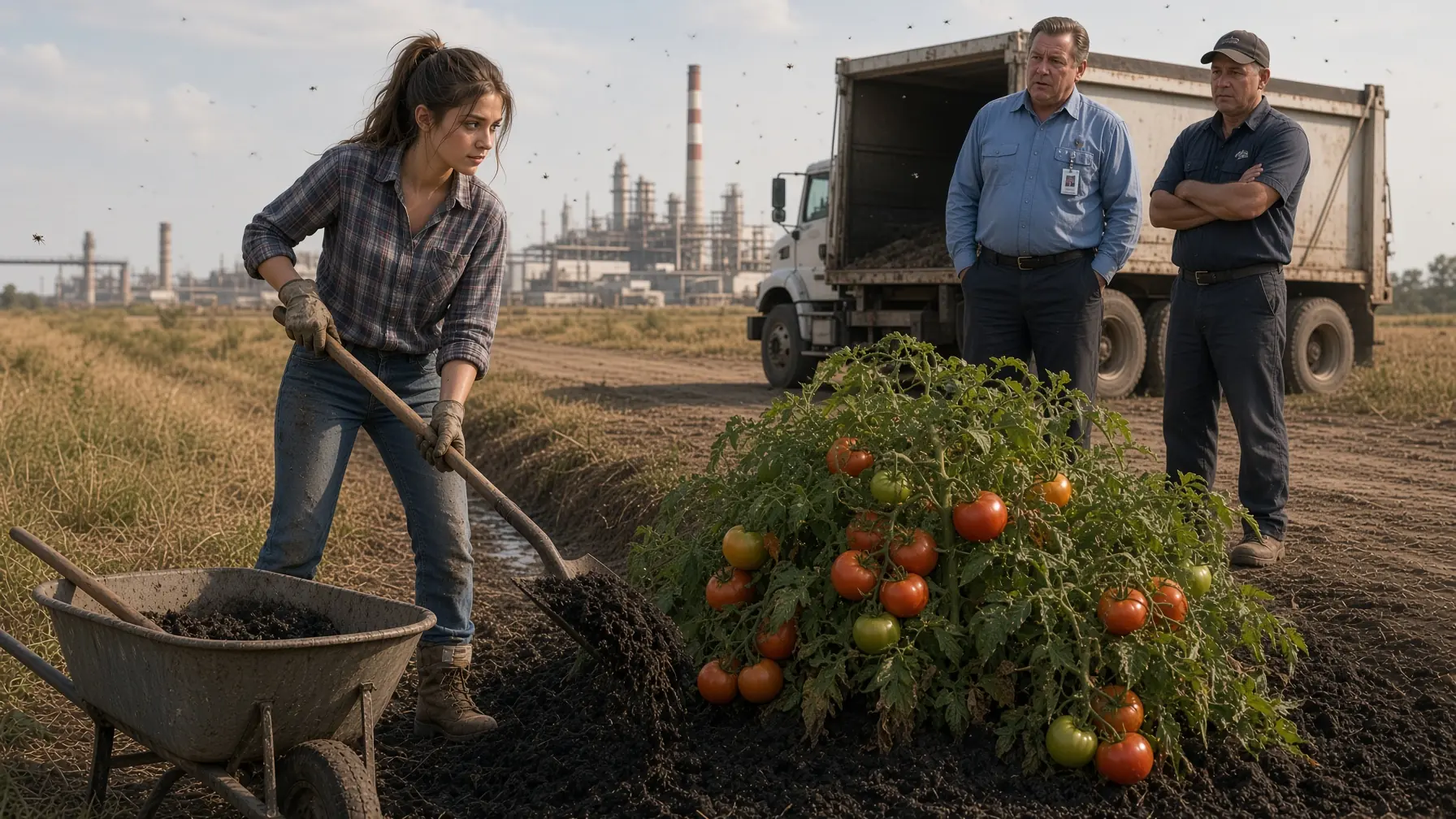
By the time sixteen-year-old Elsie Wren stepped onto the back porch that summer morning, the air over the south pasture already carried it.
Thick.
Sweet.
Sour.
Part fermented molasses, part wet hay, part something that should have stopped decomposing weeks ago but had not.
The smell settled into hair.
Clothes.
Curtains.
The inside of your nose.
It was the kind of smell visitors noticed immediately and local people eventually pretended not to.
Elsie no longer pretended.
She stood beneath the porch roof in taped work boots and an old denim shirt, looking across eighty acres that had belonged to her family longer than anyone in the house had been alive.
Near the fence line, the grass had faded from green to the color of weak tea.
Flies moved lazily above the drainage ditch.
Farther back, beyond the south fence, a new black mound steamed beneath the morning heat.
Crushed sugarcane fiber.
Filter cake.
Mud from mill washdown.
Organic processing residue.
The Callaway Sugar Refining Company called all of it byproduct.
Elsie’s father called it the reason half his bottom field no longer grew properly.
A truck reversed toward the pile.
Its backup alarm beeped.
Once.
Twice.
Again.
The driver did not look toward the Wren house.
They almost never did.
The trailer rose.
Dark material slid out in a wet, heavy mass.
Elsie watched until the truck pulled away.
She had been watching some version of that scene since she was ten.
What she did not know yet was that the same material her family had spent six years trying to make disappear would eventually become useful enough that neighboring farmers would ask how to make it themselves.
But that morning, there was nothing valuable about it.
There was only the smell.
The flies.
And the feeling that nobody important cared.
The Wren farm sat along the soft rolling edge of a river valley in southern Georgia, in a county where cane, peanuts, vegetables, and timber had fed families for generations.
Eighty acres.
A farmhouse that had once been white.
A red barn that leaned slightly east.
A machinery shed with one sliding door that never closed all the way.
And forty acres of lower ground that Elsie’s grandfather, Benjamin Wren, had considered the best soil on the property.
He used to tell her:
“You could push a broom handle into that bottom and it'd try to grow roots.”
Elsie had believed him when she was little.
Back then, sweet corn grew shoulder-high there.
Beans climbed clean rows.
Winter rye covered the ground thick enough that Elsie and her brother could hide in it when they were children.
Then Callaway Sugar expanded its processing operation on the adjoining property.
A company representative arrived one autumn afternoon wearing a tucked-in blue shirt and polished boots.
Elsie was ten.
She sat on the porch steps while he spoke to her father, Daniel.
Temporary storage, he said.
Agricultural byproduct.
Pending processing upgrades.
Fully managed.
Regulatory compliant.
Temporary became a season.
Then a year.
Then another.
The piles grew.
Rain carried dark runoff into low areas near the property boundary.
Some loads were mostly fibrous bagasse—the dry crushed stalk left after juice extraction.
Others contained wetter material from filtering and washing.
The mixture varied.
So did the smell.
The Wrens complained.
Daniel wrote letters.
He kept copies in a manila folder.
At first, every envelope was carefully dated.
Then he began writing the dates in heavier pen.
Then red.
Then he stopped expecting answers.
The county environmental office acknowledged two complaints.
A company representative inspected once.
Nothing obvious changed.
The refinery added a shallow berm.
The next heavy rain cut around one end of it.
Daniel drove to Callaway’s office three times.
After the first visit, he came home angry.
After the second, quiet.
After the third, he placed his hat on the kitchen table and said only:
“They know.”
Elsie’s mother, Ruth, asked:
“Know what?”
Daniel looked toward the south field through the kitchen window.
“All of it.”
That was worse than believing nobody understood.
The refinery manager was named Hal Brennan.
He was not a cartoon villain.
Elsie sometimes wished he had been.
Cruel people were easy to hate.
Hal was harder.
He was tired, polite, and professionally reasonable.
When Daniel complained, Hal poured coffee.
He talked about drainage studies.
Waste-handling schedules.
Permit classifications.
Operational constraints.
He said the material was largely agricultural organic matter.
Which was true.
He said no one wanted to affect neighboring land.
Probably also true.
Then he used enough procedural language to make doing nothing sound temporary.
Daniel once told Ruth:
“The man can explain why nothing can happen for forty minutes without ever saying no.”
Hal never shouted.
Never threatened.
Never said the Wren farm did not matter.
He simply behaved as though the Wren farm existed below a much larger list of priorities.
The neighbors were no better.
Some worked at Callaway.
Others hauled cane there.
Others sold fuel, tires, welding, or machine parts to contractors tied to the refinery.
Nobody wanted a feud.
When Ruth complained at Hensley Feed one afternoon, Dorothy Halsey—a woman who had known Elsie since kindergarten—looked at the floor.
“Honey,” she said, “that's just how things are now.”
Elsie was fourteen.
She remembered that sentence better than anything Hal Brennan ever said.
That was the first time she understood something unpleasant.
People did not always stop helping because they disagreed with you.
Sometimes they stopped because helping was inconvenient.
By sixteen, Elsie had stopped waiting for someone else to care more.
The thing that changed her was a tomato plant.
Late September.
Hot.
Cicadas loud enough to make the air seem electric.
Elsie was walking the southern fence after school checking for broken wire.
She reached an old section of dumping ground the company had stopped using several years earlier.
The pile there had changed.
Rain had flattened it.
Grass had crept across the edges.
The original fibrous cane material had collapsed and darkened.
Near one corner, where decomposed bagasse had mixed with soil and weeds, Elsie saw green.
She almost kept walking.
Then stopped.
A tomato plant grew out of the edge of the old pile.
Not a weak volunteer with two yellow leaves.
A huge plant.
Dark foliage.
Thick stems.
Fruit hanging heavily enough to bow several branches.
Elsie stared.
Nothing nearby looked that healthy.
She crouched.
The soil beneath the tomato was dark.
Loose.
It smelled different too.
Not like the fresh dump.
Earthy.
She pushed two fingers into it.
The material broke apart easily.
There were beetles.
Fungal threads.
Small roots.
Life.
Elsie looked from the plant toward the newer black piles farther down the boundary.
For the first time in six years, she did not think:
How do we get rid of this?
She thought:
What happened here?
The county library stayed open until seven on Tuesdays.
Elsie rode the school bus into town, waited through afternoon study period, then walked six blocks.
Mrs. Penhalligan, the librarian, was a narrow woman with silver hair and the habit of speaking softly even when no one else was present.
“What are you looking for?”
Elsie hesitated.
“Compost.”
Mrs. Penhalligan smiled.
“Garden or commercial?”
“I don't know yet.”
That answer interested her.
She brought three books.
Then two extension bulletins.
By Friday there were more waiting.