The first scream inside the Carter Memorial Hall came from a woman in the third row.
It happened less than two seconds after Falcon ripped the leather lead from Nora Bennett’s hand and lunged across the polished floor. Wooden chairs scraped backward, several guests rose instinctively, and a framed photograph of Miles Carter seemed to watch from beside a folded flag and a small arrangement of white lilies. Elaine Carter did not scream until she saw exactly where the German Shepherd was going.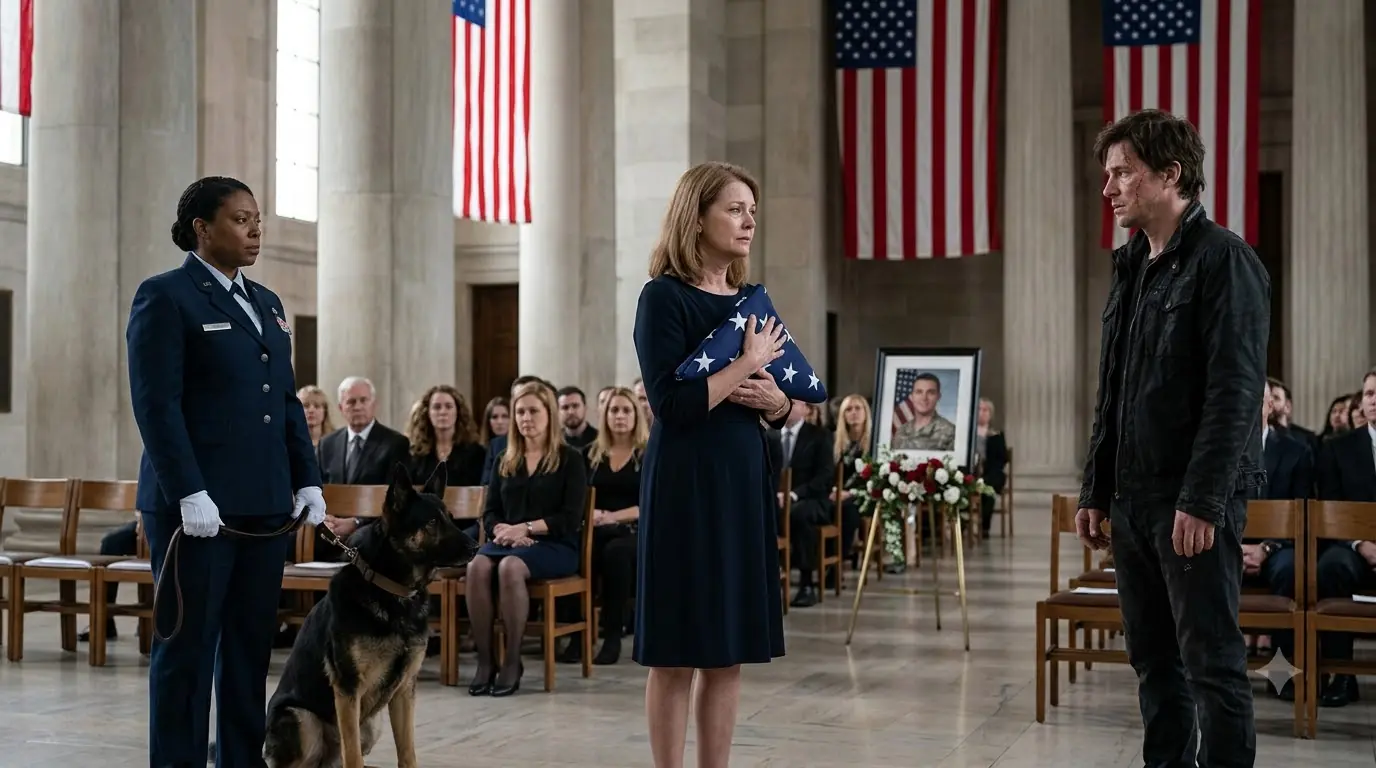
“Falcon, no!”
The dog ignored her.
He charged toward a thin, scarred man standing alone beside the final row of chairs.
The stranger raised both hands.
“Wait!”
Falcon reached him.
Then stopped.
Not a foot away.
Not growling.
Not showing his teeth.
He simply froze with his nose almost touching the man’s left hand.
The hall went silent.
Elaine had been prepared for blood.
Instead, Falcon made a sound that broke something inside her.
A low, fractured whine.
The exact sound he had made three years earlier when Elaine brought home the final box containing Miles’s belongings.
She knew it because she had never heard anything like it before.
Or since.
Until now.
The scarred stranger stared at the dog.
“I don’t know you.”
Falcon barked twice.
Sharp.
Measured.
Then he moved.
He circled behind the stranger, pressed his body against the man’s left leg, sat facing outward, and watched the room.
Elaine dropped the folded cloth she had been holding.
Nora’s face went pale.
Nobody else understood.
Elaine did.
That was how Falcon used to guard Miles when Miles was hurt.
Always the left side.
Always facing outward.
Two barks first.
Then position.
Elaine whispered:
“No.”
The stranger looked toward her.
“What?”
She pointed at Falcon.
“Where did you learn that?”
The man looked genuinely frightened.
“Learn what?”
Falcon placed one paw on his shoe.
Elaine stopped breathing normally.
Three years earlier, the government had told Elaine that her son died during an international disaster-response operation after a devastating earthquake collapsed several mountain villages in eastern Turkey.
Miles Carter had spent eleven years working in high-risk search and rescue.
Collapsed buildings.
Floods.
Earthquakes.
Industrial disasters.
Missing-person searches after storms.
The jobs changed.
His partner rarely did.
Falcon had been beside him for almost seven years.
Miles claimed the dog was smarter than half the people who evaluated him.
Falcon appeared to agree.
The two had a vocabulary built partly from formal commands and partly from things Miles invented because he found standard terminology boring.
Two barks meant recognition.
One paw meant stay.
Circling behind Miles’s left leg meant protective guard.
A broken clicking sound from an old brass training clicker meant return home.
Elaine never understood why Miles preferred that battered clicker over newer equipment.
He would only say:
“Because this one sounds like us.”
Then laugh.
Three years ago, after the earthquake, rescuers located what they believed were Miles’s remains near a collapsed emergency clinic.
The damage had been severe.
Elaine never saw his face.
Identification came through medical records, personal equipment found nearby, and a chain of official documentation that Elaine was too grief-stricken to question.
She buried a sealed casket.
Falcon came home without him.
For weeks, the dog searched every room.
He waited beside the back door at 6:20 every evening because that was when Miles usually visited his mother after returning from local assignments.
Then one day Falcon stopped waiting.
Elaine considered that moment the second time her son died.
Now Falcon sat against the scarred stranger as though three years had never passed.
Security staff moved carefully toward him.
Nora stepped between them.
“Do not rush him.”
A county animal behavior specialist named Dana Shaw stood near the aisle holding a red folder. Dana had attended the memorial because Falcon’s final placement evaluation was scheduled that week, and Nora hoped demonstrating his stability in a public environment would strengthen the case for permanent retirement with a private handler.
Instead, Falcon had broken free.
Dana stared at him.
“This qualifies as an uncontrolled charge.”
Elaine turned sharply.
“He didn’t attack.”
“He crossed thirty feet at full speed.”
“And stopped.”
Dana’s voice remained controlled.
“That does not erase the loss of control.”
Nora finally reached Falcon.
She clipped a second lead onto his collar.
“Falcon.”
The dog did not move.
“Release.”
Nothing.
Nora’s expression changed.
Falcon had obeyed her for eighteen months.
Not perfectly.
But reliably.
She repeated the command.
“Release.”
Falcon looked at the scarred man.
Then toward Miles’s memorial photograph.
Two barks.
The stranger’s scarred hand began trembling.
Elaine saw it.
So did Nora.
Dana did not appear convinced.
“Who are you?”
The man swallowed.
“Daniel Reed.”
“Do you know the Carter family?”
“No.”
“Miles Carter?”
Daniel looked toward the photograph.
Something strange happened in his face.
Recognition?
Pain?
Fear?
Elaine could not tell.
“I don’t know.”
Dana frowned.
“You don’t know whether you know him?”
Daniel’s eyes remained on Miles’s photograph.
“I have memory problems.”
The room became quieter.
Daniel continued.
“I live at Fairmont Neurological Recovery Center.”
Nora looked toward Elaine.
Daniel touched the scar near his temple.
“I woke up overseas almost three years ago.”
Elaine felt the floor shift beneath her.
Fairmont Recovery Center sat forty minutes outside the city on thirty wooded acres overlooking a narrow river.
Daniel Reed had lived there for twenty-eight months.
His medical file began with an emergency transfer from a rural clinic in Europe.
No confirmed identity.
Severe facial trauma.
Burns.
Multiple fractures.
A head injury.
Surgical reconstruction.
Confusion.
Memory loss.
When he woke, Daniel could speak English but could not provide an address.
He remembered common knowledge.
How to read.
How to drive.
Basic mathematics.
How to use tools.
But almost nothing personal.
No parents.
No childhood.
No employment.
No clear surname.
The clinic used Daniel Reed because the first responders who transferred him believed those words appeared on a damaged document found among several patients.
Eventually the temporary name became permanent.
Fairmont specialists spent two years helping Daniel rebuild an ordinary life.
He learned to manage his blackouts.
Cook.
Use public transportation.
Work part-time repairing equipment for the center’s maintenance department.
Most important, he learned to live without demanding that every blank part of his mind explain itself immediately.
Then he saw the memorial announcement in a local newspaper.
For reasons he could not explain, Miles Carter’s photograph made him nauseated.
Not emotionally.
Physically.
His hands shook.
His pulse jumped.
He smelled smoke that was not there.
Daniel almost threw the newspaper away.
Instead he attended.
He stood in the final row.
He had planned to leave without speaking.
Then Falcon saw him.
Dana temporarily suspended Falcon’s retirement evaluation that afternoon.
Nora argued.
Elaine argued harder.
Neither changed the rules.
Falcon had broken physical control in a crowded public building and charged a person. The fact that he stopped before contact mattered, but so did the behavior preceding it.
Dana gave Nora seventy-two hours.
A certified handler or approved program had to accept responsibility for Falcon.
Otherwise he would be transferred to a secure state behavioral facility for further evaluation.
That did not automatically mean he would die.
Everyone in the room understood that an older working dog with an unpredictable fixation and a failed placement review faced a difficult future.
Elaine felt sick.
Daniel heard the conversation.
“I can take him.”
Dana turned.
“No.”
Daniel stiffened.
“Why?”
“You live in supervised residential care.”
“I work.”
“You experience documented blackouts.”
“Not often.”
“You have no private residence approved for an animal with Falcon’s history.”
Daniel looked down.
Falcon sat against his leg.
Dana’s expression softened slightly.
“I am not punishing you.”
Daniel replied:
“Feels like somebody is.”
Elaine watched Falcon.
Then Daniel.
For the first time, she wondered whether everyone was asking the wrong question.
Not:
Why did Falcon charge him?
But:
Why did Falcon know him?
That night Elaine could not sleep.
Miles’s old cedar chest sat in the guest bedroom.
She had avoided it for almost three years.
Some boxes she could open.
Others had become doors she was not willing to walk through.