The wagon wheels stopped to the edge of the ford and nobody moved to help her down. The current ran high that morning, brown and swollen from three days of mountain rain, and the girl in the back of the wagon watched her own family climb down onto the far bank without so much as a glance behind them. Her name was Emiline Vaughn, and she was 19 years old, and her legs had not carried her since a fever took them from her at the age of six. Her father did not look back. Her mother straightened her bonnet and adjusted her gloves as though brushing off a thought rather than a daughter.
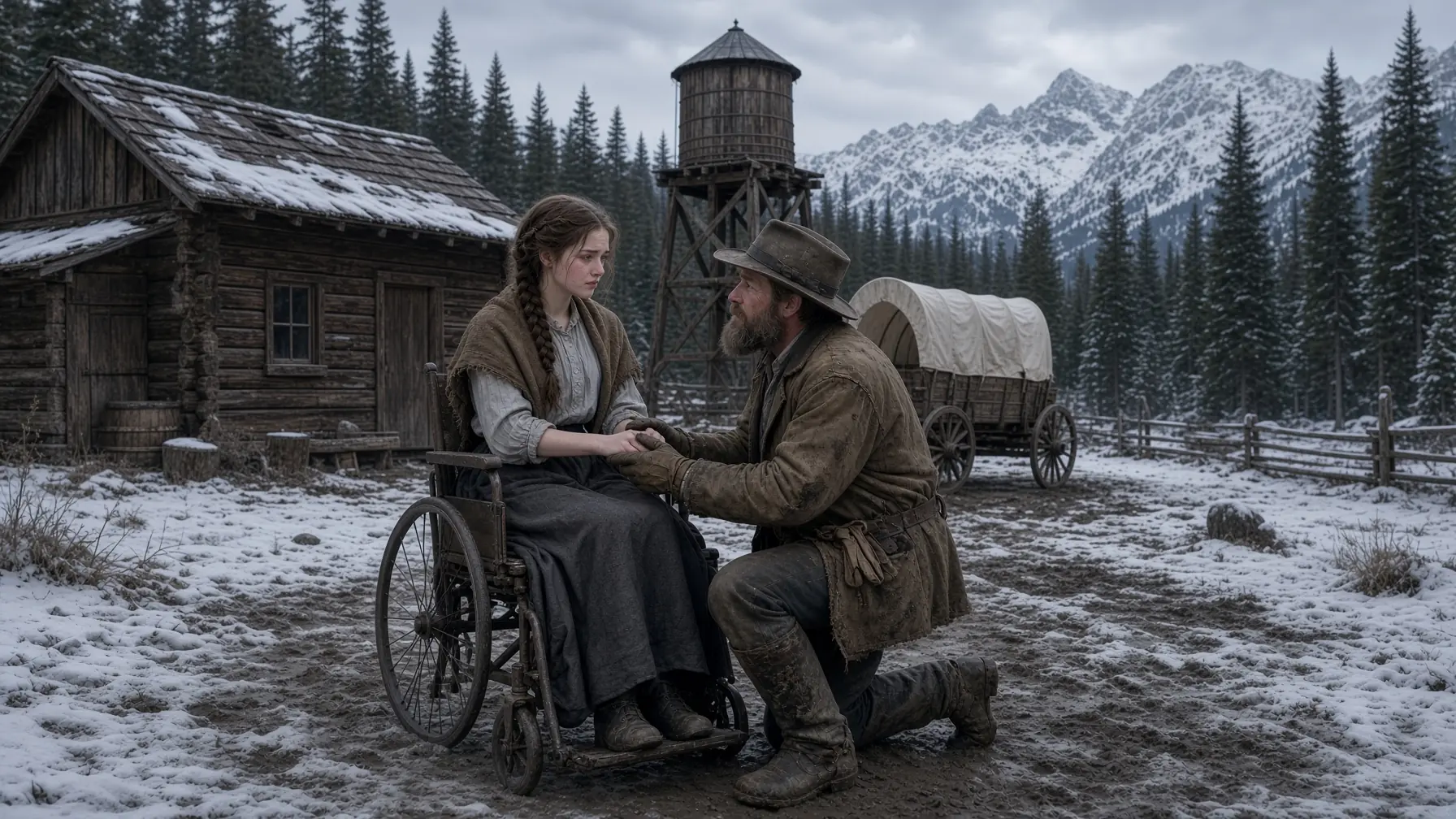
And her brother, barely 15, climbed up onto the driver's seat of a second lighter wagon, snapped the res and rolled away toward the town of Bitterroot Gap without a single word spoken. They left her there, wheelchair and all, at the edge of a swollen Ford, 300 m from anywhere that knew her name. Emiline did not cry. She had learned a long time ago that crying changed nothing, that tears were just salt water spent for no return. And so she sat in her chair at the edge of that ford with her hands folded in her lap and watched the water instead, counting the seconds the way she counted most things in her life, quietly and alone.
The Vaughn family had been rich once and richer still before the railroad deal that ruined them. And somewhere in the wreckage of that ruin, someone had decided that a crippled daughter was one burden too many to carry into a fresh start. They had told her it was for her own good. They had told her the mountain air out west would be too harsh for her lungs. They had told her many things, and none of them were true. and she had known that the moment her father would not meet her eyes.
What she did not know, sitting there with the cold spray misting her face was that the water she was watching was about to bring her the only family she would ever truly need. He came down from the ridge trail on a gray geling, a big man wrapped in a canvas coat gone soft with age, his beard more gray than brown, and his eyes the pale color of creek stones. His name was Judge Calhoun, though nobody called him judge for any court he'd ever sat in. It was a name given by men who respected how fair he judged a horse trade, and it had stuck to him the way good names do. He rained up hard when he saw her.
A woman alone at a dangerous ford was strange enough. A woman alone at a dangerous ford in a chair with wheels, abandoned with a single trunk and no horse to carry her onward. That was something else. That was a wrongness he could feel in his chest before his mind had even finished working out the shape of it. "Ma'am," he said, swinging down.
"You waiting on someone?" "No," Emiline said. "Nobody is coming back for me." He did not ask her to explain herself further. That was the first thing she noticed about him.
He did not treat her like a puzzle to be solved or a tragedy to be pied. He simply nodded once, slow, the way a man nods when he has decided something and doesn't intend to be talked out of it. Well then, he said, I reckon you're coming with me. She wanted to refuse him. Pride told her to refuse him, but her arms were tired and the sun was falling, and the water kept rising by inches.
And somewhere deep down in a place she had stopped visiting because it hurt too much to live there, a small voice told her that this stranger's offer was the first honest kindness she had been shown in longer than she could remember. He built the rig from rope and canvas and the bed of his pack horse, and he did not ask if she needed help. He simply gave it matter of fact, the way he might help any traveler whose horse had thrown a shoe. There was no performance to his kindness, no speech about how brave she was for suffering, no soft voice reserved for the broken. He spoke to her exactly as he would speak to any capable adult, and that more than anything was the thing that finally cracked something open behind her ribs.
They crossed the ford as the light was dying. And on the far side he built a fire before he built a shelter. Because he said a person needed warmth before they needed walls. And Emiline watched the flames and thought that this rough stranger understood something about survival that her own family, for all their money, had never learned at all. His ranch sat two days further up the mountain, a spread called Cutter's Rest, built from timber he'd felled himself 20 years earlier after a war he never spoke of, and a wife he'd buried not long after.
He had one hired hand, a boy named Jeb, who'd wandered in half starved two winters back and never left, and a dog with three working legs named Duke, who took one look at Emilen's chair, and decided, with the simple logic of animals, that she was exactly the kind of person worth guarding. Touque doesn't warm to strangers, Judge Calhoun told her, watching the dog settle against her wheel like he'd been assigned the post. Might be you're not one anymore. That dog's got better judgment than most of the men in Bitterroot Gap, Judge added, settling into the chair across from her with a tin cup of coffee. Never known him wrong yet.
Emiline reached down and let her fingers rest against the rough fur of Duke's neck, and the dog leaned into her hand like he'd been waiting his whole life for permission to do exactly that. It was such a small thing, a dog leaning into a hand. But Emiline had spent 13 years learning that small things were the only honest measure of anything, because grand gestures could be bought or performed, while a three-legged dog choosing where to rest his head could not be talked into lying. There was one more thing that first evening, and it mattered more to her than the fire, or the roof, or the supper. Judge Calhoun set a kettle and two full pales of hot water inside the door of the small room off the kitchen, along with a bar of plain soap, a folded towel worn soft, and a shirt and skirt of rosles that he took down from a peg without ceremony and without any speech attached.
Then he moved the wash stand chair over beside the bed where she could reach it from her own, and he set the pales where she could get at them without stretching. He did not offer to help. He did not ask whether she could manage. He simply built the thing so that she could and went out and shut the door. And Emiline heard him settle onto the porchstep outside with his pipe, well within calling distance and well out of the way.