At Briarwood High, money did not whisper.
It announced itself.
It arrived in shiny cars before first period, hung from designer shoulder bags in the hallway, flashed from silver charm bracelets at lunch, and sat in perfect rows of white teeth whenever someone laughed too loudly near the lockers.
Briarwood was a private high school tucked into the sunny hills outside San Diego, with red brick buildings, trimmed lawns, and a courtyard fountain everyone pretended not to care about but secretly used as the center of the school’s social universe.
The students dressed like magazine ads from 2002. Girls wore pastel cardigans, denim skirts, baby tees, low-rise jeans, butterfly clips, glossy lips, and tiny purses that held almost nothing useful. Boys wore varsity jackets, polo shirts, cargo pants, expensive sneakers, and watches their parents called “graduation investments,” even though most of them were still juniors.
And then there was Emma Whitmore.
Emma belonged everywhere at Briarwood because Briarwood had quietly been built for girls like her.
She was seventeen, a senior, and beautiful in the polished way that made people assume she had never had a bad hair day or an awkward conversation. Her blonde hair fell straight past her shoulders, usually pinned back with two crystal clips. Her skin was clear, her nails were French-tipped, her lip gloss was always pale pink, and her outfits looked casually perfect even when she had spent forty minutes choosing them.
Her father owned half the shopping plaza near the freeway.
Her mother chaired every charity event in town.
Her older sister had been prom queen, class president, and the kind of girl teachers still mentioned with misty eyes.
Emma had inherited the car, the clothes, the expectations, and the table near the cafeteria windows.
She had not inherited the joy.
But no one at Briarwood knew that.
No one was supposed to.
At lunch, Emma sat with her best friends, Madison Vale and Chloe Sanders, under the bright cafeteria windows where sunlight made everything look more expensive. Madison had dark hair, sharp eyeliner, and a talent for making gossip sound like public service. Chloe wore tiny hair clips, carried three lip glosses at all times, and repeated anything Madison said if it sounded mean enough to become popular.
Emma was halfway through a salad she did not want when Chloe leaned forward.
“New scholarship kid just walked in.”
Madison turned immediately. “Where?”
Emma did not look up at first.
Every year, Briarwood accepted a few scholarship students and then acted very proud of itself. Most of them learned quickly to blend in, stay quiet, and pretend they did not hear the word scholarship whispered like it was a stain.
But this boy did not blend.
He stood near the cafeteria entrance holding a tray, scanning the room with the calm expression of someone already used to not being invited.
He had dark brown hair, warm brown skin, and serious eyes that moved carefully over the tables. He wore a plain gray T-shirt under a faded navy jacket, dark jeans, and black sneakers worn white at the edges. His backpack was old but clean, with one broken zipper tied shut by a piece of string.
He was handsome.
That annoyed Emma before she could decide why.
Not polished handsome.
Not Briarwood handsome.
Something quieter.
More real.
Chloe wrinkled her nose. “Oh my gosh. His shoes.”
Madison laughed. “Those have survived events.”
Emma looked at the shoes again.
They were old.
Very old.
But not dirty.
There was a difference.
She should have said nothing.
That would have been easy.
Instead, because Madison was watching and Chloe was waiting and the cafeteria had a way of turning silence into weakness, Emma lifted her smoothie and said, “Maybe they’re vintage.”
Madison smirked. “Vintage from a lost-and-found bin?”
Chloe laughed too loudly.
The boy heard.
Emma knew because his eyes flicked toward their table.
For one second, they met hers.
She expected embarrassment.
Maybe anger.
Instead, he looked at her like he had learned something disappointing and was not surprised.
Then he walked past them and sat alone near the side doors.
Emma looked down at her salad.
Madison was still laughing.
For some reason, Emma was not.
By third period, everyone knew his name.
Daniel Rivera.
Transfer from a public school in Chula Vista.
Senior.
Full academic scholarship.
Mother worked nights at a hospital.
He had already corrected Mr. Grayson in U.S. History, which made him either brave or socially doomed.
By fourth period, Emma discovered he was in her English class.
Worse, he sat two seats away.
Mrs. Bennett stood at the front of the classroom with a stack of assignment sheets and the dangerous smile of a teacher about to ruin everyone’s week.
“As you know, Briarwood’s annual Spring Benefit is coming up,” she said. “This year, our senior English class will contribute by creating oral history profiles of people in our community. You’ll interview someone whose life story deserves to be heard and present it at the benefit.”
A few students groaned.
Emma uncapped her pen.
An interview project.
Fine.
She could do that.
Her mother made her speak at charity events every December. Emma knew how to write polished sentences that made adults clap.
Then Mrs. Bennett continued.
“I’ve assigned partners.”
Emma’s pen stopped.
Assigned partners were always a threat.
Mrs. Bennett began reading names.
“Madison and Chloe.”
Madison smiled, relieved.
Emma waited.
“Emma Whitmore and Daniel Rivera.”
The room made a small sound.
Not loud.
Just enough.
Emma felt heat rise under her skin.
Daniel looked over at her.
His expression was unreadable.
Madison twisted around in her seat, eyes wide with delight.
Emma forced a smile.
“Great,” she said.
Daniel lifted an eyebrow.
“Convincing.”
A few students nearby laughed.
Emma’s smile tightened.
“This should be easy,” she said. “I’m good at presentations.”
“I’m sure,” Daniel replied.
There was something in his tone.
Not rude exactly.
Worse.
Unimpressed.
Emma leaned closer.
“Is that a problem?”
“No.”
“Then why did you say it like that?”
Daniel picked up the assignment sheet.
“Like what?”
“Like you already decided something about me.”
He looked at her then.
Really looked.
“Funny,” he said quietly. “That must be annoying.”
Emma had no response.
Because she deserved that.
She hated that she deserved it.
Their first project meeting was in the library after school.
Emma arrived at three thirty wearing a pale yellow cardigan, white tank top, denim skirt, and platform sandals that clicked softly against the floor. She had a fresh notebook, a pink pen, and the kind of organized outline that usually made teachers smile.
Daniel was already there.
That annoyed her too.
He sat at a table near the windows, reading the assignment sheet. His old backpack rested beside his chair, and a library copy of The House on Mango Street sat near his elbow.
Emma set her notebook down.
“You’re early.”
He looked up. “You’re surprised.”
“I’m used to partners being late.”
“I’m used to people expecting less.”
She sat across from him.
“That’s not what I meant.”
“Okay.”
The word was calm.
Too calm.
Emma opened her notebook.
“We need to choose an interview subject. My mother knows the director of the community arts foundation. She’d be perfect. Very respected. Very polished.”
Daniel looked at her.
“Polished isn’t the assignment.”
Emma paused.
“What?”
“It says someone whose life story deserves to be heard. Not someone whose life already gets microphones.”
Emma’s face warmed.
“She has an important story.”
“Maybe.”
“You haven’t heard it.”
“Neither have you. You just know she photographs well at benefits.”
Emma stared at him.
Nobody at Briarwood talked to her that way.
Not because they liked her too much.
Because they feared the social consequences.
Daniel did not seem afraid of her at all.
That was infuriating.
And a little impressive.
“Fine,” Emma said. “Who would you choose?”
Daniel looked out the library window toward the parking lot.
“There’s a woman who works at the laundromat near my apartment. Mrs. Alvarez. She came here from Mexico when she was nineteen, raised four kids, and still opens the shop at six every morning. She knows half the neighborhood’s stories.”
Emma blinked.
“That’s… specific.”
“That’s usually how real stories work.”
She looked down at her notebook.
Again, no comeback.
She hated this project.
By the end of the meeting, they had agreed to interview Mrs. Alvarez.
Or rather, Daniel had made the better argument, and Emma had surrendered while pretending not to.
They planned to meet at the laundromat Saturday morning.
Emma wrote it down carefully.
Daniel packed his things.
Before he left, she said, “Daniel.”
He looked back.
She took a breath.
“I’m sorry about lunch.”
His expression did not change.
She continued quickly, “The shoe comment. It was rude.”
“Yes,” he said.
Emma flinched.
Most people would have said, It’s fine.
Daniel did not.
After a moment, he added, “But thanks for saying it.”
Then he walked away.
Emma sat in the library long after he left, staring at her pink pen.
She had apologized.
He had accepted it badly.
Or maybe honestly.
She was not sure which bothered her more.
Saturday morning, Emma drove to the laundromat in her silver Volkswagen Beetle, following directions Daniel had written on a sticky note.
The neighborhood was different from hers.
Older storefronts.
Murals on brick walls.
A taco shop with plastic tables outside.
A bus stop crowded with people carrying grocery bags.
The laundromat sat between a check-cashing place and a tiny bakery. Its sign was faded blue, and the windows were fogged from rows of spinning machines inside.
Emma parked and checked her reflection in the rearview mirror.
She had dressed down, or at least tried to. Jeans, white sneakers, a pink hoodie, hair in a ponytail. She still looked like she had dressed down with a credit card.
Daniel was waiting outside, hands in his jacket pockets.
He looked at her car, then at her.
“Cute car.”
Emma narrowed her eyes.
“Was that judgment?”
“That was observation.”
“You’re very good at making observation sound like judgment.”
“Practice.”
She followed him inside.
The laundromat was warm and loud, full of humming machines, detergent smell, and people folding clothes at long tables. Mrs. Alvarez stood near the counter, a short woman in her late fifties with silver-streaked black hair, kind eyes, and strong hands.
Her face lit up when she saw Daniel.
“Mijo,” she said, pulling him into a hug.
Daniel smiled in a way Emma had not seen before.
Soft.
Unprotected.
“This is Emma,” he said. “My project partner.”
Mrs. Alvarez turned to Emma.
“So you are the girl with the fancy school.”
Emma smiled nervously.
“I guess so.”
Mrs. Alvarez laughed.
“At least you are honest.”
The interview lasted two hours.
Emma expected to be bored.
She was not.
Mrs. Alvarez told them about arriving in California with one suitcase and no English. About working two jobs. About teaching herself to read bills by comparing words on envelopes. About raising children who translated parent-teacher conferences before they were old enough to understand the pressure. About opening the laundromat after twenty-five years of saving.
She told stories with humor and sadness braided together.
Daniel asked thoughtful questions.
Emma took notes until her hand cramped.
At one point, Mrs. Alvarez looked at Daniel and said, “This boy used to do homework at that table when his mother worked nights. Always serious. Always trying to look older than he was.”
Daniel looked embarrassed.
Emma glanced at him.
He was staring down at the recorder.
After the interview, Mrs. Alvarez insisted they eat pastries from the bakery next door.
Emma sat at a folding table with Daniel, holding a warm concha in a paper napkin.
“This is really good,” she said.
Daniel smiled faintly.
“Careful. That sounded real.”
She looked at him.
“I can be real.”
“I didn’t say you couldn’t.”
“You implied it.”
“I implied you hide it.”
Emma stopped.
The laundromat noise filled the silence between them.
Finally, she looked down.
“Maybe I do.”
Daniel did not tease her.
He did not push.
He simply took another bite of pastry and looked out at the spinning machines.
That made her want to tell him more.
Which was dangerous.
Over the next two weeks, Emma and Daniel worked together almost every afternoon.
At first, it was only for the project.
Then it became something stranger.
They met in the library, in the computer lab, in the courtyard when the weather was clear. Emma edited the presentation slides, choosing fonts and images. Daniel shaped the story, cutting anything that sounded too much like a charity brochure.
“She’s not a symbol,” he said one afternoon, crossing out one of Emma’s sentences.
Emma frowned. “I didn’t say she was.”
“You wrote her like one.”
Emma looked at the page.
He was right.
She hated how often he was right.
So she rewrote it.
Mrs. Alvarez did not build a life from nothing because she was inspirational.
She built it because rent was due, children were hungry, and giving up was never affordable.
Daniel read the new line twice.
Then he looked up.
“That’s good.”
Emma tried not to smile.
“Only good?”
“Very good.”
She smiled anyway.
Madison noticed first.
Of course.
At lunch, Emma sat down at the window table, still holding a folder from the project.
Madison looked at it like it was evidence.
“You’ve been spending a lot of time with scholarship boy.”
Emma’s stomach tightened.
“His name is Daniel.”
Chloe’s eyebrows shot up.
Madison smiled slowly.
“Oh.”
“What?”
“You said that fast.”
“Because it’s his name.”
“Defensive.”
“I am not defensive.”
Chloe leaned in. “Is he secretly cute?”
Emma opened her yogurt.
“He is not secretly anything.”
Madison gasped.
“That means yes.”
Emma looked across the cafeteria.
Daniel sat near the side doors, reading while eating a sandwich wrapped in foil. He looked up at that exact moment.
Their eyes met.
For once, he did not look away.
Neither did she.
Madison whispered, “Oh my gosh.”
Emma turned back.
“Stop.”
“This is social disaster.”
“It is a school project.”
“It is a school project with eye contact.”
Emma stood.
“I’m going to the library.”
Chloe sighed dreamily. “Classic.”
Daniel was already there when she arrived.
“You’re early,” he said.
“You always say that.”
“You always are.”
Emma sat across from him.
For a while, they worked quietly.
Then Daniel slid a paper toward her.
It was a draft of his opening narration.
Emma read it.
His writing was simple, direct, and beautiful in a way that did not ask for applause.
She looked up.
“You’re good at this.”
He shrugged.
“I mean it,” she said.
His expression shifted slightly.
“I know.”
“No, you don’t. You looked like you were getting ready to throw the compliment away.”
Daniel looked down.
Emma recognized that gesture.
She did it with sadness.
He did it with praise.
“Why do you do that?” she asked.
“What?”
“Act like anything good said about you is suspicious.”
He smiled faintly.
“Maybe because at Briarwood, it usually is.”
That hurt because she knew it was true.
“Not from me,” she said quietly.
Daniel looked at her.
The library felt suddenly too still.
Then his voice softened.
“Okay.”
One small word.
But different now.
Not dismissal.
Trust.
The Spring Benefit arrived on a Friday night in April.
Briarwood transformed itself into a polished dream. The gym was covered in white fabric, silver lights, flower arrangements, and framed student projects. Parents arrived in expensive dresses and suits. Students wore pastel gowns, pressed shirts, satin skirts, shiny shoes, and carefully styled hair.
Emma wore a pale blue dress with a matching cardigan and silver clips in her hair. She looked exactly like her mother wanted her to look.
Daniel wore black dress pants, a white shirt, and a navy tie Emma knew he had borrowed because the tag had left a faint crease.
He looked nervous.
That surprised her.
“You okay?” she asked backstage.
“Fine.”
She raised an eyebrow.
He sighed.
“Do not look at me like that.”
“Like what?”
“Like you’re about to professionally understand me.”
Emma smiled.
“I thought you hated polished presentations.”
“I hate fake ones. This one matters.”
The words made her chest tighten.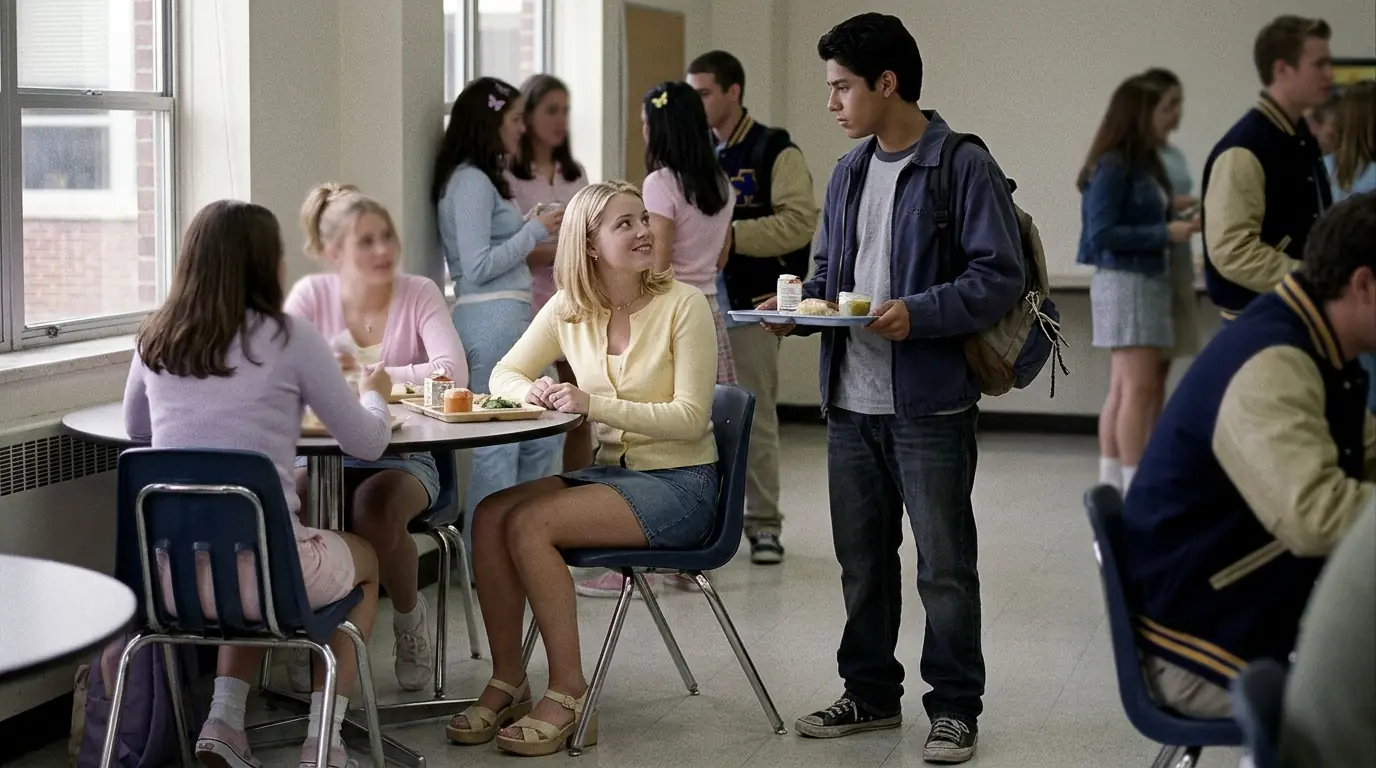
Before they went on, Emma reached into her purse and pulled out a small box.
Daniel stared.
“What is that?”
“Open it.”
“No.”
“Daniel.”
“Why are rich people always giving boxes?”
She rolled her eyes and opened it herself.
Inside was a pair of simple black dress shoes.
Daniel’s face changed immediately.
Emma spoke quickly.
“They’re not charity. They’re not because I’m embarrassed by your shoes. I just… I noticed your dress shoes at rehearsal were too tight. You kept shifting your weight. These are my cousin’s. He wore them once, and they’re your size. I asked.”
Daniel said nothing.
Emma’s confidence crumbled.
“I shouldn’t have. That was weird. Forget it.”
She started to close the box.
Daniel stopped her gently.
His fingers brushed hers.
“Emma.”
She looked up.
His voice was quiet.
“Thank you.”
No sarcasm.
No defense.
Just thank you.
She smiled, relieved.
He looked at the shoes, then at her.
“You noticed?”
She nodded.
“I notice things too.”
They presented Mrs. Alvarez’s story to a room full of people who usually paid to feel generous without feeling uncomfortable.
This time, they listened.
Emma opened with grace, but not polish. Daniel followed with honesty, but not bitterness. Together, they told the story of a woman whose life had been built in early mornings, tired hands, folded shirts, unpaid bills, laughter, sacrifice, and stubborn hope.
Mrs. Alvarez sat in the front row beside Daniel’s mother, wiping her eyes with a tissue.
When the presentation ended, the applause came slowly at first.
Then stronger.
Then everyone stood.
Emma looked at Daniel.
He was not smiling exactly.
He looked moved beyond smiling.
Afterward, Emma’s mother approached them.
She wore pearls, a cream suit, and the expression she used at charity functions.
“That was lovely,” she said.
Emma braced herself.
Her mother turned to Daniel.
“You speak very well.”
Daniel nodded politely.
“Thank you.”
Emma’s mother looked at Emma.
“I didn’t know you could write like that.”
The words should have felt like praise.
They did not.
They felt like a door with a lock on it.
Emma forced a smile.
“I guess I can.”
Daniel noticed.
Of course he did.
Later that night, after the benefit ended and students began carrying decorations to cars, Emma slipped outside through the side doors.
Rain had started.
Soft at first.
Then heavier.
She stood under the awning in her pale blue dress, arms wrapped around herself, watching water blur the parking lot lights.
The door opened behind her.
Daniel stepped out.
“You disappeared.”
“I’m dramatic.”
“Not usually.”
She laughed once.
It came out wrong.
He stood beside her.
For a while, neither spoke.
Then Emma said, “My mom looked surprised.”
Daniel waited.
“That I could write something real.”
He looked at her.
Emma swallowed.
“I think everyone is surprised when I’m more than what they expected. Sometimes I am too.”
Rain hit the pavement in bright silver lines.
Daniel took off his jacket and draped it over her shoulders.
She looked at him.
He shrugged.
“Weather behavior.”
She smiled faintly.
“I think I know someone who would say that.”
“Sounds like a smart person.”
For once, she laughed for real.
Then the laughter faded.
“I’m tired,” she whispered.
Daniel’s face softened.
“Of what?”
“Being easy to admire.”
The confession hung between them.
Daniel stepped closer, not touching her, just there.
“You’re not easy,” he said.
Emma looked up.
He added, “That was a compliment.”
She smiled through sudden tears.
“I know.”
The rain kept falling.
Students passed behind the glass doors, laughing, carrying flowers, living inside the bright version of the night.
Outside, Emma felt more herself than she had all evening.
Daniel looked at the parking lot.
“Do you have a ride?”
“My mother left early. My dad was supposed to come back, but…”
She checked her phone.
No messages.
Of course.
“I can wait,” she said.
“I’ll wait with you.”
“You don’t have to.”
“I know.”
He said it simply.
Like staying was not a performance.
Like she did not have to earn it.
So they waited in the rain-bright quiet, under the awning, his jacket around her shoulders and the applause from the benefit still echoing somewhere behind them.
After that night, everything changed.
Not publicly at first.
Public change was complicated at Briarwood.
Madison noticed Emma wearing Daniel’s jacket the following Monday and nearly dropped her smoothie.
Chloe whispered, “That is not a project jacket.”
Emma ignored them.
Daniel sat with her once at lunch, and the window table went silent like a foreign diplomat had arrived.
Madison stared at him.
Daniel stared back calmly.
Finally, Madison said, “So, Daniel. Do you always make girls do community service before giving them your jacket?”
Emma choked on her water.
Daniel said, “Only the difficult ones.”
Chloe gasped.
Madison laughed despite herself.
Emma looked at Daniel in disbelief.
He looked pleased.
Slowly, awkwardly, impossibly, he became part of her world.
And Emma became part of his.
She visited the laundromat again and helped Mrs. Alvarez organize old photos for a community display. She met Daniel’s mother, who hugged her immediately and told Daniel in Spanish that he looked nervous, which made him groan. She learned that Daniel had two younger cousins who adored him and a grandmother who made tamales so good Emma almost cried.
Daniel came to Briarwood events and refused to be impressed by anyone’s money. He helped Emma rewrite her college essay because, according to him, “This sounds like your mother wrote it in heels.” He told her when she was performing. She told him when he was assuming the worst.
They argued often.
About wording.
About pride.
About whether Clueless was secretly smarter than people gave it credit for.
Emma said yes.
Daniel said obviously yes, but he wanted to see how hard she would defend it.
By May, prom was everywhere.
Posters in the hallway.
Girls whispering about dresses.
Boys pretending not to care.
Madison planning photo angles with military seriousness.
Emma waited for Daniel to ask.
Daniel did not.
For one week, she pretended not to care.
Then she found him after school near the courtyard fountain.
“Are you not asking me to prom on purpose?”
Daniel looked up from his book.
“Hello to you too.”
“I’m serious.”
“I know. You skipped the warm-up insult.”
She crossed her arms.
He closed the book.
“I wasn’t sure you wanted me to.”
Emma blinked.
“Why wouldn’t I?”
He looked across the courtyard at the polished brick buildings, the expensive cars waiting beyond the gates, the life Emma had always known.
“Because this is your world.”
The words hurt.
She sat beside him.
“No,” she said softly. “It’s just where I go to school.”
Daniel looked at her.
Emma took a breath.
“And I want to go with you.”
His expression shifted.
Slowly, he smiled.
“Then, Emma Whitmore, will you go to prom with me?”
She smiled back.
“That was very casual.”
“I can kneel dramatically if needed.”
“Please don’t.”
“So is that a yes?”
“Yes.”
His smile widened.
“Good.”
She leaned closer.
“And Daniel?”
“Yeah?”
“You’re allowed to want things here too.”
He looked at her for a long moment.
Then he nodded.
“I’m learning.”
Prom night arrived bright and windy, the kind of California evening that made the whole school look like a movie set.
The theme was Starlight Serenade, which meant navy curtains, silver balloons, fake stars, and a photo backdrop that Madison described as “acceptable after emergency revisions.”
Emma wore a soft white dress with tiny blue flowers embroidered along the hem. Her hair was half-up with crystal clips. For once, she did not choose the dress her mother liked most.
She chose the one she could breathe in.
Daniel arrived in the black shoes, dark suit, and navy tie.
Emma opened the door and stared.
He looked down at himself.
“What?”
“Nothing.”
“That was a loud nothing.”
She smiled.
“You look handsome.”
He looked away, embarrassed.
“There you go, throwing compliments like weapons again.”
“You’ll survive.”
At prom, people stared.
Of course they did.
Emma Whitmore and Daniel Rivera walking in together was not something Briarwood knew how to categorize.
Madison took one look at them and declared, “Good. The dress works.”
Daniel leaned toward Emma. “Is that approval?”
“From Madison? That’s emotional vulnerability.”
They danced badly at first.
Emma tried to lead.
Daniel objected.
She stepped on his shoe and panicked.
He laughed.
“You’re more worried about the shoe than my foot.”
“They’re important shoes.”
“They’re just shoes.”
She looked at him.
“No,” she said. “They’re not.”
He understood.
His smile softened.
During the slow song, Daniel held her carefully, one hand at her waist, the other holding hers.
Emma looked around the gym.
At the girls glittering under silver lights.
At the boys in loosened ties.
At Madison pretending not to watch.
At the school that had once felt like a stage she could never leave.
Then she looked at Daniel.
“I’m glad you didn’t let me choose the arts foundation director,” she said.
He laughed softly.
“That is a very strange prom confession.”
“I mean it.”
“I know.”
“You made the story better.”
He shook his head.
“Mrs. Alvarez made the story better.”
“You made me listen.”
Daniel looked at her, and the teasing left his face.
“You listened because you wanted to.”
Emma’s throat tightened.
She had spent so long believing she was shallow because people liked her better that way.
But Daniel never let her stay shallow.
He never let her hide there.
“Can I ask you something?” she said.
“Yeah.”
“Do you still think I’m fake?”
His expression changed.
“No.”
She exhaled.
He stepped closer.
“I think you were lonely.”
Emma’s eyes burned.
“And now?”
He smiled softly.
“Now I think you’re here.”
She kissed him before fear could talk her out of it.
It was gentle and warm and a little awkward because Daniel smiled halfway through it and Emma whispered, “Don’t laugh,” which made him laugh more.
Near the punch table, Chloe screamed.
Madison said, “Finally,” like she had directed the whole thing herself.
Emma did not care.
Graduation came in June, under a clear blue sky.
Briarwood arranged white chairs on the lawn, flower arches near the stage, and a professional photographer near the fountain. Parents wore linen suits and summer dresses. Students cried into each other’s gowns and promised to visit in college.
Emma’s parents sat together but stiffly.
Daniel’s mother sat beside Mrs. Alvarez, both of them cheering before his name was even called.
Daniel graduated with honors.
Emma won the senior writing prize for her oral history project.
When her name was announced, she looked at Daniel first.
He smiled like he had known all along.
After the ceremony, Emma found him near the side courtyard where they had once argued about stories and polish.
He handed her a folded paper.
“What is this?”
“Read it.”
It was a printed copy of their final presentation.
At the bottom, Daniel had written:
Emma,
You taught me that privilege can hide loneliness.
You taught me that listening is different from hearing.
You taught me that people can become real when someone gives them room.
Also, your first draft was terrible.
— Daniel
Emma laughed through tears.
“That last line ruined the moment.”
“It grounded it.”
She hugged him.
He held her tightly.
Around them, Briarwood shimmered with endings. Expensive cameras flashed. Parents called names. Madison shouted for Emma to fix her hair before pictures. Chloe was crying so hard her mascara had surrendered completely.
Emma looked across the lawn at the school that had taught her how to be admired, and at the boy who had taught her how to be known.
The future was not simple.
Daniel had accepted a scholarship to UCLA.
Emma was going to a liberal arts college farther north.
Distance waited.
So did fear.
So did all the old habits they would have to unlearn again and again.
But Emma was no longer afraid of becoming someone unexpected.
Daniel took her hand.
“Ready?”
She looked at him.
“For what?”
He glanced toward Madison waving both arms like an air traffic controller.
“Apparently, a thousand pictures.”
Emma laughed.
Then she squeezed his hand.
Together, they walked back toward the crowd, her graduation gown fluttering in the bright afternoon air, his new shoes polished but already creased from dancing, their fingers linked between them.
Emma had once mocked those shoes because it was easier than admitting she noticed him.
Now she knew better.
The things people wore, carried, hid behind, or walked through were never the whole story.
Sometimes the boy with the worn-out sneakers had the strongest heart in the room.
Sometimes the girl with the perfect life was quietly falling apart.
And sometimes, if both of them were brave enough to listen, a school project could become a love story neither of them saw coming.