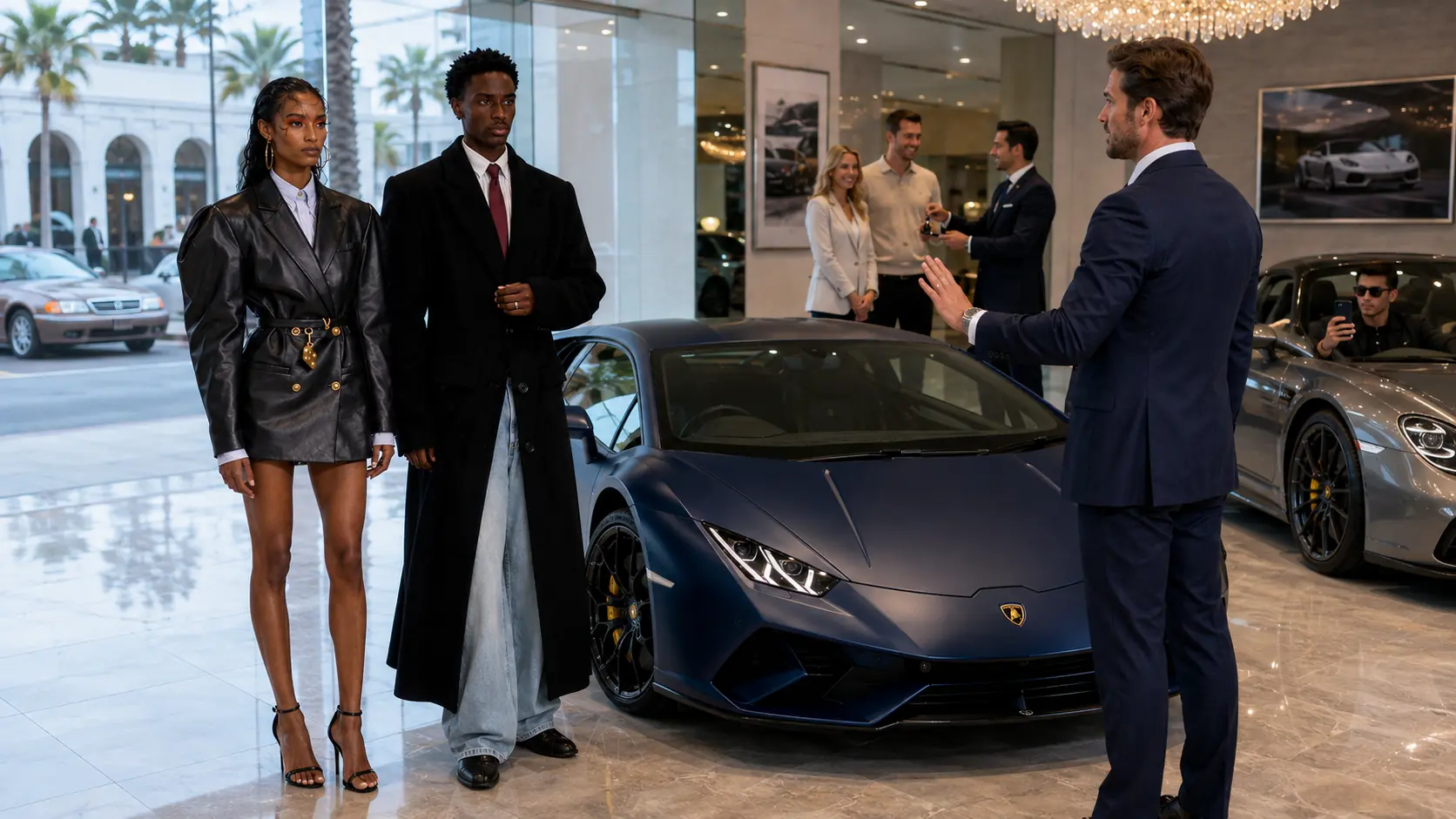
“Sir, ma’am, please step away from the vehicle.”
The sentence cut through the showroom with the kind of polished coldness that made people look up before they understood why.
A few customers turned from the espresso counter. A young man in designer sunglasses paused beside a red Ferrari with one hand still resting on the roof. Near the reception desk, a sales associate stopped mid-sentence and looked toward the pearl-white Bentley Bentayga sitting beneath the chandelier lights.
Malcolm Price stood beside the Bentley with his wife, Vivian, one hand resting gently on the open door.
Vivian had only leaned closer to look at the stitching.
They had not raised their voices.
They had not climbed into the car.
They had not damaged anything, argued with anyone, or asked for treatment beyond the basic respect every customer should receive when they walk into a showroom.
Still, the sales manager was walking toward them like he had discovered a problem.
His name was Preston Vale.
He was forty-one, tall, smooth-faced, and dressed in a navy suit that probably cost more than the monthly rent of the young associate standing behind him. His smile was the kind people practice in mirrors. Wide enough to count as polite. Thin enough to warn you not to mistake it for kindness.
“That vehicle begins at nearly three hundred thousand dollars,” Preston said. “We don’t allow casual handling of inventory in that class.”
Vivian turned slowly.
She was forty-six, dressed in a simple tan blouse, dark trousers, flat shoes, and a watch that looked modest only because Preston did not know enough to recognize it. Malcolm wore a clean gray polo, black jeans, and sneakers. They had arrived in an old Honda Accord with faded paint, a small crack in the rear bumper, and a veteran parking decal on the windshield.
That was all Preston needed.
Not to know them.
To decide them.
Malcolm looked at him calmly.
“We’re not handling it casually.”
Preston’s smile did not move.
“Of course. Then I’m sure you won’t mind completing a preliminary finance profile before we continue.”
Vivian lifted one eyebrow.
“To look at the stitching?”
“For vehicles of this caliber, yes.”
That was a lie.
Everyone in the room knew it.
A white couple near the Porsche display had just been handed keys for a test drive without showing anything more than enthusiasm. A young influencer in a silk shirt had spent fifteen minutes filming himself inside a Lamborghini while a salesperson angled the door for better lighting. Nobody had asked him for a credit application.
But Vivian and Malcolm were Black.
And in Preston Vale’s showroom, that changed the rules.
Vivian let her gaze move around the room.
The polished stone floor.
The glass offices.
The espresso bar.
The brushed metal sign on the wall that read Sterling Crest Motors.
Then she looked back at Preston.
“Is that your written policy?”
Preston clasped his hands in front of him.
“It is management discretion.”
There it was.
Discretion.
The word that let bias put on a tie and pretend it was professionalism.
Malcolm took a slow breath.
He knew his wife well enough to know the dangerous part was not when she became angry. Vivian’s anger did not get loud. It got clean. It became still, patient, almost gentle, and that was usually when someone had already run out of chances without knowing it.
Preston misread her silence.
“You may find our pre-owned location in Van Nuys more comfortable,” he added. “They carry inventory in a more practical range.”
The showroom went quiet.
Vivian’s face did not change.
Malcolm’s did.
Only in the jaw.
“Practical for who?” he asked.
Preston turned his attention to him.
“Sir, if you become confrontational, I’ll have to ask security to assist.”
Vivian smiled.
Not warmly.
Not softly.
It was the kind of smile that arrived after disappointment had finished taking notes.
“Please do,” she said. “Call whoever you think you need.”
Preston lifted his chin, satisfied.
He thought he had taken control.
He had no idea he was standing in front of the woman who owned the dealership, the inventory, the service bays, the building, and the payroll system that had issued his last check.
Her name was Vivian Price.
Preston did not know that.
Because when she and Malcolm entered the showroom, she had introduced herself only as Mrs. Price, and nobody had bothered to ask anything after seeing the Honda.
He did not know she was the founder and CEO of Meridian Auto Group, a luxury dealership company that owned thirty-four locations across nine states. He did not know Meridian had acquired Sterling Crest Motors seven months earlier after a confidential review revealed a beautiful showroom with a long record of ugly customer complaints.
He did not know Vivian had spent the past half year visiting her dealerships unannounced.
Not to punish small mistakes.
Not to scare employees.
To learn what customers experienced when nobody knew the owner was watching.
Preston Vale had just answered that question with perfect clarity.
To understand why Vivian did not raise her voice, you would have to go back twenty-eight years.
Before the Bentleys.
Before the acquisitions.
Before the magazine covers and leadership awards and industry panels where executives suddenly called her visionary.
Vivian Harris was seventeen when she walked into a used car dealership in Sacramento with her father.
Her father, Raymond Harris, had fixed municipal buses for thirty-four years. He could hear an engine misfire from across a parking lot. He could tell you whether a transmission was tired by the way the gearshift settled into park. He had saved for ten months to help Vivian buy a used Toyota before she left for college.
They came to see a blue Camry in the front row.
The salesman glanced at Raymond’s work shirt, then at Vivian’s braids, and told them the cheaper cars were around back.
Raymond said they had come for the Camry.
The salesman laughed.
Not openly enough to be called cruel.
Just quietly enough to be worse.
He said they would need real financing for that.
Vivian did not remember leaving the lot.
She remembered her father’s face on the drive home.
He did not look angry.
He looked tired in a way that made her chest hurt.
At a red light, he said, “Baby, don’t ever let somebody else’s small imagination become the ceiling over your life.”
Vivian never forgot it.
Years later, after business school, after dealership finance, after being mistaken for an assistant in rooms where she was the person signing the deal, she opened her first small car lot with seven used vehicles, a rented trailer, and one mechanic who believed in her because he had known her father.
She named it Harris Motor House.
By forty, she had turned it into Meridian Auto Group.
Luxury came later.
Wealth came later.
Respect came later too, though Vivian learned early that some people respected money only after it proved it could affect them.
Malcolm had been there for most of it.
He met her when the office still had a portable heater and the printer jammed twice a week. He was a former Air Force maintenance engineer, quiet, precise, and patient enough to let Vivian work eighteen-hour days without pretending ambition was a flaw. He also had the annoying habit of driving old cars long after they should have been replaced.
The Honda they drove that day had belonged to his older brother.
After his brother died, Malcolm kept it because grief attaches itself to strange objects. The seat still leaned slightly to the left. The glove compartment still held an old tire gauge. The radio only worked when it felt charitable.
Preston saw that Honda and built a complete story.
That was his first mistake.
Sterling Crest Motors sat on one of those Beverly Hills corners designed to make money look natural. All glass, white stone, chrome, and soft lighting. The cars were displayed like art pieces. Bentley, Ferrari, Aston Martin, Rolls-Royce, Porsche, Range Rover, and special-order vehicles for customers who spoke about delivery dates the way other people spoke about birthdays.
Before Meridian acquired it, Sterling Crest had a reputation.
It sold expensive cars.
It also decided very quickly who deserved to be treated like a buyer.
Vivian had heard enough.
Seven customer complaints in fourteen months.
Three trade-in disputes that looked suspiciously similar.
Two former employees who left after saying the culture was “selective,” a word Vivian had learned usually meant something uglier when translated honestly.
So she and Malcolm went in unannounced on a Saturday morning.
They parked the Honda in the side lot because the valet ignored them at the front entrance.
Vivian noticed.
Malcolm noticed her noticing.
He did not say anything.
After twenty-three years of marriage, he knew when commentary would only interrupt the evidence.
Inside, the showroom smelled like leather, espresso, and polished wealth.
A young sales associate at the desk looked up immediately.
“Good morning. Welcome to Sterling Crest. Let me know if you’d like anything opened.”
Her name tag read Tessa Kim.
She looked nervous, but not dismissive.
Vivian liked her right away.
“Thank you,” Vivian said. “We’re just looking for now.”
“Of course. Take your time. If you want to sit in any vehicle, I’ll be happy to get the keys.”
That was the correct answer.
Respectful.
Simple.
No assumptions.
Then Preston came out of his glass office.
He had seen the Honda.
He had seen Tessa being helpful.
He moved quickly, as if a spill needed to be cleaned before it stained the marble.
“I’ll handle this, Tessa,” he said.
Tessa hesitated.
Only for a second.
Vivian saw it.
So did Malcolm.
Preston stepped in front of her with practiced ease.
“Good morning,” he said. “Looking for anything specific?”
Malcolm nodded toward the Bentley.
“We wanted to see the Bentayga.”
Preston’s expression changed just enough to tell the whole story.
“That’s an upper-tier vehicle.”
“We know.”
“Most clients interested in that model schedule private appointments.”
“We’re here now,” Vivian said.
Preston looked toward the side lot.
Toward the old Honda.
Then back at Vivian’s shoes.
“I see. Well, without an appointment, our access is limited.”
“Access to what?” Malcolm asked.
“To inventory of that value.”
Vivian gave him one more chance.
“We don’t need champagne or a presentation. We only want to look inside.”
Preston’s smile tightened.
“We have to protect high-value inventory from unnecessary wear.”
At that exact moment, the influencer inside the Lamborghini adjusted the seat again while filming himself.
Vivian looked toward him.
Preston did not.
“Does unnecessary wear apply to him too?” she asked.
Preston’s jaw moved.
“Every customer interaction is evaluated individually.”
“Yes,” Vivian said. “I’m starting to see that.”
The room went quieter again.
A finance specialist behind the reception desk looked up from his monitor. His name was Owen Patel, and he had worked there long enough to know when Preston was about to become a problem. He had watched the same thing happen many times.
A Black dentist redirected to financing before seeing a Range Rover.
A Latina restaurant owner asked if she had “realistic expectations.”
An older Korean couple ignored until their son arrived in a suit.
Owen had told himself he was there to handle paperwork, not culture.
That excuse had become harder to carry.
Vivian looked back at Preston.
“I’d like to speak with the general manager.”
Preston’s smile grew more confident.
“That would be me.”
“Then I’d like to speak with whoever supervises you.”
“There is no one above me in this building.”
“Not what I asked.”
His face hardened.
“Ma’am, I’ve tried to be courteous.”
“No,” Vivian said. “You’ve tried to be subtle.”
Malcolm’s eyes moved toward her.
There she was.
The blade.
Preston did not understand the warning.
“Sir,” he said, turning to Malcolm, “I’m going to ask you and your wife to step away from the vehicle. If you refuse, I’ll call security.”
Malcolm looked at him for a long second.
“My wife asked to look at a car.”
“And I explained the process.”
“You explained your prejudice and called it process.”
The words landed hard.
Several customers turned fully now.
Phones began to rise.
Preston’s face flushed.
“I will not tolerate accusations in my showroom.”
“Your showroom?” Vivian asked.
He looked at her.
“My showroom.”
That was his second mistake.
Vivian pulled her phone from her purse.
Preston pointed at it.
“Recording is not allowed.”
“I’m not recording.”
“Then what are you doing?”
“Calling my executive counsel.”
He blinked.
“Your what?”
Vivian tapped the name.
The call connected after one ring.
A woman answered.
“Vivian?”
“Renee,” Vivian said. “Emergency executive line. Sterling Crest Beverly Hills. Put leadership, HR, compliance, and legal on now.”
Preston stared at her.
Somewhere behind him, Owen Patel went very still.
He knew that voice.
He had heard it on quarterly calls.
Tessa looked at Owen.
“What’s wrong?”
Owen whispered, “That’s Vivian Price.”
Tessa’s eyes widened.
“The CEO?”
Owen nodded.
The call was on speaker now.
Renee Alvarez, general counsel for Meridian Auto Group, spoke with controlled speed.
“Vivian, are you safe?”
“For now.”
Preston looked between them.
“Who are you?”
Vivian reached into her purse and removed a black business card with silver lettering.
She held it out.
Preston took it like a man accepting a document from a judge.
Vivian Price
Founder and Chief Executive Officer
Meridian Auto Group
His face changed in stages.
Confusion.
Disbelief.
Recognition.
Fear.
He looked toward the Meridian logo on the showroom wall, newly installed after the acquisition but apparently never studied closely enough to save him.
“You’re not…”
Vivian finished for him.
“The owner?”
Preston swallowed.
“I didn’t recognize you.”
Vivian’s eyes sharpened.
“That is the problem you think you have?”
His mouth opened.
No answer came.
She took one step closer.
“Had you recognized me, you would have treated me differently.”
“Mrs. Price, I—”
“You knew I was a customer.”
He went silent.
That silence said everything.
Renee’s voice came through the phone.
“Executive team is on. HR is present. Compliance is present.”
“Good,” Vivian said. “Then everyone should hear this live.”
Preston recovered just enough to reach for the old tool.
“There has been a misunderstanding.”
“No,” Vivian said. “There has been a demonstration.”
That word changed the temperature of the showroom.
A misunderstanding lets people retreat into confusion.
A demonstration gives them no hiding place.
Vivian turned toward Tessa.
“When we walked in, you greeted us.”
Tessa nodded quickly.
“Yes, ma’am.”
“You offered to help without asking what we could afford.”
“Yes, ma’am.”
“Thank you.”
Tessa’s face tightened with emotion.
Vivian turned to Owen.
“Mr. Patel.”
He stood straighter.
“Yes, ma’am?”
“Mr. Vale told us financial screening is standard before viewing vehicles in this range. Is that true?”
Preston snapped, “Owen.”
Vivian did not look away from Owen.
“You are protected,” she said.
Owen inhaled slowly.
“No, ma’am. It is not true.”
The showroom murmured.
Preston’s face reddened.
Owen continued, voice shaking but clear.
“He uses that line when he thinks someone doesn’t belong here.”
Preston pointed at him.
“That is slander.”
Owen looked terrified.
Then he looked tired of being terrified.
“No,” Owen said. “It is Wednesday.”
A few people looked confused.
Owen lifted his chin.
“Every Wednesday, we review customer loss reports. You always say the same thing. ‘Some people don’t know when they’re out of their league.’”
Vivian stayed still.
The room did not.
Something moved through the employees like air finally entering a sealed room.
Vivian turned toward the security guard near the side entrance.
He was a broad man in his fifties named Ronald Hayes, former LAPD, now private security, with the patient face of someone who had decided long ago that most trouble announces itself before it acts.
“Mr. Hayes, did Mr. Vale ask you to remove us?”
Ronald nodded.
“Yes, ma’am.”
“Why didn’t you move?”
He glanced at Preston.
“Because you weren’t doing anything wrong.”
Preston threw both hands slightly outward.
“This is ridiculous. I was protecting company property.”
Vivian looked at the Bentley.
Then back at him.
“No. You were protecting your assumptions.”
Renee spoke again.
“Vivian, compliance has pulled prior complaint summaries. Seven customer complaints tied to this location. Four marked resolved by local management. Three closed without contact.”
“Who closed them?”
A pause.
“Preston Vale.”
Vivian looked at him.
He looked away.
There are moments when denial becomes more damaging than confession.
Preston still chose denial.
“Those were nuisance complaints.”
Owen laughed once.
He seemed surprised by the sound.
Vivian turned back to him.
“Something else?”
Owen hesitated.
Then nodded.
“Trade-ins.”
Preston’s entire body went rigid.
“Don’t.”
Owen looked at Vivian.
“Minority customers were being offered lower first-pass trade-in values. Sometimes five to ten thousand below market. If they pushed back or brought outside appraisals, we adjusted. If they didn’t, the store profited.”
Malcolm’s expression changed.
Until then, he had been controlled.
Now his eyes hardened.
Vivian did not speak for a few seconds.
The silence was worse for Preston than anger would have been.
“Renee,” Vivian said finally. “Did you hear that?”
“Yes. Legal, compliance, HR, and operations all heard it.”
“Lock Mr. Vale out of all systems now.”
Preston reached for his phone.
“Wait.”
At the reception desk, Tessa’s computer chimed.
Owen looked at his screen.
“His access just terminated.”
The showroom seemed to inhale.
A man who had spent years deciding who belonged now could not even open his own office files.
Vivian looked toward Ronald.
“Please escort Mr. Vale to collect personal belongings. He leaves with dignity if he chooses dignity.”
Ronald nodded.
“Yes, ma’am.”
Preston looked at Vivian.
“You can’t destroy my career over one conversation.”
Vivian’s voice stayed calm.
“One conversation did not create seven complaints, closed cases, employee fear, and a trade-in pattern.”
“I’m sorry.”
“I believe you are sorry this happened to me.”
He had no response.
Because that was the truth.
He was not sorry he had done it.
He was sorry he had done it upward.
Ronald walked him toward the office hallway.
No one clapped.
Vivian would not have respected a room that clapped.
This was not entertainment.
It was correction.
After Preston disappeared behind the glass wall, Vivian turned to the staff.
“We are closing the showroom for one hour.”
Nobody moved.
She looked at them.
“Customers with appointments will be offered rescheduling, transportation, or another consultant. Walk-ins will be apologized to and served properly when we reopen. But this room needs to understand something before another person walks through those doors.”
Her voice carried without effort.
“A luxury dealership does not sell dignity. It owes dignity.”
The sentence landed on the polished floor and stayed there.
She continued.
“Cars can have price points. Human beings do not.”
Tessa wiped her eyes quickly.
Owen stared at the floor.
Ronald stood near the hallway, arms folded.
Vivian looked at them one by one.
“If you have witnessed misconduct, you will have a protected way to report it today. If you participated in misconduct, you will have a chance to tell the truth before the records tell it for you. If you believe the brand is protected by making people feel small, you are working in the wrong business.”
Then she turned to Tessa.
“When we reopen, you will assist us with the Bentayga.”
Tessa blinked.
“Me?”
“You treated us like customers before you knew we mattered.”
Vivian paused.
“That means you understood the job.”
An hour later, Sterling Crest reopened under a different energy.
Not louder.
Clearer.
Preston’s office door was closed. His nameplate had been removed. Tessa held the Bentley keys with both hands, nervous but determined. Owen had already been moved into an interim finance oversight role by corporate order.
This time, nobody asked Vivian and Malcolm for proof of funds.
Tessa opened the Bentley, explained the interior, the engine, the warranty, the custom options, the service schedule, and the delivery timeline. When she did not know something, she said, “Let me confirm that,” and found the answer.
Vivian liked that.
Confidence without pretending.
Malcolm sat in the driver’s seat and ran one hand over the steering wheel.
“My brother would have said this car is too clean to trust,” he said.
Vivian smiled from the passenger side.
“Your brother also said our dishwasher sounded haunted.”
“It did.”
“It was running normally.”
“It was running suspiciously.”
Tessa laughed softly.
The sound eased the last of the tension around them.
They bought the Bentley that afternoon.
Not because of Preston.
Not to prove they could.
Vivian had planned it for months as a surprise anniversary gift for Malcolm. He had spent decades celebrating her wins while treating his own wants like optional equipment. He loved cars more than he admitted, not for status, but for engineering, for movement, for the sound of a machine built with care.
The paperwork took twenty-two minutes.
Less time than Preston had spent trying to remove them from the showroom.
That detail stayed with Vivian.
By evening, the video had spread.
The internet did what the internet always does. It cut the incident into pieces, chose sides, added music, removed context, and turned a painful demonstration into a public spectacle. Some people praised Vivian. Some accused her of setting a trap. Some defended Preston by saying luxury sales required judgment.
Vivian had heard that word too many times.
Judgment.
Discretion.
Fit.
Tone.
Brand protection.
So many elegant words for deciding who deserved to be respected before facts appeared.
Meridian Auto Group issued a statement the next morning.
At Meridian, every customer receives dignity before we know their budget, because dignity is not earned at the finance desk. We have opened a full audit of Sterling Crest Beverly Hills, including customer service practices, trade-in valuations, prior complaints, and local management conduct. Employees who provide truthful information are protected. Customers who believe they were treated unfairly are invited to contact our review team directly.
The calls began within hours.
A Black surgeon who had been ignored until he mentioned his hospital title.
A Mexican American contractor whose Range Rover trade-in had been valued $8,400 below independent appraisal.
A Korean couple told a Ferrari was “not available for viewing,” only to watch another customer sit inside it ten minutes later.
A retired teacher who had saved for five years to buy a Porsche and left after being asked whether she was shopping “for her employer.”
Vivian read every report.
Not because she wanted to.
Because leadership meant looking directly at damage done beneath your logo.
The audit took six weeks.
By the end, Preston Vale was not suspended.
He was terminated for cause.
Two sales associates resigned before interviews could be completed. One finance manager admitted trade-in valuations had been “adjusted according to perceived buyer sophistication,” which sounded like business language until legal translated it properly. A customer restitution fund was opened. Past trade-in deals were reviewed. Several customers received checks large enough to make them cry.
Sterling Crest closed for three business days.
When it reopened, the glass office that had belonged to Preston was gone.
The walls came down.
In its place stood an open customer consultation area with no raised desk, no tinted glass, no little throne where a manager could watch the floor like it belonged to him personally.
The sign outside changed.
Meridian Beverly Hills.
Underneath, in smaller letters, Vivian added a sentence.
Every customer enters equal.
Tessa became the youngest showroom manager in the Meridian network.
Owen became regional compliance lead for valuation practices.
Ronald Hayes trained security teams across the company on intervention, bias awareness, and the difference between safety and profiling.
Vivian wrote letters to every customer harmed by the old culture.
Not legal templates.
Real letters.
Specific.
Direct.
Some customers accepted refunds.
Some accepted apologies.
Some refused both.
Vivian respected all of them.
Her father had taught her that repair was not the same as forgiveness.
One year later, Vivian returned to the same showroom with Malcolm in the midnight-blue Bentley they had custom ordered after buying the first one for immediate delivery.
This time, they arrived for the opening of the Raymond Harris Automotive Fellowship, a program funding training for young people from underrepresented communities who wanted careers in dealership ownership, automotive finance, service management, and high-end sales.
On the wall near the entrance hung a black-and-white photograph of her father.
Raymond Harris stood beside a city bus in work coveralls, one hand on a wrench, the other raised against the sunlight. He looked tired, proud, and entirely himself.
Beneath the photo were his words.
Don’t let somebody else’s small imagination become the ceiling over your life.
Vivian stood in front of the photograph for a long time.
Malcolm stood beside her.
Neither spoke.
Some silences are heavy.
This one was full.
Tessa came over eventually, confident now in a charcoal suit, holding the scholarship program folder.
“Mrs. Price, the students are ready.”
Vivian looked toward the showroom doors.
Families were entering.
Students.
Parents.
Mechanics.
Sales trainees.
People who might once have been measured by shoes, skin, cars, accents, or the wrong kind of hesitation.
Now they walked beneath bright lights and open doors.
Vivian nodded.
“Let’s begin.”
During the ceremony, she told the story of walking into that used car lot with her father.
She did not mention Preston by name.
He was not the center of the story.
Men like him often believe they are the main event because their damage is loud. But Vivian knew better. The center was Raymond Harris sitting in his work shirt, too tired to argue with a salesman who could not imagine the future standing in front of him.
The center was the lesson he gave his daughter afterward.
The center was every young person in that showroom learning that they did not need permission from small-minded people to build large lives.
After the ceremony, a little girl about nine years old stood near the Bentley display, staring through the window with both hands clasped behind her back.
Her mother whispered, “Don’t touch, baby.”
Tessa walked over with a smile.
“She can sit inside if she wants.”
The girl’s eyes widened.
“Really?”
“Really.”
Vivian watched from across the room as the child climbed carefully into the passenger seat and ran her fingers over the leather like she was touching the edge of a dream.
Nobody asked her mother for proof of funds.
Nobody looked at their shoes.
Nobody told them to try a different lot.
Malcolm slipped his hand into Vivian’s.
“You okay?”
Vivian looked at the girl in the Bentley.
Then at her father’s photograph.
Then at the open showroom floor where the old glass office had once stood.
“Yes,” she said. “I am.”
People would tell the story the easy way.
A sales manager insulted a Black couple in a Beverly Hills dealership.
Then found out the wife owned the whole company.
That version was satisfying.
It had a clean twist.
But Vivian always understood the deeper truth.
The problem was not that Preston Vale insulted the wrong woman.
There was no right woman to treat that way.
No right man to dismiss.
No right customer to measure by an old car, a simple blouse, a last name not yet known, or a number not yet printed on a credit application.
Vivian did not become worthy when Preston read her business card.
She had been worthy when she walked through the door.
Before the phone call.
Before the executive line.
Before compliance pulled complaints.
Before the showroom fell silent around her.
Power did not create her dignity.
It only forced the room to recognize what had been standing there all along.
And that, more than the Bentley, more than the viral video, more than Preston’s termination, was the reason Vivian rebuilt the showroom the way she did.
So the next person would not need to own the building to be welcomed inside it.
So the next father and daughter would not be sent around back.
So the next dream could be touched without first being weighed against somebody else’s prejudice.
That was the work.
Not revenge.
Not spectacle.
A door opening the same way for everyone.