The first day Milo Vance brought his lunch to Wexford Hall Academy, he carried it in a brown paper bag folded twice at the top.
No insulated lunchbox.
No monogrammed container.
No stainless-steel thermos with his initials engraved on the side.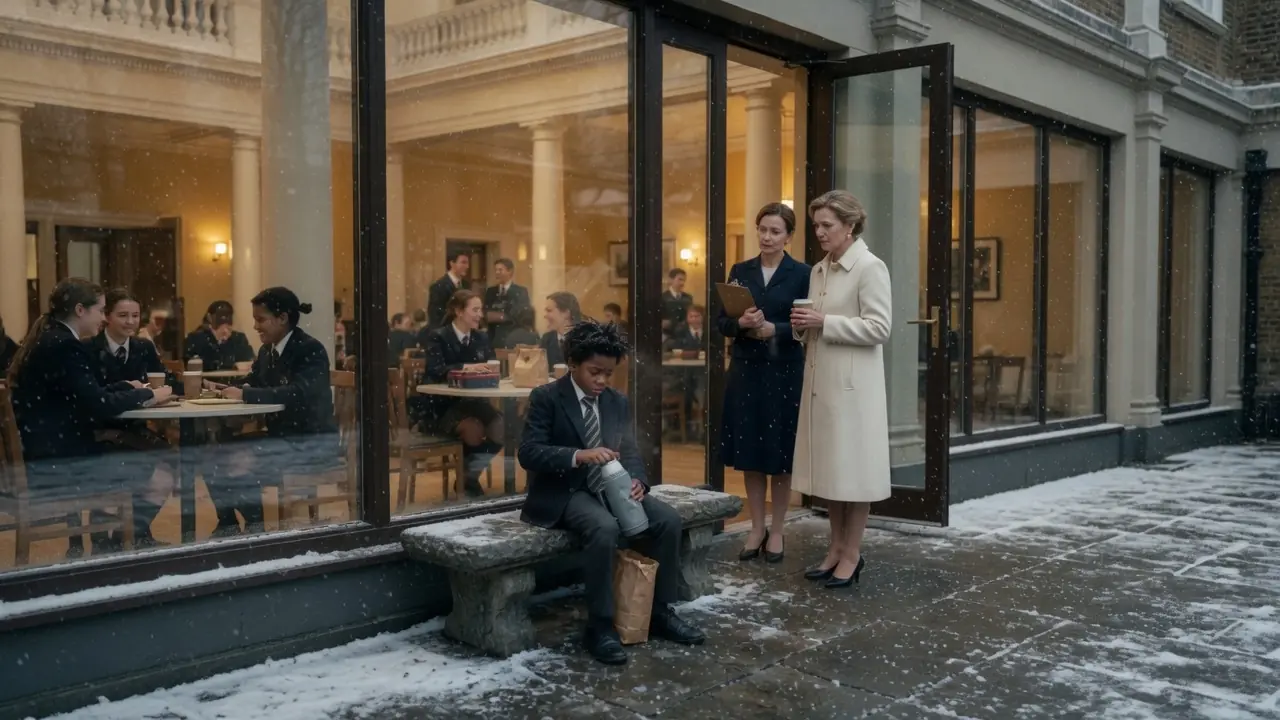
Just a brown paper bag with his name written in blue marker by the woman he called Mom.
Milo was ten years old, small for his age, with serious dark eyes, a quiet mouth, and hair that never stayed flat no matter how much water he pressed into it before school. His navy blazer was secondhand, but clean. The sleeves were a little short. His shoes were polished until they shone, though the soles had already begun to wear thin near the edges.
He had earned his place at Wexford Hall Academy through a full academic scholarship.
That was what the letter said.
Congratulations, Milo Vance.
We are pleased to welcome you to Wexford Hall Academy as a recipient of the Founders Merit Scholarship.
Milo had read the letter seventeen times.
His adoptive mother, Evelyn Mercer, had cried the first time she read it.
Not loudly.
Evelyn rarely cried loudly.
She pressed one hand to her mouth, blinked hard, and pulled Milo into her arms in the kitchen of their small brick duplex on Juniper Row, a modest street in the working-class side of Briarwick, a town nobody outside the county could find on a map.
“You did this,” she whispered into his hair. “Nobody handed it to you. You earned it.”
Milo believed her.
At first.
Wexford Hall Academy stood on a hill above the east side of Briarwick, behind wrought-iron gates and old stone walls covered in ivy. The school had red brick buildings, tall windows, trimmed lawns, and a fountain in the center courtyard where no child was allowed to throw coins, although many did.
Everything there seemed polished.
Even the silence.
Parents arrived in black SUVs, silver sedans, and imported cars with quiet engines. Children stepped out wearing blazers that fit perfectly, shoes that never squeaked, backpacks that looked new even in November.
Milo stepped out of Evelyn’s old blue sedan on his first morning and tried not to stare.
Evelyn noticed anyway.
She always noticed.
“You belong here,” she said.
Milo looked through the gate at the other students.
“They look like they know already.”
“Know what?”
“How to be here.”
Evelyn leaned over and straightened his tie.
“Then learn. That’s what school is for.”
He smiled because she wanted him to.
Then he grabbed his backpack and lunch bag, stepped out of the car, and walked toward the gate.
For the first two weeks, everything went better than he expected.
His teacher, Mrs. Caroline Bell, seemed kind in a careful way. She praised his reading scores and asked him to help pass out math worksheets. The librarian, Mr. Alden, let him check out three books at once after Milo finished the class novel in two nights.
A boy named Owen Pike showed him where to find extra pencils when his broke.
A girl named Sophie Lang shared colored markers during a history project.
Milo began to think maybe being different did not have to mean being alone.
Then lunch changed everything.
It started with a table.
Wexford Hall’s cafeteria was called the Dining Commons, because ordinary words were apparently not expensive enough. It had tall windows, polished floors, white columns, and round tables instead of long lunch benches.
Every table seemed to form its own little country.
The soccer boys near the windows.
The girls with velvet headbands near the bulletin board.
The loud fourth graders beside the drink station.
Milo usually sat at a table near the middle with Owen, Sophie, and two other students from his class. He brought peanut butter sandwiches, apple slices, pretzels, sometimes leftover pasta in a plastic container Evelyn had washed and reused too many times.
Nobody said much about it at first.
Then one Thursday in October, a mother walked into the cafeteria during lunch.
Her name was Beatrice Whitcomb.
Everyone knew who she was because she chaired the Parent Excellence Council, organized the winter auction, and spoke to staff members as if she paid their salaries personally. Her son, Preston, was in Milo’s class and wore loafers that cost more than Evelyn’s weekly grocery budget.
Beatrice stood near the entrance with two other mothers, Marla Trent and Whitney Cale.
They were not there to eat.
They were there to observe.
Milo noticed because adults who pretend not to watch children are usually watching hardest.
He kept eating.
His sandwich had banana slices in it because Evelyn had run out of jelly, and he liked the sweetness.
Preston Whitcomb wrinkled his nose from the next table.
“What is that smell?”
Milo looked down at his sandwich.
“It’s peanut butter and banana.”
Preston made a face.
“That’s disgusting.”
Owen glanced at Milo and then at Preston.
“It’s just food.”
“It smells poor,” Preston said.
Two boys laughed.
Not hard.
Enough.
Milo felt his ears go hot.
Across the cafeteria, Beatrice saw the exchange.
She did not correct her son.
Instead, she leaned toward Marla and whispered something.
The next day, Mrs. Bell asked Milo to stay behind after morning reading.
She closed the classroom door halfway, not all the way.
That made it feel less serious and more serious at the same time.
“Milo,” she said gently, “we’re going to try a small adjustment at lunch today.”
He held his library book against his chest.
“What kind of adjustment?”
Mrs. Bell smiled with only part of her face.
“Some parents have raised concerns about table comfort. You know how lunch can be. Different children have different needs.”
Milo did not understand.
“Did I do something wrong?”
“No, no. Not wrong.”
She looked toward the hallway.
“It’s just that transitions can be sensitive in a community like ours. You’re still finding your place.”
“My place?”
She touched his shoulder lightly.
“Just for a little while, I think it might be best if you sit at the side table near the courtyard doors.”
Milo knew the table.
It was not really a lunch table.
It was a narrow table where extra napkins and plastic forks were kept when events ran long.
Nobody sat there unless they were sick or in trouble.
“By myself?” he asked.
Mrs. Bell’s smile faded.
“Only until things settle.”
“What things?”
Her eyes softened, but not enough to help him.
“Milo, sometimes it’s easier not to make waves.”
He stared at her.
That was the first time he understood that adults could be kind in a voice and cruel in a decision.
At lunch, he sat at the side table.
Owen looked confused from across the cafeteria.
Sophie started to stand, but Mrs. Bell, who was supervising lunch that day, shook her head slightly.
Sophie sat back down.
Milo opened his brown paper bag.
Inside was a turkey sandwich, carrot sticks, and a small cookie wrapped in foil.
Evelyn had drawn a tiny star on the napkin.
You’ve got this, kiddo.
He folded the napkin and put it back in the bag.
He did not eat the cookie.
The side table became routine.
At first, it was “temporary.”
Then it was “easier.”
Then nobody called it anything at all.
The table moved farther from the others after the Parent Excellence Council held a meeting about “preserving the dining environment.” Milo heard that phrase from Preston, who repeated adult language the way children do when they do not understand how ugly it sounds.
“My mom said the school has to protect its image,” Preston told him one afternoon.
Milo was tying his shoe near the classroom door.
“What image?”
Preston shrugged.
“The kind people pay for.”
By November, Milo ate alone every day.
Then came the cold.
The Dining Commons opened onto a stone courtyard with benches, planters, and a small iron gate leading toward the lower field. When the cafeteria became crowded during a visiting parents’ lunch, Mrs. Bell led Milo to a bench outside.
“Just today,” she said.
But it was not just today.
The courtyard bench became his lunch spot.
At first, the weather was only cool.
Then sharp.
Then bitter.
Wexford Hall sat on a hill, and winter wind moved through the courtyard like it had been invited personally. Milo wore his coat, but it was thin. Evelyn had bought it at a church sale in September, guessing he might grow into it.
He had not.
The sleeves covered his wrists, but not his hands.
He learned to eat quickly before the cold made the bread stiff.
He learned to sit with his back against the wall to block the wind.
He learned not to cry where the cafeteria windows could see.
One Tuesday, snow began falling during lunch.
Not much.
Just a dusting.
Enough to turn the courtyard stones white at the edges.
Milo sat on the bench with his lunch bag between his knees and tried to open a container of soup Evelyn had packed in a cheap plastic thermos. The lid stuck. His fingers were too cold to grip it properly.
Inside, through the tall windows, children laughed over trays of hot food.
Mrs. Bell stood near the door talking to Beatrice Whitcomb.
Beatrice glanced outside.
Her eyes landed on Milo.
Then moved away.
Mrs. Bell saw him too.
For one second, Milo thought she might come out.
She did not.
The door remained closed.
By the time he got the thermos open, the soup was lukewarm.
He drank it anyway.
That evening, Evelyn noticed his hands.
She always noticed.
“Milo,” she said, taking them gently. “Your fingers are freezing.”
He pulled them back.
“I forgot my gloves.”
“You don’t own gloves.”
“I mean I forgot to tell you I need some.”
Evelyn studied him.
“What happened at lunch?”
“Nothing.”
The word came too fast.
Evelyn set down the dish towel.
“Milo.”
He looked at the kitchen floor.
Their kitchen was small, with yellowing cabinets, a stove that clicked before lighting, and a refrigerator covered in library schedules, school papers, and one old photo from the day Evelyn adopted him.
He had been six in that photo.
Holding a teddy bear.
Looking suspicious of happiness.
Evelyn had been thirty-eight, tired and hopeful, one hand on his shoulder as if she was afraid he might run.
She had not been rich then.
She was not rich now, at least not in ways people could see.
Milo did not know about the scholarship fund.
He did not know that Evelyn Mercer had once been Evelyn Hartwell, daughter of the Hartwell Foundation family.
He did not know she had walked away from inherited money in her twenties after refusing to become a decorative donor at charity luncheons.
He did not know that three months before his acceptance letter, Evelyn had quietly transferred enough money to Wexford Hall Academy to fund every scholarship child at the school for the next ten years.
She had not done it for recognition.
She had done it because she knew what doors could do when they opened for the right child.
And because Milo had earned the chance to walk through one.
He only knew her as Mom.
The woman who worked from a laptop at their kitchen table.
The woman who bought generic cereal and still somehow made birthdays feel magical.
The woman who said money could build a bridge, but character decided who got to cross it.
“What happened at lunch?” she asked again.
Milo shrugged.
“I eat outside now.”
Evelyn went very still.
“Outside?”
“It’s fine.”
“Why?”
He rubbed one sleeve between his fingers.
“Because some parents think I make people uncomfortable.”
The kitchen fell silent.
The refrigerator hummed.
A car passed outside.
Evelyn’s face did not change much, but something in her eyes did.
Something old and dangerous.
“Who told you that?”
“Nobody exactly.”
“Milo.”
“Mrs. Bell said it was easier not to make waves.”
Evelyn turned toward the sink.
For a moment, Milo thought she was angry at him.
Then he saw her hands gripping the counter.
When she turned back, her voice was calm.
Too calm.
“How long?”
“A few weeks.”
“Outside the whole time?”
“Not when it rains hard. Then I sit near the lost-and-found.”
Evelyn closed her eyes.
Milo hurried to explain.
“It’s not bad. I read sometimes. Mr. Alden lets me keep books. And I’m not hungry. You pack enough.”
She crossed the kitchen and knelt in front of him.
“You listen to me carefully,” she said. “Being fed is not the same as being welcomed.”
His throat tightened.
“I don’t want you to make trouble.”
Evelyn touched his face gently.
“You are not trouble.”
He tried to nod.
But his eyes filled anyway.
She hugged him then, and he held on harder than he meant to.
That night, after Milo went to bed, Evelyn sat at the kitchen table with her laptop open.
She did not email Mrs. Bell.
She did not call the headmaster.
She did not post anything online.
Evelyn Mercer had learned long ago that people who cared about image feared mirrors more than shouting.
She opened the donor portal for Wexford Hall Academy.
Then she opened the security access agreement attached to her scholarship endowment.
Because when the Hartwell Scholarship Fund had been approved, Evelyn had included one quiet condition: any student receiving support through her fund would be protected under independent compliance review, with full access to cafeteria, hallway, and common area camera footage if discrimination complaints arose.
The board had signed it without reading carefully.
People often read generosity less closely than contracts that cost them.
Evelyn requested the footage.
Not one day.
Six weeks.
By morning, she had what she needed.
She watched Milo enter the Dining Commons with his brown paper bag.
She watched children make room for him.
She watched Beatrice Whitcomb speak to Mrs. Bell.
She watched the side table become his assigned place.
She watched the day Sophie tried to sit beside him and Mrs. Bell stopped her.
She watched the courtyard lunches.
She watched Milo sit in his coat, head bent over a sandwich, while adults stood warm behind glass and called it order.
On the final clip, snow moved through the courtyard.
Milo struggled with the thermos.
Mrs. Bell watched from inside.
Beatrice watched too.
Neither opened the door.
Evelyn paused the video there.
Her son’s small hands were red from cold.
The cafeteria behind him glowed with warm light.
For a long time, she did not move.
Then she made two phone calls.
The first was to her attorney, Nadine Cross.
The second was to the chair of Wexford Hall’s board of trustees.
Three weeks later, Wexford Hall held its annual Winter Giving Gala.
The gala was the most important night of the school year.
Parents arrived in evening gowns and dark suits. Valets parked cars in perfect rows. The gymnasium had been transformed with white tablecloths, glass centerpieces, soft music, and a stage framed by blue velvet curtains.
A banner near the entrance read:
WEXFORD HALL ACADEMY
BUILDING CHARACTER, LEADERSHIP, AND EXCELLENCE
Milo did not attend.
Evelyn had arranged for him to stay with their neighbor, Mrs. Vale, who made cinnamon rolls and owned three cats with legal-sounding names.
“You have a boring grown-up meeting?” Milo asked that afternoon.
“Something like that.”
“Do I have to worry?”
Evelyn smiled.
“No.”
He studied her.
“You look like when you fixed the landlord’s plumbing charge.”
“That was a good look.”
“That was a scary look.”
She kissed his forehead.
“Only for people who send bad bills.”
At the gala, Beatrice Whitcomb moved through the room like royalty.
She wore a silver dress, diamond earrings, and the confident smile of someone certain the evening belonged to her. Her husband, Clayton, stood nearby discussing investments with two other fathers. Preston ran through the dessert table area with other children whose parents had hired babysitters but brought them anyway for photographs.
Mrs. Bell stood near the teachers’ table, smoothing her navy dress and laughing at something the music instructor said.
Headmaster Philip Crane took the stage at seven-thirty.
He was polished, handsome, and very good at sounding sincere in front of donors.
“Good evening, Wexford families, faculty, and honored guests,” he said. “Tonight, we celebrate not only academic excellence, but the values that define our community.”
Applause rose politely.
Evelyn sat near the back at a reserved table.
Most people did not recognize her.
Those who did assumed she was a minor donor, perhaps connected to the scholarship program. She wore a simple black dress, pearl earrings, and no expression worth gossiping about.
Nadine Cross sat beside her, silver-haired and calm, a folder resting in front of her plate.
Headmaster Crane continued.
“At Wexford Hall, every child matters. Every child belongs. Every child is given the dignity to rise.”
Evelyn’s hand tightened around her water glass.
Nadine glanced at her.
“Wait,” she murmured.
“I am.”
The headmaster smiled toward the audience.
“And this year, we are honored by a remarkable anonymous gift to our Founders Merit Scholarship Fund. This gift ensures that gifted students, regardless of financial background, may access the Wexford experience.”
Beatrice clapped with the others.
Then leaned toward Marla Trent and whispered, “As long as access doesn’t change the experience for everyone else.”
Evelyn heard her.
So did Nadine.
The headmaster continued.
“Tonight, our anonymous benefactor has agreed to step forward.”
The room shifted.
People sat straighter.
Money has gravity.
It pulls attention faster than virtue.
Headmaster Crane looked toward the back.
“Please join me in welcoming Mrs. Evelyn Mercer, founder of the Hartwell-Mercer Scholarship Trust.”
The applause began uncertainly.
Then grew as people realized the woman walking toward the stage was not minor at all.
Beatrice’s face changed first.
Recognition.
Then calculation.
Then alarm.
Mrs. Bell stopped clapping.
Evelyn climbed the stage steps and shook Headmaster Crane’s hand.
He leaned toward the microphone.
“Mrs. Mercer’s extraordinary generosity has made possible one of the largest scholarship endowments in our school’s history.”
More applause.
Evelyn stood at the microphone and waited until it faded.
She looked out over the tables.
At the parents.
At the teachers.
At the board members.
At Beatrice Whitcomb, who now sat perfectly still.
“Thank you,” Evelyn said. “I did not come tonight to speak about generosity.”
The room quieted.
“I came to speak about what generosity reveals.”
A few people exchanged glances.
Headmaster Crane’s smile remained, but stiffened.
Evelyn continued.
“When I funded the Hartwell-Mercer Scholarship Trust, I believed Wexford Hall could become the kind of school where talent mattered more than a parent’s bank account. Where children were judged by curiosity, discipline, kindness, and effort.”
She looked toward the banner.
“Building character, leadership, and excellence. That is what the wall says.”
A polite laugh moved through the room.
Evelyn did not smile.
“I believed that.”
The laugh died.
“Then I learned that one of the scholarship students supported by this fund had been removed from his lunch table. Not because he misbehaved. Not because he harmed another child. Not because he violated school rules.”
She paused.
“He was removed because some adults decided he did not match the image they wanted to purchase.”
The room went silent.
Mrs. Bell’s face drained.
Beatrice reached for her water glass and missed it slightly.
Headmaster Crane moved toward the microphone.
“Mrs. Mercer, perhaps—”
Evelyn turned to him.
“No.”
One word.
The headmaster stopped.
Nadine Cross rose from her table and walked to the side of the stage.
That movement made several board members sit straighter.
Evelyn looked back at the audience.
“I could describe what happened. But descriptions give people room to imagine innocence. So I will show you.”
Behind her, the large projection screen lowered.
A murmur moved through the gala.
The first clip played.
Milo entering the cafeteria with his brown paper bag.
Sitting with Owen and Sophie.
Preston Whitcomb making a face.
Beatrice and Marla watching from near the entrance.
The clip had no sound, but it did not need it.
The next showed Beatrice speaking to Mrs. Bell near the hallway.
Then Mrs. Bell keeping Milo after class.
Then Milo carrying his lunch to the side table.
The room became completely quiet.
No silverware.
No whispers.
No polite coughs.
Another clip.
Sophie standing with her tray, about to join Milo.
Mrs. Bell shaking her head.
Sophie sitting back down, confused.
Another clip.
Milo alone by the courtyard doors.
Then outside.
On the bench.
Coat pulled tight.
Lunch bag between his knees.
The final clip played.
Snow falling.
Milo struggling to open his thermos with red fingers.
Inside, Beatrice Whitcomb stood with a coffee cup.
Mrs. Bell beside her.
Both looking out.
Neither moving.
Evelyn did not watch the screen.
She watched the room watch itself.
That was far more useful.
A woman near the front covered her mouth.
One father looked down at his plate.
Clayton Whitcomb leaned toward Beatrice and whispered something sharp, but she did not answer.
Mrs. Bell had begun crying silently.
Evelyn let the video end.
The screen went black.
For several seconds, nobody spoke.
Then Evelyn returned to the microphone.
“The child you watched is my son.”
A gasp moved through the room.
Not because a child had suffered.
Because now the suffering had a powerful witness attached.
Evelyn heard the difference.
Her voice stayed steady.
“His name is Milo Vance. He is ten years old. He reads two grade levels above his class. He loves astronomy, library corners, and drawing maps of imaginary cities. He writes thank-you notes without being asked. He still worries that taking up space makes life harder for other people.”
Her voice tightened for the first time.
“And for six weeks, this school taught him that he was right to worry.”
Mrs. Bell lowered her head.
Evelyn looked at her.
“Mrs. Bell, you were trusted with my child during the school day. You did not protect him from cruelty. You translated it into procedure.”
The words landed hard.
Mrs. Bell pressed a hand to her mouth.
Evelyn turned toward the front table.
“Mrs. Whitcomb, you used influence to isolate a child because his lunch, his clothes, and his scholarship made you uncomfortable. You did not preserve the school’s image. You revealed it.”
Beatrice stood abruptly.
“This is outrageous.”
Her voice shook.
“My concern was never about that boy personally. It was about maintaining standards. Parents pay significant tuition for a certain environment.”
Evelyn nodded once.
“Yes. And there it is.”
Beatrice looked around, realizing too late that the room was no longer following her.
Evelyn’s voice sharpened.
“You believed tuition purchased the right not to see poverty. You believed your comfort mattered more than a child’s dignity. You believed scholarship meant permission to enter the building, but not the table.”
No one rescued Beatrice.
That silence sounded different from the one at the mill door.
This silence had judgment in it.
Headmaster Crane stepped forward.
“Mrs. Mercer, I assure you the administration was unaware of the full scope—”
Nadine Cross reached the microphone before he could continue.
“As counsel for the Hartwell-Mercer Scholarship Trust, I will clarify that the endowment agreement contains a student dignity clause, an anti-discrimination compliance clause, and a footage access provision approved by this board. Based on the evidence reviewed, the trust is suspending the next disbursement pending formal corrective action.”
The room stirred.
Now money had entered the wound.
People paid attention differently.
Nadine continued.
“Furthermore, Mrs. Mercer has requested an independent investigation into administrative knowledge, staff conduct, and parent interference in student placement.”
Headmaster Crane looked as if he had swallowed glass.
A board member stood.
“Mrs. Mercer, surely we can discuss this privately.”
Evelyn looked at him.
“Children are often humiliated publicly and repaired privately. Tonight, we reverse the order.”
That sentence moved through the room like weather.
No one spoke against it.
Not openly.
Then something unexpected happened.
A small chair scraped near the side of the room.
Sophie Lang stood up.
Her mother reached for her, but Sophie shook her head.
“I tried to sit with Milo,” she said, voice trembling. “Mrs. Bell told me not to.”
Mrs. Bell began to cry harder.
Sophie’s voice grew stronger.
“And Preston said his mom said Milo smelled like basement food.”
A collective breath moved through the room.
Beatrice whispered, “Preston.”
But her son was staring at the floor.
Owen Pike stood next.
“He’s my friend,” Owen said. “I should have sat outside with him anyway.”
His father put a hand on his shoulder.
Not to stop him.
To steady him.
One by one, small truths entered the room.
A cafeteria aide said she had reported concerns to the assistant headmaster.
The assistant headmaster denied receiving them, then faltered when Nadine asked if he wanted to answer under oath.
A parent admitted hearing Beatrice complain about “scholarship optics.”
Another said she had been uncomfortable but did not want to start drama.
Evelyn listened to all of it.
Then she said, “Every child in this school learned something from what happened to Milo. Some learned they could be excluded if they were poor. Some learned cruelty works if it wears pearls. Some learned silence is safer than courage.”
She looked around the room.
“Now they will learn what accountability looks like.”
Within forty-eight hours, Wexford Hall changed in ways that could not be hidden behind newsletters.
Mrs. Bell was placed on administrative leave pending review.
Headmaster Crane issued a public apology so carefully worded that Evelyn rejected the first draft and the second.
Beatrice Whitcomb resigned from the Parent Excellence Council after several council members threatened to resign if she did not.
The school board voted to create an independent student dignity committee with scholarship family representation.
The Dining Commons seating policy was rewritten.
No child would ever again be separated based on “parent concern” without documented behavioral cause and administrative review.
But policies were the easy part.
Milo returned to school on Monday.
That was harder.
Evelyn offered to keep him home a few days.
He shook his head.
“I don’t want them to think I’m scared.”
“You are allowed to be scared.”
“I know.”
He zipped his backpack.
“I want to go anyway.”
At drop-off, the gate looked the same.
The stone buildings.
The fountain.
The children in perfect blazers.
But the air felt different.
Adults looked at Evelyn and then looked away.
Some looked ashamed.
Some looked curious.
Some looked annoyed that discomfort had been brought to their door.
Evelyn ignored them.
She knelt in front of Milo.
“You do not have to make anyone feel better today.”
He nodded.
“You do not have to forgive quickly.”
He nodded again.
“And you do not have to eat outside.”
This time, he smiled a little.
“I know.”
At lunch, Milo entered the Dining Commons carrying his brown paper bag.
The room shifted around him.
Some children stared.
Some whispered.
Preston Whitcomb sat at a table near the window, eyes fixed on his tray.
Milo walked toward the middle table out of habit, then stopped.
Owen stood up.
So did Sophie.
Owen picked up his tray and walked to Milo.
“Where are we sitting?”
Milo blinked.
“You don’t have to—”
“Where are we sitting?” Owen repeated.
Sophie joined them.
Then two more students.
Then a girl from another class who had never spoken to Milo before.
Milo looked at the side table.
Then at the courtyard doors.
Then at the table in the middle.
“The middle,” he said.
They sat there.
Nobody clapped.
That would have been too much.
Children are better than adults at knowing when a moment needs normalcy, not performance.
Owen traded half a cookie for Milo’s pretzels.
Sophie asked about his imaginary city maps.
A boy named Theo said peanut butter and banana was actually good if you toasted it.
Milo ate slowly.
The cafeteria was warm.
That evening, Evelyn found a note in Milo’s lunch bag.
Not hers.
Someone had written it on a piece of notebook paper.
I’m sorry I didn’t sit with you sooner.
Owen.
Under it, Sophie had added:
Me too. Tomorrow we’re saving you a seat.
Milo pretended not to care.
But he folded the note carefully and put it in the drawer beside his bed.
The story spread beyond Wexford Hall because stories like that do.
At first, people argued.
Some said Evelyn had humiliated the school.
Others said the school had humiliated itself.
A few tried to make Beatrice Whitcomb the victim of “public shaming,” but that effort faded when more details came out.
The camera footage did not care about social standing.
Neither did the cold bench.
Letters arrived at Evelyn’s house.
Some from parents at Wexford Hall.
Some from strangers.
One came from a scholarship student who had graduated years earlier.
They never made me eat outside, she wrote. But they made sure I always knew I was visiting someone else’s world. Thank you for saying what we couldn’t.
Evelyn read that letter three times.
Then she showed it to Milo.
He read it carefully.
“Were there other kids like me?”
“Yes.”
“Did anyone help them?”
“Not enough.”
He looked at the letter.
“Then maybe now they will.”
Evelyn touched his hair.
“That’s the idea.”
Spring came slowly to Briarwick.
Snow melted from the Wexford lawns, leaving patches of brown grass and mud the maintenance crew hated. The courtyard bench stayed where it was, but someone placed a brass plaque on the wall behind it after the student dignity committee’s first project.
It read:
No child earns belonging by suffering quietly.
The idea came from Sophie.
Milo said it was “a little dramatic.”
Owen said dramatic was fine if it made adults uncomfortable.
By May, Milo had become less careful in small ways.
He raised his hand more.
He laughed louder.
He brought peanut butter and banana sandwiches without hiding them.
One day, he invited Preston Whitcomb to sit with them after Preston stood alone near the drink station looking miserable.
Owen looked surprised.
Sophie looked skeptical.
Preston looked terrified.
Milo shrugged.
“He can sit if he doesn’t say mean stuff.”
Preston sat.
For several minutes, nobody spoke.
Then Preston said, “My mom said I’m supposed to apologize.”
Milo looked at him.
“Are you sorry because she said, or because you are?”
Preston looked down.
“At first because she said.”
Owen made a face.
Preston continued.
“But then my dad showed me the video. And I saw you outside.”
His voice got smaller.
“I was mean.”
Milo opened his lunch bag.
“Yes.”
Preston looked like he had expected an easier answer.
He did not get one.
“I’m sorry,” he said.
Milo thought about it.
Then nodded.
“You can have a pretzel.”
It was not forgiveness.
Not fully.
But it was more than Preston had earned and less than the adults wanted.
It was a child’s version of repair.
Small.
Conditional.
Possible.
The end of the school year arrived with a ceremony in the auditorium.
Awards were given for math, music, athletics, service, and leadership. Parents filled the rows with cameras ready. Teachers stood near the walls in formal clothes.
Milo received the fifth-grade reading award.
When his name was called, he walked onto the stage carefully, but not timidly. Evelyn stood and applauded. So did Owen, Sophie, Mr. Alden, and half the cafeteria table.
Mrs. Bell was not there.
She had resigned in April.
In her letter, she wrote that she had failed to act according to her own values.
Evelyn hoped that was true.
She also hoped it hurt enough to matter.
After the ceremony, Headmaster Crane approached Evelyn in the lobby.
He had survived the investigation, though not untouched. The board had placed him under a corrective leadership plan, a phrase Evelyn found both ridiculous and fitting.
“Mrs. Mercer,” he said. “Milo had an excellent year academically.”
“He had an unnecessarily hard one socially.”
Crane lowered his eyes.
“Yes.”
A pause.
Then he added, “We are trying to become better.”
Evelyn looked across the lobby.
Milo was laughing with Owen and Sophie near the trophy case. His blazer sleeves were still a little short. His shoes still needed replacing. His lunch bag was tucked under one arm because he had forgotten to throw it away.
He looked like himself.
Not fixed.
Not untouched.
Still himself.
“That is the only apology that matters,” Evelyn said. “Become better.”
That summer, the Hartwell-Mercer Scholarship Trust expanded.
Not only for tuition.
For coats.
Lunch support.
Transportation.
Books.
Field trip fees.
All the hidden costs that make “opportunity” humiliating for the children who receive it.
Evelyn insisted the fund be anonymous to students but impossible for administrators to ignore. Every scholarship child would have an advocate outside the school hierarchy. Every concern would be documented. Every adult who confused image with dignity would meet Nadine Cross, which was a consequence all its own.
In August, before the new year began, Wexford Hall held a faculty training session.
Evelyn spoke for twelve minutes.
No longer.
Long enough.
She stood before teachers, administrators, and board members in the same auditorium where Milo had received his reading award.
“I do not expect you to make scholarship students feel lucky,” she said. “Luck is not the point. They are not guests in your building. They are students in your care.”
Some teachers took notes.
Some looked uncomfortable.
Evelyn continued.
“If a child eats alone because of cruelty, that is a failure of supervision. If a child hides hunger because lunch support feels shameful, that is a failure of design. If a child believes silence is the price of belonging, that is a failure of every adult in the room.”
She paused.
“Do not make children earn dignity by enduring what adults refuse to confront.”
No one applauded at first.
Then Mr. Alden did.
Slowly, others joined.
Evelyn did not need applause.
But she hoped it meant at least some of them had heard.
On the first day of sixth grade, Milo stood in their kitchen with his backpack on and a new lunchbox in his hand.
It was dark green.
Plain.
No initials.
No cartoon.
He had chosen it himself.
Evelyn packed peanut butter and banana on wheat bread, pretzels, grapes, and a cookie wrapped in foil.
She wrote a note on the napkin.
Same as before.
You’ve got this, kiddo.
Milo read it before placing it in the lunchbox.
“You know I’m older now,” he said.
“I do.”
“You don’t have to write notes every day.”
“I know.”
He zipped the lunchbox.
“But maybe still sometimes.”
Evelyn smiled.
“Sometimes.”
At drop-off, the gates of Wexford Hall stood open.
Milo stepped out of the car.
Then leaned back in.
“Mom?”
“Yes?”
“Did you really pay for all those scholarships?”
Evelyn looked at him carefully.
He must have heard it somewhere.
Children always do.
“I helped fund them,” she said.
“Why didn’t you tell me?”
“Because I wanted you to know you earned your place before you learned I helped build the doorway.”
Milo thought about that.
“Do I belong there because of the money?”
“No.”
“Because of the test?”
“Partly.”
“Because of me?”
Evelyn’s eyes softened.
“Yes. Because of you.”
He nodded, satisfied.
Then he looked toward the school.
“If they do it to someone else, I’ll say something.”
“I believe you.”
He adjusted his backpack.
Then smiled.
A real smile.
The kind that reaches places fear used to live.
“I might make waves,” he said.
Evelyn laughed.
“Good.”
Milo walked through the gate with his lunchbox swinging at his side.
Near the courtyard, Owen waved.
Sophie called his name.
A new boy stood beside them, small and nervous, wearing a blazer that looked borrowed and holding a paper lunch bag folded twice at the top.
Milo noticed him immediately.
Evelyn watched from the car.
Her son walked over, said something, and pointed toward the Dining Commons.
The new boy looked unsure.
Milo waited.
Then Owen and Sophie waited too.
Finally, the boy followed them inside.
Evelyn sat behind the wheel for a moment after the doors closed.
The hilltop school looked as polished as ever.
Red brick.
Ivy.
Fountain.
Perfect lawns.
But somewhere inside, a table in the middle of the cafeteria had one more seat saved.
That was how change began sometimes.
Not with a gala.
Not with a check.
Not even with a video on a screen.
With a child who had eaten alone in the cold deciding no one else would.
Evelyn started the car and drove home.
For the first time in a long time, she did not feel like she was leaving Milo behind enemy lines.
She was leaving him at school.
Where he belonged.