The sound of the metal canteen hitting the floor should have meant nothing.
It was an accident, the kind of small noise that happened dozens of times every day inside the dining hall at Camp Vora. Nineteen-year-old Leo Miller had reached for his tray, caught the edge of his canteen with his sleeve, and watched helplessly as the aluminum bottle bounced once against the polished floor before rolling beneath the table. Several soldiers glanced over, and one young man beside Leo smirked before returning to his potatoes.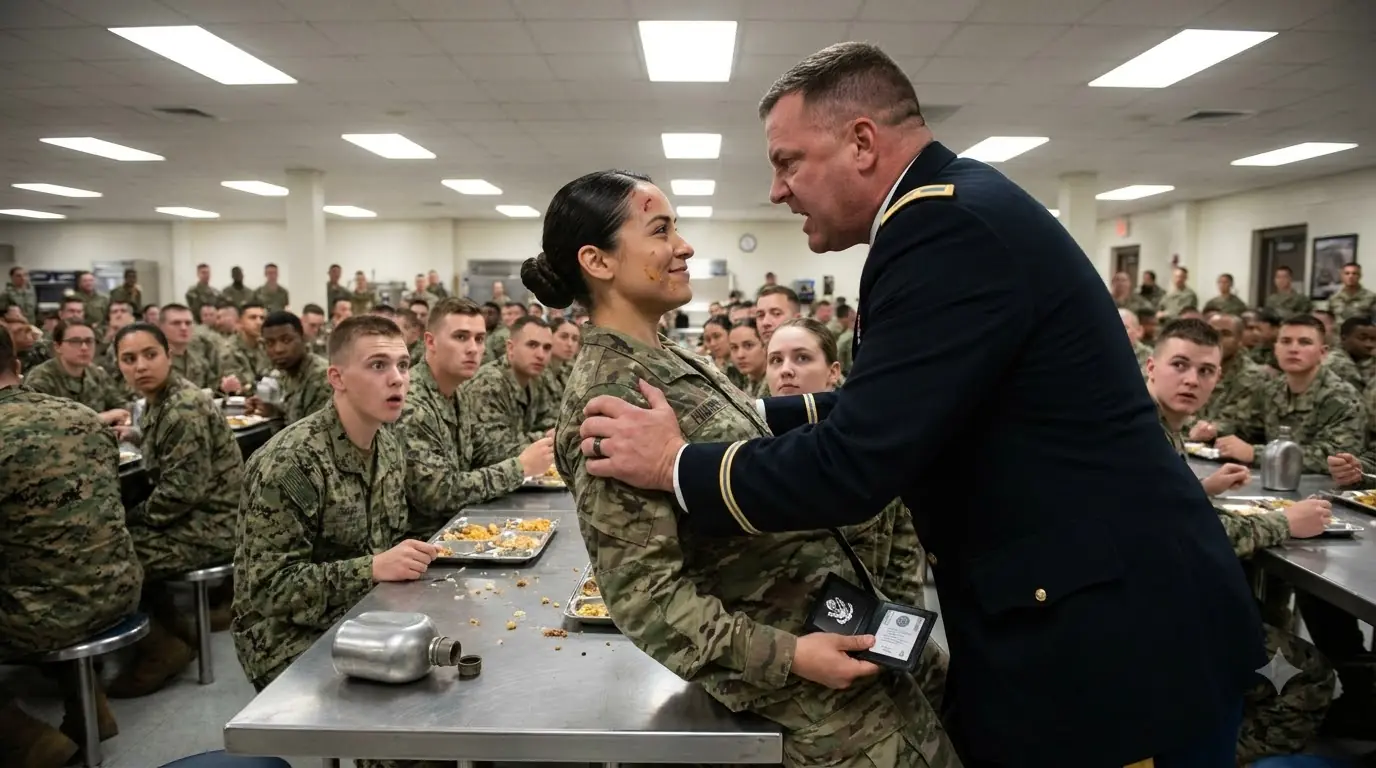
Then Major Thomas Sterling stood.
That changed everything.
Conversations disappeared in seconds. Forks slowed halfway to mouths, chairs stopped scraping, and even those who had their backs turned seemed to recognize the particular silence that followed Sterling whenever he decided someone had offended him. He was forty-five, broad through the chest, thick-necked, meticulously groomed, and always dressed as though somebody important might enter the room without warning.
Sterling’s career had once been considered promising.
Years earlier, people had described him as ambitious, energetic, and decisive. Somewhere along the way, ambition turned into resentment when promotions slowed and assignments stopped becoming more prestigious. By the time he arrived at Camp Vora, he had developed a habit of measuring authority not by what he accomplished but by how quickly a room became afraid of him.
Leo knew that reputation.
Everyone did.
He stood beside the steel dining table with both hands pressed against the seams of his trousers while the canteen continued rolling slowly beneath a chair. His face had already lost color before Sterling had taken three steps toward him. Leo was small for nineteen, barely one hundred forty pounds, with sandy hair clipped close and a narrow face that made him look even younger when frightened.
Sterling stopped directly in front of him.
“What was that?”
Leo swallowed.
“My canteen, sir.”
“I can see what it was.”
Sterling bent slightly closer.
“I asked what that was.”
Leo’s eyes dropped automatically.
“An accident, sir.”
Sterling smiled.
It was not pleasant.
“An accident.”
“Yes, sir.”
“You think accidents stop mattering because you use the word accident?”
“No, sir.”
“Then perhaps you can explain why you were careless enough to turn my dining facility into a circus.”
Leo looked as though he had forgotten how to breathe.
At the far end of the table, Elena Vance put down her fork.
For twenty-two days, nobody at Camp Vora had known who Elena really was.
That was intentional.
She wore ordinary fatigues without visible insignia, a practice easily explained by paperwork delays attached to newly transferred personnel awaiting administrative processing. She carried herself carefully, speaking enough to seem normal but never enough to become memorable. At thirty-nine, she had learned that invisibility was not created by hiding in corners but by becoming exactly what everyone expected to see.
A tired transfer.
A quiet professional.
Someone unimportant.
Camp Vora had several hundred transient personnel moving through specialized courses and administrative assignments each month. One more nameless face generated little curiosity. Elena had used that anonymity to eat where junior personnel ate, wait where they waited, stand in supply lines, sit inside common rooms, and listen.
Mostly, she listened.
The first reports had reached the Office of the Inspector General five months earlier.
Anonymous complaints.
Then more.
Unusual disciplinary practices.
Mandatory “donations” collected for unofficial unit funds.
Junior personnel pressured into buying expensive event tickets from organizations linked to senior leaders.
Retaliatory schedules assigned after complaints.
Punishments administered publicly for minor errors.
Requests for transfer mysteriously delayed.
Performance reports changed after people asked questions.
One allegation on its own might have been explainable.
Thirty-seven were not.
The problem was evidence.
Nobody wanted to sign a statement.
When investigators contacted former personnel, some denied everything they had previously reported anonymously. Others admitted incidents only after repeated assurances, then withdrew cooperation before formal interviews. The pattern suggested fear rather than fabrication.
Elena requested the field assignment herself.
Her superiors objected.
A colonel spending weeks pretending to be a low-level transient inside a regional installation was not standard practice. It was administratively inconvenient, operationally awkward, and potentially embarrassing if discovered. Elena argued that formal inspections had already failed because Camp Vora transformed every time outside oversight arrived.
The complaints stopped.
The halls became clean.
Policies were followed.
Sterling became charming.
Then inspectors left.
Within days, the reports began again.
Elena wanted to see the installation when nobody thought anyone important was watching.
So Colonel Elena Vance disappeared.
In her place arrived an administrative holdover with a generic transfer file, no obvious rank, and instructions to wait for final assignment confirmation.
For the first week, Elena saw nothing dramatic.
That worried her more than if she had.
Systems built around intimidation rarely announced themselves immediately. They appeared in small behaviors: people looking toward doors before speaking, junior staff lowering voices when certain names were mentioned, supervisors changing subjects when Elena asked normal questions about schedules or finances. She began noticing how frequently people apologized for things that required no apology.
Then names emerged.
Sterling’s most often.
Major Thomas Sterling.
Operations officer.
Unofficial problem solver.
Officially efficient.
Unofficially feared.
Elena collected observations without interfering.
That was the hardest part.
When she saw a young specialist ordered to remain standing for three hours because his boots were not polished to Sterling’s satisfaction, she documented it. When she overheard a sergeant warn a subordinate that refusing to buy a seventy-five-dollar dinner ticket would “look bad during evaluations,” she documented it. When a trainee disappeared from a preferred course after filing a written complaint, Elena documented the timeline.
She did not reveal herself.
She needed the pattern.
She needed witnesses.
Most importantly, she needed Sterling to behave naturally.
That afternoon in the dining hall, he did more than that.
He gave her everything.
Leo was still trying to answer when Sterling’s voice rose.
“You send money home, don’t you, Miller?”
Leo froze.
Several people looked up sharply.
Elena did too.
“Yes, sir.”
Sterling nodded.
“Mother has medical problems?”
Leo’s expression changed.
He clearly had not expected the conversation to become personal.
“Yes, sir.”
“Expensive?”
Leo said nothing.
Sterling smiled faintly.
“I asked you a question.”
“Yes, sir.”
“Then perhaps someone who needs every paycheck should develop the discipline to hold on to government equipment.”
A few soldiers looked down.
Elena felt something tighten in her chest.
Sterling was not correcting carelessness.
He was enjoying exposure.
That distinction mattered.
Leo’s mother, Janice Miller, had kidney disease.
Elena knew because Leo had mentioned it quietly to another young soldier in the laundry room days earlier. He sent most of his discretionary income home to help with transportation, prescriptions, and utilities. Somehow Sterling had learned the same information.
Now he was using it publicly.
Leo bent to retrieve the canteen.
Sterling snapped:
“Did I tell you to move?”
Leo straightened immediately.
“No, sir.”
“Then stand there.”
Elena watched the room.
Sergeant Marcus Hayes, seated two tables away, had stopped eating.
Hayes was thirty-eight, lean, methodical, and had been at Camp Vora nearly four years. Elena had noticed him before because he possessed the distinctive posture of someone who wanted to intervene and had trained himself not to.
He stared at Sterling.
Then looked down.
There it was again.
Fear wearing the uniform of professionalism.
Sterling continued.
“You people think standards are optional until somebody gets hurt.”
Leo whispered:
“No, sir.”
“Speak.”
“No, sir.”
Sterling stepped closer.
“You embarrassed this section.”
“I’m sorry, sir.”
“Sorry is what people say after they make other people clean up their incompetence.”
That was when Elena stood.
The movement seemed small.
A chair sliding backward.
A woman rising.
But everyone nearby noticed.
Sterling turned.
Elena stepped between him and Leo.
Not aggressively.
Her hands remained visible.
Her voice stayed level.
“He dropped a canteen, sir.”
Sterling stared at her.
Elena continued.
“It was an accident. There’s no reason to escalate this.”
The silence deepened.
Leo looked at her as if she had stepped in front of a moving truck.
Hayes raised his head.
Across the room, civilian cook Brenda Lawson stopped carrying a tray of bread toward the serving line.
Sterling slowly turned his entire body toward Elena.
“What did you say?”
Elena held his gaze.
“I said there’s no reason to escalate this.”
Sterling’s face darkened.
“Who are you?”
“Elena Vance.”
“What section?”
“Temporary administrative hold.”
Sterling glanced at her empty collar.
His eyes became colder.
“No visible rank.”
“My record is still processing.”
“So you are nobody.”
Elena said nothing.
Sterling stepped closer.
“Do you understand what happens to people who interfere with my personnel?”
Leo whispered:
“Ma’am, it’s okay.”
Elena looked back briefly.
“No.”
One word.
Calm.
Then she faced Sterling again.
“He made a mistake.”
“Correct it.”
“Don’t humiliate him.”
Sterling’s jaw flexed.
“You are instructing me?”
“I’m asking you to maintain perspective.”
The room seemed to stop breathing.
Hayes half rose.
Then remained seated.
Sterling came closer until less than a foot separated them.
“You have no idea where you are.”
Elena almost smiled.
That was precisely the point.
“I know exactly where I am.”
Something in that answer pushed Sterling past restraint.
Later, witnesses disagreed about whether he spoke first.
Some remembered a curse.
Others remembered only movement.
Elena remembered the hand.
Sterling reached behind her neck and upper uniform, caught a fistful of fabric, and drove her forward toward the table.
The impact was loud.
Her face struck the edge of an aluminum meal tray before her shoulder hit the tabletop. Salisbury steak slid across the metal, mashed potatoes scattered over the table, and a cup tipped onto its side. Elena’s forehead hit the tray divider hard enough to make her vision flash white.
Then everything stopped.
No one moved.
Sterling held her down for perhaps two seconds.
Maybe three.
It felt longer.
“You do not challenge me in my facility.”
His voice came close to her ear.
Elena smelled tobacco and coffee.
“You understand?”
Elena did not answer.
Sterling released her.
She stayed bent over the table.
Not because she was defeated.
Because she was counting.