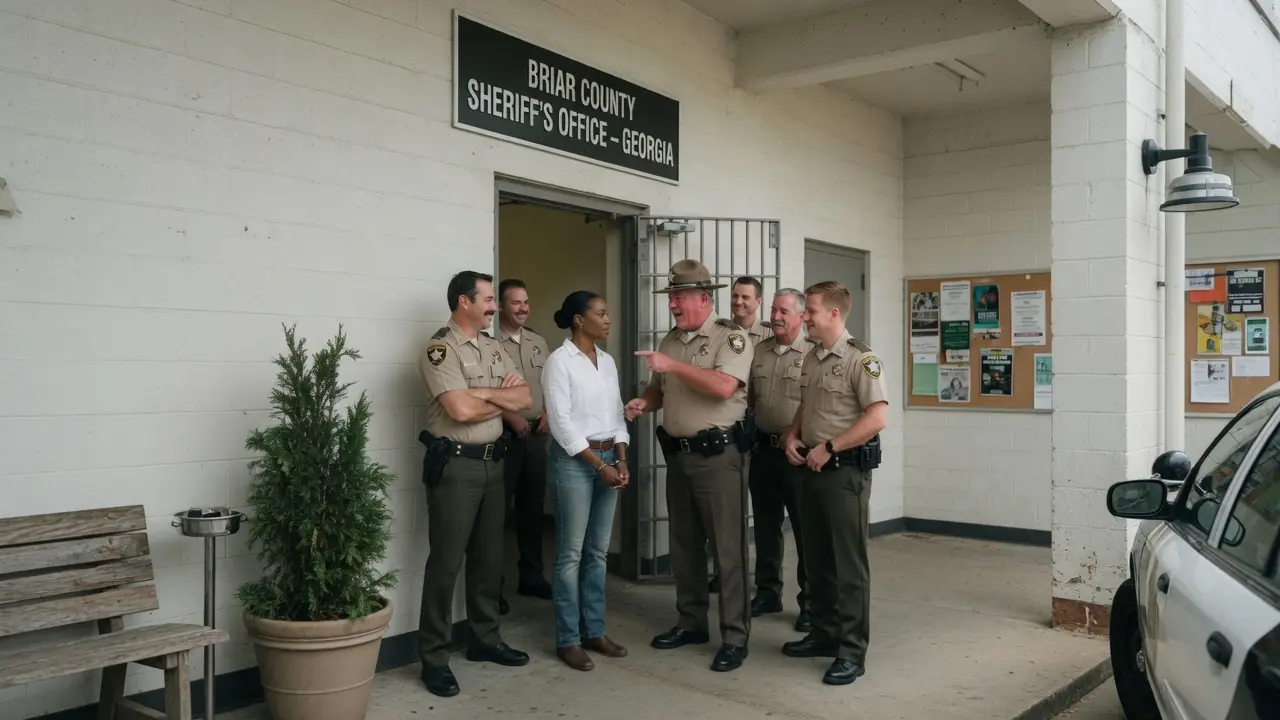
The handcuffs cut into Major General Angela Whitaker’s wrists as Sheriff Boone Caskill shoved her through the steel door of holding cell three.
The cell smelled of bleach, old concrete, and men who had spent too many nights learning that small counties could make a person disappear for a while without anybody asking questions. Angela stumbled once, caught herself, then turned around slowly. She did not cry. She did not beg. She did not raise her voice.
That seemed to annoy Caskill more than anything else.
He stood outside the bars with his thumbs hooked in his tactical vest, sunburned face shining under the fluorescent lights, his silver badge catching the room’s hard glare.
“You got a real problem with authority, lady,” he said.
Angela looked at him with the calm expression of a woman who had briefed generals during missile alerts and stared down contractors who thought billion-dollar invoices could scare her.
“No,” she said. “I have a problem with unlawful authority.”
Deputy Wade Harlan laughed from behind the booking desk.
Caskill smiled, but there was no humor in it.
“You can spend the night thinking about that mouth.”
Then he slid the bolt shut.
The metal sound echoed through the cell block.
Caskill believed he had just taught another out-of-town Black woman how things worked in Briar County, Georgia. He believed the road, the badge, the building, the deputies, the paperwork, and the silence all belonged to him. He believed the woman in the white blouse and faded jeans had no real power once he took her phone and locked the door.
He was wrong.
Less than five minutes later, a secure line from the Pentagon would ring at his front desk.
By sunset, every lie Boone Caskill had built his career on would begin falling apart.
The day had started with heat.
Not ordinary heat.
Georgia heat.
The kind that rose off the asphalt in trembling waves and made distant trees look like they were floating. The kind that turned steering wheels hot enough to punish bare hands and made sensible people stay indoors with air conditioning and sweet tea.
Angela Whitaker had no patience left for weather.
She was forty-nine years old, exhausted down to the bone, and running on coffee, discipline, and the kind of stubborn will that had carried her through twenty-eight years in the United States Army. For the past seventy-two hours, she had been inside a restricted operations center beneath the Pentagon, coordinating a classified logistical deployment involving aircraft, ships, fuel schedules, satellite communications, medical units, and enough moving parts to bury a lesser officer alive in mistakes.
Angela did not make mistakes often.
That was why people called her when failure was expensive.
She was a two-star general, one of the highest-ranking women in Army logistics, a veteran of Iraq, Afghanistan, and three command rotations that had taught her how much survival depended on getting the right things to the right people before the wrong hour arrived.
But that Friday afternoon, none of that showed.
No uniform.
No stars.
No medals.
No staff officer beside her.
She wore a loose white linen blouse, dark jeans, low boots, and aviator sunglasses. Her hair was pulled back simply. Her luggage sat in the back seat of a rented dark blue Chevy Malibu. On the passenger seat lay a paper cup of coffee she had bought an hour earlier and forgotten to drink.
She was driving to Savannah to see her aunt Ruth, who had fallen the week before and refused to admit she needed help.
Angela had told her staff she would be unreachable for a few hours unless the world caught fire.
Then she set the cruise control to fifty-five and headed south.
Briar County was a long, flat stretch of rural Georgia that sat between larger places and fed off people passing through. Locals knew the county by reputation. Speed trap. Old courthouse. Sheriff’s office that treated outsiders like walking revenue. Judges who smiled too much at fundraisers. Deputies who parked behind pecan trees and claimed every driver was weaving.
Angela knew none of that.
She knew the posted speed limit.
She knew her lane position.
She knew the rental agreement was in the glove compartment.
She knew her encrypted government phone had been pinging passive location data since she left Washington, because officers at her level did not simply go dark without systems noticing.
What she did not know was that Sheriff Boone Caskill had built Briar County into his own little kingdom.
Caskill was fifty-four, thick-necked, red-faced, and proud of being feared. He had been sheriff for twenty-one years. His father had worn the badge before him. His brother ran the towing company that got most of the county’s impound business. His cousin worked at the courthouse. His campaign treasurer owned the private probation service that collected fees from traffic court cases.
The system was small.
That made it easier to control.
Caskill knew which judges would sign what. He knew which complaints could be lost. He knew which deputies would lie and which ones would stay quiet. He knew that most people passing through Briar County would pay the fine, swallow the humiliation, and keep driving.
He had made a career out of choosing people he thought would not be able to fight back.
At 2:37 p.m., red and blue lights exploded in Angela’s rearview mirror.
She let out a slow breath.
Not fear.
Procedure.
She signaled right, eased the Malibu onto the gravel shoulder, put the car in park, shut off the engine, lowered the driver’s window, and placed both hands on the steering wheel.
She had trained young soldiers to survive traffic stops overseas. She had sat through enough civil rights briefings to know what careful looked like at home.
She watched the cruiser door open in her side mirror.
Deputy Wade Harlan stepped out first.
He was late twenties, bulky, flushed, and carrying himself with the swagger of a man who had mistaken borrowed authority for personal importance. His right hand rested near his sidearm as he approached. His sunglasses hid his eyes, but not the way he looked into the car before speaking.
“Afternoon.”
“Good afternoon, Deputy,” Angela said. “Was I speeding?”
He leaned closer.
“You crossed the center line a couple times back there.”
“I did not.”
His eyebrows lifted.
“Excuse me?”
“I maintained my lane.”
“Been drinking?”
“No.”
“Medication?”
“No.”
“Then why were you swerving?”
“I was not swerving.”
That was the first moment Harlan looked irritated.
Not because she was rude.
Because she was certain.
Before he could answer, another vehicle roared onto the shoulder behind them. A black Dodge Ram with a brush guard and county lights in the grille stopped hard enough to kick gravel. The driver’s door opened, and Sheriff Boone Caskill stepped out.
Harlan straightened.
That told Angela almost everything.
Caskill walked up on the passenger side and tapped hard on the glass with two fingers.
Angela reached over and lowered the window.
“Problem, Wade?”
“Driver was weaving, Sheriff.”
Caskill leaned in, eyes moving over Angela’s face, her clothes, the rental car, the out-of-state plates, the expensive phone near the console.
“License and registration.”
Angela kept her movements slow.
“This is a rental. The agreement is in the glove compartment. My license is in my purse. I am reaching for both now.”
She handed him her civilian driver’s license and the rental agreement.
She did not hand him her military ID.
She was traveling low profile for a reason. She had no desire to turn a traffic stop into a rank contest, and she still believed, for another few seconds, that this could be handled properly.
Caskill studied the license.
“Angela Whitaker. Virginia address. Long way from home.”
“I am visiting family in Savannah.”
“You always talk like that?”
Angela looked at him.
“Like what?”
“Like you’re better than the people asking questions.”
“I am answering clearly.”
Caskill’s jaw moved once.
“Step out of the vehicle.”
“For a lane violation?”
“Step out.”
Angela knew the law.
She knew the Supreme Court cases.
She knew arguing on the shoulder with an officer already performing dominance was a poor tactical choice. So she unbuckled her seat belt, opened the door, and stepped onto the gravel.
The heat hit her immediately.
So did the smell of dust and exhaust.
“Hands on the roof,” Caskill ordered.
Angela complied.
“I do not consent to a search of my person or vehicle.”
Harlan gave a small laugh.
Caskill stepped behind her.
“You don’t decide that.”
“I am stating my rights for the record.”
“The record?” Caskill said. “You think this is court?”
“I think this is a traffic stop.”
“Wrong.”
His hand closed around her wrist.
Hard.
Too hard.
He twisted both arms behind her back with unnecessary force. Pain shot through her shoulders, sharp enough to make her inhale, but Angela did not move otherwise. She knew what men like Caskill wanted: a jerk, a flinch, one desperate movement they could write into a report as resistance.
“You are under arrest.”
“On what charge?”
“Disorderly conduct.”
“For stating my rights?”
“For having a bad attitude.”
Harlan smirked.
Angela turned her head slightly.
“Sheriff, I strongly recommend you slow this down.”
Caskill tightened the cuffs until the metal bit deep.
“I strongly recommend you shut up.”
He shoved her toward the cruiser.
Her shoulder struck the rear door. Harlan opened it, and Caskill pushed her inside with a hand on the back of her head. The car had been sitting in the sun, and the heat inside was brutal. Angela sat upright anyway.
Caskill leaned into the open door.
“Let’s see how important you feel after a few hours in my jail.”
Angela met his eyes.
“You have no idea what you just did.”
He grinned.
Then slammed the door.
The ride to the Briar County Sheriff’s Office took twelve minutes.
Angela used every one of them.
She memorized the route, the radio traffic, the vehicle number, the deputy’s nameplate, the time of arrest, the condition of the cuffs, the fact that neither officer read her rights, and the absence of any field sobriety test, citation, or recorded probable cause. She recorded it all in her mind with the precision of a command report.
Briar County’s sheriff’s office was a squat cinder-block building beside a closed gas station and a county maintenance yard. The American flag out front snapped in the hot wind. A faded sign near the door promised integrity, service, and public trust.
Angela almost stopped walking to look at it.
Inside, the air smelled of stale coffee, floor cleaner, and old paper.
A dispatcher sat behind the front desk chewing gum and scrolling on her phone. Her nameplate read Marlene. She looked up as Caskill and Harlan brought Angela in.
“Got one?”
“Out-of-state attitude problem,” Caskill said. “Book her for reckless driving, disorderly, resisting if she keeps talking.”
“I have not resisted,” Angela said.
Caskill looked at Marlene.
“See?”
Marlene chuckled before she had fully decided whether it was funny.
Harlan removed the cuffs long enough to empty Angela’s pockets and purse onto a metal counter. Wallet. Keys. Sunglasses. Lip balm. Rental agreement. A black reinforced encrypted communications device, heavier than a normal phone and marked with no commercial branding.
Caskill picked it up.
“What is this?”
“My property.”
“Looks like a burner.”
“It is not.”
“You drug people always got fancy toys.”
Angela’s expression did not change.
“I am invoking my right to make a phone call.”
Caskill laughed.
“You’ll call somebody when I say you can.”
“I am advising you that denying that call will substantially worsen your legal exposure.”
He stepped close enough that she could smell tobacco on his breath.
“Lady, in Briar County, I am the legal exposure.”
Angela looked at him for a long second.
“Understood.”
Caskill gestured toward the hallway.
“Cell three.”
Harlan walked her down the corridor and shoved her into the holding cell.
The door shut.
The lock turned.
Angela sat on the concrete bench, folded her hands in her lap, and waited.
Outside, Caskill performed for his deputies.
“Give her an hour,” he said. “They all get polite after the cell starts talking to them.”
Nobody answered.
His confidence filled the room the way cheap cologne fills a small elevator.
But Angela knew something he did not.
Her encrypted device was not just a phone. It was tied to secure Department of Defense tracking protocols. Her scheduled check-in window was 1600 hours. If she missed it, her command center would not assume she forgot. High-ranking officers responsible for classified operations did not simply vanish in rural Georgia.
At 4:07 p.m., her first missed ping registered.
At 4:11, the system elevated.
At 4:14, the National Military Command Center opened a trace.
At 4:16, someone in Washington tried to reach her device.
It was locked in Caskill’s evidence box.
At 4:19, Caskill checked the clock and finally decided to amuse himself.
“Bring her the phone,” he told Harlan. “Put it on speaker. I want to hear who she calls.”
Harlan unlocked the cell and handed Angela the device.
“Two minutes.”
Angela stood.
She did not dial a regular number.
She entered a seven-digit secure sequence, then pressed her thumb against the encrypted screen.
The connection opened instantly.
“Watch Center, duty officer.”
“This is Iron Meridian Actual,” Angela said. “Authentication code Delta Six Victor Two.”
Harlan frowned.
“Who are you calling?”
The voice on the line changed immediately.
“Authentication confirmed. General Whitaker, we have been attempting to contact your device. Are you secure?”
“Negative,” Angela said. “I am unlawfully detained at the Briar County Sheriff’s Office in Georgia. My communications device was seized. My transport is compromised.”
Harlan’s face emptied.
“General?”
The voice on the phone became sharper.
“Do you require extraction?”
“Administrative intervention should suffice,” Angela said. “Connect me to the Joint Chiefs duty officer and patch in Deputy Secretary Harold Vance.”
“Stand by, General.”
Harlan backed out of the cell so fast he nearly struck the doorframe.
“Sheriff!”
Caskill looked up from the booking desk.
“What?”
Before Harlan could answer, every phone line in the sheriff’s office began ringing at once.
Not one.
All of them.
The dispatch board lit up like a Christmas tree.
Marlene stopped chewing gum.
“What the hell?”
“Answer it,” Caskill snapped.
She picked up the main line.
“Briar County Sheriff’s Office.”
A voice cut through the room, calm and severe.
“This is Lieutenant General Marcus Ellery calling from the Pentagon. Who am I speaking with?”
Marlene’s face went pale.
“This is Marlene. Dispatch.”
“Marlene, your department is currently holding a major general of the United States Army. You have sixty seconds to put Sheriff Boone Caskill on this line.”
Her hand trembled as she held out the receiver.
“Sheriff,” she whispered. “It’s the Pentagon.”
Caskill stared at her.
The room changed.
Power does not always leave with noise.
Sometimes it leaves through a ringing phone.
Caskill took the receiver slowly.
“This is Sheriff Caskill.”
“Sheriff Caskill, this is Lieutenant General Marcus Ellery. You are unlawfully detaining Major General Angela Whitaker, a senior officer of the United States Army and an active Department of Defense command asset. You have seized a secure federal communications device, interfered with military command protocols, and exposed yourself and your department to federal charges.”
Caskill swallowed.
“Now hold on. She was driving recklessly in my jurisdiction, and she resisted—”
“Do not lie to me,” Ellery said.
The sentence was quiet.
That made it worse.
“We have telemetry from her rental vehicle. Speed, lane position, braking, route history, and location data. We also have audio triggered when Deputy Harlan approached the vehicle. Your stated basis for the stop is false.”
Caskill looked at Harlan.
Harlan looked at the floor.
Ellery continued.
“You will unlock the cell. You will return General Whitaker’s property. You will preserve every dash camera, body camera, booking camera, dispatch recording, call log, and server file connected to this incident. Federal agents from the FBI and the DOJ Civil Rights Division are en route from Atlanta.”
Caskill gripped the desk.
“How far?”
“Forty-two minutes.”
The room seemed to shrink.
“If General Whitaker is not seated in your lobby, unharmed and unhindered, when they arrive, I will personally request charges that include kidnapping a federal officer.”
The line went dead.
Nobody moved.
Marlene looked at Caskill as if she had never seen him clearly before.
“What did you do?”
Caskill did not answer.
He walked down the hallway with the keys in his hand.
The sound of each step seemed too loud.
When he opened the cell, Angela was standing.
She had already ended her call.
Her posture was perfect.
Her eyes were calm.
“General,” Caskill said, and the title came out bitter. “There has been a misunderstanding.”
“No,” Angela said. “There has been a crime.”
“You’re free to go.”
“I know.”
She stepped out of the cell, but stopped beside him.
“You built your power on people who had nowhere to call.”
His face tightened.
“I am not one of them.”
In the booking area, Harlan returned her purse, wallet, keys, and encrypted phone with shaking hands.
Angela checked everything carefully.
Then she turned to Marlene.
“Lock down the server room.”
Marlene blinked.
“What?”
“Every camera file. Every dispatch log. Every phone record. Every booking entry. If one file disappears, whoever allowed it will become part of the federal case.”
Marlene began typing immediately.
“Yes, General.”
Caskill tried to recover one last piece of himself.
“Look, maybe we can all calm down. You continue on to Savannah, I write this up as a roadside misunderstanding, and nobody needs to ruin anybody’s life.”
Angela looked at him.
“Sheriff, you ruined your life before I crossed the county line.”
Then she sat in the lobby and waited.
The next forty-two minutes were the longest of Boone Caskill’s career.
Angela did not pace.
She did not yell.
She did not threaten.
She sat in a plastic chair, reading an old field-and-stream magazine from a side table as if she were waiting for an oil change. Caskill stood behind the counter sweating through his shirt. Harlan whispered into his phone, then stopped when nobody answered. Marlene typed like her own future depended on the keyboard.
It probably did.
Caskill tried calling the county judge.
Voicemail.
The mayor.
No answer.
His brother at the towing company.
Straight to voicemail.
The kingdom had already begun closing its gates to the king.
At exactly 5:08 p.m., black SUVs entered the parking lot.
Four of them.
Matte black.
Federal plates.
They boxed in Caskill’s Dodge Ram so tightly that no one could move it without a tow truck. Doors opened in unison, and agents in FBI and DOJ windbreakers stepped into the heat with the coordinated efficiency of people who had not come to negotiate.
The front doors opened.
Special Agent Dana Wilkes entered first, tall, composed, and carrying a federal warrant in one hand.
She looked at Angela.
“General Whitaker, are you injured?”
“Wrists are bruised,” Angela said. “Otherwise functional.”
Wilkes nodded once.
Then turned toward the counter.
“Boone Caskill.”
Caskill lifted his chin.
“I am the elected sheriff of this county.”
“Not for long.”
She placed the warrant on the counter.
“You are under arrest for deprivation of rights under color of law, false imprisonment, obstruction, and interference with a secure federal communications device. Turn around and place your hands behind your back.”
Caskill’s hand drifted near his belt.
Every agent in the room moved.
“Hands!” one shouted.
Caskill froze.
For the first time in twenty-one years, every person in the room saw him understand that his badge could not protect him from the law he had spent his life abusing.
He raised his hands.
Wilkes cuffed him hard.
Not cruelly.
Properly.
That distinction mattered.
Deputy Wade Harlan was arrested next. He cried before the cuffs closed. Marlene was removed from the console while a federal cyber team took control of the servers. Agents sealed the evidence room, tagged cameras, pulled hard drives, photographed the holding cells, and began interviewing every deputy in the building.
Outside, locals gathered.
They filmed Caskill being walked out of his own office.
Some watched in shock.
Some in satisfaction.
Some with the strange fear of people realizing a man they had obeyed for years might finally have to answer for all the things they had whispered about but never proved.
Angela stood beneath the awning with Agent Wilkes.
“We can escort you to Savannah,” Wilkes said.
Angela looked toward her rental car.
“No need.”
“You sure?”
“I would like to finish my drive.”
Wilkes almost smiled.
“I suspect the road will be clear.”
Angela signed one preliminary statement, accepted a copy of the evidence receipt, then walked to the dark blue Malibu. She started the engine, turned the air conditioning high, pulled back onto Route 119, and set the cruise control to fifty-five.
She did not look back.
But Briar County did.
By morning, the arrest of Sheriff Boone Caskill was national news.
The headline spread faster than the county could prepare for.
Georgia Sheriff Arrested After Detaining Army Major General.
At first, Caskill’s supporters tried the usual defenses. The general must have been difficult. There had to be more to the story. Officers make tough calls. Outsiders do not understand rural policing. Let the process work.
Then the process began working.
Federal investigators pulled twenty-one years of complaints.
They found traffic stops with missing dash footage.
Arrests with no probable cause.
Cash seizure records tied to out-of-state drivers.
Towing fees routed through Caskill’s brother.
Dismissed complaints signed by the same two supervisors.
Court fines linked to private probation contracts.
Body camera files that failed during force incidents and worked perfectly during routine patrol.
Briar County was not a sheriff’s office.
It was a toll booth with handcuffs.
Caskill’s downfall did not stop with his arrest.
Deputy Harlan accepted a plea deal first.
Men like him usually do.
He gave federal investigators names, habits, shortcuts, and the internal language the department used when it wanted to target passing motorists without saying so directly. He admitted Caskill trained deputies to create suspicion after the stop, not before it. He admitted the sheriff expected a certain number of arrests and seizures each week. He admitted travelers with out-of-state plates were preferred because they were less likely to fight charges from far away.
Marlene testified about deleted files.
The county judge resigned after investigators found text messages proving he approved inflated charges to pressure defendants into paying fines.
The mayor denied knowledge until bank records suggested otherwise.
Caskill’s brother lost the towing contract and then his business license.
Within three months, Briar County was under federal oversight.
Angela visited her aunt in Savannah two days late.
Aunt Ruth was eighty-one, sharp-eyed, and sitting in a recliner when Angela arrived with a suitcase, bruised wrists, and a story that had already interrupted every local news broadcast.
Ruth listened without speaking.
Then she said, “Did you at least scare him?”
Angela smiled for the first time in two days.
“I believe the Pentagon did.”
Ruth nodded.
“Good. Sit down. You look tired.”
For a few hours, that was all Angela wanted to be.
Tired.
Not symbolic.
Not historic.
Not the face of a federal investigation.
Just tired in her aunt’s living room, drinking sweet tea and listening to an old woman complain about hospital food.
But stories do not always ask permission before they become larger than the person who lived them.
A week later, Angela gave a brief statement outside the federal courthouse in Atlanta.
She wore her Army service uniform.
Two stars on her shoulders.
Ribbons across her chest.
The bruises on her wrists were still faintly visible.
Reporters shouted questions as she approached the microphones.
Angela waited until the noise fell.
“What happened to me is getting attention because I am a general,” she said. “But Sheriff Caskill did not build his system for generals. He built it for people he believed had no power, no platform, and no one to call.”
The cameras clicked.
“This case is for them.”
Then she stepped away.
The trial came the following spring.
Caskill entered the federal courtroom in a dark suit that did not fit his shoulders properly without the vest, badge, and gun. He looked smaller than he had in his own station. Not humble. Just reduced.
The prosecution played the audio from the traffic stop.
Angela’s calm voice.
Harlan’s false accusation.
Caskill’s demand.
Angela stating her rights.
Caskill arresting her for having what he called a bad attitude.
Then the prosecutors played the Pentagon call.
The courtroom listened to Lieutenant General Ellery explain, in a voice cold enough to frost glass, exactly how far Caskill had overreached.
Jurors watched dash camera footage from other stops.
A college student from North Carolina whose cash was seized during a fake drug suspicion stop.
A Black nurse from Florida arrested after asking why she was being searched.
A retired couple from Maryland threatened with jail until they paid a cash bond for a fabricated reckless driving charge.
A truck driver who lost three days of work because Caskill claimed his paperwork looked suspicious.
One by one, the people Briar County had treated as temporary problems became witnesses with names.
Angela testified last.
Caskill’s lawyer tried to suggest she had been confrontational.
Angela looked at him with the same expression she had given Caskill on the shoulder of Route 119.
“I was precise,” she said. “People who rely on intimidation often mistake precision for disrespect.”
The jury convicted Caskill on all major counts.
False imprisonment.
Deprivation of rights.
Obstruction.
Evidence tampering.
Conspiracy related to unlawful seizure and extortion.
He was sentenced to eighteen years in federal prison.
When deputies led him away, he looked once toward Angela.
There was no apology in his face.
Only disbelief that the world had finally stopped obeying him.
Angela did not need an apology.
The verdict mattered more.
Briar County changed slowly after that, as places do when corruption has been dug in like roots around a foundation.
The sheriff’s department was reorganized under federal monitoring. Traffic stop data had to be reported publicly. Body and dash camera footage uploaded automatically to outside servers. Cash seizures required judicial review. Complaints went to an independent board. The private probation contract was canceled. The towing contract was opened for public bidding.
It was not a miracle.
It was paperwork, oversight, pressure, testimony, and persistence.
That was how real change usually looked.
Less like thunder.
More like people refusing to let records disappear.
Months after the trial, Angela drove Route 119 again.
Same stretch of road.
Same heat.
Different rental car.
She had no operational reason to pass through Briar County. She could have taken the interstate and saved time. But there are some roads a person has to drive twice, not because the road deserves it, but because fear should not get the final map.
The old sheriff’s office still stood.
The sign had changed.
Briar County Public Safety Center.
Temporary Federal Oversight Office.
Angela pulled into the parking lot and sat for a moment with both hands on the wheel.
The building looked smaller.
Maybe it had always been small.
Maybe fear had made it larger.
A young deputy stepped out of the front door and noticed the car. He was maybe twenty-five, clean uniform, nervous posture. He started to approach, then recognized her.
His steps slowed.
Angela rolled down the window.
“Ma’am,” he said. “General Whitaker.”
“Deputy.”
“I just wanted to say...” He stopped, searching for words that were probably too heavy for him. “We watch the training video now. Every class.”
Angela looked at him.
“The stop?”
He nodded.
“The stop. The call. The arrests. All of it.”
“And what are you supposed to learn?”
He straightened a little.
“That the Constitution is not an inconvenience.”
Angela held his gaze.
“Good.”
She rolled the window back up, pulled out of the parking lot, and continued south at exactly fifty-five miles per hour.
Years later, people in Briar County would still tell the story, though not all of them told it the same way.
Some said Sheriff Caskill got too rough with the wrong woman.
Some said he should have checked her ID.
Some said the Pentagon overreacted.
Those were the people who still missed the point.
The truth was simpler and harder.
Angela Whitaker had not become worthy of rights because she wore stars on her shoulders. She had not earned constitutional protection through rank, medals, or classified access. The law had belonged to her before the Pentagon called. It had belonged to every driver Caskill stopped. Every person he threatened. Every traveler he caged in that concrete cell.
The difference was not that Angela had rights.
The difference was that she had a number to call that Briar County could not ignore.
That was what haunted her most.
Not the cuffs.
Not the cell.
Not Caskill’s sneer.
The thought of all the people who had sat on that same concrete bench with no secure line, no military command center, no federal escort already moving toward them.
So she used the attention.
She testified before a state oversight committee. She worked with civil rights lawyers to fund legal aid for rural traffic-stop victims. She pushed the Department of Defense to create clearer protocols for service members detained by local authorities while traveling under orders. She wrote letters, gave statements, sat in hearings, and refused to let the story become only a viral headline about a sheriff who picked the wrong woman.
Because Boone Caskill had not picked the wrong woman.
He had picked the same kind of person he had always picked.
He just did not know she could prove it.
That was the lesson Angela carried from Route 119.
Power is most dangerous when it is local, familiar, and certain nobody important is watching.
But justice, when it finally moves, can travel farther than a county line.
It can ring through every phone in a corrupt station.
It can arrive in black SUVs from Atlanta.
It can open a cell door.
It can take a badge from a man who mistook it for a crown.
And sometimes, on a sweltering Georgia afternoon, it can begin with a woman in a rental car, driving exactly the speed limit, keeping both hands on the wheel, and refusing to let a sheriff turn her silence into consent.