910 Dean Kesler left the maintenance meeting at 9:14 at night. A rolled set of blueprints under one arm and his jacket slung over the other. His eyes tired, the hallway behind him dark, except for the last row of overhead lights still humming. He turned the corner toward the executive wing without thinking, already rehearsing what he'd tell Poppy about being late again. The door to the corner office opened before he reached it.
Julia Renwick stood there, one hand on the dark wood, the skyline of Denver glittering behind her through the glass, her whole silhouette lit from the back by a city that never quite slept either. Dean, arms full, barely glanced up. "Thanks," he said. And then, out of some old buried habit, honey, he froze. His face went hot.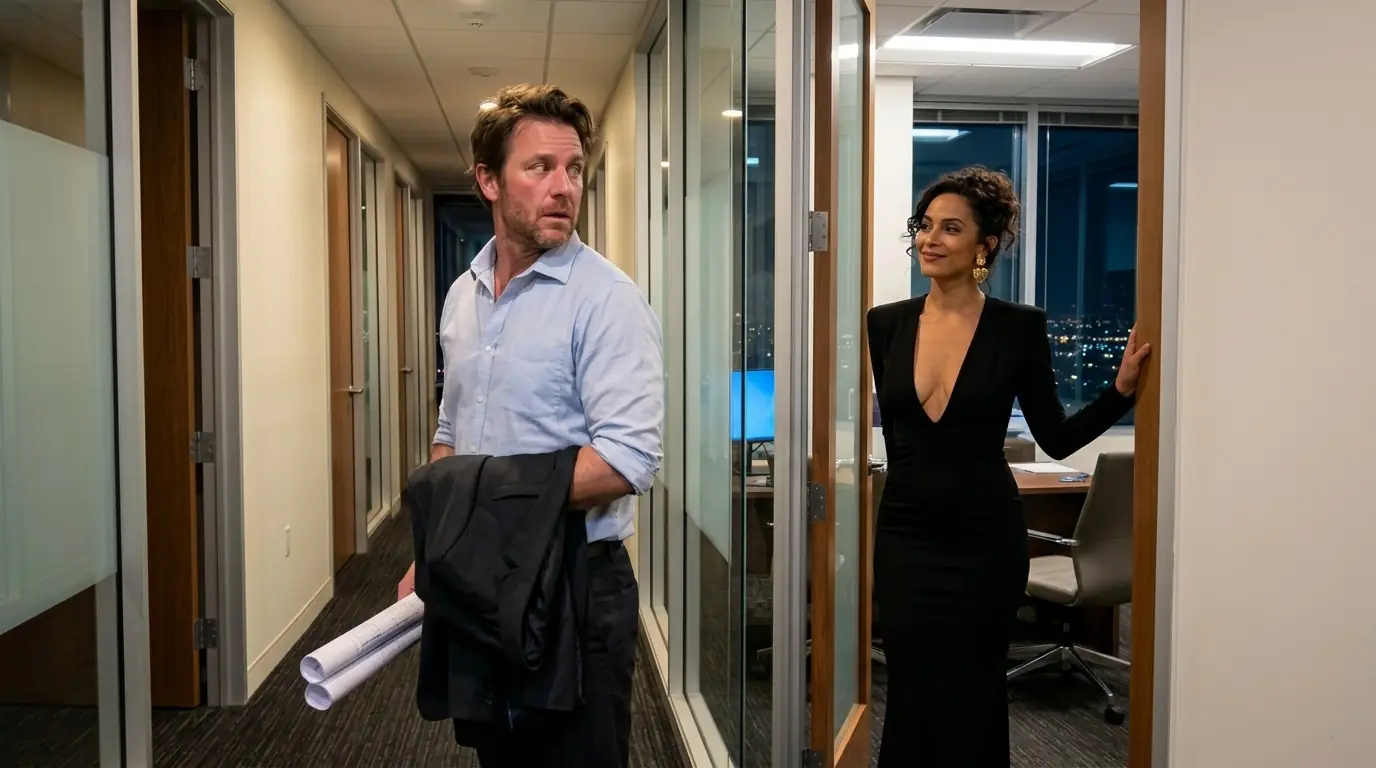
He opened his mouth to take it back, to explain, to disappear into the floor if the floor would have him. Julia only smiled, tilted her head, and said, ""Say it again."" Dean did not say it again. He stood there instead, the blueprint slipping slightly under his arm, his mouth working around an apology that kept refusing to come out whole. "I'm sorry that was I wasn't thinking. It's a habit, an old one.
It wasn't about you. I didn't mean to. I know you didn't," Julia said. And there was no heat in it, no edge, just something closer to curiosity. The kind of look she rarely let herself wear in this building.
"Relax, Dean. It's fine." She used his name like she'd used it a hundred times before. Though, as far as he could remember, she never had. That undid him more than any reprimand could have.
He nodded, muttered something about locking up the east stairwell, and walked away faster than he needed to. The elevator doors closing on his own reflection before he could decide what expression to make. He stood in the empty elevator car with his ears still burning. Replaying the exact half second where the word had left him before his brain had a chance to stop at nine floors of silence gave him plenty of time to build an explanation nobody had asked for yet. By the time the doors opened on the parking level, he'd talked himself into believing she'd forget it by morning.
Mostly because believing anything else felt unbearable. He drove home with the radio off, replaying it anyway. Not the word itself exactly, but the way she hadn't flinched, hadn't laughed at him, hadn't done any of the things a boss was supposed to do when an employee called her honey in a hallway at 9 at night. The apartment smelled like the grilled cheese Poppy had clearly made herself, badly and proudly. She was 8 years old and sitting cross-legged on a kitchen chair with her homework folder open and untouched.
Waiting for him the way she always did, like his key in the lock was the best part of her whole day. "You're late," she said, not accusing, just informational. ""I know, bug. Big meeting."" He kissed the top of her head, dropped the blueprints on the counter where they didn't belong, and started pulling out the real dinner ingredients before she could ask more questions about grilled cheese as a life philosophy. "Did anything interesting happen?" She asked, swinging her legs, the chair creaking with the motion.
"He thought about the doorway, the skyline, the word that had fallen out of his mouth like it had been waiting years for the chance. "Nothing interesting," he said, and smiled at her in a way that was more tired than it was dishonest. She let it go the way kids do when the answer doesn't matter as much as the presence of the person giving it and started telling him instead about a substitute teacher who couldn't pronounce anyone's last name correctly. Dean listened with half his attention on the stove and half of it still standing in a doorway nine floors above the parking garage. Later, after Poppy had brushed her teeth and negotiated an extra 10 minutes of reading time she wasn't technically owed, Dean sat alone at the kitchen table with the blueprints he'd brought home.
Not because he needed them there, but because his hands wanted something familiar to hold. He didn't unroll them. He just rested a palm flat against the paper, the way he used to before every big presentation years ago, and let himself think for exactly one minute about a woman standing in a doorway with the whole city behind her. Then he put the blueprints away and went to check that Poppy had actually turned off her lamp. The next morning, the elevator was crowded enough that Dean told himself he had an excuse to stand in the back corner, eyes on his phone, doing an admirable job of not looking for anyone in particular.
That afternoon, when Dean came back from a service call to grab the tools he'd left at his desk in the operations office, there was a paper cup sitting exactly where his hand would land first. Coffee, still faintly warm, a little bitter the way he liked it, though he had never once told anyone in this building how he liked it. No note, no explanation. He looked around the empty office like the cup might explain itself, then picked it up anyway, and drank it, standing there, staring at nothing, wondering how she'd known and wondering with a small, uncomfortable jolt whether she'd asked someone or simply guessed or noticed something about him he hadn't realized was visible. Celeste Byrne caught him 3 days later in the sublevelase archive, a windowless room of steel shelving and rolled drawings that smelled like dust and old ink.
She had a set of structural plans spread across the drafting table, frowning at a column of numbers like they'd personally wronged her. "You know load calculations, right?" She asked. Not really a question, more an accusation she was hoping he'd deny. "A little," Dean said, which was the understatement of his adult life.
She slid the drawing toward him anyway. More out of desperation than confidence, tapping a pencil against the edge of the table while she waited. Dean looked at it for four seconds, maybe five, before his finger landed on a column near the northeast corner. "This beam's undersized for what they're loading it with. Somebody either changed the tenant mix on this floor after the original design, or somebody made a mistake, and it wasn't a small one."
Celeste stared at him, pencil forgotten midair. "How do you know that just by looking at it?" Dean realized half a second too late that he had answered too fast, too precisely in language that belonged to a different job title than the one printed on his badge. "Lucky guess," he said, and reached for his coffee like it might save him. "Celeste didn't push it that day.
She went back to her own desk, filed the drawing, told herself the maintenance guy had probably just picked up more from years on job sites than she'd given him credit for." But that night, alone in the archive after Dean had gone, she pulled a box off the bottom shelf that hadn't been opened in years, its label faded, its tape brittle. Inside were the original consulting contracts from the tower's structural retrofit, nearly a decade old. She flipped through the signature pages out of nothing but curiosity. The kind that comes from staring at old paper too long on a slow evening.
She found the name before she was looking for it. D. Kesler, P.E., the engineer of record on every drawing in the box. The man who had redesigned the tower's entire load-bearing frame under an independent consulting contract and then vanished from the profession completely. No forwarding address in any file, as if he'd simply stopped existing.
Celeste sat with that for a long time in the quiet of the archive, the building settling around her the way old buildings do at night, and said nothing to anyone. But the next time she saw Dean in the hallway, she looked at him a beat too long, like she was seeing a second person standing where the first one used to be. That same night, long after the offices had cleared out, Dean rode the service elevator to the roof access and stood at the railing. Looking down at Denver, lit up gold and white below him and the mountains a black shape against a darker sky. He came up here sometimes when the building got too loud in his head.
10 years ago, he'd have been standing in a boardroom instead, presenting drawings like the one Celeste had shown him. Before all of that became a life he used to have instead of the one he was living, he didn't let himself finish the thought. He never did. He just stood there, hands cold on the railing, until the wind made him go back down three floors below. In the glasswalled conference room reserved for board business, Foster Lang sat across from a man nobody in the building recognized.
A thin red folder open on the table between them. Both their voices low enough that even the night cleaning crew gave the room a wide and curious berth, pushing their cart past without slowing down. The unwritten rule at Ashgrove Realty had never been written down anywhere. But everyone who worked there long enough understood it without being told. Executives and staff did not discuss the particulars of each other's careers.
Not really. Not beyond the job titles stapled to their badges. To Julia, Dean was operations. To Dean, Julia was the new CEO, her father's replacement, a name on memos before she was ever a face in the hallway. Neither of them asked the other what that meant underneath the surface.
And for weeks, that arrangement held, mostly because neither of them trusted themselves to ask without giving something else away. It broke briefly on a Tuesday when a spring storm knocked out half the block's power for 11 minutes and the service elevator Dean happened to be riding stalled between the ninth and tenth floors with Julia inside it. Her phone dead, her patience visibly fraying at the edges before she caught herself and smoothed it back down. "Of course," she said to the ceiling, mostly to herself. "Of course it's this one.
It'll come back on," Dean said, glancing at the small emergency light overhead. "The backup generator kicks in around the ten-minute mark. We're at eight." She looked at him properly for the first time since the door incident, like she was recalibrating something. "You know the building's timing that specifically?"
"It's my job, too," he said, which was true and also not the whole truth. And he let the ambiguity sit there instead of chasing it. They didn't talk about work again after that. 15 minutes stretched long enough that the silence needed filling. And Julia, unprompted, filled it with something small, she took her coffee black, she said, because her father used to make her drink it that way as a teenager to toughen her up for board meetings she wasn't allowed to attend yet.
Dean told her in exchange that his daughter had entered a drawing in the school art show, something involving a purple dog that was either a dog or possibly a dragon. The intent had been unclear even to the artist. "How old is she?" Julia asked. "Eight.
Going on thirty." Julia laughed. Actually laughed. A short surprise sound like it had escaped before she'd approved it. Then just as quickly, she folded it back in and said something that cost her more.
"I used to think this job would get easier once I proved myself. It doesn't. You just prove yourself again every single week to a room that decided who you were before you walked in." Dean didn't offer sympathy because he sensed she'd hate that more than the elevator being stuck. Instead, he said, "Sometimes people spend so long being strong for everyone watching that they forget what they sound like when nobody is."
Julia looked at him for a long moment in the dim emergency lighting. Like she was trying to place where a man who fixed HVAC systems had learned to say something like that. Before she could ask, the lights flickered fully back on. The elevator gave a small mechanical shudder, and the doors opened on the 10th floor like nothing had happened at all. Before the doors opened, Julia glanced at him once more, almost as an afterthought.
For what it's worth, she said, "I never actually minded the honey thing. I just wanted to see what you'd do if I called your bluff."" Dean felt his face go warm all over again in exactly the way it had that first night. "That's cruel, effective," she corrected. And there was the smallest curve at the corner of her mouth, gone before the doors fully opened. They stepped out separately, a careful two feet between them, and didn't look back at each other, though both of them, in their own offices minutes later, sat very still for a while before doing anything else.
Neither one quite ready to return to the version of the day they'd been having before the power went out. Poppy's school held its spring showcase on a Thursday evening. The gymnasium strung with construction paper stars, folding chairs arranged in uneven rows by parents who'd shown up early to fight over the ones with the clearest sightlines. Dean left work early enough to get a seat in the second row, a bouquet of grocery store carnations wilting slightly in his fist because he'd bought them on the way and forgotten to put them in water. When Poppy spotted him from the wings, her whole face opened up in a way that made the whole ridiculous day worth it.
Julia had no reason to be there at all except that Ashgrove sponsored the district's arts program and a courtesy meeting with the PTA fundraising chair had been scheduled in the same building that same evening. One of those obligations that landed on a CEO's calendar without her ever choosing it. She was walking out through the side hall when she saw him through the gymnasium doors. Not operations dean, not elevator dean, but a man crouched down at his daughter's height, flowers crushed against his chest. Laughing at something the girl had said.
Looking for just a moment entirely unguarded, Julia didn't go in, she stood at the edge of the doorway long enough to watch Poppy point at something on stage, and Dean nodded like it was the most important information he'd ever received. And then she let herself smile once privately before turning and walking back to her car. Dean never knew she'd been there at all. In the car, she sat for a moment before starting the engine, turning the image over in her mind the way she rarely let herself turn anything over a man who spent his days keeping an entire office tower running quietly in the background, spending his evening exactly where he wanted to be, without an audience, without anything to prove. It made her wonder, uninvited, what it might feel like to be looked at by someone the way he just looked at his daughter.
Back at the office the next day, Foster Lang stopped by the operations floor under the pretense of a budget review and told Dean with the practiced ease of a man who'd delivered worse news before that mechanical maintenance on sublevels one and two would be trimmed for the quarter. Cost optimization, he called it the phrase sliding out smooth as a coin. Dean didn't raise his voice. He didn't need to. He pulled up the maintenance logs on his tablet and turned it toward Foster, walked him through exactly which systems that trim would touch and what the failure window would look like if certain checks got skipped even twice.
Foster's jaw tightened, but he covered it fast, told Dean he'd take it under advisement, and left the floor faster than the conversation warranted, his shoes clicking a little harder on the tile than they had on the way in. That evening, an email landed in Julia's inbox from an address she didn't recognize. Four sentences long, vague, and unsigned. Something about a basement safety concern and records that didn't match. She read it twice, decided it read like the kind of anonymous complaint every large building generated eventually forwarded it to nobody, and closed her laptop for the night of the word sitting somewhere in the back of her mind.
Anyway, refusing to fully settle, Julia stayed past 10 that same week. The floor above operations empty, except for the hum of the HVAC system, and the occasional groan of the building settling into the cold. She found Dean in the sublevel, sleeves rolled up, a panel open in front of him, a single work light throwing long shadows across the concrete. She didn't have a reason to be down there. She told herself she was checking on the maintenance concerns Foster had mentioned.
But the truth was simpler and less flattering. Her apartment was too quiet lately, and the thought of going back to it felt heavier than usual that night. "Long night?" She asked and sat down on the step above him without waiting for an invitation. "Every night's a long night down here," Dean said, not looking up from the panel. ""It's the price of an old building with good bones."" She let the silence hold for a minute before she said, quieter than her usual register.
"My father's sick. Sicker than the board knows. That's the real reason he stepped back. Not retirement. Not the version in the press release."
She hadn't planned to say it. It came out anyway. The way things do at 10 at night in an empty basement with no cameras and nobody watching. Dean set down his tools. "I'm sorry."
"Don't be." Everyone up there already thinks I got this job because of him. If they find out he's actually gone, they'll think I'm running the company on borrowed time until they can push me out entirely. She wrapped her arms around her knees and unguarded posture. Dean suspected almost nobody at Ashgrove had ever seen.
"There isn't a single person on that board who's actually on my side." Dean poured coffee from the thermos he kept for exactly this kind of night and handed it to her without a word. Not because he had an answer, but because he didn't, and the coffee was the only true thing he had to offer. She drank it, made a small surprised sound at how good it was, and asked what he'd put in it. "Cinnamon," he said.
"My wife used to add it. I never stopped." He said it plainly, without inviting a follow-up question. And Julia, to her credit, didn't ask one. After a while, she stood to leave.
At the base of the stairs, she turned back just once. "Thank you," she said. "Dean.", it was the first time she'd used his name instead of his title. And she said it like she meant to keep it. Dean stayed down there another hour after she left.
Not because there was more work to do, but because the basement felt different now, less like a place he hid in and more like a place something real had happened. He thought about how easy it had been to tell her about the cinnamon and how hard it still was to tell anyone the rest of it. And he wondered, not for the first time, how long a person could keep drawing that line, before it stopped making sense to draw at all. Two nights later, Foster Lang sat in the corner booth of a bar six blocks from the tower, the kind of place with no windows facing the street, and a bartender who didn't ask questions. Across from him, a man in a gray jacket slid an envelope across the table, thick enough to be noticed without being counted in public.
"The inspection report needs to be gone before the shareholder meeting," Foster said. "Not edited. Gone." Celeste Byrne found the discrepancy on a Tuesday afternoon while pulling files for the annual safety handoff, a task nobody enjoyed and everybody put off until the last possible week. The structural inspection report for sublevel two, the one that should have carried an inspector's original wet signature, had instead a signature that didn't sit quite right on the page.
Too clean, too centered, copied from somewhere else, and pasted where it didn't belong. She almost let it go. She told herself paper got misfiled all the time in a building this old. But something about the timing bothered her, and she pulled the electronic backup archive instead, an old server directory that predated the current filing system, one that Foster Lang had no reason to know still existed because it had been saved years ago under a defunct project code from back when Dean was still listed as engineer of record. The original report was still there and it told a different story.
Entirely a documented structural crack in a load-bearing column on sublevel two flagged as urgent, requiring immediate remediation before any further occupancy changes. The version now sitting in the active files omitted the crack completely, cleared the column for renewed use, and cleared the way, not coincidentally, for a sale that would close within the month. Celeste's hands were shaking by the time she printed both versions side by side. She thought about taking it straight to Julia and then thought about what would happen to her if she was wrong. If this turned out to be some clerical mixup she'd misread out of paranoia and her career ended over a filing error.
She thought about who in this building would actually understand the language of a load calculation without her having to translate it first. And there was only one name on that short list. She found Dean in the operations office at 6:00 in the evening, closed the door behind her, and set both printouts on his desk without a word, her hands still trembling slightly at the edges of the paper. Dean read them once, then again, slower. The blueprint under the discrepancy was one he recognized without needing the header to tell him the retrofit he'd designed himself, the column he'd personally specified to carry more than double the code minimum because he'd never believed in building anything that merely met the standard.
Someone had taken the one system in this tower engineered never to fail quietly and made it fail on paper instead for money. "Who else has seen this?" He asked. "Nobody. Just you."
Celeste's voice cracked slightly. "I didn't know who else to trust with it." Dean sat with that for a long moment. The weight of two different lives pressing against each other across his desk. The man who fixed thermostats for a paycheck and the engineer who had once staked his name on this building standing for a hundred years.
He could file this quietly, let someone else's name go on the report, disappear back into the version of himself that didn't get noticed, or he could walk into Julia's office, and be seen completely for the first time in almost a decade by the one person whose opinion had started without his permission to matter more than he was ready to admit. Dean found Julia in her office past 8, the city already dark outside her window, and set the two printouts on her desk the way Celeste had set them on his. "I need to tell you something first," he said. Before she could ask what it was, before you read any of this, I used to be an engineer, a structural engineer. I designed the retrofit on sublevelase 2, the one in that report, under an independent contract 9 years ago.
I'm the reason that column is rated the way it's rated. I'm not just operations. I haven't been telling you the whole truth about who I am, and I should have." Julia's face did something complicated. Surprise first.
Then something closer to hurt. Quick and involuntary. There and gone. "Nine years. And you never once—" "I know," he said.
"I know how that sounds." "Why?" He didn't have a clean answer. So he gave her the true one instead. Because the last time I was that person, I lost the version of my life that mattered most to me.
And I told myself I'd never let a job be the thing that took me away from my daughter again. Hiding was easier than explaining. Julia looked at the reports instead of at him for a moment, giving them both somewhere else to put their eyes. Then she pulled her chair closer to his side of the desk. "Walk me through it," she said.
"All of it." Now they worked through the night, papers spread across the conference table, comparing timestamps, cross-referencing signatures, building the kind of airtight case that would survive a room full of lawyers with two days' notice and every incentive to discredit it. Around 11:00, Julia sent out for coffee neither of them needed, and both of them drank anyway, just for something to hold. Somewhere near midnight, in the quiet between two documents, she looked up at him and asked, "Softer than she meant to that night at my door, when you said it, ""Honey—were you thinking of someone else?"" Dean didn't look away from her. "For a long time, that word only ever meant one person, and I hadn't said it out loud in years.
That night, it came out because, for the first time in a long time, I didn't feel like I was doing all of this alone." Julia didn't answer that directly. She didn't need to. His phone buzzed on the table between them. Poppy calling past her bedtime.
And Julia gestured for him to take it. "Just checking. You're not going to be super late again," came the small voice through the speaker and to say good night. Good night, Dad. Dean said it back.
And Julia watched him do it. And something in her chest loosened slightly, the way it does when you see proof that a person is exactly as good as you'd hoped he was. When he set the phone down, Julia was still looking at him. And for once, she didn't try to hide it. "You're a good father," she said simply like it was a fact she just finished verifying rather than a compliment she'd decided to give.
"I try to be," Dean said. "Some days that's all it is. Trying. That's most of it, I think." Julia said the trying.
She looked back down at the papers between them, and neither of them said anything else about it. Though the silence that followed felt different from the ones that had come before it that night, warmer, less careful, the shareholder meeting convened at 9 the following Thursday. The boardroom's long table filled with faces that had known Ashgrove Realty longer than Julia had been alive. Foster Lang sat near the head of the table, composed, unaware of what the folder in front of Julia contained until she opened it. She presented the discrepancy first, the falsified signature, the missing crack, the timeline that placed the reports alteration three weeks before the proposed sale.
Then she turned to Dean, seated at the far end of the table where operations staff normally weren't invited to speak and said plainly to the room, ""This is Dean Kesler, the structural engineer of record who designed this system nine years ago. I have asked him to walk the board through the technical findings directly."" Dean stood and for the first time in a long time spoke in the voice that had once belonged entirely to blueprints and load calculations. Precise, unhurried, undeniable. He explained the crack, the column, the load path, the consequences of clearing an unsafe structure for continued occupancy. He did not raise his voice.
He didn't need to. Foster Lang tried first to call it a clerical error, then an outdated file. Then when the electronic timestamp appeared on the screen behind him, tried simply to talk over it until the chairman asked him once firmly to sit down. The board voted seven in favor, two against to suspend Foster Lang effective immediately and refer the falsified report to the city of Denver's building safety division for formal investigation. Before the room adjourned, Julia added one more thing unprompted, her voice carrying to every corner of the table.
"I also want the board to know that Ashgrove's operations department has been carrying expertise this company failed to recognize for almost a decade. That changes today." One of the older board members, a woman who had sat on Ashgrove's board since before Julia was born, stopped by Dean on her way out and shook his hand, holding it a beat longer than a formality required. "Nine years," she said, shaking her head slightly. 9 years this building's been standing on work nobody thanked you for.
"That's over now. Understood?" Dean nodded, unsure what to say to that, and settled for, ""Thank you, ma'am."" Which seemed to satisfy her well enough. Dean stood at the end of the table as the room emptied out around him, aware for the first time in years of being looked at as exactly who he was, not who his badge said he was. Across the room, Julia caught his eye once briefly before the chairman pulled her into a debrief.
And in that half second, neither of them needed to say anything at all. That night at the kitchen table, Poppy looked up from her cereal eaten well past its usual hour. Since Dean had let her stay up to hear about his day and asked with the devastating directness only an 8-year-old can manage, ""So, your boss—is she the smiling lady from the newspaper thing?"" Dean nearly choked on his coffee. ""Where'd you even see a newspaper thing?"" "Mrs. Alvarez had it at pickup," she said. ""Isn't that your dad's building?"" Poppy tilted her head, waiting, entirely unaware of what the question was actually asking. Dean just smiled, said nothing, and reached over to steal a piece of her cereal, which she allowed with the weary patience of a child, used to her father dodging questions he wasn't ready to answer yet.
The building settled back into its ordinary rhythm. Within a week, though, something had shifted in the way people looked at Dean in the hallways, not the invisible presence he'd been for 9 years, the man who fixed things and disappeared before anyone thanked him, but someone the building staff now nodded to a beat longer than they used to. Someone whose name they'd suddenly bothered to learn. Julia called him into her office on a Wednesday, not for a repair, and offered him the newly created role of director of structural engineering and safety, effective immediately, full authority over the very systems he'd once designed under someone else's letterhead. Dean hesitated longer than the offer probably warranted.
"The last time I let this kind of work back into my life," he said carefully. ""I lost track of what actually mattered. I'm not sure I want to make that mistake twice." "This isn't that job," Julia said. "You get to design the terms this time." He thought about Poppy, about the lobby downstairs where she sometimes did her homework on weekends while he finished a shift.
Laughing with the security guard, entirely unbothered by any version of his old life or his new one, just happy he was nearby. Maybe, he thought, a second beginning didn't have to look like the first one. "Take the weekend," Julia said, softer than the offer itself had been. "It's not going anywhere. Neither am I."
Dean looked at her for a moment, struck by how much that last part sounded like something bigger than a job offer, though neither of them said so out loud. He told her he would think about it and meant it, and left her office that afternoon, lighter than he had in longer than he could easily remember. He talked it over with Poppy that night. In the careful, simplified way parents explain big decisions to children who deserve honesty without the weight of it. "Would it be okay?"
He asked her if I did the kind of work I used to do before you were born, the building kind, the kind that means longer days sometimes. Poppy considered this with her usual gravity. "Would you still make my lunch every day?" "Then yeah,", she said already moving on to more pressing matters, namely whether they had enough milk for cereal in the morning. Dean laughed quietly at how simple the whole question had turned out to be for the one person whose opinion mattered most.
Julia showed up at his apartment that Saturday afternoon, a white bakery box balanced in one hand, an excuse already prepared about thanking him properly for saving the building, though both of them understood without saying so that the excuse was mostly for form's sake. Poppy answered the door before Dean even reached it, delighted, unbothered by the fact that her father's boss was standing on their doorstep. "You're Miss Julia," she said. "It was not a question. "Dad talks about you weird," Poppy said.
Dean looked mortified. "Weird how?" Julia asked stepping inside clearly not planning to let that detail go unexamined. Poppy considered the question with the seriousness of a much older person "Like when he talks about Mom. Careful, like it matters a lot."
Nobody in the room said anything for a second. Then Julia set the bakery box on the counter, looked at Dean over Poppy's head, and something passed between them that had nothing to do with the building or the board or 9 years of careful hiding. Poppy, satisfied with having said the important thing out loud, wandered off toward the living room to find the good crayons, entirely unaware of what she'd just done. Julia stayed for an hour longer than the bakery box excuse required, sitting at the same kitchen table where Dean did his daughter's homework with her most nights, drinking coffee that was admittedly worse than his, and laughing at a story Poppy insisted on telling about the purple dog that may or may not have been a dragon. When she finally stood to leave, Dean walked her to the door, and neither of them rushed the goodbye the way people do, when they're in no particular hurry to be anywhere else.
On the rooftop of Ashgrove Tower, the same place Dean had once stood alone with a decade of grief pressed against his chest, Julia stood beside him now, two paper cups of coffee cooling between them, Denver spread out below in gold and glass, and the long dark line of the mountains beyond it. Neither of them said much. There was nothing that needed announcing. Not after everything the last month had already said for them in quieter ways. The coffee left on his desk, the 15 minutes trapped in an elevator, the basement stairs at 10 at night, the boardroom where she'd said his real name to the whole company without flinching.
"You know," Julia said eventually, watching the traffic move in thin gold lines far below them. When my father built this company, he used to say the tower only stayed standing because somebody was always paying attention to the parts nobody else noticed. I used to think that was a metaphor for management. I don't think it was. Dean looked out at the same skyline he'd stood in front of alone so many times.
And for the first time, it didn't feel like a place he was hiding in. "Maybe it's both," he said. Julia reached over and took his hand, simple, unhurried, and turned to him with the same look she'd worn the night this all started. "Say it again," she said.
Dean looked at her, fully awake this time. No reflex, no accident, just a choice he was finally ready to make out loud. "Honey." Across town, in a small apartment that smelled faintly of grilled cheese, Poppy slept soundly, unaware that somewhere above the city, her father had finally stopped hiding from the truest thing he knew how to say. Sometimes the words that slip out by accident are the only truth a person hasn't found the courage to say on purpose.