"Dad? You think they'll hire you?"
Jacob kept his eyes fixed on the cracked blacktop of the county road. "I hope so, Emma."
"I think they will," she nodded with the absolute, unshakeable certainty of an eight-year-old child. "I think you're the best cowboy in Texas."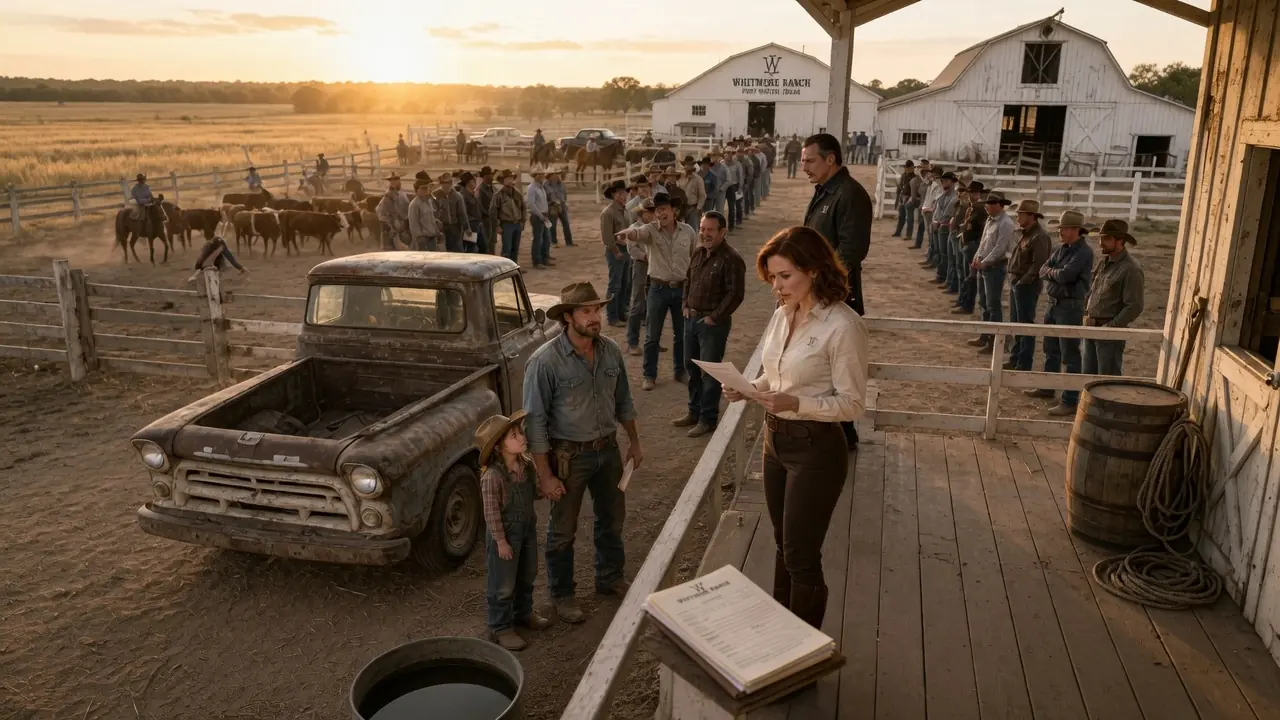
Jacob smiled, not because he believed her, but because she did. Emma sat in the passenger seat of their old pickup truck, wearing a faded hat that was entirely too big for her head and scuffed boots that swallowed her small feet. The truck's air conditioning had died years ago, the passenger door could only be opened from the outside, and the dashboard rattled with every mile. Still, her smile was wide enough to make him believe, if only for a second, that everything would eventually be all right.
He wished he shared her confidence. The truth was, Jacob hadn't applied for a job in over twenty years. He had spent most of his adult life building something of his own—a small ranch, a family, and a steady future. Then his wife, Sarah, died, and the worst drought in a generation settled over the plains. For two years, the relentless Texas sun had burned through pastures, dried up wells, and destroyed ranches that had survived for generations.
Jacob had sold off his cattle, his tools, and his equipment piece by piece, trying to protect the last thing he had left: hope. But hope doesn't settle bank loans or put food on the table. On this particular Tuesday morning, he was driving toward the massive Whitmore Ranch because he had completely run out of options. Pride had become a luxury he could no longer afford.
The Whitmore Ranch appeared on the horizon shortly after sunrise, looking less like a working spread and more like a fortress of untouchable wealth. It spanned thousands of acres of perfect, white-railed fencing, grand barns, and hundreds of horses. It was the kind of place people wrote books about, the kind of place men like Jacob usually admired only from the highway.
The main gravel lot was already packed with dozens of trucks. Dozens of applicants had already lined up—strong men, young men, men with better clothes, newer equipment, and significantly better chances. Jacob parked his truck at the far end of the lot, mostly because that was the exact spot where the engine gave a loud shudder and stopped running entirely.
Emma climbed out of the passenger side and reached up, her small fingers wrapping tightly around his. She didn't do it because she was frightened; she did it because she knew he was.
The line of applicants stretched nearly a hundred yards down to the main stable entrance. Jacob took his place at the back, standing quietly. He had spent his entire life doing hard, honest labor. He knew how to repair a fence line, break a wild stallion, fix a tractor engine, and patch a roof in a rainstorm. He knew how to survive, but standing in a line of strangers begging another person for a paycheck felt heavier than anything he had ever faced.
The other men in line noticed him immediately, their eyes tracking his worn boots, his faded work shirt, and the old truck sputtering at the edge of the property. One of them let out a low laugh. "Looks like somebody brought his kid to a job interview."
Several others smirked, whispering among themselves. Jacob kept his gaze fixed ahead, completely ignoring them.
The words hung heavily in the air. Emma lowered her eyes, her grip tightening on Jacob's hand. For a fraction of a second, the old fire flashed in Jacob's veins. He wanted to step out of line and teach the man a lesson about respect. But then he remembered a phrase Sarah used to tell him whenever things got tight: *Pride doesn't feed our children.* He forced his hands to stay flat at his sides, remaining entirely silent. And somehow, the restraint hurt more than a blow.
---
Minutes later, a sudden movement spread across the front of the stable. The ranch hands stood up straighter, the managers cut their conversations short, and everyone turned toward the main office doors.
Eleanor Whitmore had arrived.
As the sole owner of the wealthiest ranching empire in Texas, her presence immediately commanded the space. She walked through the crowd carrying a thick stack of hiring applications. There were no security guards surrounding her, and no administrative assistants—just Eleanor. She moved down the line, greeting long-time employees by name, shaking hands with neighbors, and reviewing the preliminary paperwork.
Then, she stopped completely.
Her eyes fixed onto a single application sheet. She read the text once, then read it a second time, her fingers tightening against the paper. The color completely disappeared from her face. The senior ranch manager standing beside her frowned, looking confused. "Ms. Whitmore? Is there a problem with the registry?"
She didn't answer him. Instead, she slowly lifted her head, her sharp eyes searching the long line of faces stretching across the yard. When she spoke, her voice wasn't loud, but it held a resonant, cold authority that cut through the ambient noise of the ranch.
"Jacob Miller?"
The entire yard fell dead silent. Jacob looked up, his brow furrowing. Emma squeezed his fingers. For several seconds, nobody in the crowd moved or breathed.
Eleanor took a slow, deliberate step forward, staring across the gravel at him as though she had just seen a ghost. And in a way, perhaps she had. Because the name *Jacob Miller* wasn't supposed to simply appear in a standard hiring line at the Whitmore Ranch—not after twenty years of empty roads, not after all the searching, and not after the promise her father had died trying to fulfill.
---
To everyone else standing in that line, Jacob Miller looked like a beaten man. His hat was worn, his jeans were frayed at the cuffs, and his daughter was holding his hand because they had nowhere else to go. Nothing about his current appearance suggested that he had once been a man other people depended on. Nothing suggested that years earlier, entire counties across the state of Texas had known his name. And that was exactly how Jacob preferred it.
At forty-two, he no longer cared about titles or reputation. He cared about keeping the small, dried-up piece of land that held the last physical memories of Sarah. He had sold his favorite horses and his best equipment just to ensure Emma's present was safe, but eventually, every man reaches the baseline where reality overrides pride.
Emma didn't understand the full scope of their financial ruin, and Jacob thanked God for that ignorance every night. To her, their small, dusty ranch was still the most beautiful place in Texas. She loved the sunsets and loved listening to his stories while sitting on a crate in the workshop. She had inherited her mother's absolute, resilient kindness—the kind of grace that refuses to sour into bitterness, no matter how hard the world pushes. Sometimes, watching her care for an injured bird or share her lunch with a neighbor, Jacob felt a mixture of profound comfort and sharp terror. She was becoming exactly like Sarah.
Sarah used to tell him, *The strongest people are always the ones nobody notices.* When he was a young man, he had disagreed with her. He had believed strength was a visible asset—a badge, a title, a heavy reputation. Then he spent a lifetime watching Sarah face her illness with a quiet, unyielding grace, and she taught him that real strength happens when nobody is holding a camera. It happens in the quiet choices.
After she passed, Jacob stopped talking about his past entirely. At first, it was because the memories cut too deeply. Then, it was because the titles no longer mattered. Emma knew her father had traveled extensively before she was born; she knew people occasionally recognized his face in distant towns, and she knew there was an old, locked iron box hidden beneath the workbench in the shop that he never opened. But she never asked questions. She understood instinctively that some wounds are too deep to disturb, so she simply let them rest.
And Jacob never volunteered the data. He never told her about the investigations, the manhunts, or the long nights spent tracking people who didn't want to be found. He never told her about the gold federal badge he had locked away in that box the day they buried her mother. And he certainly had never told her the name *William Whitmore*.
The truth was, Jacob had met William Whitmore long before the private jets, the front-page profiles, and the titles labeling him the king of Texas ranching. Back then, William had simply been another struggling cattleman trying to survive a brutal season. But Jacob had spent two decades believing that whatever had occurred between them had been lost to time. People get old, families grow, and promises fade into the background. At least, that's the story he told himself. He had to believe it, because believing anything else would have made his current poverty too heavy to bear.
Standing in the yard, watching the wealthy managers look right through him, Jacob felt a strange sense of relief. He didn't want special treatment or historical recognition. He just wanted a standard paycheck to clear his loan. He looked down at his daughter, and she smiled up at him.
"Dad?"
"Yeah, Emma?"
"You still look nervous."
He let out a soft laugh, rubbing his neck. "That obvious, huh?"
She nodded seriously. "Mom always said that nervous people are the ones telling the truth."
The phrase hit him harder than she could comprehend; Sarah had told him that exact line hundreds of times during his old department days. He managed a smile. "Your mom was usually right about things, Emma."
"Then everything will be okay," she said, squeezing his hand.
Jacob wished he shared her certainty. Because at that exact second, Eleanor Whitmore was walking straight toward him, holding his application form, and the past he had spent his entire adult life trying to bury had finally caught up with his name.
---
The spring floods of that year had become an indelible part of Texas history. Entire roads had been washed into the mud, bridges had collapsed overnight, and families had been forced to abandon their properties as the rivers broke their banks. Somewhere deep inside a narrow canyon, nearly two hundred miles from where the Whitmore empire stood today, a young William Whitmore had made the worst decision of his life: he had attempted to cross the rising water anyway.
At the time, William owned fewer than two hundred acres of land. He had no managers, no corporate accounts, and no political leverage—just a mountain of debt, a herd of cattle, and a family depending on his survival. The storm arrived significantly faster than the weather reports had predicted. The river rose six feet in an hour, the road completely vanished under the torrent, and within minutes, his truck had been swept off the road, pinned violently against a sheer canyon wall.
The water kept climbing. His radio lines failed, his engine flooded, and for the first time in his life, William Whitmore realized he was going to die alone in the dark. Later, he would write in his private journals that the strangest variable of the crisis wasn't the terror, but the absolute silence—the realization that the world simply continues to turn while one person waits for his existence to end.
He spent nearly three hours trapped inside that cab, watching the water rise toward his chest, fully believing nobody on Earth knew his location. Then, through the roar of the flood, he heard an impossible sound: the whinny of a horse.
He looked up through the glass. Standing on the unstable ledge of the canyon wall was a young cowboy who couldn't have been more than twenty-two years old. He was thin, wearing a rain-soaked hat that looked far too old for his frame, and he was holding a heavy utility rope. That young cowboy was Jacob Miller.
Back then, Jacob wasn't a rancher or a father; he was simply a young man returning home from a routine cattle delivery when he noticed a broken section of fencing near the canyon road. Most people would have turned their horses around and sought high ground. Jacob didn't.
The extraction should have been a physical impossibility. The current was entirely too swift, the canyon walls were actively sliding into the mud, and his horse lost its footing twice on the rocks. But Jacob never let go of the line. He didn't act like a hero, and he didn't shout grand proclamations; he looked thoroughly annoyed, as if saving a drowning stranger in a flash flood was merely an inconvenient chore that needed to be completed before sundown.
Three hours later, William Whitmore walked out of that canyon alive because a stranger had risked his life for him. At the county hospital, William tried to hand him a stack of cash. Jacob flatly refused it. William offered him land, stable employment, shares—anything he wanted. Jacob simply smiled, shook his head, and said a phrase William would carry in his mind for twenty years: *"If you're still breathing, that's payment enough for me."*
Before Jacob rode away, William made a definitive promise, locking his fingers around the young man's hand. *"One day, Jacob, I will repay this debt. I swear it to you."*
Then, life happened. The years passed down the track. William built his massive empire; Jacob built his family. They never crossed paths again, but William Whitmore never forgot the face in the canyon—not once, and not for a single day. He hired private investigators, inquired with old marshals, tracked names through land registries, and followed every loose rumor. Whenever he traveled across the state, he asked the exact same question to the local sheriffs: *"Has anyone seen a cowboy named Jacob Miller?"*
Eventually, his corporate board assumed he would stop the search. He never did. And when William Whitmore finally passed away, Eleanor discovered a locked secure room in the back of his estate—a room filled with maps, records, investigator files, and one single manila folder larger than all the rest, labeled: **JACOB MILLER.** Inside the folder rested a single handwritten note from her father, underlined twice in thick black ink: *“If Jacob Miller ever appears on our land, execute the promise. Help his family before he has to ask.”*
Standing in the gravel hiring yard, Eleanor finally understood the data. She looked at Jacob—older now, his face lined with tired crevices, standing in a faded shirt beside a little girl who looked up at the world with that exact same unguarded kindness. For the first time in twenty years, the promise had located its home.
But not everyone at the Whitmore Ranch was pleased by the arrival. Because while Eleanor saw the resolution of her father's oldest debt, someone else saw an immediate threat to his architecture. Standing on the veranda of the main office, Victor Cain had just realized that Jacob Miller was never supposed to enter this property.
---
Victor Cain sensed the structural danger before anyone else in the yard. While the other applicants continued to whisper among themselves and Emma tried to understand why the owner was walking toward them, Victor watched the scene play out from the second-floor administrative balcony. He didn't know Jacob Miller personally, but he knew the name from the private files. And that was more than enough.
For years, Victor had operated alongside the Whitmore family as an external investment advisor, legal consultant, and manager of their major commercial contracts. To the local public, he was simply a brilliant, modern businessman helping Eleanor streamline the ranch's logistics after her father's death. But behind closed doors, Victor wanted far more: he wanted absolute influence, corporate land transfers, and matching seats on the executive board. He wanted to transition portions of the historic Whitmore land into commercial developments William never would have tolerated while he was breathing. And above all, Victor required Eleanor to depend entirely on his counsel.
So when she recognized the name of a broken cowboy standing in a standard hiring line, Victor realized he had a major problem. This wasn't just an anonymous applicant; this was the single man who could connect Eleanor back to her father's original values—the exact values Victor required her to forget to clear the path for his contracts.
That afternoon, the targeted rumors began circulating through the ranch channels. First among the stable hands, then through the managers, then into the local town mercantile. The whispers said that Jacob Miller had only turned up at the ranch because he knew William had passed away and couldn't defend his records. They said he was intentionally weaponizing his young daughter to secure unearned sympathy from the estate. They said the entire canyon rescue story had probably been fabricated or embellished decades ago. They said a man in severe debt always materializes the second he smells old family money.
Jacob heard fragments of the whispers while working the corrals; Emma heard portions of them near the supply sheds. But Jacob didn't react. He didn't raise his voice, he didn't demand an apology, and he didn't confront a single manager. He simply put his head down and executed his labor perfectly.
And that restraint irritated Victor more than any confrontation would have. Arrogant men expect shouting; they expect anger, defensiveness, and desperation because those reactions are easy to manipulate on camera. Jacob offered an absolute, unshakeable silence. And silence from a patient man is an exceptionally dangerous variable.
Within the week, Victor shifted his tactics, calling Eleanor into a private executive session. He laid out several financial folders on the mahogany table, speaking in that low, smooth, protective register he used to manage her decisions.
"Eleanor, your father was an exceptionally honorable man," Victor said, smoothing his tie. "But guilt can make even the strongest men believe stories they shouldn't entertain. Jacob Miller is completely bankrupt. He materialized on this property the exact week his bank notes cleared the default line. It's highly probable your father searched for a myth, or that this individual discovered the old files and decided to leverage the narrative for a corporate handout."
Eleanor reviewed the papers without responding, her expression tight.
Victor pressed on, planting the seeds of doubt. "He's an outsider, Eleanor. We have major land contracts clearing this month. We can't afford to have unpredictable variables accessing the estate's core assets." He didn't need to convince her all at once; he just needed the question to linger in her mind during the board votes.
That same evening, an anonymous folder was left on Eleanor's office desk. Inside were compiled copies of Jacob's financial distress—liens, late payments, defaults, and a series of typed notes suggesting he had researched the Whitmore family's holdings before filing his job application. The presentation looked completely organized, clean, and entirely too convenient.
Jacob recognized the architecture immediately when Eleanor, looking visibly uncomfortable, showed him the files in the study the next morning. He read through every single page without a trace of emotion on his face, then closed the folder and set it back flat on the desk.
"Do your administrators know who delivered this to your desk, Eleanor?" he asked.
"No," she admitted. "It was left after the shift cleared."
Jacob looked out the wide window toward the far pastures of the ranch. For a second, he looked entirely exhausted, the weight of his long years lines showing in the lamplight. But inside his chest, something old and precise had reawakened. The broken cowboy vanished; the protective father remained, and behind him, the federal investigator who had spent two decades tracking hidden trails returned to the surface.
Jacob Miller began to investigate the ranch—not officially, and entirely out of sight, using the exact metrics he had mastered when he wore a gold shield. He compared entry dates, checked digital signatures on the corporate ledger, spoke quietly with long-time stable hands who had known William, and analyzed the supply chain files. He looked at who avoided his eye in the corridors, and tracked the contracts that had been revised immediately following William's death.
Slowly, the data aligned into a clear visual picture, and it was significantly larger than a simple rumor about an old rescue.
The estate's capital was systematically leaking. Small, recurring amounts were disappearing from the maintenance accounts; corporate transfers were being masked as basic administrative fees; and land lease options were being altered without the required board quorum. Most importantly, a network of shell companies was quietly purchasing the surrounding parcels of land near the Whitmore property lines following false appraisals that had artificially lowered the land values. Every single transaction routed back to one single financial center: Victor Cain.
Jacob wasn't surprised. Men like Victor rarely execute a single strike; they prepare the ground meticulously, isolate the target, manufacture a crisis, and then step forward offering a pre-packaged corporate solution that is, in reality, the final trap. That was exactly the play he was executing against Eleanor: first weaken her baseline confidence, then discredit anyone who could remind her of her father's integrity, and finally secure enough board proxy votes to turn William's legacy into personal profit.
Jacob worked through the data in complete silence for three nights. Emma noticed the change. She found him sitting at the small desk in the guest quarters Eleanor had provided, surrounded by ledger sheets and printed property records.
"Dad?"
He looked up from the pages. She stood there in her pajamas, clutching the old stuffed horse Sarah had hand-sewn for her years ago. "Are you in trouble again?"
Jacob smiled gently, pulling her into his arms. "No, baby. I'm just stopping one from happening."
Emma looked down at the highlighted text. "Is it because of that man from the balcony?"
Jacob didn't give her the operational details. He simply kissed her forehead. "Sometimes, Emma, people try to make good people doubt who they are."
She was quiet for a second, resting her chin on the stuffed horse. "Mom always used to say that good people don't need to shout to prove they're strong."
The phrase drilled deeper into Jacob's heart than she could comprehend. Sarah always materialized like that—through their daughter's voice, her quiet gestures, and the absolute grace she had left behind in the world. Jacob closed the folders firmly. "Your mom was right. Go get some sleep, kiddo."
---
The next morning, Jacob walked into William Whitmore's historic office—a room Eleanor rarely entered because the grief still lingered in the air. Everything had been left exactly as her father had maintained it: the old books on the shelves, the land maps pinned to the walls, and his old work hat still hanging from the wooden peg near the door.
Jacob understood men like William; men who built empires out of the dirt with their bare hands tended to store their most vital tools and secrets in plain, functional spaces close to their daily labor. He began examining the desk drawers, checking the bindings of the account ledgers, and reviewing the corporate registries.
Then his eyes caught a detail on the wall behind the desk: an old photograph of a young William standing in front of a tractor nearly buried in river mud. The frame was hanging slightly crooked against the wood paneling. Jacob stepped closer, reached up, and moved the frame aside.
Hidden inside a small cut-out in the wood was a single manila envelope. It was yellowed with age, its wax seal completely intact. Written across the front stock in William Whitmore's heavy, unmistakable cursive block letters was a single explicit command: *“If they ever attempt to turn my daughter against Jacob Miller, give her this immediately.”*
Jacob held the paper in absolute silence. Because in that second, he realized William hadn't just spent twenty years searching for him—William had also known with absolute certainty that one day, the opportunists in his inner circle would attempt to block the truth from reaching his daughter.
---
The emergency board meeting at the Whitmore Ranch drew a much larger crowd than the administration had anticipated. By sunrise, trucks and utility vehicles lined the entry road for nearly a mile. stable hands, area ranchers, corporate attorneys, council members, and long-time neighbors who had known William Whitmore for decades filled the hall. Everyone had caught wind of the escalating ledger dispute. Some believed the rumors that a bankrupt cowboy had manipulated the family's assets; others believed Victor Cain was about to finalize his corporate restructuring of the valley.
Only one person in the assembly hall held the complete data set: Jacob Miller.
The session was held in the central building pavilion. At the head of the long table sat Eleanor Whitmore, flanked by her corporate lawyers and financial advisers. Sitting at her right, with the relaxed, smiling posture of a man who believed he had already secured the required proxy votes, was Victor Cain. He smiled broadly when Jacob walked through the doors.
He stopped smiling the exact second he noticed the yellowed envelope in Jacob's hand.
The entire room fell into an absolute hush. Eleanor stood up from her chair, her voice trembling slightly under the lights. "My father spent twenty years of his life searching for one specific cowboy," she said, looking straight across the room at Jacob. "Today, I think this room is finally going to understand why."
Jacob walked to the front of the table, setting down a compact stack of certified folders. There was no dramatic performance, no trace of anger, and no lengthy speech—just the hard evidence.
The first sheets he displayed were the verified bank logs, mapping the transfers from the maintenance funds to Callaway Consulting LLC, followed by the Secretary of State's registry proving Victor held the sole proprietorship. Then came the signed affidavits from former managers, suppliers, and foremen who had remained silent for two years out of fear of corporate retaliation. Each independent statement revealed another piece of the exact same machine: Victor Cain had spent years preparing an administrative takeover of the Whitmore land through deliberate financial manipulation.
Then, Jacob slid the anonymous folder across the table, displaying the digital tracking forensic report Brennan had run, mapping the files directly to Victor's administrative office terminal. It was the absolute proof of the smear campaign.
Victor attempted to maintain his composure, unbuttoning his jacket. "These are unverified, highly irregular accounting theories—"
Jacob didn't argue with him. He simply placed William Whitmore's yellowed envelope directly in front of Eleanor.
The final trace of color drained from Victor's face.
Eleanor broke the wax seal with trembling fingers. The room went so silent you could hear the Texas wind whistling through the stable eaves outside. She unfolded the parchment sheet and began to read aloud, her voice echoing off the high beams:
*"If you are reading these words, Eleanor, then someone in that room has actively tried to make you doubt the integrity of Jacob Miller."*
Several board members shifted uncomfortably in their leather chairs.
Eleanor paused, her breath catching sharply in her throat as she recognized her father's handwriting, before she forced herself to continue. *"Do not believe a single word they tell you. Twenty years ago, Jacob Miller pulled me out of a flooded canyon when he possessed absolutely nothing of his own. He was young, he was poor, and he owed my name nothing. And yet, he chose to risk his life for a stranger anyway."*
Several of the old stable hands lowered their heads, their eyes wet.
Eleanor kept reading, the text cutting through the room like iron. *"I spent twenty years of my life trying to locate him to repay that debt, not because Jacob ever asked for a handout—because honorable men never do. If Jacob Miller ever appears on our land, help his family before he ever has to ask. Protect his child's future."*
The letter continued for three more paragraphs, and with every single sentence, Victor Cain's corporate architecture vanished into thin air. William had fully documented his initial concerns regarding Victor's accounting tracks before his passing, outlining the exact clauses that protected the land from unilateral transfer. He had known enough to ensure his daughter held the legal shield.
When Eleanor finished the final line, she sat down, unable to speak further.
Sheriff Harrison stood up slowly from the first row of chairs, his face hardened into a stern scowl as he looked across the table at the executive. "I believe the department is fully finished here, Victor."
Victor stammered, attempting to reframe the data as standard corporate strategy and administrative miscommunication. But nobody in the room was listening to his performance anymore; the fear he had used to control the ledger for three years had completely evaporated.
Two county investigators stepped forward from the doorway, their badges visible. Victor Cain stood up, adjusted his jacket out of pure muscle memory, and was led out of the pavilion without looking back once. And with his exit, twenty years of institutional lies cleared the room.
---
Later that afternoon, the sparse Texas sun began to set, casting a deep gold hue across the property lines. Eleanor located Jacob standing near the white rails of the main breaking corral.
A hundred yards away, Emma and Noah were laughing, feeding fresh carrots to the new foal—completely untouched by the adults' corporate reckoning. For a long moment, neither adult spoke, watching the children.
Then, Eleanor handed him a thin leather folder. "My father's estate attorneys finalized this framework an hour ago, Jacob."
Jacob didn't reach out to take the papers. "I told you, Eleanor. I didn't file that job application because your father owed me a check."
"The checkbook is irrelevant," Eleanor said, her eyes bright with tears as she pressed the folder into his hand. "This belongs to your daughter. It's a full, ironclad partnership agreement for the entire western quadrant. The land is hers."
Jacob looked down at the deeds, then turned his head to look at Emma, whose laughter carried across the gravel. Finally, a small, genuine smile broke across his face.
"Why did you really come to this line, Jacob?" Eleanor asked softly.
Jacob watched his daughter run along the rails, her hat still tilted slightly too low over her eyes. "Because the simplest reasons are always the truest ones, Eleanor. I came because she needed a future."
Eleanor couldn't find the syllables to respond, because in that exact second, she understood the data completely. Her father hadn't spent twenty years searching for Jacob Miller simply because the man had pulled him out of a flooded canyon; he had spent twenty years searching because Jacob was the kind of man who would execute the rescue without ever expecting a single thing in return.
Months later, as the sun set gold over the vast horizon of the valley, Jacob worked in the newly completed horse restoration workshop—the exact workshop William Whitmore had always envisioned building on the land. He wasn't operating as a hired hand, and he wasn't operating as an employee. He was operating as family.
He thought he was applying for a simple ranch hand job to clear a debt. He had never realized he was simply walking back into a promise written twenty years earlier in the mud of a canyon.