“You and your boy need a home,” Clara whispered.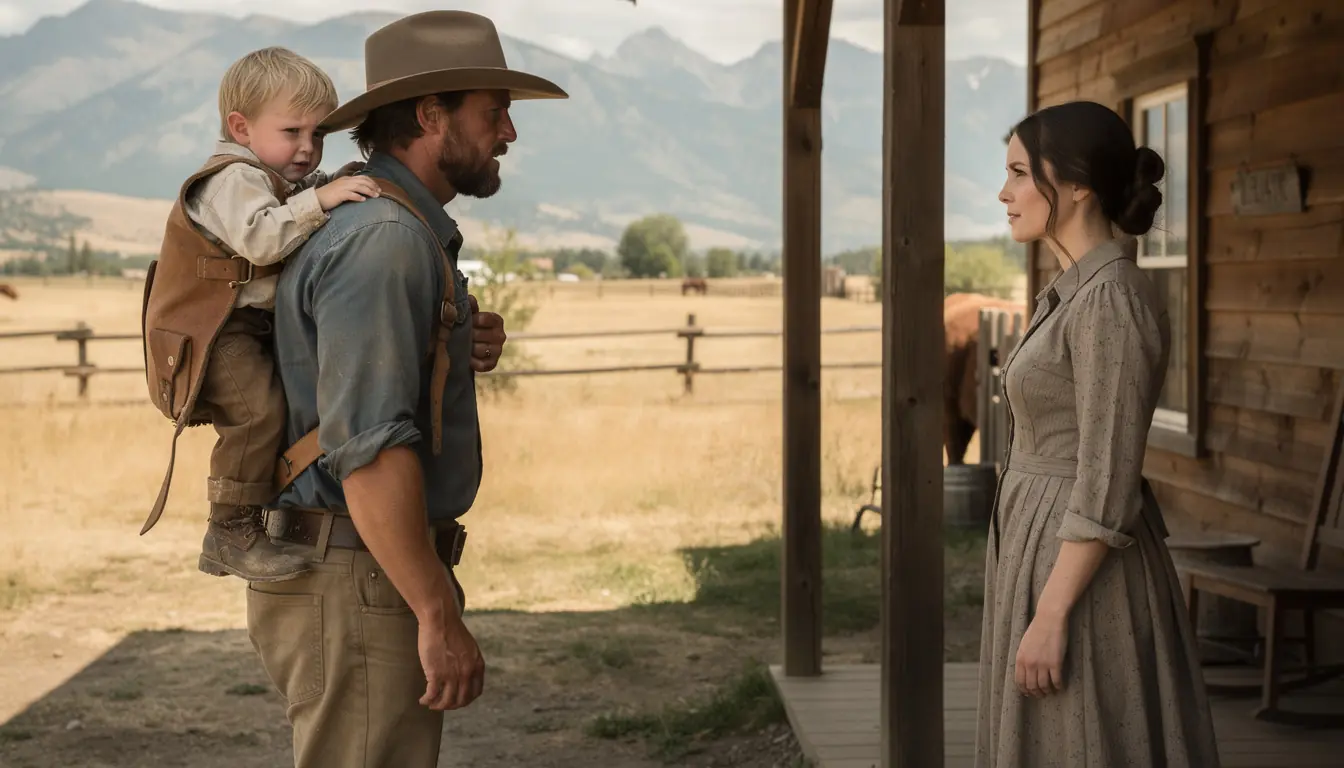
Silas Thorne stopped at the foot of her porch as though the words had struck him in the chest. Twelve years had passed since Clara had last seen her first love. Back then, Silas had been a hopeful young ranch hand with strong shoulders, an easy smile, and a promise to return before winter. He never had.
Now he stood before her beneath the fading Montana sun, dressed in a dust-covered shirt and a worn leather vest. On his back, secured inside a handmade leather carrier, was a little boy not yet two years old. The child had golden hair and tired blue eyes, and one small hand was curled tightly around his father’s shoulder strap.
Silas was thinner than Clara remembered, and the years had hardened his face, but his eyes were exactly the same. They still held the quiet warmth that had once convinced a nineteen-year-old girl she could follow him anywhere.
Clara tightened her fingers around the fabric of her faded red calico dress. She had worn that same dress on the day Silas left the Bitterroot Valley. It had been bright crimson then, a bold splash of color against the gray hills. Now the Montana sun had softened it to the color of a faded rose.
“His name is Toby,” Silas said.
His voice was rough from dust and exhaustion, the voice of a man who had spent too many days without proper sleep. Clara looked at the boy. Toby rested his cheek against his father’s back and watched her with the solemn uncertainty of a child who had learned not to expect kindness from strangers.
“Where is his mother?” Clara asked softly.
Silas lowered his eyes, his shadow stretching long across the parched dirt. “She died last winter.”
The words settled between them like heavy stones. No music came from the cabin. No wind moved through the dry golden grass. Even the old windmill seemed to hold its breath.
Clara knew what it meant to bury the person with whom you had planned your entire future. Her husband, Arthur Montgomery, had died of fever three years earlier. He had left her the ranch, a failing well, and enough debt to keep the bank circling like a hungry hawk.
Silas looked toward the distant, shimmering road. “I shouldn’t have come here,” he muttered.
“Then why did you?” Clara asked, her voice trembling.
“My horse is nearly spent,” Silas replied, his jaw tight with shame. “Toby hasn’t eaten since morning. The rail camp turned me away. The boarding house in Stevensville would not take a man who couldn’t pay in advance.”
He swallowed hard, unable to meet her gaze. “I remembered your cabin.”
Clara felt the old wound inside her rip open. “You remembered my cabin, but you did not remember the girl who waited twelve years for an explanation.”
Silas finally met her eyes, and the pain in them was undeniable. “I remembered her every day.”
Toby stirred on his back and gave a weak, sleepy whimper. Silas immediately reached behind him and touched the boy’s small leg to reassure him. That single tender movement changed something deep inside Clara. Whatever anger she still carried belonged to another lifetime. The child standing at her gate had done nothing wrong.
Clara stepped down from the porch, her boots crunching on the dry silt. “You and your boy need a home,” she said firmly.
Silas stared at her in disbelief. “Clara, I’m not asking for charity.”
“Good, because I’m not offering charity.” She pointed toward the damaged windmill and the dry cattle trough beside it. “My well is failing. The north fence is down, and the bank expects payment before the first snowfall. You need shelter for your son, and I need someone who knows how to keep a ranch alive.”
Clara’s voice softened to a whisper. “Then we will decide whether you came here because you had nowhere else to go, or because some part of you was finally ready to come home.”
For the first time, Toby lifted his head. He looked at Clara, then at the open cabin door.
“A home?” he murmured.
It was only one word, spoken in a tiny, fragile voice, but it nearly broke Clara’s heart. She turned away before Silas could see the tears gathering in her eyes.
“Bring him inside,” she said. “The evening air is turning cold.”
Silas remained frozen for one more second. Then he followed his first love into the home he had once dreamed of building with her.
Outside, the late-summer sun hung low over the Bitterroot Mountains. The valley glowed with copper light and dry golden grass. It was August of 1889. Montana Territory stood on the very edge of statehood, but far from the speeches and celebrations in Helena, survival remained the only law that mattered.
The drought had emptied the creeks weeks earlier. Cattle moved slowly across the fields, their ribs beginning to show. The earth had cracked beneath weeks of punishing, relentless heat, and somewhere beyond the northern ridge, a thin line of smoke was already rising into the sky.
That first evening, Clara warmed a little milk on the stove and softened a piece of bread in it for Toby. The boy sat at her kitchen table wrapped in a heavy wool blanket, watching her with cautious, wide blue eyes. Silas stood near the door as though he still expected to be asked to leave at any moment.
“He eats slowly when he is frightened,” Silas said quietly.
Clara placed the warm bowl in front of Toby. “Then no one will hurry him here.”
Toby looked at his father before touching the silver spoon. Silas nodded his approval. Only then did the child begin to eat.
Clara pretended to busy herself near the woodstove, but she noticed every small, heartbreaking detail. Toby’s sleeves were much too short for his growing arms. One of his tiny boots had been repaired with rough twine. His left sock had a gaping hole near the heel. Silas had clearly given the boy everything he could possibly offer. Love alone had not been enough to keep hardship away.
When Toby began to fall asleep at the table, Silas lifted him with practiced care. The little boy curled against his father’s chest without even waking.
“You are good with him,” Clara said.
“He is all I have,” Silas replied.
He spoke the words quietly, but Clara heard the raw fear beneath them. She opened the door to the small spare room and gestured toward the bed.
“You can put him here.”
Silas looked at the clean sheets, the folded quilt, and the small oil lamp glowing beside the window. “I can sleep in the barn.”
“I offered both of you a home,” Clara countered.
“I don’t want the town talking about you, Clara.”
“The town has been talking about me since Arthur died.” Clara met his eyes without blinking. “I survived their gossip before. I will survive it again.”
Silas carried Toby into the room. As he lowered the child onto the bed, Toby’s fingers caught around one of Clara’s buttons. It was a small polished silver button that had come from her father’s old Union Army coat.
Clara gently opened the child’s tiny hand. “My father gave me that before I came west,” she explained.
Toby stared at the polished silver in his palm. “Pretty,” he whispered.
Clara smiled despite the weight in her chest. “You may hold it until you fall asleep.”
Silas watched her tuck the blanket around his son. For one fragile moment, they did not look like two strangers. They did not look like people separated by twelve years of silence. They looked like the family they might once have become.
Long after Silas had fallen asleep on the floor, Clara remained beside Toby’s bed. The little boy had wrapped one hand around the silver button. She gently eased it from his fingers after he drifted back to sleep.
His breathing was soft and uneven, as though even in sleep he expected the world to take something else from him. Clara reached down and brushed a strand of golden hair from his forehead.
For years, she had convinced herself that the silence of the cabin did not trouble her. She had told herself she was fortunate to have land, work, and enough strength to survive. But sitting beside Toby, she finally admitted how empty the rooms had become.
There had been no small footsteps crossing the floor, no sleepy voice calling from the darkness, no tiny stockings hanging near the stove in winter. Toby stirred and opened his eyes.
“Clara,” he whispered.
“I’m here.”
“Papa go?”
“No,” she said gently. “Your papa is right beside you.”
The boy looked toward Silas, sleeping on the floor. Only then did his small body relax. Clara pulled the quilt higher over his shoulders.
“Papa comes back,” Toby murmured.
The words struck Clara harder than she expected. Silas had once failed to return for her, but to this child, he was the man who always came back.
Clara looked down at the sleeping father and son. Perhaps a person could be both the cause of an old wound and the answer to a new prayer. She remained beside Toby until his breathing became steady again.
Before leaving, she placed the silver button beneath his pillow. For the first time in three years, Clara did not feel alone inside her own home.
The next morning, after Toby woke, Clara returned the silver button to her sewing basket for safekeeping. Later that same morning, Silas began working before the sun had climbed high. He repaired the broken north fence line, cleaned the silt from the well housing, and climbed the tall windmill tower to inspect the failing gears.
Clara watched from the kitchen garden. She saw the muscles in his shoulders tighten beneath his faded shirt. Years had changed his face, but not the way he worked. Silas still treated every task like a sacred promise.
By noon, the heat was a physical weight. Sweat had darkened his collar and stained his hat. Clara carried a jar of cool water out to him.
“You don’t have to rebuild the whole ranch in one day.”
“I have twelve years of silence to repay,” he replied.
She stopped beside him, her shadow falling over his work. “Work can repair a fence, Silas, but it cannot explain why you disappeared.”
His hands went suddenly still. “I wrote to you, Clara.”
“I never received a single letter.”
“I sent six,” he said, his voice cracking.
Clara’s breath caught in her throat. Silas looked toward the distant, hazy mountains.
“My father was dying back then. He made me promise to take the family north to safety. By the time I returned to the valley, I was told you had married Arthur Montgomery.”
“I waited two years for you.”
“I came back three months too late,” he whispered.
Neither of them spoke for a long time. The only sound was the dry grass rustling in the heat. From the porch, Toby laughed at a grasshopper jumping through the dust. The sound was small and bright, and it loosened something that had been trapped between them for twelve years.
Clara handed Silas the jar of water. “Then perhaps we have both spent twelve years grieving a lie.”
Silas took the water, but his fingers brushed hers. Neither of them pulled away immediately. The old connection was still there, quiet but unmistakable.
Clara turned away first. She did not trust herself to remain that close to him. For twelve years, she had built her life around the belief that Silas had chosen not to return. That belief had carried her through lonely winters, through Arthur’s illness, and through the long nights after his death. Now six missing letters had shaken the foundation of everything she remembered.
“Who told you I had married?” she asked.
Silas hesitated. “Your uncle Charles.”
The color drained from Clara’s face. Charles had never approved of Silas. He had called him a penniless dreamer and warned Clara that love could not fill an empty pantry. After her mother died, Charles had handled the family’s mail and accounts.
A cold understanding moved through her. “He knew I was waiting for you.”
Silas stared at her. “Are you saying he kept the letters?”
“I do not know.”
But the answer was already visible in her face. Silas lowered the water jar.
“I spent years believing you had chosen Arthur.”
“And I spent years believing you had forgotten me.”
There was no way to recover the years that had been stolen. Arthur had been a decent husband, and Silas had loved Toby’s mother. Their lives had continued, even while a part of each of them remained trapped in the past.
Clara looked toward Toby on the porch. “We cannot pretend those years did not happen.”
“I would never ask you to.”
“But we can stop letting a lie decide what happens next.”
Silas nodded slowly. It was not forgiveness, not yet, but it was the first honest step toward it. They would never know for certain what Charles had done with the letters, but neither of them would allow his silence to steal another day.
Later that afternoon, a rider approached the ranch. Clara gripped the wooden handle of her lantern as the sun began to dip. Living alone had taught her to treat every unexpected sound with caution. She stepped back toward the porch where Toby was playing.
A tall, thin man stepped out of the rising dust. Clara lowered the lantern when she recognized him. It was Jedediah, their neighbor from three miles over the ridge.
“I saw Silas repairing your north fence today,” Jedediah said. “I didn’t know he had returned to the valley.”
“He arrived yesterday with his little boy,” Clara replied. “They had nowhere else to stay.”
Jedediah studied her face for a long moment. He did not ask the question already forming in his weary eyes. Everyone in the valley remembered what Silas Thorne had once meant to Clara.
“The well went dry at my place this afternoon,” Jedediah muttered. He looked down at the dirt, defeated. “My wife is distraught. Sarah is crying over the kitchen garden as we speak. I came to see if I could borrow a few buckets of water.”
Clara felt a wave of sympathy for the man. In this territory, a dry well was a slow death sentence.
“Take what you need, Jedediah. The pump is still working, thanks to Silas.”
Jedediah cupped one hand beneath the pump and drank deeply. When he lifted his face, his eyes were red with exhaustion.
“A man does not understand how rich he is until his children ask for water he cannot give them.”
He filled his heavy wooden pails in the growing dark. Clara watched him leave, a lonely figure in the vast emptiness. It was a stark reminder of how fragile their existence truly was.
That night, Clara lay awake in her narrow bed. She listened to the unfamiliar sound of another person moving inside the cabin. Silas was sleeping on the floor beside Toby’s bed. Twice, she heard him rise to check the boy’s breathing. He was a man haunted by what he had already lost.
By dawn, he was outside again, wrestling with the heavy gears of the windmill. For the next two days, they worked side by side in the heat. Silas restored the pump well enough to draw a steady stream. Clara cooked, tended the scorched garden, and kept the cabin running. In the evenings, she quietly repaired the hole in Toby’s tiny wool sock.
The boy began following her from room to room like a shadow. At first, Toby spoke to her only through shy looks and small gestures. Then, one morning, he surprised them both by calling her Clara. Each time he spoke her name, Silas looked away. He looked as though the sound awakened something he did not trust. He was afraid to want a life this good again.
On the third afternoon, Toby fell asleep in Clara’s lap. They were sitting on the porch beneath the small awning. Silas found them there when he returned from the lower pasture. For several seconds, he simply stood and watched the scene.
“You always wanted children,” Silas said softly.
Clara lowered her eyes to the sleeping boy. “Some wishes arrive late.”
Silas removed his hat and wiped his brow. “And some men arrive later than they should.”
Before Clara could answer, the wind suddenly changed.
The warm breeze became a hot, dry blast. The sharp smell of smoke moved across the valley. Silas turned his head toward the northern ridge. The faint smoke they had noticed earlier was no longer distant. It had swollen into a massive black column above the ridge.
“Clara,” he said, his voice suddenly sharp and urgent. “Take Toby inside right now.”
The afternoon sun became a white, unblinking eye above them. Smoke rolled over the ridge, turning the sky a sickly, bruised yellow. Silas ran toward the barn while Clara lifted Toby.
“The fire jumped the creek!” Silas shouted over the rising wind. “We may have less than an hour.”
He released the livestock from their pens and slapped the horses toward the open southern fields. Clara carried Toby inside the cabin and wrapped a damp cloth loosely around the boy’s shoulders, making sure his small face stayed clear of the fabric.
The boy began to cry, his voice high and thin. “Papa!”
“I’m here,” Silas called from the doorway. “I am not leaving you, son.”
Clara heard more in those words than a father’s comfort. Twelve years earlier, Silas had left her behind. This time, with fire advancing, he was promising to stay.
Silas soaked burlap sacks in the water trough and began clearing dry grass away from the cabin walls. Clara carried Toby to the wagon at the southern edge of the yard. She stayed close enough to keep one hand on him while carrying water to Silas whenever the smoke allowed.
Silas climbed onto the roof and stamped out the first sparks that landed on the shingles, but the sparks kept coming faster than he could beat them away. The roar of the flames grew louder with every passing minute. It sounded like a hundred freight trains rushing through the woods.
Ash began to drift across the yard like heavy gray snow.
“We cannot hold it!” Silas shouted down from the roof.
Clara looked at the cabin Arthur had left her. She saw the porch she had repaired with her own hands. She saw the garden she had fought so hard to keep alive. She saw the room where Toby had slept safely for three nights.
“This is all I have left, Silas!” she cried.
Silas jumped down and stepped directly in front of her. He grabbed her shoulders and forced her to look at him.
“No, Clara. It is not.” He looked toward Toby in the wagon. “A house is just wood and stone. Home is whoever still reaches for you when the walls are gone.”
A burning branch fell from the sky and struck the fence. Silas grabbed Clara’s hand with a grip of iron.
“We leave now.”
Suddenly, Jedediah appeared through the thick smoke, leading an empty wagon. His horse was wild with fear. Sarah sat beside him with a damp cloth held over her mouth and nose.
“The families are gathering at the river!” Jedediah shouted.
Silas lifted Toby into the neighbor’s wagon. Then he turned back toward the cabin door.
“What are you doing?” Clara screamed.
Silas did not answer. He ran back onto the porch and disappeared through the smoke. He returned seconds later, coughing hard.
In his arms, he carried her father’s Bible. He also held the small sewing basket from beside her chair. Inside that basket was the silver button Toby had held.
Silas pressed the basket into Clara’s hands. “I could not save your past twelve years ago, but I will not leave it behind ever again.”
Clara could no longer hold back her tears. They climbed into the wagon just as sparks struck the roof. A flying ember caught the lower edge of Clara’s red dress, scorching the fabric before Silas smothered it with his gloved hand.
Silas wrapped one powerful arm around Toby and the other around Clara’s shaking shoulders. For the first time in twelve years, she leaned against him. She let his strength hold her upright.
They rode toward the Bitterroot River as the fire rose. The horizon behind them was a wall of orange light.
Dozens of exhausted families were gathered in the shallow water. They stood with their frightened horses and their few belongings. Children were crying in the darkness. Women were praying in low, rhythmic voices.
Clara stood near the riverbank, the hem of her dress soaked. She watched the sky glow with a terrifying, hungry light. The fire raged beyond the river throughout the long night.
Silas sat beneath a broad cottonwood tree near the riverbank. Toby was sleeping soundly against his father’s chest. Clara placed the dry half of her shawl over the child.
“You saved my father’s Bible,” she said softly.
Silas looked into the orange glow across the water. “I should have come back for you twelve years ago.”
“Yes,” Clara answered, her voice honest and flat. “You should have.”
Silas accepted the truth without making excuses. “I was ashamed. By the time I learned you had married, I felt lost. I believed I had lost the right to explain.”
Clara sat down beside him on the damp ground. “You did lose that right, Silas.”
Silas lowered his eyes. His shoulders slumped.
“But perhaps,” Clara continued, reaching out, “you have earned the right to begin again.”
Toby stirred between them and reached for Clara. She took his small, warm hand in hers. Silas covered both of their hands with his own.
The heat of the fire burned beyond them. The cold river flowed beside them, but together they felt a warmth that had nothing to do with flames.
For a while, the three of them sat without speaking. Around them, frightened families whispered prayers and counted the names of those who had reached the river. The orange light faded slowly behind the smoke.
Toby shifted in Silas’s arms and pressed closer to Clara. She placed her hand against the child’s back. Silas watched the movement with an expression she could not fully read.
“What is it?” Clara asked.
“I was thinking about his mother.”
Clara did not pull her hand away. Silas looked down at his son.
“Before she died, she made me promise Toby would never grow up believing he was a burden.”
“He is not a burden.”
“I know that.” Silas swallowed. “But there were nights when I had no food, no work, and nowhere safe to put him to sleep. I was afraid love would not be enough.”
Clara looked toward the families gathered along the river. “Love alone cannot keep a roof standing.”
Silas lifted his eyes to hers.
“It means food, shelter, work, patience, and people willing to stay,” Clara continued.
A faint, tired smile touched her face. “That sounds less like romance and more like ranching.”
“Perhaps they are not so different.”
Despite the smoke and fear, Clara laughed softly. It was the first time Silas had heard that sound since returning. His face changed. For one brief moment, the years fell away. He looked like the young man who had once waited outside her father’s gate with wildflowers hidden behind his back.
“I missed that laugh,” he said.
Clara’s smile faded into something more tender. “You had no right to miss it.”
“No,” he agreed. “But I did.”
Toby stirred between them and placed one hand against Clara’s chest. She covered it with her own. Silas looked at their joined hands.
“I do not know what will be left when morning comes,” he said.
Clara leaned closer beneath the shelter of the cottonwood. “Then morning will tell us what we must rebuild.”
“And if nothing remains?”
She looked at Toby, then back at Silas. “Then we begin with the three people sitting here.”
Silas closed his eyes for a moment. When he opened them, the fear in his face had softened. The fire still burned beyond the river, but for the first time since entering the valley, Silas no longer looked like a man with nowhere to go.
By the next morning, a soft rain had begun to fall. It was light at first, just scattered drops in the ash. Then the sky finally opened with mercy.
The surviving families waited until the road was safe. Silas drove Clara and Toby back toward the ranch. The valley had become a blackened, alien world. Smoking fence posts stood like grave markers. Trees were nothing but skeletal remains against the gray sky.
Clara prepared herself to find nothing but a hole in the ground. But when the wagon reached the final hill, she gasped.
The cabin was still standing.
The porch roof had burned away entirely. One side wall was badly scorched and blackened. Yet the main logs, the heart of the home, had held firm.
Clara climbed down before the wagon had even stopped. She crossed the ruined yard and fell to her knees in the ash. Silas set Toby down a few feet away and held the boy’s hands as Toby took small, uncertain steps.
Clara covered her face and wept. “I thought I had lost everything.”
Toby looked up at her soot-streaked face. His lower lip trembled with a sudden realization.
“Mama,” the boy whispered.
For a heartbeat, even the rain seemed to fall in silence. Clara froze, her breath hitching in her chest. Toby had never called her that before.
He pulled free from Silas and stumbled into her arms. Clara made a broken sound and held him tight, pressing her face against his golden hair.
Silas knelt beside them in the wet black soot. “You do not have to call her that, Toby,” he whispered.
Clara looked at Silas through her tears. “He may call me whatever makes him feel safe.”
Silas bowed his head, unable to hold back his grief any longer. His shoulders shook as the tears finally came. Clara reached for him, drawing him into the embrace.
The three of them remained together in the ruins while rain fell over the surviving walls of their home.
“The cabin is still standing,” Clara whispered.
Silas looked at her and his son. “So are we.”
Over the following weeks, help began to arrive. Families from Stevensville sent flour and wool blankets. People from Missoula sent seed and tools for the spring. The territory had not yet become a state, but its communities were already learning to stand as one.
On November 8, 1889, word finally reached the Bitterroot Valley that Montana had officially entered the Union as the forty-first state. Jedediah rang the old dinner bell until the sound echoed across the fields. Sarah baked a small cake with the last of her sugar.
Clara did not care much for the political speeches. She cared that Toby was warm and fed. She cared that the well was running again. She cared that Silas was sitting beside her hearth every night.
By the time the first heavy snowfall arrived, the ranch was ready. Silas had rebuilt the porch and repaired the windmill gears. He had fashioned a small wooden bed for Toby and placed it beside the warm stone hearth.
One evening, Silas held the silver button in his palm.
“You gave me a home when I had nothing, Clara.”
Clara closed her fingers over his hand. “I gave Toby a room. You were the one who rebuilt the home.”
Silas shook his head slowly. “No. You did that the moment you opened the door.”
He knelt beside her rocking chair. “I cannot return the twelve years we lost to the wind, but if you will let me, I will spend my life choosing you.”
Clara touched his weathered, honest cheek. “Then do not leave again, Silas Thorne.”
“Never,” he promised.
She rested her forehead against his. Outside, the windmill turned in the cold night breeze. Its steady clanking no longer sounded lonely. It sounded like the heartbeat of a family that refused to die.
Years passed, measured by harvests and long winters. Toby grew tall and strong beneath the Montana sky. He never remembered the boarding house that turned them away, but he always remembered the woman in the faded red dress. He remembered the woman who opened her door to a man everyone else had forgotten.
Clara kept one charred piece of that red dress inside her small sewing basket. When Toby married many years later, she had a surprise. She had stitched that fabric into the corner of his quilt.
“This survived the fire,” she told him on his wedding day.
Toby touched the faded, blackened scrap of calico. “So did we, Mama.”
Clara looked across the room at Silas. His hair had turned silver, matching the winter frost, but his eyes were still the eyes of the young man she had loved. He reached for her hand across the table.
Their story was never about a perfect or easy life. It was about two people who had lost almost everything. They had lost years, security, and people they loved, but they still found the courage to open one more door.
True love does not always arrive on a white horse. Sometimes it arrives tired and covered in trail dust. Sometimes it arrives with a sleeping child on its back. And sometimes all it needs is a voice to say, “You and your boy need a home.”