The moment Caleb Rowan reached for the ring, the chapel doors swung open behind him and every head in the room turned in the same slow breath. A woman in a gray traveling coat walked down the aisle and the ring slipped from his fingers before he understood why his hands had gone cold. Mara Rowan, the wife declared dead almost seven years earlier, stood in the doorway of the Hartwell family chapel, alive and steady on her feet. She did not run to her husband, and she did not weep for the cameras that had not yet arrived.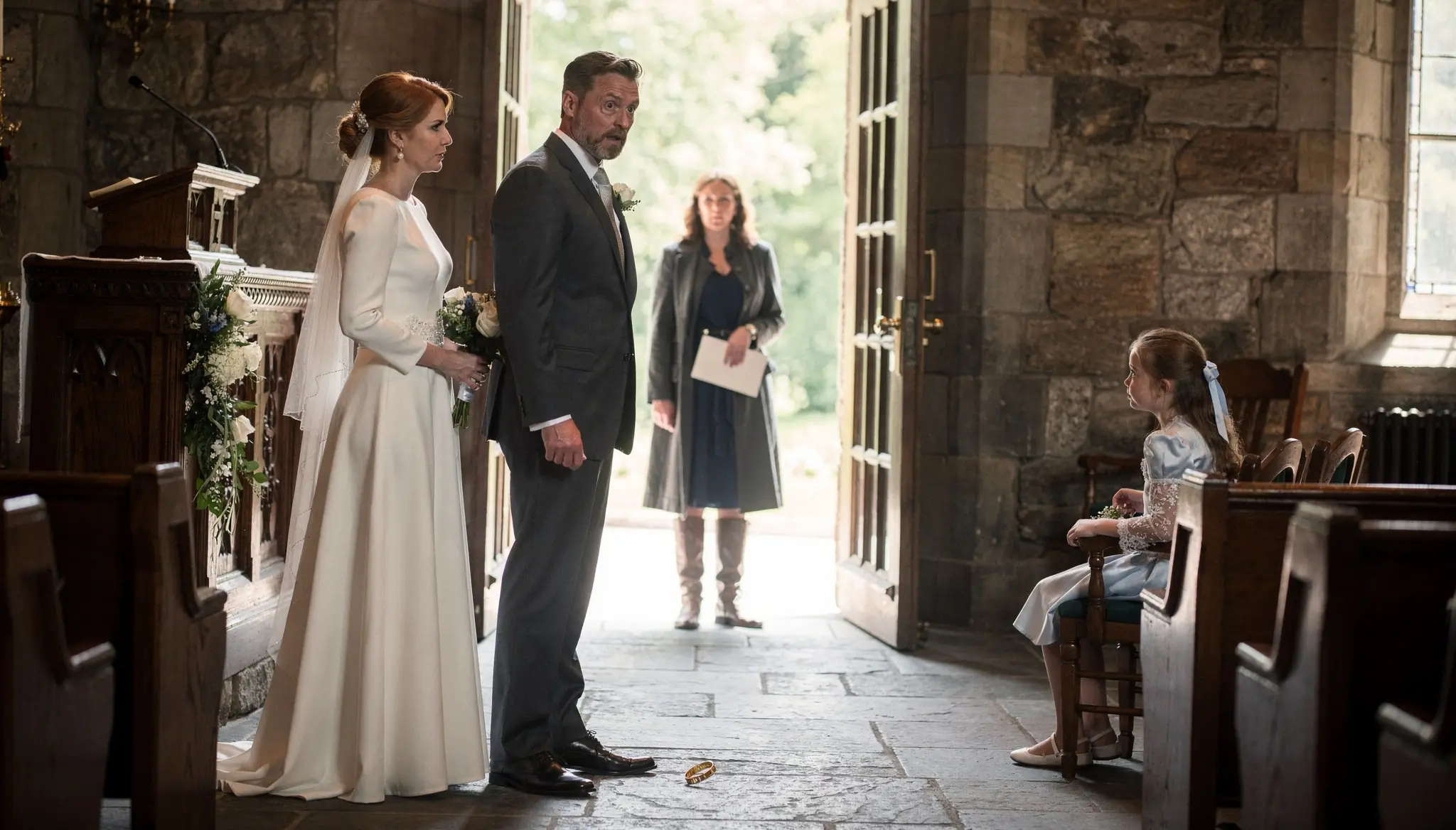
She looked past him, straight at the bride, and said the marriage in front of them was built on the very reason she had disappeared in the first place. Before hundreds of guests, the wedding folded into something closer to a trial. Caleb had spent two years learning how to love again, standing in that stone chapel beside Evelyn Hartwell, the woman who ran one of the oldest hospitality and property companies in Boston. Nora, his daughter, sat in the front row in a pale blue dress, and beside her she had left one seat empty, the way she always did at family gatherings, a small private ritual for the mother she barely remembered. Evelyn had built her entire adult life around control, around board meetings and quarterly reports and yet nothing in her boardroom training had prepared her for a ghost walking through double doors in soft daylight. Sebastian Blackthorn, chairman of the Hartwell Meridian board and Evelyn's uncle by marriage, rose from his seat immediately, already calling for security before anyone else had found their voice. His face had drained of color and beneath his outrage there was something sharper, something closer to fear, though only Evelyn would later recognize it for what it truly was.
He insisted the woman was an impostor chasing a payday, a stranger exploiting a tragedy for money, and he wanted her removed before she could finish a single sentence. Evelyn lifted a hand and stopped the security guard cold because something about the woman's face, weathered but familiar from an old personal photograph, told her this was not a stunt. Mara said the Hartwell family had forced her to vanish, and then she placed a plain envelope on the altar table between the flowers. Her hand trembled only slightly as she let it go.
The chapel had gone utterly silent by then, the string quartet frozen mid-note, every guest holding their breath as though the wrong movement might shatter whatever fragile thing was unfolding at the front of the room. She told Evelyn to look inside before making any decision about the wedding, and to remember that a signature does not lie even when the person behind it insists otherwise. Evelyn opened the envelope with the kind of composure she used in hostile takeovers and found a wire transfer order dated three days before Mara's disappearance carrying a signature that looked exactly like her own. Caleb stood frozen between the two women who had shaped the last decade of his life, unable to speak, his mind refusing to accept that his wife's voice, thought silent forever, was filling the chapel again.
Evelyn did not defend herself and did not attack Mara. She simply turned to the guests and announced, in a voice that barely shook, that the wedding was postponed until she understood exactly what she was looking at. The guests were escorted out under a light drizzle, their whispered questions trailing behind them like smoke, while Caleb, Evelyn, Mara, Sebastian, and the Hartwell family attorney remained behind in the emptied chapel. Mara explained that seven years earlier, she had discovered tens of millions of dollars missing from the employee pension fund at Hartwell Meridian, quietly rerouted through a chain of shell companies registered in three different states.
When she prepared to hand her findings to federal investigators, someone produced forged records suggesting Caleb himself might be charged as an accomplice in the scheme, a threat aimed not at her but at the man she loved. The person behind the threat went further still, promising that if she did not disappear entirely, Caleb would lose custody of Nora on manufactured grounds that would be nearly impossible to challenge. Mara fled under a borrowed name, moving through three cities before settling somewhere quiet, and she insisted she had spent every one of those years gathering proof strong enough to finally clear her family's name. Caleb could not reconcile the woman standing before him with the silence he had endured through birthdays and school recitals she had missed without sending a single word through any channel at all.
Sebastian urged her privately to call the woman a fraud on the spot, warning that Hartwell Meridian stock would open the following morning already bleeding value if the story reached the financial press first. Evelyn refused, telling him flatly that she would not build her marriage or her company's future on a lie convenient enough to protect quarterly earnings. As the four of them stood among cooling candles and drooping flowers, Mara turned toward Caleb with an expression that carried both hope and dread in equal measure. She told him she had not returned only to expose the fraud buried inside Hartwell Meridian's books.
She admitted quietly that some part of her still believed the marriage between them had never truly ended, only been interrupted by forces neither of them had chosen. Caleb said nothing because there was nothing honest he could say yet and the silence between them stretched longer than either of the women standing nearby. Seven years before that afternoon, Caleb and Mara had lived a modest contented life in a narrow row house on the edge of Boston. They were neither wealthy nor privileged, but both of them were certain of each other.
They had married young in a courthouse ceremony followed by cake and coffee at a diner two blocks from Caleb's first architectural apprenticeship and neither of them had ever imagined wanting anything grander than that. Mara kept a small garden along the back fence. Tomatoes and basil crowded together in mismatched pots, and Caleb used to tease her that she treated the vegetables with more patience than she treated him during his worst deadlines. Nora had been a toddler then, barely old enough to walk steadily across the kitchen floor, and the three of them had built a life that felt, in memory, almost unbearably ordinary and safe, filled with small rituals like Sunday pancakes and evening walks around the block that neither Caleb nor Mara had ever once taken for granted.
Mara worked in internal audit at Hartwell Meridian, a steady job with decent benefits, until she was assigned to review a redevelopment project tied to one of the company's oldest hotel properties. She grew anxious in the weeks that followed, taking calls in the stairwell instead of at her desk, hiding printouts inside cookbooks she never opened for actual cooking. One gray morning she kissed Caleb goodbye at the door, promised she would explain everything soon, and never came home again. Investigators found her car abandoned near a stretch of coastline outside the city, keys still in the ignition, no body and no clear evidence of what had happened to her.
Detectives eventually concluded she had either suffered an accident on the rocks below or chosen, for reasons no one could determine, to walk away from her own life entirely. Caleb spent years combing through that same stretch of coast, hiring investigators he could barely afford, exhausting savings meant for Nora's education on leads that always went cold. He kept a folder of every tip that came in, most of them worthless, a few cruel enough that he learned to stop hoping before he finished reading them. And he drove out to the coastline alone on the anniversary of her disappearance every single year, regardless of the weather.
He turned down every well-meaning introduction friends attempted, unwilling to build something new on top of a grief that refused to close. Once a court finally declared Mara legally deceased, he redirected what remained of his energy toward raising Nora and rebuilding the small architectural firm that bore his name, restoring old theaters and courthouses instead of designing anything new. Two years before the wedding, that quiet, careful life intersected with Evelyn's when his firm was hired to evaluate a crumbling 19th-century theater that Hartwell Meridian intended to demolish for a parking structure. Caleb was the only person in the room willing to tell Evelyn, plainly and without flattery, that the decision was a mistake dressed up as progress.
Rather than dismiss him, she challenged him to prove it within thirty days, and something in his stubborn honesty caught her attention in a way polished executives never had. Professional respect deepened slowly into something warmer over the months that followed, built through long visits and longer conversations about buildings that refused to be forgotten easily. They would sit together on overturned crates in half-renovated lobbies long after the rest of the crew had gone home, talking about everything except the things that actually frightened them, until eventually those conversations turned toward grief and loneliness neither of them had admitted to anyone else. Evelyn found in Caleb a rare kind of steadiness, a man who had survived enormous loss without letting it curdle into bitterness, and Caleb found in her a fierce, private tenderness hidden beneath the armor she wore into every boardroom.
She never once tried to replace what he had lost, and he never once expected her to. And it was that absence of pressure, more than anything else, that allowed something real to grow quietly between them. When Mara finally revealed, in the aftermath of the interrupted wedding, that the very theater where Caleb and Evelyn had met also concealed a piece of the evidence she had hidden years earlier, the coincidence struck Caleb like a second collision. It meant the past he had mourned, and the future he had chosen were somehow tangled around the same building, the same walls he had once fought to save.
News of the interrupted ceremony spread through Boston faster than any of them anticipated, and by the following morning, reporters were already framing Caleb as a man suspended between two wives, one presumed dead and one very much alive. Evelyn found herself painted as a woman who had unknowingly married the husband of a missing employee, a headline crueler and less accurate than anything she had faced in decades of running the company. Legal counsel confirmed that because a court had formally declared Mara deceased, Caleb's marriage to Evelyn would have been valid had it proceeded. Yet Mara's sudden return still opened a thicket of legal questions no one could resolve quickly.
Caleb chose to leave the Hartwell estate and return to his old apartment across town, unwilling to remain under the same roof as either woman until he understood what had truly happened seven years earlier. The apartment still held boxes he had never bothered unpacking, remnants of a life he thought he had closed for good, and sitting among them again felt like stepping backward into a version of himself he no longer recognized. Evelyn respected the distance he needed even as it left her feeling suddenly and unfamiliarly alone in a life she had only just begun sharing with someone else. In a brief careful visit Mara met with Nora for the first time since her daughter was a small girl and the meeting unfolded nothing like either of them might have imagined from old photographs.
They sat across from each other at a small cafe table, coffee cooling untouched between them, each woman searching the other's face for some trace of the family they had lost. Nora studied her mother the way a stranger studies a photograph that almost but not quite matches a memory trying to reconcile the woman across the table with the blurred shape she carried from early childhood. Nora did not embrace her mother and she did not lash out in anger either. She simply asked why Mara had never trusted her father enough to face the danger together as a family instead of disappearing without a word.
Mara had no answer that satisfied even herself. And the question settled over her like a weight she would carry for the rest of the visit. Before they parted Nora added quietly that she was not asking her mother to earn back seven years in a single afternoon. Only to stop treating the truth like something too fragile for her daughter to handle. Meanwhile Sebastian convened an emergency session of the board arguing that Evelyn's personal entanglement had thrown the entire company into crisis at the worst possible moment.
Conrad Winthrop his closest ally on the board proposed suspending Evelyn's operating authority until the situation resolved itself framing the move as protection rather than punishment. Evelyn sensed something rehearsed in how quickly the board had organized itself around Mara's return, as though certain members had anticipated this moment long before it arrived. That suspicion sharpened into something colder when a grainy video surfaced online showing Mara stepping out of a car registered to a shell company with financial ties reaching back to Sebastian Blackthorn himself. The footage spread through financial circles within hours, and Caleb watched it with a sick, sinking feeling that the woman he had mourned might now be working alongside the very people who had once threatened his family.
Mara explained that she had stolen the car from a storage facility belonging to that same shell company after discovering it held boxes of old records she believed had been scheduled for destruction. Caleb wanted desperately to believe her, and yet doubt had already taken root. Because Mara still remembered small private details from their marriage while carefully avoiding certain questions about where exactly she had spent those seven missing years. Evelyn hired an independent investigator with no connection to Hartwell Meridian's internal legal team, fearing that department had already been compromised by Sebastian's long reach within the company.
The investigator's early findings confirmed that the shell company owning the car had once received a substantial transfer from the very pension fund Mara claimed had been looted years earlier. Digging further, Evelyn's investigator located Mara's old personnel file buried deep in an archive that should have been permanently sealed after her disappearance. The folder itself looked untouched for years, its edges soft with dust, and yet the documents inside were crisp and clean, printed on paper stock that had not existed when Mara supposedly still worked at the company. That single detail alone told the investigators someone had quietly recreated the file long after the fact, backdating it to fit a story that needed telling.
It showed she had been formally terminated for embezzlement and theft of confidential data, a record entirely at odds with the whistleblower story Mara had told in the chapel. The termination carried an electronic signature matching Evelyn's own, dated to a period when company records confirmed that she had actually been overseeing operations at the London office, an ocean away. Caleb asked Evelyn, gently but directly, whether it was possible she had simply signed the document without reading it closely, trusting a subordinate's summary the way executives sometimes do. The question wounded her more than she expected, not because it was unfair, but because it revealed how easily even someone who loved her could hold a flicker of doubt in reserve.
Evelyn told him she intended to prove the truth regardless of what he believed in the meantime, and that she would not beg him to choose her while the investigation remained unfinished. Days later, the investigator delivered a breakthrough that shifted the entire shape of the case, confirming that Evelyn's supposed signature had been digitally copied from an unrelated document Sebastian himself had approved years earlier. It was not forgery in the crude, obvious sense, but a careful graft lifted from a genuine signature and pasted seamlessly onto records that had nothing to do with the original context. Evelyn stared at the forensic report for a long time, feeling something between relief and fury settle into her chest at once.
Relief because she had not unknowingly destroyed an innocent woman's life. Fury because someone inside her own family had used her name as a weapon without her knowledge or consent for the better part of a decade. Mara led Caleb and Evelyn to the old theater where Caleb had first proven himself worthy of Evelyn's trust, insisting she had hidden a physical ledger somewhere inside its walls before she vanished. She said only someone who truly understood the building's original architecture could locate the exact hollow space where she had concealed it, which was precisely why she had waited for Caleb to find it with her.
Caleb studied the aging blueprints under a flashlight beam, noticed an irregularity in the backstage framing that did not match the original construction drawings, and carefully pried open a hidden panel behind a support beam. Inside, instead of the ledger Mara expected, they found an old cassette recorder and a folded scrap of paper bearing a small embossed crest belonging to the Blackthorn family. Someone had clearly discovered the hiding place before them and removed the physical evidence, leaving only this cryptic remainder behind. The recorder still held a tape, and when Caleb pressed play, a conversation crackled faintly to life in the dusty backstage air.
The recording captured Mara speaking with an unidentified man years earlier, his voice threatening to send Caleb to prison unless she left Boston immediately and never returned. The voice had been electronically distorted, making it impossible to identify with certainty, though its cadence carried a chilling practiced calm that suggested long experience with intimidation. Caleb listened to the tape twice through, his jaw tightening with every pause and every clipped, deliberate threat, because the man on the recording seemed to understand precisely how to frighten a young mother into silence without ever raising his voice. Evelyn noted that whoever had made the recording had also taken care to protect it, wrapping the cassette in a waterproof sleeve and tucking it behind a support beam that had not been disturbed by a single renovation in decades.
It told her that Mara had never intended the tape simply as a private keepsake of her own fear. She had left it as insurance, a message meant for exactly this moment, when someone with enough standing inside Hartwell Meridian might finally be willing to listen. Partway through the recording, Evelyn caught a single line suggesting her own father had known about the scheme from its earliest stages, a detail that made her stomach drop even faster than the forged signature had. She had spent her entire life believing her father built Hartwell Meridian on integrity, and the idea that he might have shielded a fraud instead of exposing it threatened to unravel something far larger than one company's reputation.
While Caleb and Mara searched the remaining backstage corridors for any further trace of the missing ledger, old memories rose unbidden between them, softening the careful distance Caleb had tried to maintain. Mara told him quietly that she still loved him, and Caleb admitted some part of him had never fully stopped waiting for her, even as he insisted the man standing in that theater now belonged to Evelyn's future rather than Mara's past. Neither of them realized Evelyn had returned early and overheard the entire exchange from just beyond the backstage curtain. Evelyn left the theater alone that evening carrying the cassette recorder in her coat pocket but saying nothing to Caleb about what she had overheard.
He found her the next morning and tried to explain that lingering feelings for Mara did not mean he wanted his old marriage restored. That gratitude and history were not the same thing as a future. Evelyn asked, with more honesty than accusation in her voice, whether he could truly be certain of that when only days earlier he had believed Mara was dead and buried along the coastline he once searched for years. Caleb had no tidy answer to offer her. No promise he fully understood himself yet and he refused to manufacture false certainty just to comfort either of them.
Evelyn returned the engagement ring to him then, not as an ending she insisted, but because she would not let the ring become one more pressure forcing him toward a decision he had not truly made on his own. Mara, for her part, kept trying gently to rebuild something with Nora, careful never to push harder than her daughter could bear. Caleb soon discovered that Mara knew details about the wedding that troubled him deeply including the exact ceremony time and the location of a side entrance rarely used by guests. When he confronted her, Mara admitted she had been watching him for six months before finally walking through the chapel doors unable to work up the courage sooner.
She confessed she had seen him and Evelyn together on more than one occasion during that time standing close in a way that told her everything she feared to hear directly. Caleb asked why she had waited until the exact day of the wedding to finally reveal herself, rather than reaching out privately at any point during those months of watching from a distance. Mara claimed every letter she had tried sending to Evelyn had mysteriously disappeared before reaching her, and that the public chapel was the only place Sebastian's people could not quietly intercept her. Even so, something in her account still felt incomplete, as though she were shading the truth just enough to protect herself from a harder question waiting underneath.
Pressed further that evening, Mara finally admitted the direct threats against her life had actually faded roughly 18 months earlier, far longer ago than the six months she had originally claimed to Caleb. She had a real opportunity to come home safely well before that point, and for reasons she struggled to articulate even to herself, she had let that opportunity pass again and again. Mara confessed she had been terrified of Caleb's hatred, terrified Nora would refuse to know her, and terrified of facing prosecution for the false identity she had built to survive those years in hiding. She also admitted, quietly and painfully, that she had hoped Caleb might still be waiting for her, and that seeing him build a genuine life with Evelyn had left her paralyzed between grief and jealousy she was ashamed to name aloud.
Caleb's anger surfaced sharply then, because being a victim of the Blackthorn family's cruelty did not erase the months where Mara had simply chosen avoidance over honesty, safety over her own family. Mara did not argue the point, because she knew, deep down, that he was right to be angry about at least that part of her long absence. While Caleb and Mara worked through the wreckage of their shared past, Sebastian summoned Evelyn privately and offered her a stark choice meant to end the entire crisis in one stroke. He told her to publicly denounce Mara as a con artist, end her relationship with Caleb entirely, and in exchange he would guarantee her position as chief executive remained untouched by the board.
If she refused, he promised to bring a formal vote to remove her from leadership for the week's end, framing her personal choices as unforgivable instability at the company's helm. Evelyn refused the arrangement without hesitation, even knowing full well what the refusal might cost her professionally and financially. Instead, she announced an independent audit of the pension fund and stood before assembled executives to admit that Hartwell Meridian may have destroyed an innocent employee's life to protect its own image. The admission landed like a controlled detonation inside the company's carefully managed public narrative, and Sebastian's fury was immediate and unmistakable.
The following morning, Sebastian formally announced a board vote to remove Evelyn from her position as chief executive, scheduling the meeting for the earliest possible date the corporate bylaws allowed. Determined to understand exactly how deep her father's complicity ran, Evelyn returned to his old private office, untouched since his death, searching drawers she had never bothered opening before. Hidden inside a locked compartment, she found copies of letters Mara had sent years earlier, proof that they had indeed reached Hartwell Meridian's offices before being deliberately intercepted and buried. The envelopes were still sealed with the company's internal mail stamp dates, confirming they had arrived well within the window when investigators might still have acted on Mara's warnings.
Evelyn ran her thumb over the faded ink of her own name written across the front of each one, imagining a version of the past where those letters had actually reached her desk instead of a locked drawer. Beside them lay a letter her father had written but apparently never sent. A confession admitting he had learned of Sebastian's illegal transfers and initially intended to expose them publicly. He explained he had ultimately been persuaded that exposing the fraud would cost thousands of ordinary employees their jobs and so he chose silence over accountability, protection of the institution over protection of one honest woman.
Reading her father's own handwriting, Evelyn understood he had not personally engineered the scheme, but his willful silence had allowed it to flourish and had allowed Mara's life to be quietly erased without consequence. Tucked within the same letter was a reference to the original ledger being moved from the theater to the very first hotel the Hartwell family had ever built, a property known simply as the Hawthorne Grand. Drawing on his architectural training, Caleb identified an archival storage space sealed off decades earlier during one of the hotel's many renovations, a space that did not appear on any current floor plan available to the public. Racing against Sebastian's timeline, Evelyn, Caleb, and Mara traveled to the Hawthorne Grand together before anyone loyal to Sebastian could reach the archive first and destroy what remained inside.
The hotel's oldest wing had been closed to guests for years, its hallways lined with dust sheets and old furniture, waiting for a renovation that never quite began, and their footsteps echoed strangely against the marble as they searched for the sealed storage room. Caleb located the space behind a false wall, exactly where the old blueprints suggested it should be. Hidden so carefully that generations of hotel staff had likely walked past it without ever suspecting anything lay beyond the plaster. They located the missing ledger at last.
Its leather cover was cracked with age. Its pages dense with names and figures documenting years of quiet theft. To their frustration, the single page identifying the person who had originally ordered the fraudulent transfers had been carefully torn away, leaving only a jagged edge where the truth should have been. Mara then revealed she had kept that missing page separately all along, unwilling to surrender it until she felt certain of exactly whose name it would expose. The second name written on that missing page belonged not to a stranger, but to Conrad Winthrop, the very attorney who had once helped Caleb finalize the legal declaration of Mara's death.
Conrad had approached Caleb voluntarily years earlier, presenting himself as a sympathetic fair-weather friend eager to help, all while quietly ensuring that any promising leads suggesting Mara might still be alive was buried before it reached investigators or the press. Caleb felt something twist painfully in his chest as he realized the man he had once trusted as an ally had in fact helped steer him gently but deliberately toward abandoning hope altogether. Mara explained she had withheld the final page for so long because she genuinely did not know whether Evelyn herself might also be implicated somewhere in the conspiracy's tangled roots. This time, though, she chose to hand the page directly to Evelyn without hesitation.
A small but meaningful act of trust after years spent trusting almost no one at all. Sebastian, sensing the walls closing in around him, called Evelyn personally and offered one final deal, promising to leave Caleb and Nora entirely alone if she agreed to hand over both Mara and the recovered ledger. His voice on the phone was almost gentle, almost fond, the same tone he had used when, as a girl, he taught her to sail off the family summer property. That gentleness made the threat underneath it somehow more chilling than if he had simply shouted.
He reminded her that he had helped raise her after her mother passed. That he had sat beside her hospital bed during a childhood illness no one else in the family had bothered to remember. And he asked whether she was truly willing to destroy him over a woman neither of them had known existed a month earlier. Evelyn's hand tightened around the phone. And for a moment, the old childhood loyalty pulled at her harder than she expected it to.
Evelyn recorded the call from start to finish, her hands steady even as her heart pounded against the reality of what she was doing to a man who had raised her like a father figure for much of her adult life. When Sebastian realized, moments too late, that the conversation had been captured in full, he moved quickly to control the narrative, feeding reporters a story claiming Evelyn had secretly conspired with Mara to fabricate evidence against the company's own leadership. Panic rippled through shareholders almost instantly, and the board scrambled to convene the emergency vote Sebastian had already scheduled, now with even higher stakes attached to it. Standing just outside the boardroom doors, Caleb turned to Evelyn and told her he had finally made his choice.
But before he could finish the sentence, she gently placed a hand against his chest and asked him to wait. Whatever he wanted to say, she told him, it deserved a better moment than the anxious hallway outside a corporate battlefield. Caleb nodded, understanding, and the two of them walked into the boardroom together, unified in purpose, if not yet in resolution. Inside, Sebastian opened the meeting by attacking Evelyn directly, accusing her of letting a stranger's returning wife dictate the future of an entire company built across generations.
His voice carried the same practiced authority it always had in that room, the tone of a man who had spent decades assuming no one would ever dare question him beneath the Hartwell name. Several directors shifted uncomfortably in their seats, unwilling to meet his eyes, sensing already that the ground beneath his certainty had begun to crack. Conrad insisted the recovered ledger was fabricated evidence and dismissed Mara outright as a fugitive who had abandoned her own family before resurfacing to extort a wealthy corporation. Evelyn did not attempt to defend her position by denying responsibility or deflecting blame onto others in the room.
Instead, she openly acknowledged that Hartwell Meridian had failed catastrophically to protect Mara Rowan, and she read her father's unsent letter aloud to the entire board, sacrificing the family's carefully polished legacy in service of the truth. Mara herself walked into the boardroom moments later, agreeing publicly to submit to a formal investigation regarding the false identity she had used to survive, provided the assembled directors would finally hear her complete account without interruption. Caleb presented independent documentation proving the archival storage space at the Hawthorne Grand had been sealed years before Mara's disappearance, conclusively demonstrating the ledger could not have been recently manufactured as Conrad claimed. When the recording of Sebastian's threatening phone call played aloud for the assembled directors, the room fell into a heavy, uncomfortable silence that lasted for several long seconds.
Conrad attempted desperately to shift every ounce of blame onto Sebastian alone, but Mara produced additional internal documents bearing both of their signatures side by side, undermining any attempt to separate their culpability. The board voted swiftly to suspend both Sebastian and Conrad from their positions immediately, forwarding the entire case file to federal investigators for further criminal review. The scheduled vote to remove Evelyn from leadership was withdrawn entirely, with the directors instead expressing quiet admiration for how she had handled an impossible situation with unusual integrity. Even so, Evelyn chose to voluntarily step back from her role as chief executive for the duration of the independent audit, a decision that proved to everyone watching that she valued truth over the comfort of unchecked power.
Once the meeting finally ended, Caleb approached her in the hallway and extended the engagement ring toward her once more, but Evelyn paused and asked whether he was offering it out of love or simply out of guilt for the pain of the previous weeks. Caleb did not press the ring into her hand or demand an answer on the spot. He told her he needed to properly close the door on his past before he could honestly ask her to help him open a new one. In a quiet conversation at the old row house where he and Mara had once built their life together, Mara admitted she had spent months longing for everything to return exactly as it had been before her disappearance, only to realize that neither of them was the same person who had once shared that small kitchen table.
She walked with him through the narrow rooms one final time, pausing at the back door where her old garden had long since gone wild and untended, and told him she was grateful in a strange and complicated way that he had found someone capable of loving him without the shadow of her absence hanging over every quiet moment. Caleb listened without interrupting, understanding that this conversation was not really about winning her forgiveness or offering his own. It was about two people finally allowing a chapter to close on its own terms without pretending the ending was anything other than what it truly was. Caleb forgave her for vanishing, understanding now the impossible position she had been forced into, yet he refused to pretend seven years of grief and confusion could simply be erased by an apology, however sincere.
Mara agreed to complete the legal proceedings necessary to formally close their old marriage, and she began rebuilding her relationship with Nora patiently, one small visit at a time, without ever demanding forgiveness she had not yet earned. Six months later, the independent audit concluded, confirming every detail Mara and Evelyn's father's letter had described, and Evelyn returned to lead the company with an entirely reconstituted board and a new whistleblower protection program established in Mara Rowan's name. Employees whose pensions had quietly shrunk over the years received restitution, slow and imperfect, but real. And the company's new governance policies made certain no single family name could ever again shield fraud behind decades of inherited trust.
Caleb did not propose to Evelyn in a boardroom or at some lavish gathering designed to impress onlookers. He brought her instead to the same aging theater where they had first met years earlier, the building he had once fought so hard to save from demolition. He told her plainly that he was not choosing her simply because Mara had chosen to leave again. And he was not choosing her merely because she had sacrificed her position to protect the truth. He was choosing her because beside her, he no longer lived like a man perpetually waiting for a past that would never fully return to him.
He told her that for years he had measured every quiet room against an absence, always half listening for a door that would never open the way he hoped. And that Evelyn was the first person who had ever made him stop listening for it entirely. Evelyn accepted the ring this time without hesitation. Her eyes were bright in the theater's soft, worn light, and for a long moment neither of them said anything at all, content simply to stand together inside the building that had first brought them into each other's lives.
Together they planned a small, quiet wedding inside that very theater, a space that now belonged to both of their histories equally. The theater had been swept clean for the occasion, its worn velvet seats polished, its old stage lights rewired just enough to cast a warm glow across the small gathering of guests seated among the restored rows. Caleb had insisted on keeping the building's imperfections intact rather than smoothing them away entirely. The cracked plaster and the faded gold trim left exactly as they were because he believed a place that had survived so much deserved to wear its history openly.
Nora attended the small ceremony standing beside her father in a dress she had chosen herself, no longer leaving an empty seat beside her the way she once had out of habit and old grief. Mara sent a heartfelt letter of blessing rather than appearing in person, understanding at last that this particular day belonged to Caleb and Evelyn alone, not to any lingering threat of her own unfinished story. Just before Caleb slid the ring onto Evelyn's finger, a gust of wind caught the heavy doors at the rear of the theater and pushed them open unexpectedly, letting in a slice of daylight and a ripple of startled laughter from the guests. For one brief instant, Caleb's gaze drifted toward that open doorway, an old and familiar reflex he could not entirely suppress even now.
Evelyn did not ask who he thought might be standing there, and she did not flinch or pull away. She simply reached out and offered him her hand, steady and certain. Caleb turned back toward her, took her hand in his, and spoke his vows without a trace of hesitation because this time no ghost from the past could loosen his grip on the life he had finally chosen to hold on to.