Nolan Pierce walked into the mall to fix a jewelry store's flickering wiring, dressed in a plain work jacket and carrying nothing but a radio clip to his belt. Crossing the marble atrium, he heard a voice he had not heard in months call his name and turned to find his ex-wife standing beside a man in a tailored suit who radiated the confidence of someone who had never once been told no. Marissa smiled the way people smile at something they feel sorry for and introduced Nolan to her new husband as the maintenance man who used to fix things around their old apartment. Grant Blackwood barely glanced up from his phone as he shook Nolan's hand, then launched into a story about the deal he was about to close on this very mall.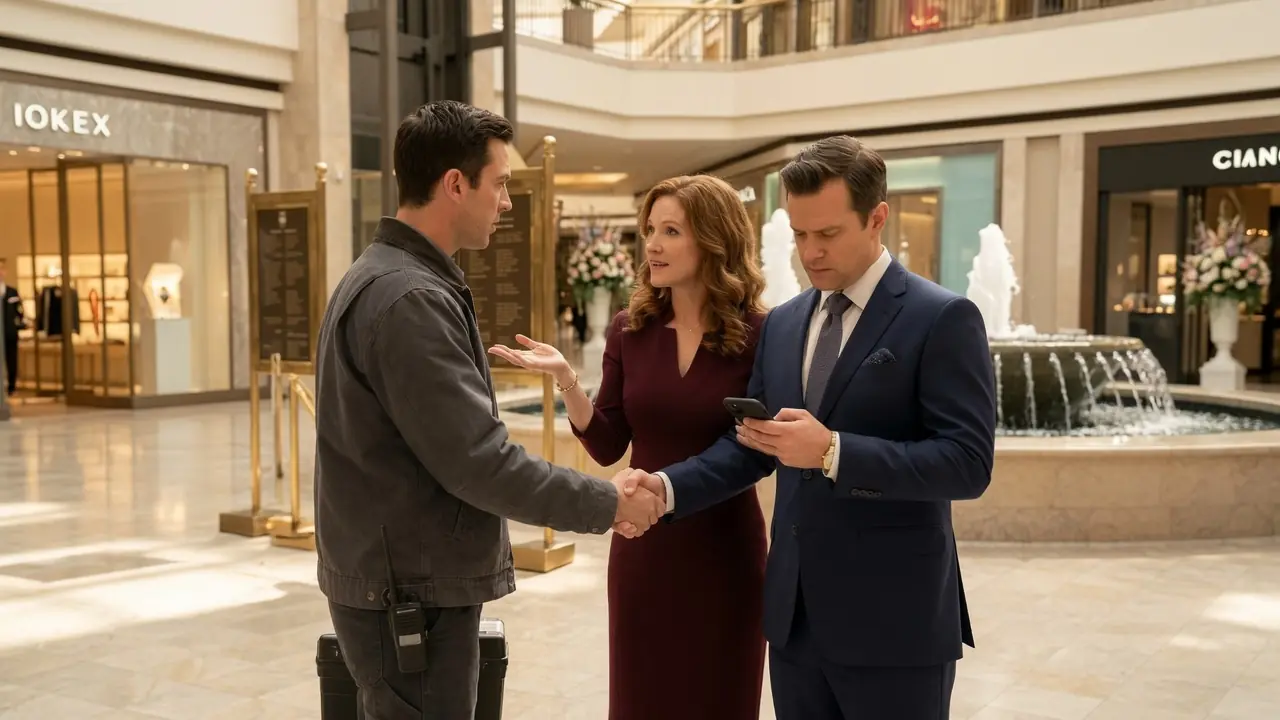
Neither of them noticed the small brass plaque near the elevator bank, the one bearing the name of the company that actually owned the building. Nolan said nothing. He simply listened and waited to see how far a man could sink before he realized he was already standing on the ground he despised. The atrium smelled faintly of espresso and fresh flowers from the kiosk near the escalators, and somewhere above them a string quartet was tuning for the evening's reception. The notes drifted down through the skylights like something out of a memory Nolan had almost let himself forget.
He noticed the way Marissa's laugh had changed since their marriage, brighter now, practiced, aimed outward rather than inward the way it used to be when it was only meant for him. He noticed, too, the way Grant's watch caught the light every time he gestured, a small habitual flourish that seemed designed to be seen. None of it wounded Nolan the way it might have years earlier. He simply filed it away the same patient way he filed away every small malfunction in the building around him, waiting for the right moment to address it properly.
Nolan arrived that afternoon the way he arrived most afternoons, slipping through a side entrance long before the atrium's afternoon crowd thickened into shoppers and strollers and teenagers clustered near the fountain. He was not there for the reception glittering under the skylights, the one with waiters carrying trays of champagne and a banner announcing an evening of investment opportunity. He was there because a jeweler on the second floor had reported a burning smell behind her display cases, and Nolan had learned, over many years, that the small warnings were the ones worth answering personally. It had become a habit nobody questioned anymore, the owner walking his own halls in scuffed boots, checking breaker panels and drainage grates with his own hands.
The staff who had worked there the longest understood exactly who he was, but at his own quiet request, they never made a show of it in front of customers. He preferred the mall to feel like a place where people simply did their jobs, rather than a stage where his presence turned heads. That anonymity had protected him for years, right up until the moment it collided with his past. Crossing the marble concourse, Nolan heard his name called in a voice that used to fill their kitchen every morning. He turned and found Marissa there, dressed in a gown clearly meant for the evening's reception, her hand resting lightly on the forearm of a broad-shouldered man Nolan had never met.
He explained that he was preparing to close on this very mall, certain that the current ownership was struggling and would soon have no choice but to accept his offer. Marissa added, almost proudly, that if the deal went through, Grant intended to transform the entire place. Grant looked around the atrium the way a man looks at a house he has already decided to gut, and declared that whoever currently owned the building clearly lacked the vision to make it worth anything. Nolan asked, quietly, whether Grant had ever actually met the owner. Grant laughed at the question, waving a hand as if swatting away something small and irrelevant, and said that men who owned buildings like this one only cared about numbers on a page, nothing more.
Before he walked away with Marissa toward the reception hall, Grant promised that by noon the following day, whoever currently held the deed would have no choice but to accept his terms. Nolan looked down at the business card Grant had pressed into his palm without quite realizing what he was doing, and understood with a strange and quiet calm that the man had just described him to his face without knowing it. The story of how Nolan came to stand in that atrium began years earlier, back when this mall was dying by inches, and nobody in Marissa's circle believed it was worth saving. In those years, Nolan worked as the facilities manager, the man who kept the failing air conditioning running and coaxed one more season out of an aging boiler while storefronts around him went dark one by one.
Marissa never understood why he poured so much of himself into a place that seemed destined to close, watching him come home late night after night, his shirt smelling of dust and machine oil, with no clear path upward that she could see. In her eyes, he had become a man without ambition, content to patch a sinking ship instead of finding solid ground. Nolan carried some of the blame for the distance that grew between them, since he rarely explained the plans forming quietly in his mind. He spent his evenings studying lease structures and cash flow statements that were not his to study, mapping the mall's hidden potential in notebooks he never showed her.
Marissa wanted the certainty of a stable life, something she could hold and plan around, while Nolan offered her only the shape of a future he had not yet built. The gap between what she needed and what he could promise widened until neither of them could bridge it, and the marriage ended quietly, without cruelty, but without rescue, either. Nolan still remembered the particular quiet of their last months together, the way conversations at the dinner table had thinned into logistics and silence, the way Marissa had started leaving lights on in rooms she was not in, as though she could not stand an empty house any more than she could stand an uncertain one.
He remembered standing in the mall's dim parking garage late one night, phone in hand, trying to find the words to explain a plan that still lived only in his head, and hanging up without saying any of it. He had told himself back then that actions would speak louder than explanations ever could, that if he simply built something worth trusting, trust would follow. It was a young man's mistake, the kind made by people who confuse patience with communication. And he had paid for it in the currency of a marriage he still, on quiet nights, wished he had fought harder to save. After Marissa left, the mall's original owner filed for bankruptcy within the year, and instead of searching for a new job, Nolan did something almost nobody expected.
He convinced a small group of investors, including a sharp and skeptical woman named Evelyn Sterling, to buy the failing property at a price low enough to seem foolish to anyone who had not studied it the way he had. He emptied his savings, took a loan against the small house he still lived in, and accepted a controlling share of stock in place of most of his salary, betting everything on a building most people had already written off. Over the following years, Nolan rebuilt the mall piece by piece, renegotiating leases, preserving the local shops that gave the place its character, and modernizing the systems he once repaired with his own hands.
As other early investors grew impatient and sold off their shares, Nolan quietly bought them back, one small transaction at a time, until he held a majority stake in the holding company that controlled the property. Today, he owned 61% of Harbor Line Retail Group, which meant that every decision about this mall, every lease, and every renovation ultimately passed through him. Evelyn, the sharp-eyed investor who had bet on him back when almost no one else would, liked to say that Nolan had bought the mall with money and rebuilt it with patience, two things most people never learn to spend wisely at the same time. She had watched him turn down offers to sell his shares for a quick profit more than once, choosing instead to keep reinvesting in the very tenants everyone else assumed were worthless.
And over time, that stubbornness had proven her right to trust him. Even so, Nolan never changed the way he lived. He avoided interviews, kept no portrait of himself in any office, and continued walking the halls in work boots long after he no longer needed to fix anything himself. Marissa only ever knew, in the vaguest terms, that he had gone to work for some kind of investment company after their divorce. And because their conversations since then had revolved almost entirely around their daughter, she had never once asked what that actually meant.
Back in the present, a message from Tessa Rowe buzzed against Nolan's hip as he stood near the elevators, informing him that Blackwood Urban Holdings had just requested an emergency presentation before the board that very evening. Grant, it seemed, was not interested in a simple partnership. He wanted full control of the mall, and he wanted it fast. Nolan typed back that the presentation should proceed exactly as scheduled, but asked Tessa to keep his identity as controlling owner out of any conversation with Grant or Marissa for now. He wanted to see, without the weight of his name hanging over the room, exactly what kind of man Grant became when he believed no one powerful was watching.
The trouble at the jewelry store turned out to be a scorched outlet behind a display case, filling the air with the faint, acrid smell of overheated wire. While the maintenance team made their way up from the lower level, Nolan located the correct breaker himself and cut power to the affected circuit before it could spread any further, his movements quick, practiced, and utterly calm. The store owner, a woman named Diane, who had leased the same corner for nearly two decades, pressed a hand to her chest and thanked him twice, calling him by name in a way that made Grant's brow furrow just slightly, though he said nothing of it.
Nolan crouched beside the outlet, running his fingers along the blackened plastic, already calculating in his head which section of the building's aging wiring would need to be prioritized in next quarter's maintenance budget. It was the kind of small, unglamorous decision that never appeared in any glossy investment proposal, the kind that only a person who actually cared about the building would ever bother making. Grant watched the whole exchange with mild impatience, the way a man watches a delay he considers beneath his attention. Grant happened to be standing nearby with Marissa, watching the scene unfold, and mistook Nolan's quiet authority over the arriving technicians for nothing more than the confidence of an experienced repairman. Grant used the moment as an illustration for his wife, remarking that this was exactly the difference between people who fixed problems and people who owned buildings.
One kind of person, he explained, spent their life solving small emergencies for someone else's benefit, while the other kind made the decisions that mattered. Nolan heard every word and said nothing, letting Grant's certainty fill the silence he left behind. Once the outlet had been secured, Grant returned to describing his renovation plans with even more enthusiasm than before, explaining that he intended to demolish the entire West Wing, home to a cluster of family-run shops, and replace it with a corridor of luxury fashion brands. Nolan asked, simply, what would happen to the tenants currently leasing that space? Grant answered without hesitation that business was not charity, and that any shop failing to generate sufficient profit would have to make way for someone willing to pay more.
Marissa felt a flicker of discomfort at the coldness in his voice, though she still found herself defending him, telling Nolan that Grant was only doing what was necessary to elevate the property. Grant turned to Nolan then and asked, almost mockingly, whether he had ever considered doing something more with his life than fixing wiring for other people. Nolan replied that sometimes the person who understood a building most intimately was exactly the person best suited to own it. Grant laughed at that, a short, dismissive sound, and told him that men who repaired buildings rarely ended up owning them. At that exact moment, Tessa approached, nearly greeting him as Mr. Pierce before catching herself, informing him instead that the attorney and the board were waiting.
Nolan smoothly redirected the conversation, asking her to double-check a maintenance report instead, and Grant, misreading the entire exchange, assumed Tessa was Nolan's supervisor and even suggested she let him leave early to change into something more appropriate for the evening's reception. Tessa kept her expression composed and agreed to follow Nolan's instructions before slipping him a folder as she turned to go. Written across its cover in plain black letters were the words reserved strictly for the owner's copy of the acquisition proposal. Marissa's eyes caught the phrase just before Nolan tucked the folder beneath his arm, though she said nothing yet, filing the small detail away with the others that had already begun to accumulate. Nolan met Tessa and the mall's attorney, Avery Sloan, in a private office tucked behind the service corridor, far from the noise of the reception being assembled upstairs.
Avery laid out the irregularities buried inside Blackwood Urban Holdings proposal with the precision of someone who had spent decades reading contracts for exactly this kind of deception. Grant's paperwork claimed the mall's occupancy rate sat at only 68% when the true figure, verified independently, stood closer to 91%. By understating the property's value on paper, Grant hoped to pressure the board into accepting an offer worth nearly 40% less than the mall was actually worth. Worse, Blackwood's team had quietly approached several major retailers, encouraging them to delay their lease renewals, then used that very hesitation as evidence that the mall was losing tenants. Grant's redevelopment plan called for shutting down the entire West Wing within 18 months, terminating leases for 42 small businesses that had operated there for years.
If the deal collapsed the way Grant had engineered it, hundreds of employees stood to lose their livelihoods without warning. Tessa wanted Nolan to reject the proposal outright, immediately, before it went any further. Nolan disagreed, insisting that Grant should be allowed to present his case publicly, in front of the board and the assembled investors, so that his own words could become the evidence against him. Avery agreed with the strategy, pointing out that if Grant relied on his falsified numbers in front of witnesses, Nolan would have clear grounds to end every negotiation and warn off any financial partners considering the deal. Tessa leaned against the edge of the desk, arms crossed, still visibly frustrated that Nolan intended to let Grant dig his own hole in full view of everyone, rather than simply shutting the door on him now.
She had worked beside Nolan long enough to know his patience was not weakness, that it was closer to the deliberate stillness of a man waiting for the right moment to close a valve rather than wrestle with a flood. Still, she worried about what the delay might cost him personally as she watched him absorb insult after insult with a composure she was not certain she could have managed herself. Nolan caught the look on her face and offered her a small, tired smile, telling her that letting Grant talk was not the same as letting him win. Nolan made clear that his decision had nothing to do with Marissa or the sting of being underestimated in front of her.
Grant's contempt was a personal matter, small and forgettable, but a plan built to harm hundreds of working families was something else entirely, and that was the reason he intended to act. Grant himself walked into the service office moments later looking for a maintenance worker to join a pre-presentation inspection of the property. He wanted someone who understood the building systems first hand to help him argue that the infrastructure was outdated and desperately in need of investment. Seeing Nolan standing there, Grant decided he had found exactly the right man for the job, certain that Nolan would make the perfect witness to a story about a mall in need of rescue.
Nolan accepted without hesitation. Avery quietly asked whether he was certain about walking into that role, and Nolan answered simply that Grant wanted the person who understood this building better than anyone else at his side, and he intended to give him precisely that. Grant led the small group through the mall himself, gesturing toward section after section he planned to tear down, describing the local shops as relics of a bygone era that wealthy shoppers no longer wish to see. Nolan asked short, pointed questions about renovation costs, energy consumption, foot traffic patterns, and projected timelines for return on investment. Grant never answered any of them directly, instead deferring each question to an assistant trailing behind him while he continued painting his vision in broad, glowing strokes.
Marissa began to notice, almost against her will, that Nolan did not speak like an ordinary maintenance worker. He understood the value of individual sections of the property, the revenue generated by each floor, and even the specific lease terms governing several of the larger anchor stores. When the group reached the West Wing, a long-time shop owner stepped out to greet Nolan with unmistakable warmth and respect, and Nolan asked about her business by name, recalling without hesitation the exact date her lease was due for renewal. The shop owner, a soft-spoken man named Walter, who sold hand-repaired watches and clocks behind a scarred wooden counter, told Nolan quietly that business had been slow through the winter, but was finally picking back up now that the weather had turned.
Nolan asked about Walter's grandson, whether he had started his apprenticeship at the shop yet the way they had discussed months earlier, and Walter's face brightened at the question in a way that had nothing to do with money or leases at all. Grant assumed, without much thought, that Nolan was simply friendly with the tenants after years of fixing things for them. A brief power flicker interrupted the corridor lighting soon after, and Grant seized on it instantly as proof that the entire building was outdated and failing. Nolan checked the nearby panel, and quickly discovered that the outage had nothing to do with the mall's electrical grid, and everything to do with a testing device from Grant's own survey team, plugged carelessly into the wrong outlet. He restored power within minutes, quietly, without embarrassing Grant in front of the group watching.
Grant took credit anyway, telling everyone that his team had just helped uncover a serious structural issue worth noting. Marissa watched the whole exchange unfold and felt the first real pull of discomfort settle into her chest, a small unease she could not yet name. Near the end of the walk-through, Nolan glimpsed a renovation map Grant had left open on a table, one he had not meant to leave in plain sight. The entire West Wing had been marked in red ink, accompanied by a note instructing that all 42 leases be terminated immediately upon takeover. This directly contradicted what Grant had promised the board only days earlier, when he swore every current tenant would be protected under the new ownership.
With Tessa's quiet consent, since the document had already been formally submitted as part of Blackwood's survey materials, Nolan photographed the map before returning it to the table. When he handed the folder back, Marissa caught a clear, unmistakable glimpse of the words printed across its cover, identifying it as the owner's copy. This time there was no mistaking what she had seen, and no way to explain it away as coincidence. Marissa found Nolan later in a quiet hallway, tucked away from the noise of the gathering crowd. The fluorescent lights humming faintly overhead, her heels clicking against the polished floor in a rhythm that betrayed how uneasy she felt beneath her composed exterior.
She had spent the better part of an hour turning the small details over in her mind. The folder, the way the staff deferred to him, the ease with which he spoke about lease terms, most maintenance workers would never think to memorize, until the pieces had assembled themselves into a question she could no longer avoid asking. Her voice was low as she asked why a general manager would hand him a folder meant strictly for the owner. Nolan did not answer directly, asking instead why she still assumed he was the same man she had left behind all those years ago. Marissa admitted that he had never once told her about any changes in his life since their divorce, and Nolan reminded her gently that their conversations after the split had narrowed almost entirely to logistics involving their daughter.
She confessed that she had introduced him poorly to Grant, though she still assumed, even now, that he had simply been promoted into some kind of management or consulting role. Nolan chose not to correct that assumption yet, telling her only that she had introduced him according to what she believed rather than what she actually knew. The conversation drifted, almost inevitably, back toward the real reason their marriage had ended so many years earlier. Nolan admitted he had stayed silent too often during those years, trusting that hard work alone would eventually make itself understood without explanation. Marissa admitted, in turn, that she had been consumed by a fear of poverty and had become fixated on the idea that only a visibly successful husband could keep that fear at bay.
Grant appeared before the conversation could go any further, visibly irritated to find his wife standing alone with her former husband. Nolan showed him the termination map without preamble, asking directly why it contradicted the promises he had made to the board only hours earlier. Grant insisted quickly that the map was nothing more than a contingency plan, then told Nolan sharply to stop overstepping a position that was not his to question. Nolan asked whether Grant intended to tell the board the truth during his presentation, and Grant answered that the board only needed to hear whatever would get the deal approved. Grant later instructed an assistant to dig into Nolan's background, but the search returned little of substance, only confirming that he had once served as facilities manager before moving on to work for Harbor Line Retail Group.
Because the company's ownership structure ran through several layered holding entities, the assistant could not determine Nolan's actual role within it. Grant concluded with total confidence that Nolan was simply a long-time employee trying to appear more important than he was. He decided to use Nolan that evening as a kind of prop, a visual example of the working man who would supposedly benefit once the deal closed. Grant even prepared in advance an offer to promote Nolan to head of maintenance in front of the entire room, believing the gesture would look generous while quietly reminding Nolan of his place. Around the same time, Avery informed Nolan that an investment bank had already begun drafting a loan agreement based entirely on Grant's falsified figures.
What had started as one man's private arrogance was rapidly becoming a real transaction with real consequences. And if Nolan did nothing during tonight's presentation, Grant's lie stood a real chance of becoming permanent fact. The investor reception filled the atrium with soft light and the low hum of conversation, board members and bank representatives and shop owners mingling beneath the skylights while a small stage waited near the fountain. Grant stood at its center in front of the assembled crowd with Marissa beside him playing the role of supportive wife to a man about to close the biggest deal of his career. Nolan remained near the back of the hall with Tessa and Avery, still dressed in the simple suit he always wore, unremarkable among the crowd.
Grant began his presentation with the same distorted figures Avery had already flagged, describing the mall as a fading asset that only Blackwood Urban Holdings had the vision to save. Partway through, he called Nolan up onto the small stage without warning, introducing him to the room as a hard-working single father who had spent years fixing the building but never once had a real chance to rise. Marissa's stomach tightened as she realized Grant intended to use Nolan as a prop for his speech, and she murmured for him to stop, but Grant continued anyway. In front of hundreds of guests, Grant offered Nolan the position of head of maintenance once the acquisition closed, framing the new salary as the kind of stability a man in his position could only dream of. Nolan thanked him and declined.
Grant, mistaking the refusal for embarrassment in front of Marissa, pressed harder, asking whether a man in Nolan's circumstances could really afford to turn down an opportunity like this one. Nolan asked quietly one final question, wondering aloud whether Grant truly wished to continue his presentation using the numbers currently on that screen. Grant told him coldly that he should learn to recognize his own limitations. Just as the tension in the room threatened to spill over, Evelyn Sterling rose from her seat and made her way toward the small stage. Assuming Evelyn was the mall's true owner, Grant brightened immediately and invited her up to say a few words in support of the acquisition.
Evelyn did not take the microphone. She turned instead to Nolan and told the room plainly that the decision belonged to him since he was the controlling shareholder and true owner of the mall. Silence dropped over the atrium like a curtain falling. Somewhere near the back, a champagne glass clinked softly against a tray and then went still as though even the waitstaff understood something irreversible had just occurred. Marissa looked at Nolan, then at Grant, watching her husband's confidence collapse into confusion as his jaw tightened the way it always did right before he lost an argument.
He still refused to admit he had lost. On the screen behind them, Avery displayed the ownership structure of Harbor Line Retail Group, confirming that Nolan Pierce held 61% of the company and final authority over every decision concerning the mall. Whispers rippled through the crowd as guests turned to one another, some reaching for their phones, others simply staring at the two men on stage as though watching a magic trick they still could not quite explain. The man Grant had just offered a maintenance job was the very person he had come here to buy out from under. Nolan did not mock Grant or bring up the marriage that once connected them.
He simply asked Avery to walk the room through the discrepancies buried inside the proposal, one by one, in plain and measured language. The true occupancy figures, the real revenue, the actual lease agreements, and the hidden plan to shutter the West Wing all appeared on the screen in sequence, and the investors in the room began to understand exactly how badly Grant had misrepresented the mall's value. Nolan revealed the termination map showing 42 shops set to lose their leases, directly contradicting the promise Grant had made to the board only days earlier that every current tenant would be protected. A representative from the financing bank stood and announced without hesitation that the loan agreement would be suspended pending further review. Grant tried to push back, claiming Nolan had turned an ordinary business negotiation into a personal act of revenge because of Marissa.
Nolan answered that he had already known Grant was her husband before the presentation began, yet had still given him a fair chance to make his case honestly. What ended the deal was never the insult Grant had offered him, but the plan to deceive an entire board and displace hundreds of people from their livelihoods without warning. Nolan formally rejected the Blackwood Urban Holdings proposal on the spot. In its place, he announced a plan to reinvest in the West Wing himself, restoring the property without terminating a single lease held by a business currently in good standing. Marissa stood frozen at the edge of the stage, realizing that Nolan was not only wealthier than she had ever imagined, but had quietly become the very kind of leader Grant had only ever pretended to be.
Grant's hands trembled slightly at his sides as he fought to keep his voice level. The polished confidence that had carried him through the entire evening was now cracking at the edges. Though furious, he kept his composure and accused Nolan of hiding his identity solely to humiliate him in public. Nolan told him plainly that he had not hidden anything to test him, and had never believed a man needed to know he owned a building before choosing to treat him with basic respect. The words settled over the room, quiet and unanswerable, and for a moment nobody spoke at all.
Before leaving the stage, Grant warned that he would make certain every investor in the room learned exactly how Nolan had really acquired the mall in the first place, and Nolan understood, even as applause began to rise around him, that tonight's reversal was far from the final word. By morning, several articles had appeared online accusing Nolan of exploiting the mall's earlier bankruptcy to seize control of the property for far less than it was worth. Grant went further, claiming publicly that Harbor Line Retail Group had once endangered the savings of small investors and pension funds during the acquisition. Though the accusations were not entirely accurate, they carried enough weight to unsettle several board members, and an emergency meeting was called to address the growing concern among major tenants.
Reading the headlines over coffee that morning, Nolan felt the old familiar pull to defend himself loudly, to call every reporter who had run the story and correct them line by line. He set the feeling aside the same way he set aside most impulses that promised satisfaction but delivered nothing useful, reminding himself that a man who had spent years building quietly did not need to start shouting now just because someone had finally noticed him. Nolan chose not to respond with personal attacks of his own. Instead, he requested an independent audit of the entire acquisition process, inviting anyone with doubts to examine the records for themselves.
The results showed clearly that the mall had already been headed for closure before Nolan ever stepped in, and that his plan had not cost investors money, but had actually helped them recover the majority of their original stake while preserving hundreds of jobs in the process. Marissa discovered the truth almost by accident, glancing at Grant's laptop while he stepped out to take a phone call, the email thread still open on the screen where anyone could see it. She read it twice before she let herself believe what it actually said, that Grant had instructed his communications team to alter the timeline in the documents sent to reporters, shifting dates in ways that made his version of events appear more favorable.
When she confronted him, Grant insisted it was nothing more than a necessary strategy, a normal part of managing public perception during a difficult deal. He even asked Marissa to publicly confirm that Nolan had once been financially irresponsible during their marriage, a claim she knew was untrue. Marissa refused. Instead, she handed Avery copies of the emails Grant had sent to his communications team, proving beyond doubt that he had known the information he released to the press was false. She was not doing it to win Nolan back, nor out of any lingering affection for the life they once shared.
She acted because she finally understood that staying silent any longer would make her complicit in a lie she no longer believed. At the board meeting that followed, held in a conference room overlooking the parking structure where morning lights spilled across a long table of untouched coffee cups, the independent audit confirmed that Nolan had rescued the mall from closure years earlier, exactly as the records showed. Board members who had wavered under the pressure of the headlines now sat quietly, some visibly relieved, others simply reading through the auditor's findings a second time, as if to be certain they had understood correctly. The bank formally withdrew its financing offer from Blackwood Urban Holdings, and Grant's own company launched an internal investigation into his conduct during the failed acquisition. Grant was ultimately removed from his position overseeing the project. His reputation was damaged not because Nolan owned the mall, but because of the way he had chosen to pursue it. Nolan held no celebration and gave no victory interviews. He simply returned to Westbridge Galleria and resumed walking through the West Wing, checking on the very shops Grant had once planned to erase. A few days later, Marissa found Nolan sitting alone at a small coffee shop inside the mall, the late afternoon light falling through the skylights above them. She apologized for the way she had introduced him to Grant, admitting that for years she had told the story of their divorce as one where Nolan simply lacked ambition, because that version made her own decision to leave feel easier to carry.
Nolan accepted her apology without offering her false hope about rekindling anything between them. The coffee between them had long gone cold, forgotten in the quiet wait of the conversation. And outside the window, a light rain had begun to streak the glass, blurring the shoppers hurrying past into soft smears of color. He told her plainly that they had both made mistakes long ago, that he had failed to share the dreams quietly forming inside him, and that she had decided his worth before those dreams ever had the chance to take shape. Marissa admitted she needed time to think about her marriage to Grant, and Nolan did not push her one way or the other, asking only that any decisions involving their daughter be made calmly, without dragging Paige into conflicts that belonged entirely to the adults around her.
In the months that followed, the West Wing was fully restored without a single long-time shop losing its lease, exactly as Nolan had promised. Walter stood near the front with a pair of scissors in hand, waiting to cut a ribbon strung across his newly refreshed storefront. And Diane from the jewelry store had brought a small tray of pastries to share with anyone who stopped by, insisting it was the least she could do after everything the West Wing had been through. He attended the small reopening ceremony, but stood quietly near the back, letting the shop owners take their place at the center of the moment instead of himself. Paige arrived a few minutes late, teasing her father that he still wore the same old work jacket despite owning the entire building around them.
And Nolan simply replied that the jacket still worked fine, so there was no reason to replace it. In the story's final moment, Nolan crossed the same marble atrium where Grant had once humiliated him in front of a crowded room, greeted now by employees who nodded to him with quiet respect rather than deference. He still stopped to help a technician wrestling with a jammed door hinge along the way, because some habits built over years of hard work never really left him. He understood, standing there in the fading afternoon light, that the greatest victory was never Marissa learning the truth about his wealth, or Grant losing face in front of investors and reporters. The real victory was that Nolan no longer needed either of their approval to know exactly who he was.
Westbridge Galleria had belonged to him on paper for years before that fateful encounter in the atrium, but it was only after that chance meeting that Nolan finally understood his life had always belonged entirely to himself. Outside, the evening light slanted gold across the parking lot, and Nolan lingered by the entrance a moment longer than he needed to, watching families drift in and out through the automatic doors, watching a young father balance a toddler on one hip while fishing for his car keys with the other hand. It was such an ordinary sight, the kind he had walked past a thousand times without pausing, and yet tonight it settled into him with unexpected weight. He thought of all the years he had spent building something patiently, quietly, without ever needing anyone to notice.
And he thought of Paige, waiting for him now at a small table inside with two cups of hot chocolate already going lukewarm. Whatever Marissa decided about her marriage, whatever Grant's future held after tonight, none of it belonged to Nolan anymore. He had spent so long being defined by what other people believed about him that it took losing nothing at all to finally understand what he had never actually lost in the first place.