For five years, Martha Vance had believed she would die alone. Then, one evening in the summer of 1878, a stranger rode onto her Kansas ranch. He was carrying a letter, written by her dead husband ten years earlier.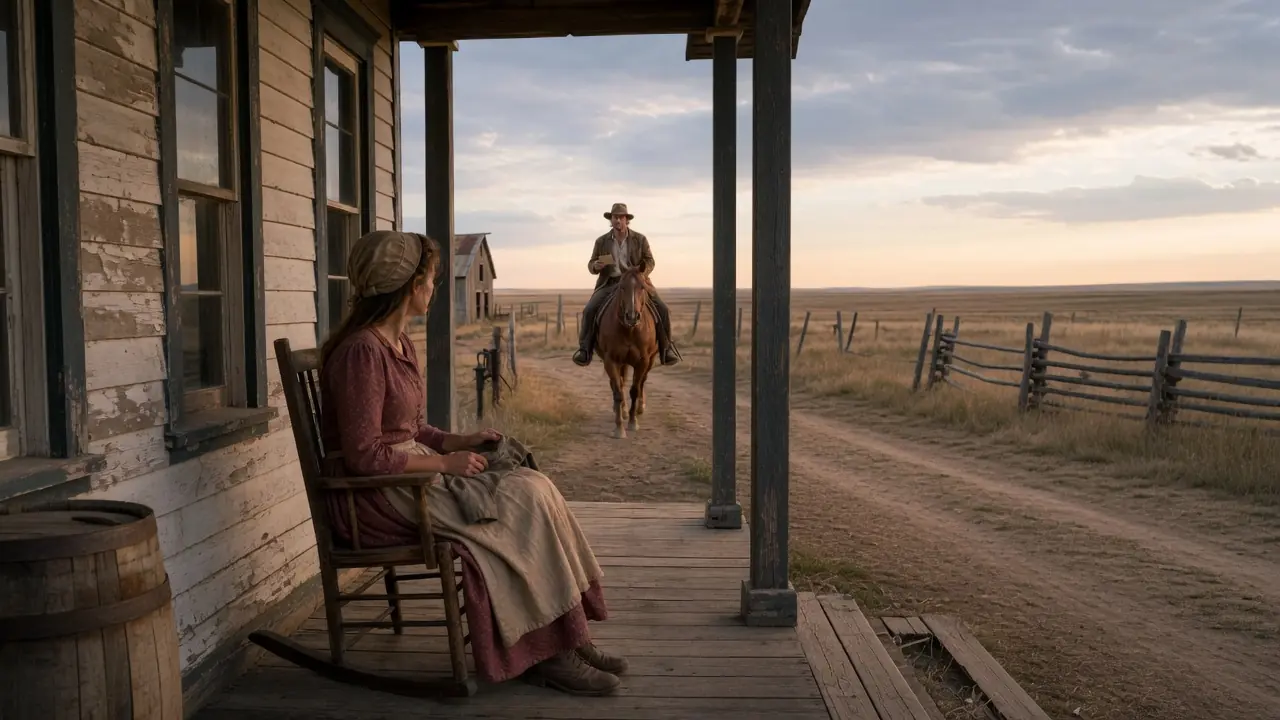
Martha stood frozen on the porch. Beside her, eleven-year-old Sarah clutched the skirt of her mother's faded red dress. The rider stopped beneath the dying sun, looking completely exhausted. Dust covered his heavy brown coat, and one of his boots rested awkwardly in the stirrup, as if an old injury made every mile painful. But it was not the man's worn face that frightened Martha; it was the yellowed envelope in his hand. Her name was written across the front in bold, slanted ink: Martha Vance. She recognized the handwriting before he even spoke. It belonged to William—the husband she had buried five winters ago, the man whose voice she had nearly forgotten in the howling prairie wind.
The stranger removed his hat, his hair dark and matted with sweat. "Mrs. Vance?" he asked.
Martha could barely breathe, the air feeling thick like wool in her lungs. "I am," she whispered.
The man dismounted slowly, his joints creaking with the weight of his journey, and walked toward the porch steps. "My name is Caleb Hale. I served with William during the war, and I rode with him again after we came west."
Sarah pressed closer to her mother's side. Martha stared at the envelope. On the back, William had written a date: 1868. Ten years earlier. This was three years after the war had ended, and five years before a fierce winter blizzard took William from their family.
"Why do you have my husband's letter?" Martha asked, her voice sharp with a sudden, defensive fear.
Caleb looked down at the dust between his boots. "Because I made him a promise," he said quietly, holding the envelope toward her. "The paper is brittle. He told me to bring it to you if I ever learned he was gone."
Martha did not reach for it, not yet. For five years she had raised Sarah alone on this unforgiving land. She had survived the droughts that cracked the earth like broken glass, fought the grasshoppers that ate the crops in a single afternoon, and endured winters so cold that ice formed on the inside of the bedroom walls. The previous December had been the hardest; Sarah had worn William's old wool shirt beneath her dress because Martha could not afford a proper winter coat for her daughter. Only three months earlier, Martha had almost reached her breaking point, standing at the gate with the deed in her hand, nearly selling the ranch to the bank for a pittance.
Now a stranger stood before her, holding a piece of the man she had loved—the voice of the man she knew before loneliness became the shape of her life. For five years Martha had kept William's boots beside the back door, moving them only twice: once when rain leaked through the roof, and once when Sarah tried to polish them for her father's birthday. Some evenings Martha still set three bowls on the table without thinking, staring at the third bowl for a long moment before quietly returning it to the shelf. Sarah had once asked, "Do you think Papa can still see the ranch?" and Martha had forced herself to smile, answering, "Every sunrise." But when Sarah went to sleep, Martha had stood alone at the window and wondered whether William could see how badly she was failing, and whether he knew how close she had come to losing everything they had built together. Now the answer to ten years of silence rested in a stranger's hand.
Caleb stepped closer. "I should have come sooner," he said. "But I spent years trying to find my way back. I was running from mistakes that were not all my own." His voice was steady, without pride, and heavy with regret.
Martha finally took the envelope, her fingers shaking so hard the paper crackled. Caleb had kept the envelope wrapped in thin oilcloth inside a worn leather Bible, allowing the paper to survive years of rain, dust, and hard travel. For one impossible moment, Martha imagined she could smell William again—the memory of his tobacco and the pine soap he used on Sunday mornings. Her knees felt like water, and she sat slowly in her old rocking chair, pressing the letter against her heart.
"Who are you really?" she whispered.
Caleb met her eyes, his gaze a piercing, honest blue. "I am a man who owes your husband his life," he said. Then he looked at Sarah, his expression softening into something resembling grief. "And I am a man who carried this letter for ten years because I was too ashamed of the man I had become to face your husband's family."
Martha looked from Caleb to the envelope as the evening wind moved through the tall golden grass. She had spent years believing the past was buried in the cold dirt; now it had ridden straight to her door. Martha looked up at the weary rider. "Why now?" she asked. "Why did it take ten years for this letter to reach me?"
Caleb lowered his eyes to his scarred, empty hands. "Because William never asked me to deliver it while he was alive. In 1868, William and I worked a freight route west of St. Louis. He had taken the work for one season because the ranch needed money for seed, cattle, and repairs. Before we parted, he gave me that envelope. He told me there was something inside, something he had never been brave enough to explain to you in person. He made me promise not to open it, and he made me promise not to deliver it unless I learned he was gone. He wanted to tell you himself one day."
Martha held the letter tighter.
"I believed he had returned home safely," Caleb said. "For years I pictured him here with you. I thought he was happy. But I was accused of attacking a man during a Reconstruction brawl. Years later, another man confessed that he had thrown the blow, but I lost nearly four years behind those stone walls. When I was released, I worked in the Nevada silver mines until I could afford a horse and the journey back east. I kept the letter wrapped in oilcloth inside my Bible every single day, searching for William whenever I passed through a cattle town. Yesterday, I finally reached Abilene. That was when I learned the blizzard had taken him five years ago." Caleb swallowed hard, the muscles in his jaw tightening. "I had kept my promise exactly as he asked. But I still arrived five years too late."
Martha felt a tear track through the dust on her cheek. She looked at the stranger's slumped shoulders; he looked like a man who had been carrying a burden far heavier than the miles behind him. "You've come a long way, Caleb Hale," Martha said, her voice softer now. "Tie your horse to the rail. There is beef stew on the stove."
Caleb hesitated, looking at the modest, clean house and at the woman in the red dress who still held her head high despite the weight of the world. "Thank you, ma'am," he said.
They went inside as the purple shadows of twilight swallowed the plains. The kitchen smelled of dried herbs and wood smoke—the smell of safety. Sarah took her place at the table and watched the stranger with wide, curious eyes. She was grieving the father she remembered only in fragments: his rough hands, his quiet rumbling laugh, and the way he had once carried her home through a sudden autumn snow.
"Who is he, Mama?" Sarah whispered.
"A friend of your father's," Martha said, her voice thick with emotion. "He brought us something precious, Sarah. Something we thought was lost forever."
Martha set the table with extra care, using the ceramic plates they had brought from back east—chipped but still clean and bright. The stew was plain but warm, made richer by the comfort of sharing a table with another living soul. They ate in a respectful silence, the only sound being the clinking of spoons. Martha kept the letter on the table next to her plate, not yet ready to open it, wanting to savor the feeling of it being there. It was as if William were sitting in the empty chair across from them.
"Tell me about him," Martha said. "Tell me about the man you knew when the world was on fire."
Caleb leaned back, his eyes searching the flickering candle flame. "William was the bravest man I ever met," he began. "We were in the cavalry together in Virginia. The mud was up to our knees and the hunger was a constant, nagging ache in our bellies, but William always had a song to keep us from fading. He talked about this land every night. He talked about a girl in a wine-red dress who was waiting for him."
Martha smiled, a small, painful flicker of light in her eyes.
"He told me he was going to build a kingdom for you," Caleb said. "He said the Kansas wind would whistle your name through the grass." Sarah leaned forward, her eyes wide with wonder. "He saved my life near the James River," Caleb continued. "My horse went down while we were crossing under heavy fire. I was trapped beneath the saddle in freezing water, but William turned his horse back into the gunfire. He jumped into that icy water without a second thought, pulled me free, and carried me to the bank. Even after a bullet grazed his shoulder, he didn't stop. I would not be sitting at this table today if your husband had valued his own life more than mine."
Martha remembered that jagged scar on William's left shoulder. He had told her it was just a fence wire accident, lying to keep her from worrying about his ghosts. He had sacrificed his safety for a friend and kept the secret to protect her peace of mind. Martha felt her heart swell with a pride that hurt. "That was William," she whispered. "Always carrying the weight for everyone else."
Caleb looked down at his hands. "There was another night I never forgot," he said. "We had not eaten since the previous morning. William had one piece of hard bread left in his pocket. He broke it in half and gave me the larger piece. I told him I was not hungry, but he laughed and said, 'Then eat it for me. I am too tired to chew.'" Caleb gave a faint smile. "I believed him until I woke before dawn. He was sitting alone beside the ashes holding his stomach because the hunger had become too painful. He would rather suffer quietly than let another man know he was in need."
Martha closed her eyes. That was the husband she remembered—a man who gave away what little he had, then pretended the sacrifice had cost him nothing.
Caleb nodded. "He wrote that letter three years after the war while we were hauling freight west of St. Louis. He was afraid, Martha—not of the road or the men we met along it, but afraid that if something happened to him, you would be left alone. He worried about you carrying the ranch, and he worried about you raising Sarah without a father." Caleb's voice broke as he looked away toward the dark window. "He was my brother, and I wish I had found you before you were forced to face those five years alone."
Martha reached across the table and touched his rough, scarred hand. "You are here now, Caleb," she said with firm grace. "A promise kept is never late in the eyes of God."
Martha drew a steadying breath and picked up a small, sharp paring knife. She carefully slit the top of the envelope. The paper inside was thin and fragile, crackling like dry leaves under a winter boot as she unfolded it with the reverence of a prayer.
My dearest Martha, it began. Her eyes filled with tears immediately, the script becoming a blur of grief and love, and she wiped them with the corner of her apron before reading aloud. I am writing beside a dying campfire on the Western Trail. Caleb is sleeping a few yards away. Tomorrow he and I will take different roads, and I do not know when our paths will cross again. I should be thinking about the miles ahead, but all I can see is you standing in the kitchen in your red dress. I see you laughing because I tried to dance with you while my boots were still covered in the thick mud of the fields.
Martha stopped reading, a broken laugh escaping through her tears. She remembered that night perfectly. It had rained for three days after their wedding, and William had pulled her into the yard beneath the storm clouds. There had been no music, only the thunder and the scent of wet grass, and they had spun in circles until they were dizzy.
Sarah looked at her mother. "What did he say, Mama?"
Martha touched the page with trembling fingers. "He remembered our first dance," she said, then continued reading.
I know the ranch is hard, Martha. I know the roof still leaks above the eastern room. I know Sarah wakes whenever the wind shakes her window, and I know you have gone without things you needed. You believed the ranch must always come first, but I have kept a secret from you. Before I rode west with Caleb, I buried a small iron box near the creek. My father brought what is inside home from California in 1849. I sealed the box in oilcloth and pine pitch. It is buried on the high bank above the creek beside the old oak tree at the bend in the water. Stand at the largest crooked root and walk twelve paces north. The box lies three feet beneath the flat gray stone.
Martha's heart skipped a beat.
I hid it because I wanted something to remain untouched. I wanted a safety net if every other part of our dream failed. Use it if the rain does not come. Use it if Sarah needs a warm coat or a safe home of her own. Use it to repair the roof. Make the house whatever color brings you joy, but do not save it simply because it belonged to me. A life spent only surviving is not the life I wanted for you. Tell Sarah that her father thought of her every day, and tell her I still remember how she wrapped both hands around my finger when she was small. And Martha, remember the night we danced in the rain. No matter how far the road carries me, that is where my heart remains. With you. Always yours, William.
Martha let the paper fall softly to the wooden table, sobbing with deep, soul-shaking releases. Sarah came around the table and threw her arms around her mother, crying too as she grieved the father she remembered only in fragments. Martha held her daughter tightly. For years, she had blamed herself, feeling like a failure whenever Sarah went to bed hungry, smiling while cutting her own blankets into pieces so Sarah would have enough wool around her shoulders, and almost selling the only home William had left them. Now she understood: he had tried to protect them all along, but the help had simply arrived too late to spare them the hardest years. That truth hurt as much as it healed.
Caleb stood up quietly, his face set in a mask of determination. "I'll get the shovel from the barn," he said, his voice thick with a soldier's respect, and walked out into the pale, silvery moonlight.
Martha and Sarah followed him, clutching a lantern between them. The night air was cool and smelled of wild sage as they walked down the slope to the winding creek. The old oak tree stood like a silent sentinel against the stars, its branches gnarled and ancient. Martha read William's directions aloud, and Caleb followed them one step at a time: One. Two. Three.
Martha held the lantern high, the yellow light dancing on the dark bark of the tree as Caleb began to dig. His muscles rippled under his sweat-stained shirt, the soil hard and packed by years of the Kansas sun. The sound of the shovel hitting the earth was sharp and rhythmic: Clang. Clang.
After twenty minutes of labor, there was a different sound—a dull, metallic thud. Caleb dropped to his knees, uncovering a flat gray stone. Beneath it lay a small iron box wrapped in layers of blackened oilcloth coated with thick pine pitch, exactly as William had written. Caleb lifted the box into the lantern light; it was far heavier than its size suggested. The latch had rusted along one edge, but the lid remained sealed until Caleb used the flat edge of the shovel to pry it open, the metal groaning and giving way with a loud crack.
Inside was a second lining of waxed cloth, and beneath it lay several rows of gold coins alongside a handful of small, raw gold nuggets. They caught the flickering lantern light, glowing like small fallen suns. Martha gasped, covering her mouth with her hand. It was a fortune for a woman who had known only scarcity. It meant a new barn, a fine school for Sarah, and an end to their fear of winter.
But Martha didn't look at the gold for long; she looked at Caleb. Caleb had never known what the letter contained, and until that night, he had not known that any gold existed. He had spent ten years carrying the path to a fortune, yet he had never broken the seal. He could have kept the letter, dug the box up in the middle of the night, and vanished into the West—but he had delivered it.
"You're a man of rare honor, Caleb," Martha said, her voice steady and full of new strength.
Caleb stood up and wiped his hands on his trousers. "I just did what William asked of me," he said simply. "I couldn't live with the ghost of a friend if I hadn't."
They walked back to the house in silence, the weight of the gold being nothing compared to the weight of the past being lifted. Martha felt a strange shift in her soul; the loneliness hadn't disappeared, but it had changed its shape.
The days became weeks, and summer slowly gave way to the crisp air of autumn. Caleb never asked to remain permanently, sleeping in the hayloft above the barn and never entering the house after Sarah had gone to bed. At first, Martha asked him to stay only until the autumn repairs were finished, but each morning Caleb found one more task that needed doing. He repaired the sagging fences, dug a deeper well that found sweet, cold water, and replaced the rotten boards above Sarah's bedroom before the first autumn rains arrived. He also helped Martha meet with the banker in Abilene, where the gold was deposited carefully, with only a small portion used at first, as Martha refused to let sudden wealth change her.
During those months, she and Caleb learned one another slowly. They ate supper together every evening and worked side by side in the garden. Some evenings they spoke about William; on others, they spoke about everything except the man who was gone. Caleb told Martha about the years he had wasted, believing that a man with a damaged name did not deserve a home. Martha told him about the night she had nearly sold the ranch, admitting her deepest fear was leaving Sarah alone. Caleb did not promise that nothing bad would ever happen, only saying, "If trouble comes, you will not face it by yourself." That promise meant more to Martha than the gold.
Sarah began waiting for Caleb beside the barn each morning, watching him from several steps away at first. Then, one morning, she brought him the small hammer that had once belonged to William. "Papa said this was the only tool that never lied," she told him.
Caleb turned the worn handle carefully in his hand. "Then I suppose we should give it honest work," he said. Together, they repaired the broken gate near the creek.
A week later, Caleb tied a rope to the old cottonwood tree and made Sarah a swing. The first time she sailed above the grass, her laughter carried all the way to the house. Martha stood at the kitchen window and covered her mouth, having almost forgotten that a child's laughter could fill an entire home. After that, Caleb taught Sarah how to whistle for the mare, how to recognize deer tracks after rain, how to repair a leather bridle, and how to carve small animals from cedar wood. When the first cold evening arrived, he returned from town with a thick, warm, dark blue wool coat for her. Sarah stared at it for a long time before throwing her arms around him, and no one spoke about the tears in Caleb's eyes.
The town of Abilene began to whisper. The sight of a widow and a mysterious stranger living on the same ranch was enough to stir a scandal. Mrs. Higgins, the banker's wife, stopped by one Tuesday. "It's a bit improper, don't you think, Martha?" she asked.
Martha didn't back down, standing tall in her faded red dress. "Caleb was my husband's closest friend," she said firmly. "He is a guest beneath my roof. He has treated both my daughter and me with honor, and he has done more for this land than your husband's bank ever did." Mrs. Higgins gathered her skirts and returned stiffly to her carriage, but Martha didn't care about the whispers; she was finally building a tomorrow.
One evening, after Sarah had gone to bed, Martha and Caleb sat on the porch beneath a million brilliant stars. The smell of dry sage filled the air. "I suppose I should move on soon," Caleb said, his voice hesitant. "People in town have begun talking. I will not repay your kindness by giving them a reason to question your name."
Martha felt a sharp pang of sadness. "You don't have to go, Caleb," she said softly. "You have never dishonored this house. You have brought more peace into it than anyone since William died."
Caleb stopped carving his piece of cedar. "Martha," he said, his voice trembling. "I'm a man with a dark past. You have the gold now; you can find a good man in town with a clean name."
Martha stood up and walked over to him. "I don't want a man who only knows how to count coins," she said. "I want the man who carried my husband's heart for a decade. I want the man who gave me back my hope." She reached out and touched his weathered cheek. "Loving you would not erase William," she whispered. "It would only mean that the life he saved for me did not end with his."
Caleb closed his eyes. "In those dark cells, I used to imagine a house with a lamp in the window," he said. "I never saw the woman inside clearly. I only knew that somewhere there might be a place where a man could be forgiven." He looked at her faded red dress. "Now I think I was dreaming of this porch, and perhaps I was dreaming of you."
The screen door creaked behind them. Sarah stood in the doorway wrapped in her quilt. "You do not have to be my father," she said softly. "No one could replace him."
Caleb lowered his head. "I know."
Sarah tightened the quilt around her shoulders. "But you could still stay." Then she went back inside and gently closed the door.
Caleb looked at Martha, standing up slowly and towering over her in the moonlight, and then he kissed her with a deep, aching tenderness. It was a kiss of homecoming, a promise of a different kind.
Caleb did not ask Martha to marry him that night, waiting instead until the first frost silvered the fields. By then, he had lived at the ranch for nearly four months, sharing their work and their meals. One Sunday morning, he took them to the old oak tree. He carried no ring, holding only a small cedar bird he had carved.
"I cannot offer you a clean past," he said to Martha. "But I can offer you every honest day I have left. I will only ask permission to love the family William left behind."
Sarah took Caleb's hand and placed it in her mother's. Martha smiled through her tears. "Then stay," she said. "Not as a guest, but as my husband."
They married two weeks later. Word of the wedding traveled through Abilene before Martha had even chosen the day. The blacksmith brought Caleb a newly polished horseshoe as a gift for good fortune, Mrs. Dalton from the bakery arrived with an apple pie and refused to accept payment, and even the banker quietly returned several fees Martha had been charged during her hardest years. Not everyone had treated her kindly, but enough people had watched Caleb work without complaint, seen him carry supplies for elderly neighbors, and watched him walk beside Sarah's horse until she was no longer afraid to ride alone. By the morning of the ceremony, the little church was filled.
The preacher took Caleb aside before the service. "You are not replacing the man who came before you," he said. "You are honoring the life he fought to protect."
Caleb looked toward Martha and Sarah. "That is all I have ever wanted to do," he replied.
There were no silk flowers; Sarah carried wild asters from the creek, and Martha wore the same faded red dress. When the preacher asked who gave the bride away, Sarah stood from the front pew. "No one, sir," she said. "Mr. Hale is the one joining our family." Even Mrs. Higgins had no sharp reply to that.
The years that followed were not free of hardship, but none of them faced another season alone. The widow who had once believed she would die forgotten grew old, surrounded by the family she thought life had denied her. Sarah became a teacher in Abilene and married a patient young doctor, raising three children who spent every summer at the ranch. The gold gave Sarah an education, but it was Martha and Caleb who taught her what made a home worth returning to.
Martha kept William's letter above the fireplace for the rest of her life, a constant reminder that loving the past did not require living inside it. Many years later, Caleb sat next to Martha on the porch. He was an old man now, his hand still resting firmly in hers.
"Did you ever regret it, Caleb?" she asked.
Caleb looked out at the Kansas horizon, where the sun was turning the grass into liquid gold. "Martha," he said, his voice roughened by age. "I spent half my life believing freedom meant never staying anywhere." He tightened his hand around hers. "But I never truly began living until I stopped riding."
The wind whispered through the tall golden grass, sounding exactly like a blessing from a long-lost friend.