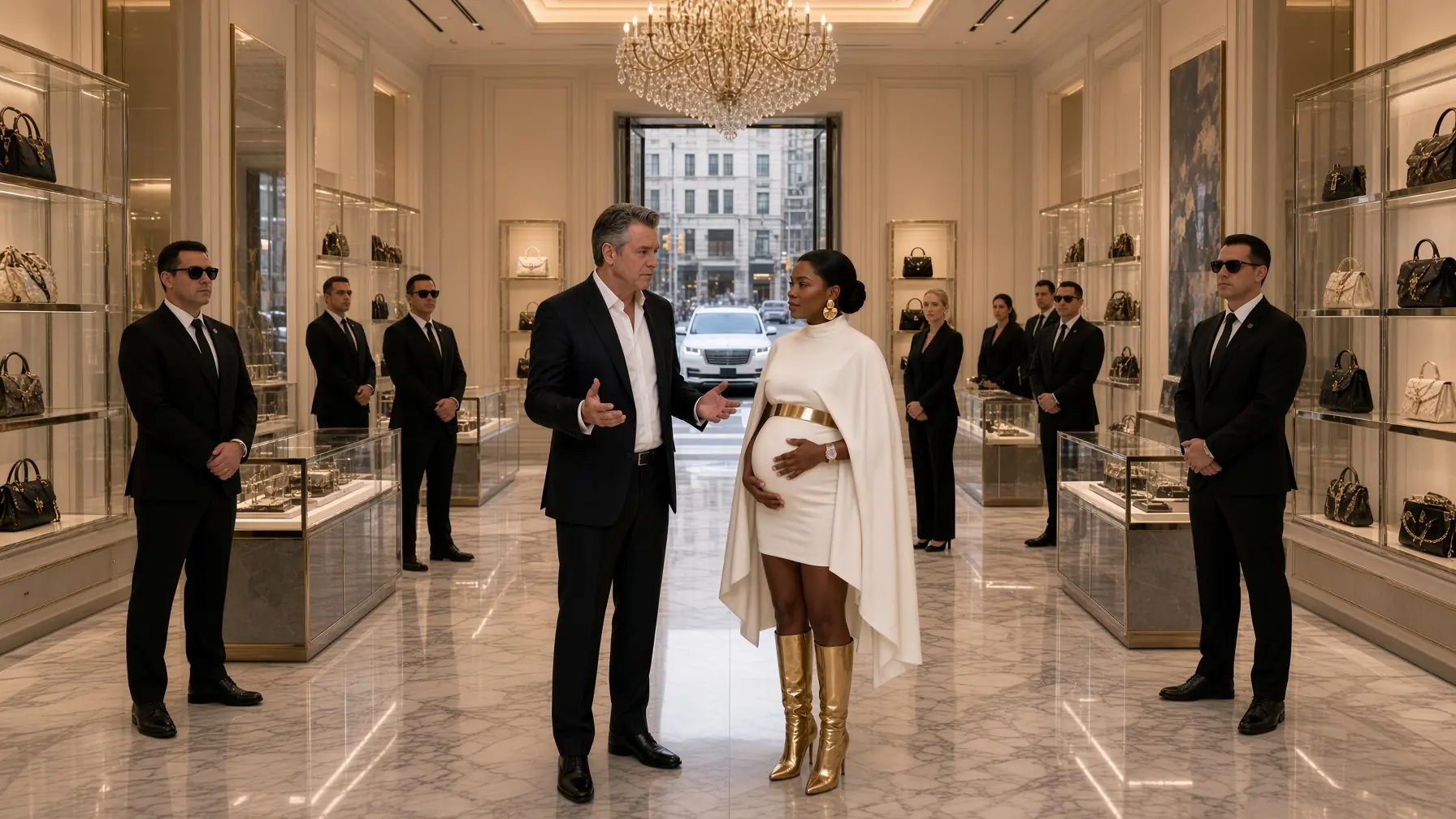
The slap cracked through the Madison Avenue boutique so sharply that every conversation stopped at once.
A row of diamond cases gleamed beneath the chandelier lights. Handbags worth more than most salaries sat behind glass like museum pieces. A salesperson froze beside a velvet tray, and a customer near the scarf wall lowered her champagne flute without realizing she had done it.
Naomi Sokolov stood in the center of Aurelia’s flagship store with one hand on her cheek and the other wrapped protectively beneath her seven-month-pregnant belly.
Her wrist monitor flashed red.
The little screen pulsed with rising numbers, heart rate climbing, blood pressure moving into dangerous territory. Naomi did not scream. She did not stumble. She simply stood there with her face turned slightly from the force of the blow, breathing carefully because her daughter was still inside her and rage could wait its turn.
The woman who had hit her was Claudia Voss, the store director.
Claudia was fifty-two, elegant, sharp-faced, and dressed in a black suit that made authority look expensive. Her hand was still raised, fingers trembling from the strike. For one strange second, she looked less like a manager and more like someone waking up after doing the thing she had always secretly wanted to do.
Then fear entered her eyes.
Not guilt.
Fear.
“She lunged at me,” Claudia said quickly, turning toward the security guards. “You both saw it. She became aggressive, and I defended myself.”
Nobody answered.
Because everyone had seen what happened.
Twelve minutes earlier, Naomi had walked into the store through the revolving glass doors at 2:41 p.m.
She wore a soft blue maternity dress, simple flats, a plain camel coat, and no visible jewelry except her wedding band and a medical alert bracelet. Her hair was pulled back neatly, and a worn leather folio rested under one arm. She looked comfortable, polished, and tired in the quiet way pregnant women look after moving through a city that never makes enough room.
She had a car waiting in forty minutes.
Her flight to Paris was later that evening.
Before that, she wanted to buy one anniversary gift.
The Aurelia flagship occupied the first three floors of a limestone building owned by Sokolov Urban Holdings, though most people shopping there never thought about who owned the walls around them. They thought about the brand. The marble. The mirrored elevator. The private rooms upstairs. The necklace collections with names like Celeste, Solenne, and L’Orée, all displayed beneath lights designed to make wealth look like destiny.
Naomi knew the building better than anyone on the sales floor.
She had reviewed every lease.
She had read every complaint.
And she had visited the store six times in the past five months under six different versions of herself.
Claudia noticed Naomi the moment she entered.
Fifteen years in luxury retail had taught Claudia to sort people before they spoke. She called it instinct. She called it brand protection. She called it understanding clientele. But beneath the polished language was something much older and uglier: a private ranking system based on clothes, race, accent, posture, age, weight, and how much money a person appeared to be announcing before they reached the counter.
Naomi did not fit Claudia’s preferred script.
Simple dress.
No designer bag.
Pregnant.
Black.
No visible luxury signals.
Claudia’s eyes moved over her and made a decision.
A young sales associate approached first.
“Good afternoon,” she said warmly. “Welcome to Aurelia. Is there anything I can show you today?”
Her name tag read Lena Park.
Naomi smiled.
“Yes, thank you. I’d like to see the Solenne pendant. The anniversary edition.”
Lena’s face brightened.
“Of course. That piece is upstairs in private viewing. I can—”
“Lena,” Claudia said from behind her.
The young associate stopped as if a string had been pulled tight.
Claudia came forward with a professional smile and a voice too smooth to be kind.
“I’ll handle this.”
Lena stepped back, embarrassed.
Naomi noticed.
Claudia positioned herself between Naomi and the staircase leading to the private viewing rooms.
“The Solenne anniversary pendant is part of our high jewelry collection,” Claudia said. “Those pieces begin at one hundred and forty thousand dollars.”
Naomi nodded.
“I know.”
Claudia’s smile tightened.
“For items in that range, we require appointment confirmation and financial verification before handling inventory.”
“Is that your written policy?”
“It is store discretion.”
Naomi let the word sit between them.
Discretion.
A pretty word for a door that opens only when the person holding it likes your face.
Near the watch counter, a white man in a linen jacket was trying on a sapphire bracelet while his teenage daughter filmed herself in the mirror. Nobody had asked him for verification. A woman by the handbag wall had touched three crocodile bags without showing so much as an ID. Lena had offered Naomi help until Claudia interrupted.
Naomi turned back to Claudia.
“I would still like to see the pendant.”
Claudia’s eyes narrowed.
“I can show you something more accessible downstairs. We have lovely pieces starting around twenty-eight hundred dollars.”
“That isn’t what I asked for.”
Several customers glanced over.
Claudia sensed the attention and adjusted her posture, building a performance around the humiliation.
“Ma’am, I’m trying to protect you from an uncomfortable situation.”
Naomi’s expression did not change.
“You are creating one.”
The words landed softly.
That made them sharper.
Claudia’s face hardened.
“I will need proof of payment capability before this conversation continues.”
Naomi reached into her folio.
Claudia’s hand moved beneath the counter and pressed the silent security alert twice.
Her story was already forming.
Suspicious customer.
Reached into bag.
Escalated when asked reasonable questions.
Luxury stores had survived on stories like that for years.
Two guards arrived from the side corridor.
One was tall and white, mid-forties, with a blank security face and a hand near his belt. The other was a Black man in his thirties named Andre Miles, former Army, watchful and restrained. Andre looked at Naomi and immediately slowed down.
She was too calm.
Too still.
Too prepared.
Claudia turned toward the guards.
“This customer became argumentative when asked for verification. She reached into her bag aggressively.”
Andre looked at Naomi.
“Ma’am, can you show us what you’re reaching for?”
Naomi lifted one hand, slow and open.
“My business card.”
She removed it from the folio and handed it to Andre.
The card was matte ivory with only her name and a phone number.
Naomi Ellison Sokolov.
Andre read it.
Something flickered across his face.
Recognition.
Claudia missed it because she was too busy staying in control.
Naomi’s phone vibrated.
She glanced down and declined the call.
The screen showed a biometric alert from her medical monitoring app.
Her heart rate had risen again.
“My vitals are being recorded in real time,” Naomi said. “I’m seven months pregnant. Any physical contact or stress event will be medically documented.”
Claudia laughed.
It was brittle and too loud.
“Legal threats now?”
“No,” Naomi said. “Notice.”
A young woman near the fragrance counter had her phone raised.
She was pretending to check a text, but the camera was recording. Her name was Brianna Torres, a college student shopping with her aunt. The video already had a caption typed across the top.
Luxury store profiling pregnant Black woman live.
Viewers were beginning to join.
Andre handed the card back.
“Mrs. Sokolov, I think we should slow this down.”
Claudia snapped her head toward him.
“Excuse me?”
“I said we should slow it down.”
“She is refusing procedure.”
Naomi looked directly at Claudia.
“You have not shown me a procedure. You have shown me your judgment.”
Claudia’s mouth tightened.
“You people always come in with an attitude and then act surprised when there are standards.”
The store froze.
Andre’s face changed.
Lena, behind the register, stopped moving completely.
Naomi tilted her head.
“You people?”
Claudia flushed.
“That is not what I meant.”
“It is exactly what you meant. You said it before your professionalism could catch up.”
A few customers murmured.
Claudia looked around and saw the room slipping from her.
That was when she made the second mistake.
She tried to grab it back.
“You need to leave,” she said.
“I asked to buy a necklace.”
“And I refused service.”
“On what basis?”
“My basis.”
Naomi turned slightly toward the exit.
Not to flee.
To preserve the moment.
She had enough.
The testing data was clear. The pattern was confirmed. The difference between visit one, when she wore a six-thousand-dollar dress and carried a visible designer bag, and visit seven, when she arrived plainly dressed and pregnant, had been recorded in body language, response time, product access, and security activation.
She was done.
Claudia saw Naomi turn and mistook restraint for victory.
Her face sharpened.
No one would walk out making Claudia Voss look foolish in her own flagship.
“Don’t you turn your back on me,” Claudia hissed.
Naomi looked over her shoulder.
That was when Claudia struck her.
The sound cracked through the room.
Naomi’s head snapped sideways.
Her palm went to her cheek, then immediately to her belly.
The wrist monitor began beeping.
Blood pressure: 148 over 96.
Heart rate: 112.
Brianna gasped behind her phone.
The live stream jumped from hundreds of viewers to thousands.
Comments flooded faster than anyone could read.
Did she just hit a pregnant woman?
Please tell me this is being recorded.
Call police now.
Claudia turned toward the guards, panic disguised as authority.
“You saw it. She came at me. I defended myself.”
Andre stepped between Claudia and Naomi.
“No, ma’am.”
The two words were quiet.
But they changed the room.
Claudia stared at him.
“What did you say?”
Andre’s face stayed calm.
“I did not see her threaten you. I saw you strike her.”
The white guard beside him looked uncomfortable, then nodded once.
“So did I.”
Claudia’s world began to tilt.
The NYPD officers arrived two minutes later, responding to the security call Claudia herself had triggered.
She rushed toward them.
“Officers, thank God. This woman became aggressive. She attempted to access restricted merchandise and then lunged at me.”
The lead officer looked past Claudia to Naomi’s cheek, her belly, her medical monitor, and the guards standing near her with the wrong kind of tension for Claudia’s story.
“Ma’am,” he said to Naomi, “do you need medical attention?”
“I may,” Naomi answered. “My vitals spiked after being struck. I have continuous records.”
She handed him her ID, her medical bracelet information, and a black credit card Claudia had never seen because Claudia had never let the transaction reach that point.
The officer read the name on the license.
His posture changed.
“Mrs. Sokolov?”
Claudia heard the tone and did not like it.
“That ID could be fake,” she said. “Run it. Run everything.”
Naomi looked at her.
“Please do.”
The officer stepped aside and spoke into his radio.
Outside, three black Range Rovers pulled to the curb in a clean, synchronized line.
No sirens.
No panic.
Just arrival.
Four men in dark suits stepped out. They moved with the coordinated precision of people who had spent years making danger feel unwelcome. The lead security officer was tall, broad, and gray-eyed, with a faint Ukrainian accent when he spoke.
“Mrs. Sokolov,” he said, entering the store. “We received the biometric alert.”
His eyes moved to her cheek.
Then to the wrist monitor.
Then to Claudia.
His jaw tightened.
“Mr. Sokolov is leaving the Midtown office now. Do you want immediate medical transport?”
“Not yet,” Naomi said. “Preserve the scene first.”
Claudia let out a nervous laugh.
“Who are these men?”
Nobody answered her.
That was the first time the room treated Claudia the way she had treated other people.
As irrelevant.
The store phone rang.
Lena answered it with shaking hands.
Her face went pale.
“Claudia,” she whispered. “It’s corporate.”
Claudia snatched the receiver, relief flaring.
Corporate would understand. She had sold millions for this store. She knew how to protect the brand. She knew the clientele. She knew what they expected.
“Sir, I’m handling an incident with a disruptive customer,” she said.
The voice on the other end was loud enough for people nearby to hear fragments.
The building owner.
His wife.
Assaulted.
Pregnant.
Emergency board call.
Claudia’s face changed.
“I didn’t know who she was,” she whispered.
Naomi heard it.
So did everyone else.
The regional CEO’s voice rose through the phone.
“You didn’t know who she was? Claudia, what exactly did you need to know before not striking a pregnant woman in the face?”
The line went dead.
The silence that followed was total.
A second later, a black Mercedes stopped outside.
Mikhail Sokolov stepped out.
He was forty-nine, dark-haired, broad-shouldered, and dressed in a charcoal suit that looked expensive because it was cut well, not because it needed to announce itself. He had the face of a man who had built everything twice: once in a country his family fled and once in a country that made him prove himself again.
He entered the store and saw Naomi first.
The anger in him became still.
That was worse than shouting.
He crossed to her, took her hand, and looked at her cheek without touching it.
“Baby?”
“I’m all right.”
“You are not.”
“She needs an ambulance,” Andre said. “Her monitor spiked.”
Mikhail nodded once to his security chief.
“Call Dr. Morgan. Have the clinic prepare.”
Then he turned toward Claudia.
“Is this the woman who hit my wife?”
Claudia swallowed.
“Mr. Sokolov, I’m so sorry. I didn’t realize—”
“You did not realize she mattered?”
“No. I mean—”
“You mean if she were not my wife, you would still be explaining why she deserved it.”
The words landed with brutal accuracy.
The NYPD officer stepped forward.
“We’re going to need the full security footage.”
“You’ll have it,” Naomi said. “Every angle.”
She turned toward Luis Alvarez, the building’s security director, who had arrived with a tablet in his hands and a sick expression on his face.
“Luis.”
“Yes, Mrs. Sokolov.”
“Pull the last twenty minutes from store cameras, building cameras, and entry cameras. Preserve audio where available. Chain of custody begins now.”
“Yes, ma’am.”
Claudia looked from Naomi to Mikhail.
“I want a lawyer.”
“You will need one,” Naomi said.
There was no cruelty in her tone.
Only accuracy.
The promotional screen above the main counter flickered.
Luis had connected the store’s security feed.
The footage began playing on the sixty-inch display usually used to show jewelry campaigns.
Naomi entering.
Lena greeting her.
Claudia interrupting.
The financial verification demand.
The security call.
The “you people” line.
Naomi turning to leave.
The slap.
The room watched in silence.
Claudia watched herself destroy her own defense in high definition.
When the video froze on the frame of her palm against Naomi’s face, Naomi addressed the store.
Her voice remained calm.
That made people lean in.
“This does not happen only in luxury stores,” she said. “It happens in restaurants, hospitals, schools, banks, hotels, airports, and offices. People decide who is safe, who is rich, who is honest, who belongs, and who must prove themselves before they receive basic dignity.”
Her hand moved over her belly.
“For Black women, stress is not theoretical. It lives in blood pressure, medical outcomes, pregnancy risk, and the body’s constant need to prepare for disrespect before it arrives.”
The store was silent.
A woman near the scarf wall lowered her eyes.
Brianna’s live stream had passed 30,000 viewers.
Naomi looked at Claudia.
“You did not just insult me. You endangered my child.”
Claudia’s mouth trembled.
“I’m sorry.”
“No,” Naomi said. “You’re sorry the room finally recognized the damage.”
The third-floor conference room at Aurelia was designed for private clients and brand strategy meetings.
Crystal water glasses.
Leather chairs.
A wall of windows overlooking Madison Avenue.
A table long enough to make hierarchy feel built into the furniture.
An hour after the slap, it held Naomi, Mikhail, Aurelia’s regional leadership, two corporate attorneys, Luis Alvarez, Andre Miles, and Claudia with a company-appointed lawyer beside her.
Naomi sat at the head of the table with her laptop open.
A nurse had checked her vitals twice.
Her cheek was still red.
Her daughter was still moving.
That was the only reason Mikhail remained seated.
“I want to clarify something,” Naomi said. “I was not here only to shop today.”
The regional president, Pierre Laurent, looked confused.
“You were not?”
“No.”
She turned the laptop.
A spreadsheet filled the screen.
“For six months, I have been conducting undercover equity audits across retail tenants in buildings owned by Sokolov Urban Holdings. Aurelia occupies eight of our properties. I visited this location seven times under different presentation conditions.”
She clicked to the first slide.
Photos appeared.
Naomi in an emerald gown, diamond earrings, a structured designer bag.
“This was visit one. Visible wealth markers. I was greeted in nine seconds, offered champagne, escorted upstairs, and shown pieces above two hundred thousand dollars without verification.”
She clicked again.
Naomi in a tailored suit.
“Visit two. Professional presentation. Immediate service.”
Another slide.
Naomi in casual luxury wear.
“Visit three. Similar outcome.”
Then the final photo appeared.
Naomi in the blue maternity dress she wore that day.
“Visit seven. Plain clothing. No visible luxury markers. Black pregnant woman. Denied access, asked for proof of payment, security called, assaulted.”
No one spoke.
She advanced the slide.
Metrics appeared.
Greeting times.
Product access.
Security escalation.
Payment verification requests.
Tone analysis.
Customer complaints by demographic.
“The data is not emotional,” Naomi said. “It is consistent.”
Pierre looked ill.
“Our company was not aware of—”
“You received seventeen complaints over three years about this location,” Naomi said. “Your HR team closed fourteen as unsubstantiated. Three received template apologies. None resulted in structural change.”
Mikhail leaned forward.
“Aurelia’s lease contains an anti-discrimination enforcement clause.”
Pierre looked at him.
“We understand.”
“No,” Mikhail said. “You are beginning to.”
Naomi continued.
“Three Aurelia locations passed the audit. They treated every version of me with respect. Four failed. This flagship failed most severely.”
Claudia’s attorney leaned forward.
“Mrs. Sokolov, are you admitting this was a setup?”
Naomi turned to him.
“No. I am stating that your client was observed making free choices under ordinary business conditions.”
The attorney closed his mouth.
Good choice.
Mikhail placed a folder on the table.
“Your lease termination notice was filed at 2:56 p.m.”
Pierre’s head snapped toward him.
“That is impossible.”
“It is executed.”
“This flagship generates nearly seventeen million dollars annually.”
“Yes.”
“You cannot terminate over one employee.”
Naomi’s eyes did not move.
“This is not one employee. It is a documented pattern.”
Pierre’s legal counsel whispered something to him.
Naomi closed her laptop.
“We are willing to discuss phased continuation under strict conditions. Immediate termination of Claudia Voss. Full operational audit. Third-party oversight. Public quarterly equity reporting. Customer service monitoring. Executive bonus structure tied to compliance outcomes. Restitution process for documented prior complaints.”
Pierre looked stunned.
“That is extremely invasive.”
“That is accountability,” Naomi said. “You have confused privacy with impunity.”
Mikhail checked his watch.
“My wife needs medical evaluation. You have two minutes to decide whether Aurelia wants reform or eviction.”
The room went quiet.
For a company built on image, the math was simple and brutal.
Refuse, and lose the flagship, face a lawsuit, and become the luxury brand that let a pregnant Black customer get slapped on camera.
Agree, and survive under supervision.
Pierre signed.
Not nobly.
Not because his heart changed.
Because consequences had finally become more expensive than discrimination.
Three months later, Claudia Voss stood in Manhattan criminal court and accepted a plea.
Assault.
Aggravated harassment.
False reporting.
The sentence included probation, community service, mandatory counseling, and a fine that would hurt but not ruin her. The civil case would be worse. Aurelia terminated her for cause, cutting off severance and triggering a review of her management history.
Her apology sounded like every apology written after someone loses the audience.
I regret that my actions did not reflect my values.
Naomi read it once.
Then closed the article.
Aurelia’s flagship closed for thirty days.
When it reopened, the store looked the same to most customers.
Same marble.
Same chandeliers.
Same glass cases.
Different machinery beneath the surface.
Every employee had completed intensive equity training. Not a two-hour slideshow. Six full days of customer scenario review, bias testing, civil rights law, medical risk awareness, and recorded role-play with actors portraying different kinds of shoppers.
Nine employees quit.
Naomi considered that part of the reform.
People who only tolerate dignity when nobody measures them should not sell luxury.
The monitoring system came online on reopening day.
It tracked greeting times, service duration, security calls, language triggers, complaint resolution, and demographic disparities based on voluntary customer data. It did not replace human judgment. It exposed patterns human judgment had been hiding.
Within two months, the gap closed.
Black customer satisfaction rose sharply.
Security calls dropped.
Sales increased.
Complaints fell.
The store made more money after it stopped treating exclusion as elegance.
That was the part executives understood fastest.
One board member called Naomi’s method radical.
She corrected him.
“It is not radical to measure whether customers are being mistreated. It is only uncomfortable for people who benefited from not measuring.”
Other retailers noticed.
Not because they suddenly found a conscience.
Because they found risk.
Within a year, Sokolov Urban Holdings required equity compliance monitoring in every luxury tenant lease across its portfolio. Other property owners copied the clause. Business schools wrote case studies. Law students studied Naomi’s audit method. Retail workers began using the phrase service parity in union discussions, complaint filings, and training sessions.
Naomi did not become a consultant.
She did not go on a speaking tour while eight months pregnant.
She published the methodology, gave two interviews, and then had her daughter.
Her name was Zora.
The night after bringing Zora home, Naomi sat in the nursery in their Brooklyn Heights townhouse, the baby asleep against her chest. The room was quiet except for soft breathing and the low hum of the air purifier. Ukrainian embroidery from Mikhail’s mother hung beside framed prints by Black women artists Naomi loved.
It looked like two histories learning to share one room.
Mikhail stood in the doorway holding a cup of tea.
“Your mother says dinner is ready.”
“My mother has been saying dinner is ready since I was nine.”
“She is persuasive.”
“She is relentless.”
He came in and sat beside her.
Zora shifted but did not wake.
“People keep asking if I forgive Claudia,” Naomi said.
Mikhail looked at his daughter.
“And do you?”
“It’s the wrong question.”
He waited.
Naomi ran one finger gently over Zora’s tiny hand.
“I didn’t do this to punish one woman. I did it so the next woman doesn’t need a law degree, a wealthy husband, a body monitor, and a viral video to be believed.”
Mikhail nodded.
“Claudia was a person.”
“Yes.”
“But the disease was bigger.”
Naomi looked toward the window, where the city glowed beyond the glass.
“Exactly.”
Downstairs, both families waited around a table that smelled of borscht, collard greens, roasted chicken, black bread, cornbread, dill, garlic, and butter. Mikhail’s father was telling a story in accented English. Naomi’s mother was correcting him like they had been family for decades instead of years. Laughter moved up the stairs, warm and ordinary.
Naomi stood carefully with Zora in her arms.
“Tomorrow, the work continues,” she said.
Mikhail touched her shoulder.
“Tonight?”
“Tonight we eat.”
Months later, people would retell the story the easy way.
A store manager slapped a pregnant Black woman in a luxury boutique.
Then found out the woman’s husband owned the building.
That version had a twist.
It had power.
It had the satisfaction people crave when arrogance meets consequence.
But Naomi always knew the deeper truth.
The problem was not that Claudia slapped the wrong woman.
There was no right woman to slap.
No right customer to profile.
No right mother to endanger.
No right person to make prove their worth before being treated with dignity.
Naomi did not become deserving when the Range Rovers arrived.
She was deserving when she walked through the door.
Before the black card.
Before the security team.
Before the lease clause.
Before the data.
Before the world watched.
Power did not create her dignity.
It only forced the room to recognize what had been standing there all along.
And that was why Naomi built the system.
Not for revenge.
Not for applause.
For the woman who would come next.
For the customer without a famous name.
For the pregnant mother without a biometric monitor.
For the young associate brave enough to say what she saw.
For every person who had been told, directly or softly, that they did not belong in a place where their money, their body, their story, and their dignity were supposed to matter.
The slap was loud.
The reform was louder.
And long after the video stopped trending, the doors at Aurelia opened differently.