At 6:17 on a Monday morning, Caleb Turner stepped out of his farmhouse and realized that the ground beneath his pecan trees had disappeared.
Not literally.
The soil was still there somewhere.
But forty acres of orchard floor had been buried beneath broken branches, torn leaves, green husks, standing water, and thousands upon thousands of immature pecans.
Caleb stopped at the end of the porch.
For several seconds, he simply stared.
The storm had arrived a little after midnight.
By two in the morning, wind had been driving rain sideways hard enough to rattle the old farmhouse windows.
Caleb had stood beneath the porch roof watching lightning flash over rows of trees his grandfather had planted more than fifty years earlier.
Each flash gave him a frozen photograph.
Branches bent almost horizontal.
Rain moving across the orchard in sheets.
The oldest pecan tree near the south fence twisting in the wind.
Then darkness again.
At 3:11, the electricity went out.
At 4:30, the worst of the wind finally moved east.
Caleb did not sleep afterward.
He sat at the kitchen table until dawn with a flashlight beside him and a weather radio humming on batteries.
His father, Tom, came downstairs before six.
Neither man said much.
There was nothing useful to say until they saw the orchard.
Now they were seeing it.
Tom stepped onto the porch behind his son.
“Bad?”
Caleb did not answer.
He pulled on his work boots and walked toward the first row.
The ground made a sucking sound beneath each step.
Green pecans lay everywhere.
Some still attached to torn stems.
Others split inside broken husks.
Most were weeks away from maturity.
Caleb picked one up.
Wiped the mud against his jeans.
Cracked the shell beneath the heel of his boot.
The kernel inside was pale.
Soft.
Unfinished.
He stared at it.
Tom came beside him.
“Too early.”
“Yeah.”
“How much?”
“I don't know yet.”
Caleb already knew enough to be afraid of the answer.
They walked.
One irrigation riser had been exposed when water washed soil away.
Two lateral lines had pulled loose.
Several branches thicker than Caleb’s leg lay across the grass.
An old tree near the southern property line had split almost perfectly down the center.
The two halves remained standing, but Caleb knew it was finished.
That tree had been planted by his grandfather.
Tom stopped beside it.
For the first time that morning, his face changed.
Caleb pretended not to notice.
They kept walking.
By eight-thirty, Caleb had estimated the loss three times.
Each version produced nearly the same result.
Roughly one-quarter of the expected crop had come down too early.
Not all of it.
Maybe not exactly twenty-five percent.
But enough.
Enough that the equipment payment due in November suddenly felt heavier.
Enough that fertilizer invoices mattered more.
Enough that the repair loan from last year’s pump failure no longer looked temporary.
Enough that Caleb could see, with uncomfortable clarity, what the farm might look like if the next twelve months went badly.
The storm had taken a portion of his crop.
But by nine that morning, Caleb understood the crop itself was only the first problem.
Everything that had fallen was still in the orchard.
And something had to happen to it.
Pecan orchards look simple from a highway.
Rows of trees.
Grass beneath them.
Nuts appear.
Farmers harvest them.
That simplicity disappears the moment something goes wrong.
Caleb walked slowly through the eastern rows.
The fallen pecans were mixed with shredded leaves, broken husks, twigs, small branches, and mud.
In lower areas, water stood three inches deep.
The mechanical harvester could not enter.
Even if it could, it would collect everything.
Immature nuts.
Rotting husks.
Sticks.
Mud.
Leaves.
Material no processor wanted mixed with the later marketable harvest.
Tom stood near the equipment shed holding coffee.
“We bring in labor.”
Caleb looked at him.
“With what money?”
Tom stared into the cup.
Neither needed the calculation explained.
Forty acres cleaned by hand after a countywide storm would not be cheap.
Caleb called two crews anyway.
The first answered from another orchard thirty miles south.
“Three weeks minimum.”
“I can't wait three weeks.”
“Neither can the twelve people ahead of you.”
The second company could come sooner.
Then the owner gave Caleb the estimate.
Caleb asked him to repeat it.
The number did not improve the second time.
“Does that include hauling?”
“Yes.”
“What about disposal?”
“Separate depending on volume.”
Caleb closed his eyes.
“Thanks.”
He hung up.
The insurance agent was next.
Tree damage might qualify under parts of his coverage.
Certain infrastructure damage too.
The immature crop was complicated.
Cleanup costs were even less certain.
Caleb spent almost forty minutes hearing versions of:
“We need to review your policy.”
“Take photographs.”
“Document everything.”
“Don't dispose of damaged property until adjusted where possible.”
Useful instructions.
None removed a single pecan from the ground.
By noon, Caleb had received sympathy from seven people.
Actual help from nobody.
Then Lena Brooks arrived.
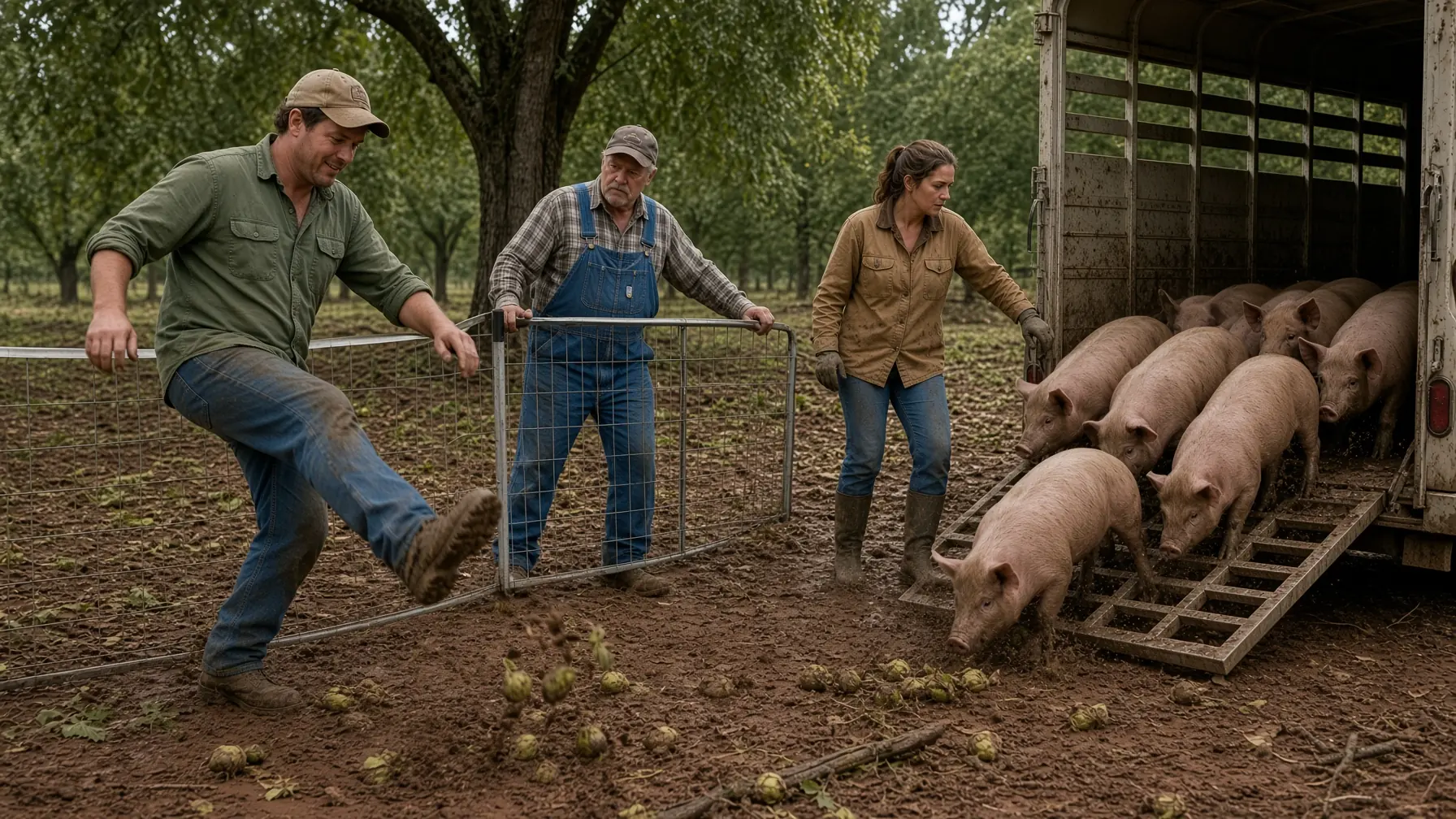
She came in an old white pickup pulling a dusty livestock trailer.
Caleb knew her from the farmers market in Statesboro.
Lena raised heritage-cross pigs on twelve acres about ten miles away.
She sold pork directly to several restaurants and through two regional markets.
She was practical, loud when necessary, and had once spent twenty minutes explaining to a chef why “pasture-raised” did not mean pigs lived on grass alone.
She stepped out in rubber boots.
“Lord.”
Caleb leaned against the shed.
“That's about where I'm at.”
“Heard the storm came right across you.”
“It did.”
“House?”
“Fine.”
“Trees?”
“Some aren't.”
She looked toward the rows.
“How much crop?”
“Maybe twenty, twenty-five percent early drop.”
Lena whistled softly.
Then she walked.
Caleb expected another expression of sympathy.
Instead she crouched.
Picked up a cracked pecan.
Smelled it.
Looked beneath a layer of leaves.
Then walked farther.
Ten minutes later she came back.
“How many of those are you planning to pick up?”
Caleb laughed once.
“None if I'm being honest.”
Lena looked toward her trailer.
“My pigs would.”
Caleb stared.
“What?”
“They'd eat a fair amount of this.”
He looked at the trailer.
Then back at her.
“You came here planning this?”
“No.”
“Then why are there pigs in your trailer?”
“Taking them to another paddock.”
Caleb waited.
Lena continued.
“Pigs eat nuts.”
“I know pigs eat nuts.”
“Apparently not enough to stop looking at me like that.”
Caleb almost smiled.
Then she became serious.
“Not all of it. Not cleanly. And you can't just dump pigs in forty acres and pray.”
Tom had walked closer.
“Good, because we're not doing that.”
Lena nodded.
“I wouldn't either.”
Tom looked surprised.
She pointed toward the orchard.
“But Caleb has feed on the ground and a cleanup problem.”
Then toward the trailer.
“I have animals that can turn some of that into weight.”
Tom shook his head.
“And root every tree to death.”
“Could.”
“Chew irrigation.”
“Probably, if we let them.”
“Destroy the grass.”
“If stocked wrong.”
Tom looked at Caleb.
“This is a terrible idea.”
Lena shrugged.
“Could be.”
Caleb looked at her.
“You're not selling this very well.”
“I’m not selling anything yet.”
She pointed toward the south corner.
“Two acres.”
Tom groaned.