The first note screeched horribly across the auditorium, and the audience smiled just as planned. Westwood Academy had its rules, traditions, and rigid hierarchies that had stood for generations. Caleb Williams, a scholarship student wearing a secondhand uniform that was meticulously pressed by his mother every night, was never meant to rise above his place. The recital was a perfectly set trap designed to humiliate the boy who dared to believe he belonged among them. But in that moment of calculated cruelty, something dangerous awakened inside him.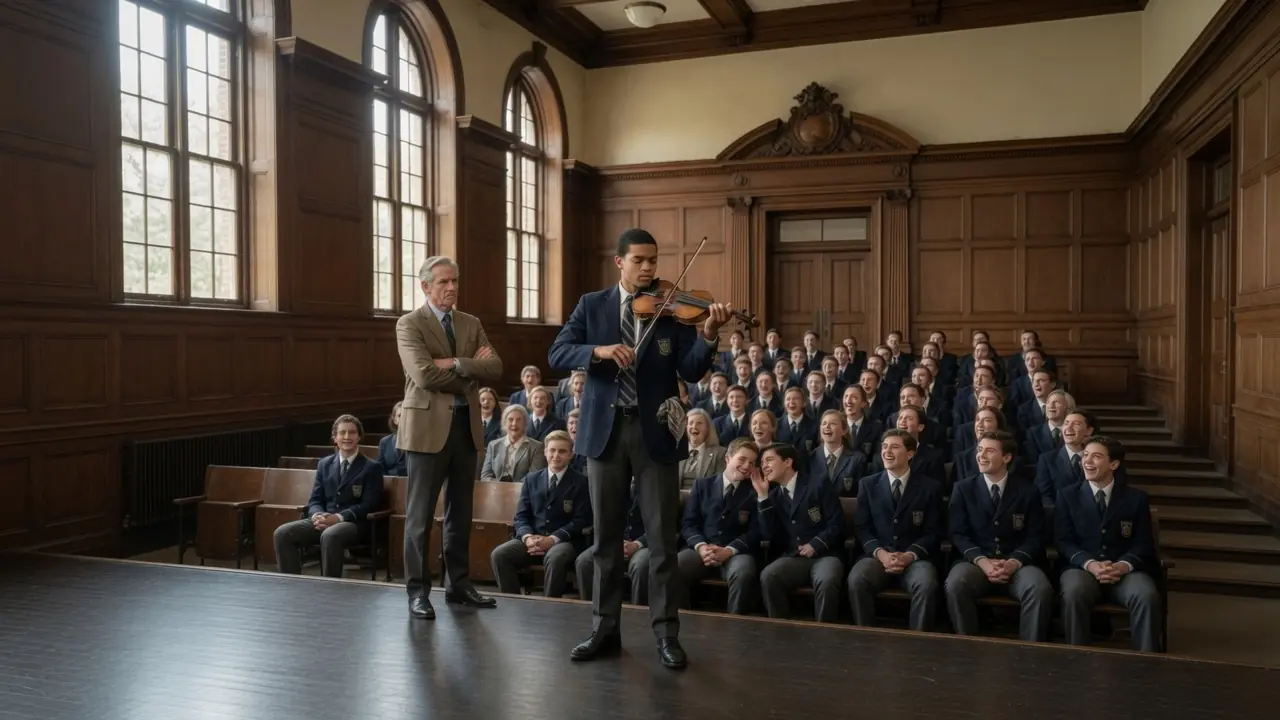
His eyes closed slowly. His posture shifted with quiet confidence. The next note pierced the air with shocking perfection. What followed wasn’t just music — it was vengeance delivered note by devastating note. Caleb dismantled everything they thought they knew about talent, power, and who truly deserved to be heard.
The first rays of dawn crept through the thin curtains of their small apartment as Caleb Williams opened his eyes. It was 5:30 a.m., a full hour before his alarm was set to ring. These quiet morning hours belonged only to him and his violin. He slipped out of bed carefully, so as not to wake his mother Naomi sleeping in the next room. Their apartment wasn’t large — just two bedrooms, a tiny kitchenette, and a living area that doubled as a dining room — but it was filled with the warmth of family history.
Photos lined the walls showing his grandfather William in his Sunday best holding a gleaming violin, his mother at her high school graduation with a proud smile, and a young Caleb at age six struggling to hold an instrument that seemed far too big for his small frame. Caleb moved to the corner of his bedroom where his grandfather’s weathered violin case sat atop his desk. The leather was cracked in places, the faded name tag still reading William Williams alongside old concert programs tucked into a side pocket.
He ran his fingers gently over the name tag before opening the case. The violin inside wasn’t new or expensive, but to Caleb it was priceless. His grandfather had played this very instrument in jazz clubs across the city decades ago, creating music that made people dance and cry in equal measure. Now it was Caleb’s turn to make it sing again. He positioned the violin under his chin, closed his eyes, and let the notes of Bach’s Partita Number Two fill the small room as his fingers danced across the strings with practiced precision.
For these few precious moments, Caleb wasn’t a scholarship student at an elite school where he didn’t belong. He was simply a musician lost in his craft. The smell of fresh coffee and toast eventually pulled him back to reality. Caleb carefully returned the violin to its case and made his way to the kitchen where Naomi was already preparing breakfast. “Morning Mom,” he said, giving her a quick kiss on the cheek.
“Morning baby,” Naomi replied with a warm smile, though Caleb didn’t miss the worried crease between her brows as she quickly tucked a stack of bills under a cookbook. They sat down together at the small table for their daily morning ritual. “You’re up early again,” she noted. Caleb smiled. “Wanted to get some practice in before school.” He shared his positive thought first: he had finally nailed that tricky passage in the Bach partita. Naomi’s eyes lit up with pride. “That’s wonderful, Caleb. I knew you would.” Her own positive thought was the same as always: his music would take him places no one in their family had ever been.
Thirty minutes later, Caleb stood at the bus stop with his backpack slung over one shoulder. Inside were carefully covered school books and several sheets of handwritten music he had been working on during lunch breaks. The bus arrived with a squeal of brakes. Conversations quieted as he walked down the aisle. At Westwood Academy, an imposing gray stone building covered in ivy with manicured grounds like a protective moat, Caleb still stood out despite wearing the same uniform as everyone else. Generations of wealthy alumni stared down from portraits in the halls, none of them looking like him.
In English class with Miss Pennington, he raised his hand to discuss The Great Gatsby, but she passed over him repeatedly before finally calling on him with a slight frown. His articulate response about the exclusionary nature of the American dream surprised her, but she quickly moved on. In music class, Mr. Reynolds publicly criticized Caleb’s uniform while ignoring far worse violations by students like Ethan Morgan, the principal’s son and the school’s star violinist. Caleb endured it all in silence and practiced whenever he could find a moment.
One afternoon, after Ethan and his friends deliberately took the practice room he had reserved, Caleb found a cramped storage closet near the gymnasium. The space smelled of cleaning supplies, but it was private. He was halfway through his piece when Mr. Whitmore, the elderly janitor, opened the door. Instead of scolding him, the old man listened with quiet appreciation. “You have a nice tone. Good vibrato too,” he said before leaving Caleb wondering about the knowing look in his eyes.
The announcement of the surprise recital for the school board and university representatives filled Caleb with anxiety. Mr. Reynolds made participation mandatory, his gaze lingering on Caleb as he emphasized “inclusion.” Caleb overheard students betting he couldn’t even hold the bow correctly. He also heard Reynolds in the teachers’ lounge saying the performance would prove certain students simply didn’t belong. That night, unable to sleep, Caleb thought of his grandfather who had never received formal recognition despite his talent. The memory strengthened his resolve. He practiced harder than ever — in the bathroom at home for better acoustics, during lunch, and in hidden corners of the school.
The night before the recital, Naomi gave him his grandfather’s old handkerchief as a good luck charm. “Your grandpa used to keep this in his pocket during performances,” she said softly. The next morning, she took time off work to attend. Backstage, Caleb felt the weight of mocking glances and whispers. When his turn finally came, the first note screeched horribly, triggering scattered laughter. Humiliated, he touched the handkerchief in his pocket, closed his eyes, and began again.
This time the music flowed pure and true. Vivaldi’s Winter filled the auditorium with raw emotion and surprising nuance. The audience fell completely silent, then erupted in loud, genuine applause. Even some teachers leaned forward in disbelief. Mr. Reynolds’s smug expression had turned into a tight-lipped glare. But the triumph was short-lived. Reynolds immediately stepped forward, questioned the simplified arrangement, and demanded to examine the violin, implying some form of cheating.
Principal Morgan escorted Caleb off stage to his office. Naomi burst in furiously, demanding answers. After a tense confrontation filled with veiled accusations, the violin was kept for “examination” and Caleb was suspended from all music activities. News of his performance spread quickly through Westwood. Some students began treating him with newfound respect. Olivia Franklin, a recent transfer student, openly defended him and confronted Ethan’s bullying in the hallway. “Some of us actually thought your playing was brilliant,” she told Caleb loud enough for others to hear. “It had something Ethan’s performance didn’t — soul.”
Mr. Whitmore later revealed his own past as a Juilliard-trained violinist who had once taught at Westwood before being pushed out for advocating for Black students. In secret sessions in the maintenance room after hours, he began mentoring Caleb, correcting his technique and sharing decades of hard-earned wisdom. “Talent without proper technique will only take you so far,” he told him gently, “but you have something that can’t be taught — heart.”
Olivia’s father, James Franklin, a civil rights attorney, offered legal help after hearing the full story. Eleanor Holloway, director of the Metropolitan Youth Orchestra and an old friend of Mr. Whitmore, contacted Caleb after seeing a video of his recital. She offered him a place in an upcoming young artist competition and even provided a reliable loaner violin while promising to help restore his grandfather’s instrument.
The school retaliated with false vandalism charges against Caleb. With James Franklin’s help, the accusations quickly collapsed due to lack of evidence and Caleb’s solid alibi. The administration then offered a large financial settlement in exchange for a non-disclosure agreement and silence about the discrimination. Naomi read the papers carefully, then tore them in half right in front of the board members. “My son isn’t for sale,” she declared firmly, “and neither is our dignity.”
Caleb threw himself into intensive training with both Mr. Whitmore and Miss Holloway. For the competition, he made a bold choice: performing an original composition titled “Grandfather’s Hands,” blending classical structure with the jazz influences he had learned from his grandfather’s stories. Ethan, feeling his own position threatened, waited for Caleb outside Miss Holloway’s studio one afternoon. “That competition is serious business,” he warned with a cold smile. “Some doors don’t open for people like you no matter how well you play.”
On the day of the competition at the gleaming West Lake Concert Hall, Caleb arrived by public bus with his mother. Luxury cars dropped off other competitors and their families. When his turn came, Caleb stepped onto the stage with quiet determination. He performed “Grandfather’s Hands” with deep emotion and authenticity, pouring years of struggle, love, and resilience into every note. The audience sat in rapt silence, visibly moved. When the final note faded, thunderous applause filled the hall.
Win or lose, Caleb had already claimed his voice. He had refused to let anyone silence his music or define his worth. Somewhere in the audience, Naomi wiped tears from her eyes, Mr. Whitmore nodded with quiet pride, and Olivia cheered loudly. The boy who had once been meant to stay invisible had finally made himself heard.