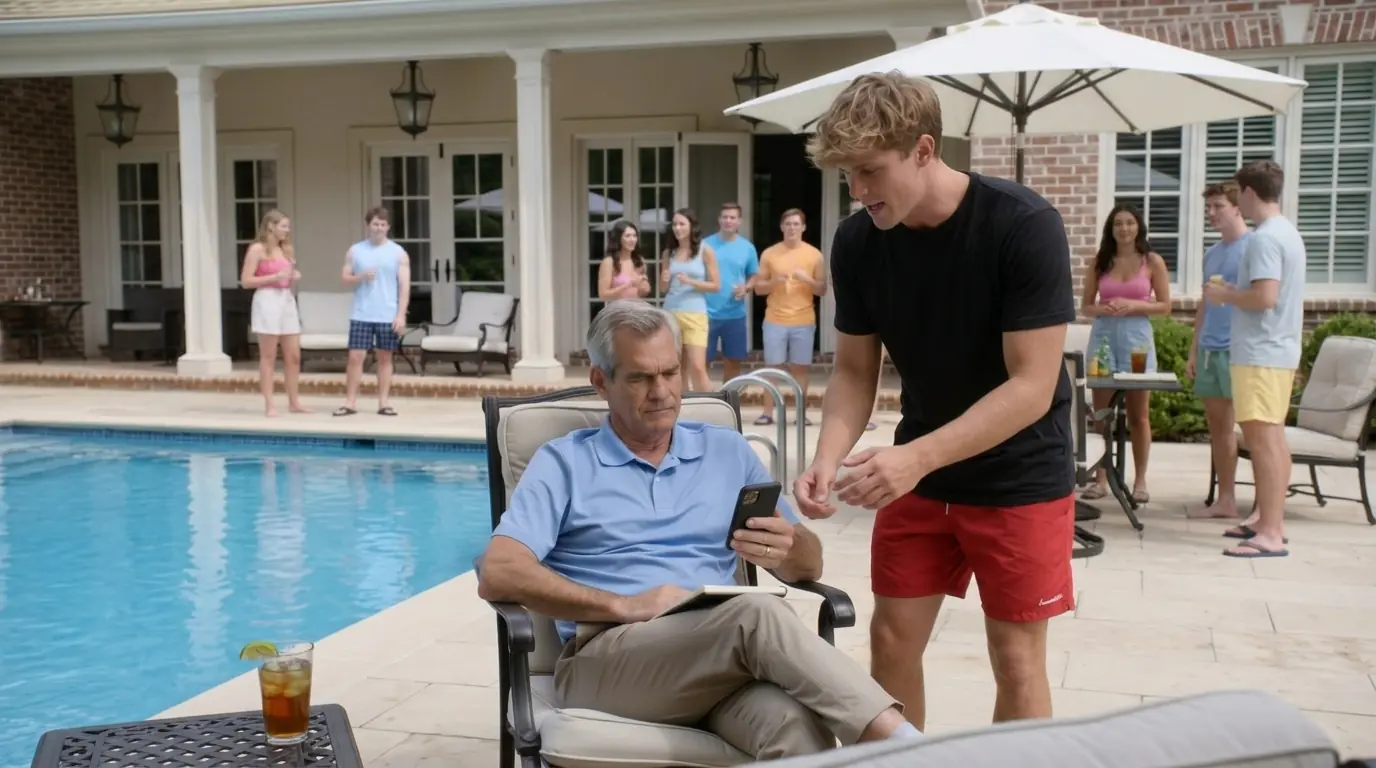
“Get up, old man. This pool belongs to the neighborhood now.”
For a second, I honestly thought I had misheard him.
I was sitting in my own backyard on a quiet Saturday afternoon, newspaper folded across my lap, coffee cooling on the small glass table beside me, while four teenagers stood at my gate like they had just discovered a country and intended to claim it. The one in front could not have been more than nineteen. Bleached hair, expensive sunglasses, oversized tank top, and the kind of confidence that usually comes from never having consequences arrive on time.
Behind him, three friends carried towels, a portable speaker, and swim bags.
They were not embarrassed.
They were not confused.
They were looking at me like I was the trespasser.
I had moved to Briar Glen three weeks earlier because it looked peaceful. Mature trees. Quiet cul-de-sacs. People who waved from porches and kept their yards tidy without turning it into a competition. After twenty-two years in law enforcement, I wanted ordinary mornings, quiet evenings, and a pool I could sit beside without hearing sirens in my sleep.
Apparently, peace had not been included in the closing papers.
The kid pointed at me again.
“I said move. We’re swimming.”
I set my coffee cup down slowly.
Old habits do not disappear when you retire. You learn to lower your voice before raising the temperature. You learn to count details before counting insults. Height, weight, hair color, number of people, exits, tone of voice, who looks nervous, who looks eager, who is performing for the group.
One of the boys near the back did not look comfortable.
I noticed him immediately.
The leader was already peeling off his shirt.
“Excuse me,” I said. “Is there something I can help you with?”
He laughed like I had asked a stupid question.
“Help us? No, dude. You can help yourself by getting out of the way.”
His friends snickered.
The uneasy one looked down at his shoes.
The leader tossed his shirt onto my patio chair, the one my daughter had bought me as a housewarming gift, then walked toward the pool like he had been doing it for years.
“This is our neighborhood pool now.”
I looked from him to the water, then back.
“Son, this is my backyard. That is my pool. You and your friends are on private property.”
He rolled his eyes.
“My mom is the HOA president.”
He said it the way some people say my father is a judge or my uncle owns the dealership.
Then he stepped closer, smiling with all the confidence of a person borrowing someone else’s authority and mistaking it for his own.
“She said private pools have to be shared for community use. You can’t just sit back here hoarding it like some cranky boomer.”
“I’m sorry,” I said. “Your mother told you my pool is community property?”
“She said the whole neighborhood has access to shared recreational amenities. That means pools.”
“No,” I said. “It does not.”
That was the first moment his smile slipped.
People like him are used to resistance in theory, but not in practice. He had expected confusion, maybe anger, maybe an old man shouting while teenagers laughed and filmed. He had not expected calm.
Calm makes bullies nervous because it refuses to become the scene they rehearsed.
He leaned toward me.
“We’re not asking.”
Then he turned, ran three steps, and cannonballed into the pool.
Water exploded across the patio, soaking the bottom half of my newspaper and splashing into my coffee cup. His friends cheered and followed him in. One did a sloppy backflip. Another turned on the speaker, and music blasted across my fence line hard enough to make the windows tremble.
The uneasy boy stayed near the edge for three seconds.
Then peer pressure reached him.
He jumped in too.
For the next twenty minutes, my backyard became their private resort.
They laughed, splashed, shouted over the music, and talked about bringing more people the next day. The leader, whose name I learned was Tyler Langford, stretched out on a pool float he had dragged from my storage box and looked around like an investor reviewing a property.
“You need better chairs,” he called. “This setup is sad.”
One friend laughed.
Another asked if I had beer.
Tyler looked at me and grinned.
“Yeah, Mr. Neighborhood Spirit. Got anything cold for us?”
I said nothing.
I watched.
I documented in my head the way I had documented worse things in worse places for most of my adult life. Exact phrases. Faces. Phone positions. The path they took through the gate. The wet footprints across the deck. The unopened latch they had clearly forced because the gate had been locked when I sat down.
When they finally climbed out, dripping water across my patio furniture and leaving empty snack wrappers beside the pool pump, Tyler put his sunglasses back on and pointed at me again.
“We’ll be back tomorrow around noon.”
He glanced at the chairs.
“And clean this place up before then. Make it more welcoming.”
His friends laughed as they walked out.
The uneasy one looked back once.
I made a mental note of him too.
After the gate slammed behind them, I sat there with my ruined newspaper in my lap and a pool full of strangers’ noise still hanging in the air.
Then I smiled.
Not because it was funny.
Because they had no idea what kind of old man they had just decided to test.
Inside, I took out a notebook from my desk drawer.
It was black, worn at the corners, and older than my new house. I had carried notebooks like it through domestic calls, fraud investigations, homicide scenes, courthouse hallways, and late-night interviews with people who believed the absence of witnesses meant the absence of truth. Documentation had saved me more than once.
It would save Briar Glen too.
I wrote down the date.
Time.
Names where known.
Descriptions.
Exact quotes.
Damages.
Possible witnesses.
When I finished, I sat back and looked at the page.
If Tyler had been telling the truth, I had not met the real problem yet.
I had only met her son.
The real problem arrived Sunday morning in beige heels.
I heard them before I saw her, clicking up my driveway with the sharp rhythm of a person who believed even concrete should listen. The knock came three seconds later, firm, impatient, and theatrical enough to suggest she had already decided how the conversation would go.
I opened the door.
A woman in her mid-forties stood on my porch with a severe blond bob, a fitted cream blazer, and a leather binder clutched against her chest. Her smile was polished enough to sell insurance and cold enough to cancel it after the first claim. She looked past my shoulder into the house before she looked at my face.
“Good morning,” she said. “I’m Patricia Langford, president of the Briar Glen Homeowners Association.”
“I gathered.”
Her smile did not move.
“We need to discuss your attitude.”
“My attitude.”
“Yes.”
She stepped past me into the foyer without waiting for an invitation.
That told me almost everything I needed to know.
People who respect boundaries do not practice entering homes like that.
Patricia stopped in the living room and let her eyes travel over the furniture, the bookshelves, the framed photographs, the unpacked boxes stacked near the hallway. She was not observing. She was appraising. Looking for weakness. Looking for leverage.
The binder opened with a crisp snap.
“My son mentioned yesterday’s unfortunate misunderstanding.”
“There was no misunderstanding.”
Her smile sharpened.
“Mr…”
“Mercer,” I said. “Jack Mercer.”
She wrote the name down with unnecessary force.
“Mr. Mercer, Briar Glen is a community built on harmony, cooperation, and shared standards. Residents who move here are expected to understand that personal preferences cannot override collective expectations.”
“Is that what your son called breaking into my backyard?”
“Tyler is a spirited young man.”
“He is nineteen.”
“And passionate about community access.”
“He forced open my gate, entered private property, used my pool without permission, and told me to leave my own backyard.”
Patricia gave a small laugh.
The kind of laugh people use when they want to make your objection sound childish.
“I can see you’re still adjusting.”
“To trespassing?”
“To HOA living.”
She flipped through the binder and stopped on a tabbed page.
“Briar Glen regulation 41-B states that recreational features visible from adjoining properties may be designated as community-enhancing amenities when their restricted use undermines neighborhood cohesion.”
I looked at her.
“My pool is behind a fence.”
“Still visible from the second-floor windows of two adjacent homes.”
“That does not make it public.”
“It makes it part of the community experience.”
I almost admired the sentence.
It was nonsense wearing a blazer.
She continued before I could respond.
“Refusal to participate in reasonable community enjoyment may result in corrective fines, compliance hearings, and, in serious cases, board recommendation for forced sale proceedings.”
There it was.
Not a conversation.
A threat wrapped in stationery.
“You’ve used that line before,” I said.
Her eyes flicked up from the binder.
Only for half a second.
Then the smile returned.
“Excuse me?”
“The rhythm. The wording. You’ve said this to people before.”
She looked pleased despite herself.
“Briar Glen has had residents who struggled with cooperation. The Rileys. The Porters. The Hansens. They all eventually understood that community standards exist for everyone.”
“They still live here?”
Her smile thinned.
“No.”
“That’s interesting.”
Her fingers tightened slightly around the binder.
“People who refuse harmony often find another community more suitable.”
I nodded.
“Sounds like a pattern.”
“It is leadership.”
“No,” I said. “It sounds like pressure.”
Her face hardened, and for the first time, the polite mask slipped enough for me to see the machinery underneath.
“Mr. Mercer, let me be very clear. My son and a few neighborhood friends will be using your pool again this afternoon. I expect there will not be further unpleasantness.”
“You expect me to allow teenagers onto my property because you wrote something in a binder?”
“I expect you to comply with the HOA rules you agreed to when you purchased this home.”
“I’d like a copy of these rules.”
She smiled again, triumphant now.
“I’ll have one delivered.”
“And the appeals process?”
That caught her.
“Appeals?”
“Yes.”
“Appeals are reviewed by the board.”
“Who is on the board?”
“Dedicated residents.”
“How many?”
“Enough.”
“Elected?”
“Of course.”
“When was the last election?”
Her pen tapped the binder once.
Then twice.
Small tells matter.
“The board follows all required procedures.”
That was not an answer.
It was the place an answer was supposed to go.
She shut the binder.
“I’m sure we understand each other.”
“I understand more than you think.”
She paused at the door.
“Then I suggest you act accordingly.”
After she left, I watched through the window as she walked back down my driveway, shoulders straight, binder tucked under one arm like a general carrying surrender terms.
She thought she had just intimidated a retired man in a quiet house.
What she had actually done was explain her entire operating system.
By Monday morning, the campaign had begun.
At 6:12 a.m., I heard movement outside my bedroom window.
I looked down and saw Patricia crouched beside my mailbox with a measuring tape and a phone, photographing my lawn like it was evidence in a murder trial. At 8:00, a printed violation notice appeared on my windshield.
Grass height exceeds approved community standard by one-quarter inch.
Fine: $75 per day until corrected.
I stood in the driveway holding the notice and looked at a lawn that had been mowed two days earlier.
At 8:21, Patricia called.
“Mr. Mercer, I wanted to make sure you received the notice. We take lawn maintenance very seriously.”
“I did receive it.”
“Good. We prefer to resolve these matters before they escalate.”
I looked through the kitchen window.
Tyler and five friends were entering my backyard with towels and a cooler.
“Patricia,” I said, “your son is currently trespassing on my property again.”
There was silence.
Then her voice came back flatter.
“Tyler is exercising community access.”
“He is opening a cooler beside my pool.”
“Then he must be thirsty.”
“He appears to have brought beer.”
Another pause.
“Mr. Mercer, I would advise you not to make accusations you cannot prove.”
“I never do.”
She hung up.
That afternoon, a second citation arrived.
Unauthorized fence modification.
I inspected the fence and found one board loosened near the gate. The screws had been backed out just enough to create a gap. It had not been damaged by weather. Someone had done it deliberately, then photographed the result.
That was when Ruth Caldwell knocked on my front door.
She was seventy-six, small, neatly dressed, and carrying a folder against her chest like it contained something dangerous.
“Mr. Mercer,” she said, voice trembling. “I saw what they did to your fence.”
I stepped aside.
“Come in.”
She sat on the edge of my couch and opened the folder.
Inside were violation notices.
Dozens of them.
Grass height in January.
Fence discoloration that did not exist.
Trash bins visible from the street on a day she had been out of town.
Holiday lights left up too long when she had not put up holiday lights at all.
“She did this to my husband and me for two years,” Ruth said. “After he died, it got worse.”
“How much did you pay?”
Her hands shook.
“Almost five thousand dollars.”
“Why?”
“I was afraid they would put a lien on my house.”
There are different kinds of theft.
Some men break windows.
Some women wear blazers and make elderly widows feel like paperwork can take their home.
Ruth looked toward my window, where the faint sound of teenagers splashing still carried from the backyard.
“She drove the Porters out,” she said. “And the Masons. And the Rileys. Anyone who questions her eventually leaves.”
That evening, George Miller came by.
He was a retired electrician with broad hands, a tired face, and a stack of receipts.
“Patricia made me repaint my house three times,” he said. “Same approved color every time. Cost me nearly nine grand.”
“Why didn’t you challenge it?”
“Because the last man who asked about the HOA finances got thirty violations in a month.”
He glanced toward Patricia’s house down the street.
“The elections are fake too.”
I looked up.
“Tell me.”
George leaned closer.
“Most folks don’t even know when they happen. Notices get buried in the holiday mail. Last election had maybe four ballots. Patricia, her neighbor Linda, some guy who got his fees waived, and Tyler.”
“Tyler voted?”
“He was seventeen.”
I wrote that down.
George watched me.
“You a lawyer?”
“No.”
“You sure write like one.”
“Old habit.”
He didn’t ask more.
Smart man.
Friday night was when Tyler finally did what people like him always do.
He overplayed his hand.
The first car pulled into my driveway at 7:18.
Then another.
Then two more.
By 7:25, Tyler had led a parade of seven teenagers into my backyard carrying beer, speakers, folding chairs, and a baseball bat. They kicked open the gate instead of unlatching it. The uneasy boy from the first day stood near the back again, pale-faced and silent.
This time, the party was not only arrogant.
It was angry.
I stepped outside with my phone recording in my shirt pocket.
“Tyler.”
He turned from the cooler, beer foam already on his chin.
“Look who came to visit his own pool.”
His friends laughed.
“This ends now,” I said.
He stepped toward me, swaying slightly.
“No, old man. You end now. This is our pool, our neighborhood, our rules.”
“You’re drunk, trespassing, and causing property damage. I’m giving you one chance to leave.”
“Consequences?” he said, grinning. “From you?”
He grabbed an empty beer bottle and threw it.
It missed my head by less than a foot and shattered against the fence, sending glass into my garden bed.
That changed things.
Not emotionally.
Legally.
Tyler grabbed the baseball bat and swung at one of the pool lights. Plastic cracked. Sparks snapped. His friends shouted. One knocked over a planter. Another threw a pool skimmer into the water. The speaker kept thumping.
“Oops,” Tyler yelled. “Cheap lights, man.”
I stood still.
Recording.
He smashed the filtration housing next. Then he kicked a patio table hard enough to bend one leg. His friends recorded on their phones. Someone was laughing too loudly. The uneasy boy finally backed away, but he did not leave.
Tyler turned toward me, raising the bat like a performer taking applause.
“You scared yet?”
“No,” I said. “Are you livestreaming?”
He blinked.
Then his grin widened.
“Yeah. Fifty people watching me improve your boring backyard.”
“Good.”
Something in my tone got through the alcohol.
His smile faltered.
“What does that mean?”
“It means I appreciate thorough documentation.”
He stared at me.
For the first time since he had stepped into my yard, uncertainty crossed his face.
I made one call.
“Tom,” I said when the line picked up. “It’s Jack. I need warrants reviewed tomorrow morning. I’ve got trespassing, vandalism, destruction over felony threshold, underage drinking, and a livestreamed confession. Also probable financial crimes through the HOA.”
A pause.
Then my old captain’s voice said, “Still retired, huh?”
“Trying to be.”
“I’ll meet you at ten.”
I hung up.
Tyler looked at the phone in my hand.
“You called the cops?”
“No,” I said. “I called someone who knows which cops to call.”
He tried to laugh.
It came out wrong.
By Saturday night, my office looked like a case board.
Security footage.
Screenshots from Tyler’s livestream.
Statements from Ruth, George, and four other neighbors.
HOA notices.
County election records.
Bank records George had managed to copy from an old board packet.
Public filings.
Invoices.
Receipts.
Shell-company names.
The pattern was not messy.
It was elegant in a criminal way.
Patricia had collected over $112,000 in fines across three years. Less than $19,000 had entered the HOA operating account. Fake maintenance contracts had been paid to a landscaping company registered under her maiden name. Several “compliance review fees” had gone directly to a payment account tied to Tyler’s private college tuition and Patricia’s new SUV.
She had not been enforcing rules.
She had been running a small government with no oversight and treating the residents like taxpayers in a dictatorship.
The anonymous email came at 11:46 p.m.
You are looking in the right place. Check pool access fines against meeting minutes. She charged residents for amenities that do not exist. Also check Linda Mayhew’s fee reductions. She votes how Patricia tells her.
No name.
No signature.
Just three attached spreadsheets.
They were enough.
On Sunday evening, Patricia called an emergency HOA meeting.
The notice accused me of threatening neighborhood youth, refusing community obligations, creating a hostile environment, and endangering property values. She wanted a public hearing. A vote. A final humiliation.
She had chosen the Briar Glen Community Center.
Conference Room A.
Rows of folding chairs.
Fluorescent lights.
A podium.
A large audience.
It was a generous choice.
A courtroom is not always a courthouse.
Sometimes it is the room a guilty person picks because she thinks she owns it.
Eighty-seven residents came.
More than had voted in any HOA election in years.
Patricia stood at the front in a navy dress and pearls, with Tyler seated behind her in a collared shirt, looking washed-out and terrified. The arrogant pool king had become a boy who had finally Googled felony vandalism and did not like what he found.
Patricia tapped the microphone.
“Good evening, neighbors. We are here to address a serious threat to Briar Glen’s harmony.”
I sat in the back row with a folder on my lap.
She smiled at the room.
“Since arriving here, Mr. Jack Mercer has refused reasonable community cooperation, threatened young residents, and created unnecessary conflict over shared recreational access.”
Murmurs moved through the room.
Not agreement.
Recognition.
The old rhythm again.
The public accusation.
The official language.
The attempt to make the target look unstable before the evidence could stand up.
Patricia lifted a paper.
“His refusal to participate in community amenity sharing directly violates our governing spirit, and his hostile conduct toward teenagers has created a safety concern.”
I stood.
“Patricia, can you define shared recreational access?”
She looked annoyed.
“The regulations speak for themselves.”
“I’d like you to speak for them.”
The room quieted.
She adjusted her binder.
“Residents are expected to support neighborhood harmony by making recreational amenities reasonably available.”
“Private pools?”
“When visible from adjacent homes, yes.”
“Could you cite the county statute that allows an HOA to convert private property into shared community property?”
Her smile tightened.
“We are discussing HOA standards, not county statutes.”
“That is convenient.”
A few people murmured.
I opened my folder.
“Let’s discuss HOA standards. When was your last valid election?”
Her expression flickered.
“The board conducts elections according to all procedures.”
“How many votes were cast?”
“That is not relevant.”
“I have the records. Four ballots out of 127 eligible households. One was from your son, who was seventeen and not eligible to vote. One was from Linda Mayhew, whose HOA dues were reduced by 60 percent the same month. One was from you. The fourth was from a household that moved out two years before the election.”
The room went still.
Patricia’s face flushed.
“These are technicalities.”
“Fraud often begins as a technicality.”
Tyler whispered, “Mom.”
She shot him a look.
Bad move.
The whole room saw it.
George Miller stood.
“She made me repaint three times.”
Ruth Caldwell stood beside him.
“She took nearly five thousand dollars from me in fake fines.”
A younger woman near the middle row stood next.
“She threatened to report my husband’s truck as abandoned while he was deployed.”
Then another.
And another.
Within minutes, the room was no longer an audience.
It was a witness list.
Patricia slapped her binder shut.
“These accusations are emotional and unverified.”
“No,” I said. “They are documented.”
I placed the first stack of papers on the front table.
“Fake violations. Election irregularities. Payment diversions. Shell-company invoices. Unauthorized fines. Fee reductions tied to board votes. And Tyler’s livestream from Friday night, where he recorded himself trespassing, drinking, vandalizing my property, and admitting he believed you had made him untouchable.”
Tyler looked like he might be sick.
“Mom,” he whispered again.
This time she ignored him.
“You had no authority to investigate HOA business,” she snapped.
I reached into my jacket.
The room held its breath as my badge came out.
It caught the fluorescent light in a clean flash of metal.
Sheriff Jack Mercer
Fulton County
The silence that followed had weight.
Patricia stared at the badge.
Then at me.
Then back at the badge, as if looking twice might change what it said.
Tyler’s mouth fell open.
“No,” he whispered. “No. Mom said you were just some retired nobody.”
I put the badge away.
“I did retire from active patrol work last year,” I said. “But I remain a sworn county sheriff attached to the investigations division. I moved here for quiet. You forced me back into documentation.”
Patricia found her voice.
“This is entrapment.”
“No.”
“You hid your identity.”
“I did not lie about it. You never asked.”
“You let my son—”
“I let your son make his own choices while cameras recorded them. He trespassed. He destroyed property. He livestreamed it. He confessed to the audience. That is not entrapment. That is arrogance meeting evidence.”
The doors opened behind her.
Two deputies stepped inside.
Deputy Warren and Deputy Ellis.
Both had warrants in hand.
Tyler started crying before they reached him.
“I didn’t know,” he said. “She said it was legal. She said we could use the pool. She said nobody would do anything.”
Patricia turned on him.
“Stop talking.”
Wrong room.
Wrong moment.
Wrong instinct.
Deputy Warren moved toward Tyler.
“Tyler Langford, you are under arrest for felony vandalism, criminal trespass, destruction of private property, underage possession of alcohol, and conspiracy related to intimidation of a homeowner.”
Tyler sobbed.
“I’m sorry. I’ll pay for it. I’ll clean it. I’ll do anything.”
“That will be discussed in court.”
The handcuffs clicked around his wrists.
The sound was small.
The effect was not.
Deputy Ellis turned to Patricia.
“Patricia Langford, you are under arrest for fraud, embezzlement, harassment by scheme, falsification of association records, and conspiracy to commit theft through fraudulent HOA enforcement.”
Patricia lifted her chin.
“I want my attorney.”
“You’ll have that opportunity.”
“This is political retaliation.”
“No,” Ruth Caldwell said from the audience. “This is a receipt.”
A few people laughed.
Not because it was funny.
Because fear was finally leaving the room and needed somewhere to go.
Patricia was led out still trying to stand like she had won something.
Tyler went out crying.
When the doors closed, nobody spoke for three seconds.
Then Ruth began clapping.
One clap.
Then another.
George joined.
Then the whole room.
I did not clap.
I stood at the front table, looking at the residents of Briar Glen, people who had lived under a clipboard tyrant for years because nobody had shown them the paper cage could be opened.
Ruth came to me first.
“How do we thank you?”
“You don’t.”
She frowned.
“You just live in your home without fear,” I said. “That is what this was supposed to be.”
The legal process took months.
Tyler pled guilty to reduced charges after agreeing to restitution, alcohol counseling, community service, and a public apology to every resident whose property he had damaged or helped intimidate. His mother’s lawyers tried to blame youth, influence, confusion, and bad advice. The livestream made that difficult.
Judges do not enjoy defendants who narrate their crimes in real time.
He received six months in county detention and two hundred hours of community service.
By court order, half of those hours were spent cleaning and maintaining public swimming facilities.
The irony was not subtle.
Patricia’s case was worse.
The financial records told a clean story. Fake fines. Diverted funds. Shell invoices. Election fraud. Retaliation against residents. She had turned a community association into a private revenue machine and used fear as the collection department.
She received eighteen months in county jail.
Full restitution.
Permanent disqualification from HOA leadership.
And a civil judgment that forced the sale of her SUV and several investment accounts she had built with other people’s money.
At sentencing, the judge looked directly at her.
“Mrs. Langford, you were trusted with a community. You chose to rule it, exploit it, and frighten it. That is not leadership. That is theft with letterhead.”
The restitution checks became their own kind of neighborhood holiday.
Ruth got back everything she had paid, plus interest. She cried when the envelope arrived, then invited half the block over for peach cobbler. George used his refund to repaint his house, not because anyone ordered him to, but because he wanted blue shutters and had spent three years being afraid to choose them.
The Porters, who had sold under pressure and moved away, received compensation too.
They did not move back.
But they came to the first real community meeting and were applauded when they walked in.
The HOA was dissolved and rebuilt from scratch.
Not abolished.
Rebuilt.
That mattered.
Rules are not the enemy.
Unaccountable people are.
The new board was elected properly, with notices mailed, emailed, posted, and hand-delivered. Sixty-eight households voted. Every budget line was visible. Every fine required review. Every resident had an appeal process that included outside mediation. No board member could reduce another member’s fees without public record.
The first meeting lasted three hours and involved more arguments about mulch color than I believed human beings could survive.
It was messy.
Democracy usually is.
But nobody was afraid.
That made it beautiful.
And my pool became something Patricia had never understood.
A real community space.
Not because someone forced me.
Because I chose it.
Every Tuesday and Thursday during summer, I opened the gate from six to eight for families on the block. Parents brought snacks. Kids played Marco Polo. Ruth brought cookies. George taught two elderly neighbors how to float. The uneasy boy from Tyler’s group, whose name was Evan, came one evening and asked if he could help clean leaves from the pool.
He looked at the ground when he said it.
“I should have stopped him,” he told me.
“Yes,” I said.
He nodded.
“I didn’t.”
“No.”
“I’m sorry.”
I handed him the pool net.
“Start with the deep end.”
He came back the next week.
And the week after that.
By the end of summer, he was helping teach smaller kids to swim. Some people are bad. Some are weak in the wrong moment and need a long road back. Evan walked his.
Tyler’s road was harder.
Community service did not fix him overnight.
Nothing does.
But cleaning public pools under court supervision taught him more about ownership than his mother ever had. The first apology letters were stiff and lawyer-written. The later ones sounded more like him. Less polished. More ashamed.
He wrote one to me near the end of his sentence.
I thought being allowed to do something was the same as being right. I thought Mom having power meant we were good people. I know now that if you need people to be scared of you to feel respected, you are not respected.
I kept the letter.
Not because it erased what he did.
Because it showed he had started to understand why it mattered.
Six months after the arrests, Briar Glen looked like the neighborhood I thought I had moved into.
Better, actually.
Not because the lawns were perfect or the shutters matched, but because people finally stopped moving like they were being watched by someone waiting to punish them. Children crossed yards again. Neighbors borrowed ladders. Front porches became places to sit instead of places to inspect from behind curtains.
Ruth started a care list for residents who needed help after surgery, illness, or bad weather.
George ran for county council on a platform against HOA abuse and shocked everyone by winning.
Evan organized a cleanup day at the community center and somehow got thirty teenagers to show up before noon on a Saturday, which I considered borderline miraculous.
Reporters called for months.
Most wanted the easy headline.
Sheriff moves into HOA nightmare and exposes corruption.
Teenager takes over wrong pool.
HOA president arrested after harassing wrong homeowner.
Those titles were catchy.
They were also too small.
People asked why I had not shown my badge the first day.
Why let Tyler swim?
Why let Patricia walk into my house?
Why let them escalate?
The answer was simple.
A badge can stop a moment.
Evidence can stop a pattern.
If I had flashed my badge on Saturday afternoon, Tyler would have run home, Patricia would have apologized through clenched teeth, and the neighborhood would have gone right back to living under her binder. Ruth would still be paying fake fines. George would still be repainting. The next new resident would become the next target.
I did not need to win an argument in my backyard.
I needed to end the machine.
And machines leave tracks if you are patient enough to watch them work.
The old newspaper from that first Saturday dried badly.
The pages warped.
The ink blurred.
The coffee stain never came out.
I kept it folded in my office drawer next to the first note I wrote about Tyler and his friends. Sometimes, when people ask about Briar Glen, I take it out and look at it. Not for nostalgia. For reminder.
That whole case began with a wet newspaper and one sentence.
This is our pool now.
It ended with a community learning that nobody owns peace by making others afraid.
On the first anniversary of Patricia’s arrest, the neighborhood held a summer cookout.
No speeches.
I insisted on that.
There were burgers, folding tables, kids in the pool, music at a reasonable volume, and a sign near the gate that read: Private property, community invited by consent.
Ruth said the sign was a little pointed.
I said pointed signs prevent dull lawsuits.
She laughed.
George brought his council campaign banner even though the election was over. Evan brought a group of teenagers and made sure they cleaned up before leaving. A young family who had moved into Patricia’s old house brought a watermelon and asked if the neighborhood was always this friendly.
Ruth looked at me.
Then at the pool.
Then at the street, where people stood talking in small circles beneath the trees.
“No,” she said. “We had to learn.”
That was the truth.
Communities do not become healthy because someone removes one bad person. They become healthy when people stop outsourcing courage. When they attend meetings. Ask questions. Keep receipts. Believe the neighbor who says something feels wrong. Refuse to let politeness become a hiding place for corruption.
That was what Patricia never understood.
She thought power was the ability to make people comply.
Real power is what happens when people no longer have to.
As the sun went down, the pool water caught the light in clean blue ripples. Children jumped in where Tyler once stood bragging about ownership. Parents laughed where Patricia had tried to manufacture fear. Ruth sat under an umbrella eating watermelon. George argued with someone about zoning. Evan helped a little boy find his goggles.
Ordinary things.
That was the victory.
Not the arrests.
Not the headlines.
Not even the restitution.
The victory was ordinary life returning to people who had forgotten what it felt like.
I sat in my chair beside the pool, newspaper folded neatly on my lap, coffee on the table, gate open by choice.
This time, when I heard kids laughing on the other side of the fence, I did not tense.
I called out, “Come on in. Walk, don’t run.”
And they did.
Because rules, when they are fair, do not destroy freedom.
They protect the space where freedom can breathe.