The wind in Willow Creek, Kansas, had a way of slipping through every crack in a house and every crack in a heart.
It carried dust down the single main street, under doorframes, into water barrels, and between the pages of old hymnals in the chapel. That wind had been blowing across the prairie long before Eliza Thorne arrived, and it would keep blowing long after folks forgot the creak of her wagon wheels.
She rolled into town in late October of 1885, riding beside a freight driver who had taken her last thirty miles for two dollars and her only good sewing thimble.
She carried no trunk.
No husband.
No welcoming family. 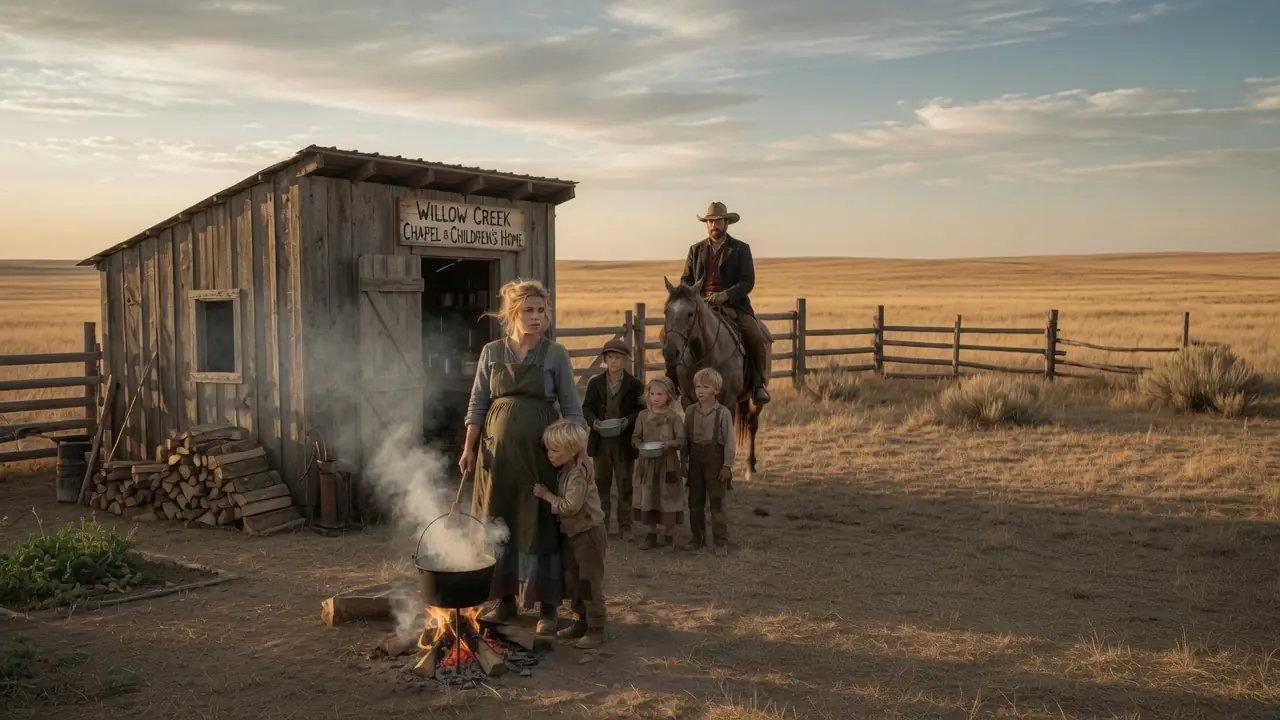
Only a faded carpetbag, a heavy cast-iron skillet wrapped in burlap, and one hand resting gently over the baby growing inside her.
Her husband, Thomas Thorne, lay buried somewhere along the Cedar Creek Trail under a lone cottonwood with no marker. He had died pulling another family’s wagon from a flooded crossing, swept away when the bank collapsed. Eliza could still feel his hand slipping from hers, the roar of the river drowning out her scream.
After that, people offered the kind of help that came with distance. Condolences. Advice. Sympathetic looks. But no one offered a real place to stay for long.
Thomas’s cousin had promised her shelter in Willow Creek, then sent word through the preacher that his wife “wasn’t comfortable taking in a pregnant widow of uncertain means.” The words were polite on paper but left Eliza standing alone in the dusty street with nowhere to turn.
That was how she found the chapel.
It stood at the edge of town, once white but now weathered gray, its steeple tilting slightly toward the open prairie like it was too tired to keep pointing at heaven. A faded sign read Willow Creek Chapel and Children’s Home.
The word “home” looked hopeful.
The building looked worn out.
A loose shutter banged in the wind. The front steps sagged in the middle. Behind the chapel, a crooked kitchen addition leaned under a mismatched roof. From inside came the soft sounds of children — not joyful laughter, but the quiet bravery of kids trying not to seem hungry.
Reverend Elias Hart opened the door before she could knock a second time. He was a thin man in his fifties with kind eyes, ink-stained cuffs, and the tired shoulders of someone who had prayed for help and mostly received silence.
“Yes.”
He glanced past her, hoping for supplies that weren’t there. His eyes dropped to her rounded belly, and pity flickered across his face before he could hide it.
Eliza lifted her chin.
“You said in your telegram you needed someone who could cook, mend, and look after the children.”
“I did,” the reverend said softly. “And I meant it.”
“Then I’m here.”
The children waited in the back room around a long table made of mismatched boards. There were eleven of them, ranging from a watchful fifteen-year-old girl to a wide-eyed four-year-old boy. Their clothes were clean but patched. Their faces held the sharp look of kids who had learned not to expect second helpings.
The oldest girl stood first.
“I’m Rose,” she said. “I help with the little ones.”
Her voice was polite but guarded. Eliza recognized that armor.
One by one they gave their names.
Rose, fifteen, who watched everything.
Caleb, thirteen, all elbows and restless energy.
Emma, eleven, with a needle always tucked in her sleeve.
The twins, Jacob and Jonah, nine, impossible to tell apart until one grinned.
Luke, eight, who carried a slingshot “just for crows.”
Lila, seven, who collected pretty stones.
Sophie, six, who whispered every answer.
Tommy, five, who asked if Eliza had ever seen a real Indian.
Little Charlie, four, left on the chapel steps as a baby and still slept with a flour-sack doll.
And tiny Violet, with dark curls and serious gray eyes, who didn’t speak until Rose gently nudged her.
“Violet,” the girl whispered.
Eliza looked around the room — at the thin faces, the nearly empty pantry, the stove leaning on a broken leg, and the pot of beans boiling in water so thin it barely qualified as soup.
She set her carpetbag down.
“What’s for supper?”
“Beans,” Reverend Hart said with a helpless smile.
“With what?”
“More beans, if the Lord provides.”
A few children laughed quietly.
Eliza rolled up her sleeves.
“Well, let’s see what the Lord has already given us and make something of it.”
She browned the last bit of salt pork until the kitchen smelled almost rich. She fried onions slow until they turned sweet. She stirred in the beans, chopped the few wrinkled apples, and sweetened them with sorghum. She mixed cornmeal into golden cakes crisp at the edges.
When the meal was served, the beans were still beans.
But they tasted like someone cared.
Jacob — or maybe Jonah — took the first bite and froze.
“It tastes like Sunday,” he said.
The room grew quiet in the best way.
Eliza turned away so the children wouldn’t see her tears.
She hadn’t felt special in a very long time.
After supper, the children helped clean without being asked. They watched her carefully, waiting to see if she would disappear like the others before her.
When the dishes were done, little Charlie climbed onto the bench beside her and touched the cloth-wrapped skillet.
“What’s that?”
“My skillet.”
“Just a pan?”
Eliza smiled.
“Not just. My husband bought it the week we married. Said a good skillet could turn almost anywhere into a home.”
Charlie thought about that.
“Can it make this one?”
Eliza looked at the patched walls, the tired reverend, and the children pretending not to listen. She rested a hand on her belly.
“We can try.”
The next morning she started with breakfast.
Corn mush sweetened with apple sauce. Mint tea from leaves Rose knew. Flat biscuits that were still warm enough to make the little ones hum.
Then came real chores.
Rose helped with laundry. Emma learned to turn collars. Caleb and Luke hauled water. The twins split kindling. Lila counted supplies. Sophie helped Charlie wash his face like it was the most important job in the world.
Within a week, the chapel smelled different.
Less like damp wood and worry.
More like coffee, soap, bread, and life.
Eliza sang while she worked — old hymns, trail songs, and lullabies her mother used to sing. The children grew quiet when she sang, not because she had a beautiful voice, but because a woman singing in the kitchen meant safety.
By the end of the second week, the younger ones started calling her Mrs. Eliza.
By the third week, Charlie called her Mama Eliza.
The room went still.
Rose looked horrified.
Reverend Hart paused mid-spoon.
Charlie’s face crumpled, waiting for scolding.
Eliza knelt as best she could with her growing belly and touched his cheek.
“That’s a big name,” she said gently.
“I’m sorry,” he whispered.
“I didn’t say it was wrong.”
After that, more of the little ones started using it.
Rose held out the longest.
But Eliza noticed how the girl lingered near her at dusk, wanting closeness she didn’t know how to ask for.
Willow Creek began to notice the change.
The children walked taller. Their clothes were neater. Their faces filled out. They laughed more.
Not everyone approved.
Some women whispered that a pregnant widow had no business running a home full of orphans. Some men questioned the reverend’s judgment.
Eliza kept cooking.
The first time Colton Reed saw her, she was carrying a heavy pot of stew across the yard in a wind strong enough to steal a person’s breath.
Colton owned the biggest ranch in the county. Reed Ranch stretched for miles of good grass, creek bottom, and cottonwood groves. His cattle wore the double-R brand, and his name could quiet trouble before it started.
He was thirty-eight, tall and broad-shouldered, with dark hair, a trimmed beard, and eyes that measured everything. He had lost both parents to fever years earlier and had turned his grief into silence and profit.
People called him hard.
They weren’t wrong.
He came that day with a weak foal whose mother had rejected it. He claimed the children might learn responsibility trying to save it.
Eliza saw through the excuse immediately.
No man carried a worthless animal that gently.
She knelt beside the foal and ran careful hands over its ribs.
“It’s starving more than sick,” she said.
Colton watched her work with the children, his face carefully blank. But Eliza caught the hunger in his eyes — not for food, but for the sight of people trying together.
Days turned into weeks.
Colton found reasons to return. Supplies. Repairs. Sometimes no reason at all.
He spoke to Caleb like a young man. Taught Luke to sharpen a knife properly. Let the twins help mend fence and pretended not to enjoy their bickering. Carved a little wooden horse for Charlie.
The affection between Colton and Eliza grew slowly, like a good fire in damp wood.
Then the legal notice arrived.
The chapel and land belonged to Colton Reed.
The papers hit Eliza like a slap. She had trusted him. Let him close to the children. Let herself feel something again.
She asked him to stay away.
The children cried.
Winter came hard. Supplies ran low. Gossip grew sharp.
When little Charlie fell sick with fever, Eliza finally sent for Colton.
He rode through the snow like the devil himself was chasing him.
He brought the deed transfer papers — the land would belong fully to the church. No claim. No power over them.
He had started the process the day she sent him away.
Before Eliza could fully forgive him, the pains started.
Her baby came fast that night.
A girl.
Small, loud, and perfect.
Colton held her like she was made of morning light.
They named her Hope.
They married two weeks later in the little chapel, with eleven children in their best clothes, one sleeping newborn, and a town that had finally learned to mind its own business.
Spring came early the next year.
The chapel had new rooms, a solid barn roof, and a schoolroom where children from neighboring farms would soon study.
Eliza stood on the porch one bright morning, baby Hope against her shoulder, and watched her growing family scatter across the yard.
Colton came to stand beside her.
He had lost some of his hard edges. Not all of them — some loneliness never fully leaves a man. But he was no longer ruled by it.
“You made room for all of us,” he said quietly.
Eliza leaned into him.
“That’s what love does,” she answered. “It makes room.”
And across the Kansas prairie, under a wide blue sky, the old chapel rang with the sound of children, laughter, and life stubbornly taking root where only wind and dust had lived before.