The first strike did not break the window.
It only turned a perfect sheet of tinted glass into a web of white fractures.
Malcolm Reed watched those fractures spread outward from the point where Trooper Wade Mercer’s baton had struck, branching across the driver-side window of his dark blue Range Rover like lightning frozen inside ice. For less than a second, Wade seemed almost surprised that the glass had resisted him.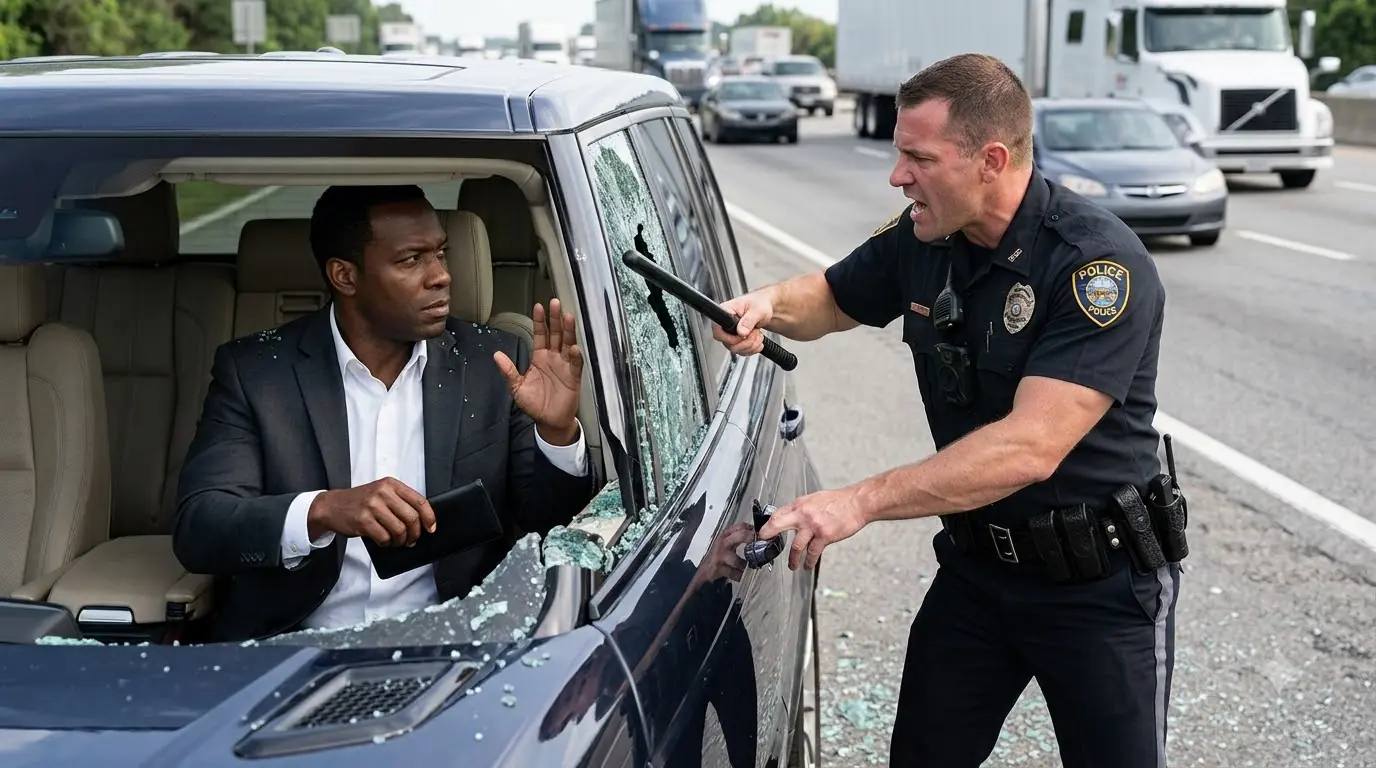
Then he raised the baton again.
“Open the damn door.”
Malcolm kept both hands visible.
“My door is unlocked.”
“Then open it.”
“You are standing against it.”
Wade’s mouth tightened.
“You think this is funny?”
“No.”
Malcolm’s voice remained quiet.
“I think you should slow down.”
That was the wrong thing to say.
Not because it was disrespectful.
Because Wade Mercer had already decided the conversation was about control.
The baton came down again.
This time the tempered glass collapsed.
Thousands of tiny pieces burst inward, striking Malcolm’s shoulder, lap, center console, and door panel in a glittering shower. He turned his face away instinctively as several pieces bounced from his cheek and disappeared between the seat and console.
Traffic continued racing past them.
A tractor-trailer thundered through the lane nearest the shoulder.
Wind rushed through the suddenly open space where the window had been.
Malcolm slowly turned back toward Wade.
The trooper was breathing hard.
“There.”
Wade pointed the broken baton end through the empty window frame.
“Now we understand each other.”
Malcolm looked down at the glass covering his charcoal suit.
Then he looked at Wade.
“No.”
Wade’s eyebrows tightened.
“No?”
“We understand something.”
Malcolm paused.
“But I don’t think it’s the same thing.”
Twenty-eight minutes earlier, Malcolm had been driving north on Interstate 85 toward Richmond.
The Range Rover moved smoothly beneath a bright Virginia sky, surrounded by ordinary weekday traffic. Malcolm had left Washington before dawn because he preferred driving himself whenever possible, especially when the meeting ahead involved complaints from people who believed authority had stopped listening to them.
His phone rested inside the center console.
Three folders were locked inside a reinforced case in the rear cargo area.
A smaller leather credential wallet sat beside the phone.
Malcolm had no reason to think he would need it before arriving.
At forty-four, he had spent seventeen years reviewing institutions that believed they were functioning correctly.
That work had taught him something simple.
Systems rarely announced that they were failing.
They produced patterns.
Complaints that sounded similar.
Reports using identical language.
Missing recordings.
Supervisors repeatedly deciding no policy had technically been violated.
One event could be coincidence.
Seven events were information.
Thirty-two were a pattern.
The district Malcolm was traveling toward had thirty-two.
Drivers had complained about prolonged roadside detentions.
Searches initiated after minor equipment stops.
Drivers ordered from vehicles despite no arrest.
Property temporarily seized and returned without documentation.
Body-camera recordings beginning several minutes after the stated start of encounters.
No single complaint proved systematic misconduct.
Together, they justified questions.
Malcolm’s office existed to ask those questions.
He was the director of the Federal Office of Transportation and Enforcement Integrity, a little-known oversight body created after several states accepted federal highway grants tied to independent review standards.
The title sounded bureaucratic.
Malcolm liked that.
Bureaucratic titles encouraged arrogant people to underestimate them.
His office could audit departments receiving federal transportation funding, review enforcement practices, preserve evidence, and refer serious matters to other federal agencies.
Most of Malcolm’s work happened quietly.
Spreadsheets.
Interviews.
Policy reviews.
Data comparisons.
Nobody made movies about compliance matrices.
That was exactly why they were useful.
He was supposed to meet a regional review team at one that afternoon.
He never reached the meeting.
At 11:16 a.m., a patrol vehicle appeared behind him.
The lights activated.
Malcolm checked his speed immediately.
Sixty-seven.
Speed limit seventy.
He signaled.
Moved onto the shoulder.
Stopped.
The trooper remained in his cruiser for almost two minutes.
Malcolm lowered the driver-side window halfway.
He placed both hands on the steering wheel.
When Wade Mercer approached, his face already carried irritation.
“License.”
Malcolm reached slowly toward his wallet.
“Registration is in the glove compartment.”
“I didn’t ask where it was.”
Malcolm stopped.
Wade leaned closer.
“You hear me?”
“Yes.”
“Then get the license.”
Malcolm handed it over.
Wade looked at the name.
“Malcolm Reed.”
“Yes.”
“Where are you going?”
“Richmond.”
“Why?”
“Meeting.”
“What kind?”
“Work.”
Wade looked through the interior.
Malcolm wore a dark suit.
The Range Rover was new.
Nothing inside the cabin was unusual.
Yet Wade stared as though ordinary details were evidence of something.
“You own this vehicle?”
“Yes.”
Wade glanced at the registration visible through the glove-compartment opening.
“Get it.”
Malcolm retrieved it.
Wade compared the name.
Everything matched.
The trooper did not return the documents.
Instead he stepped backward.
“Turn the engine off.”
“It is off.”
“Keys.”
Malcolm looked at him.
“It’s push-button.”
Wade’s irritation deepened.
“Put your hands on the wheel.”
“They already are.”
A long pause followed.
Malcolm recognized the pattern immediately.
The stop had no center.
No specific violation was being discussed.
No ticket was being prepared.
The trooper was moving from command to command, testing compliance rather than investigating conduct.
Malcolm had reviewed dozens of stops like this.
Drivers usually became confused.
Confusion became hesitation.
Hesitation was described afterward as resistance.
“Officer,” Malcolm said carefully, “what was the reason for the stop?”
Wade leaned toward the open window.
“You crossed the fog line.”
Malcolm remembered the road.
“No, I didn’t.”
Wade smiled.
“You calling me a liar?”
“I’m saying I don’t believe I crossed it.”
“That camera will tell us.”
Malcolm glanced toward the patrol vehicle.
“Good.”
Wade did not like that answer either.
Most people hearing the word camera became nervous.
Malcolm became more comfortable.
Evidence removed imagination.
Wade returned to the cruiser.
Ten minutes passed.
Then twelve.
Malcolm checked the clock.
He sent a short message to his deputy.
Running late. Traffic stop. Nothing serious yet.
The word yet was intentional.
At minute fourteen, Wade returned.
He was no longer alone.
Another trooper, Evan Pike, stood several feet behind him.
Evan looked younger.
Maybe thirty-two.
He watched more than he spoke.
Wade handed Malcolm the registration.
Kept the license.
“Step out.”
Malcolm looked at him.
“Am I being cited?”
“Step out.”
“For what?”
Wade’s hand moved toward the door handle.
“Do you have a problem following directions?”
“I’m asking the legal purpose of removing me from the vehicle.”
Wade pulled the handle.
The door remained closed because Malcolm’s foot was resting against it.
“Unlock it.”