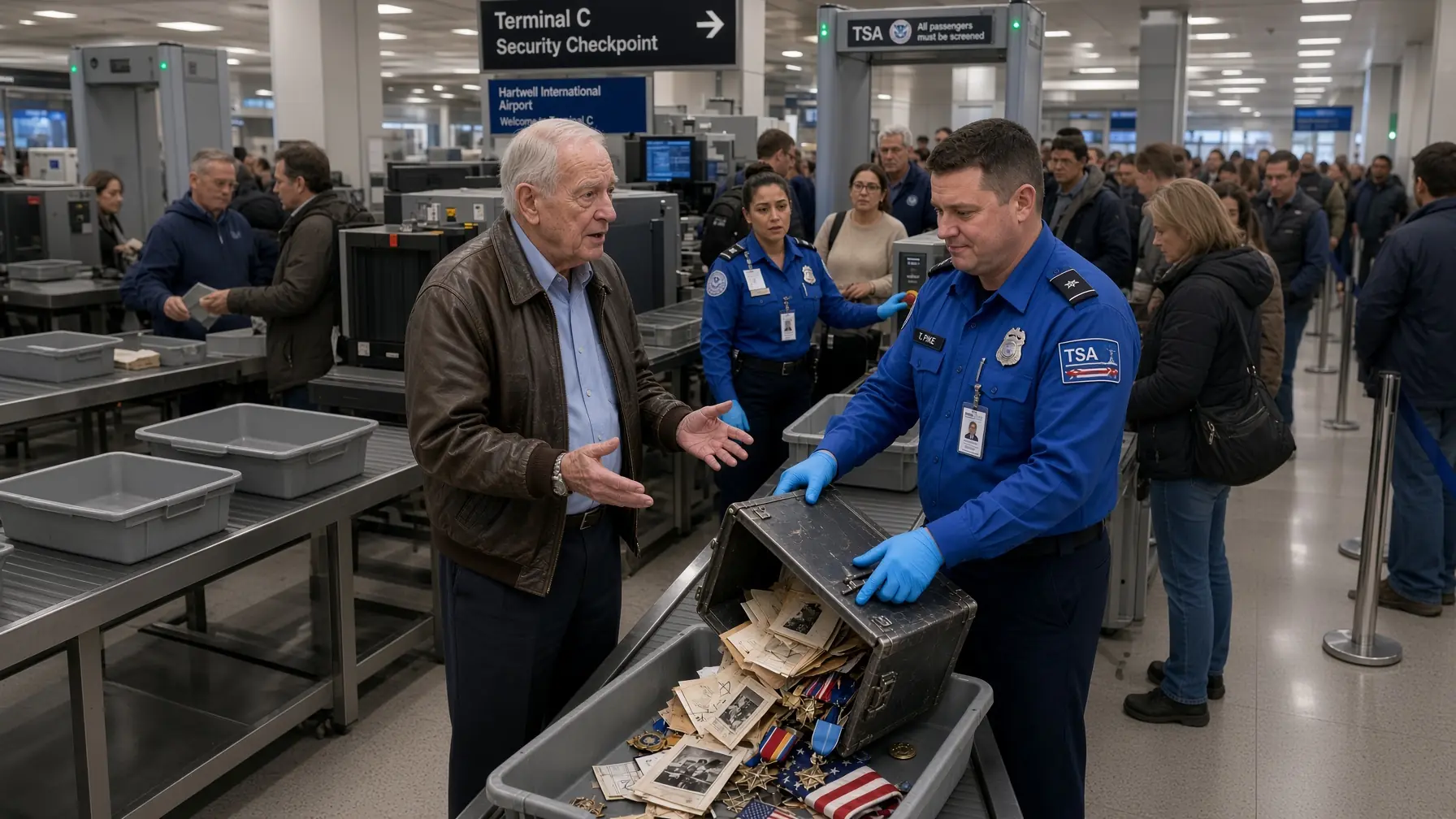
The old man held the metal case with both hands.
Not one hand.
Both.
That should have told Travis Pike something before he opened his mouth, but Travis had stopped noticing details hours earlier. By the time the morning rush hit Terminal C at Hartwell International, people had become shoes, belts, laptops, jackets, bins, delays, and arguments. Faces blurred together after a while when a man decided the line mattered more than the lives standing inside it.
The elderly traveler stepped forward slowly.
He was thin, almost narrow in the shoulders, wearing a faded brown bomber jacket with cracked cuffs, a pale blue shirt buttoned to the throat, dark trousers, and polished shoes that looked older than some of the agents working the checkpoint. His silver hair was cut short. His face carried deep lines, but his eyes were clear and steady.
The small case in his hands was dented, dark gray, and worn around the corners.
Travis looked at it and smirked.
“Sir, souvenirs still have to go in the bin.”
The old man’s fingers tightened slightly around the handle.
“It is not a souvenir.”
“Then whatever it is, it still goes through screening.”
“I understand that,” the old man said. “Please handle it carefully.”
Travis exhaled through his nose.
People were backed up behind him. A businessman had already complained about missing a boarding group. A mother was trying to collapse a stroller while holding a crying toddler. Somewhere farther down the checkpoint, another passenger was arguing about a bottle of expensive lotion.
Travis reached for the case.
The old man hesitated for half a breath.
That hesitation annoyed Travis more than refusal would have.
“Sir, I need the item now.”
The old man handed it over.
“My name is Colonel Arthur Langford,” he said quietly. “Retired. That case contains military decorations and documents. Some of them are fragile.”
Travis barely listened.
He took the case with one hand, turned toward the gray inspection bin, and tossed it.
The metal hit hard.
The sound cracked through the checkpoint.
The case flipped once, struck the side of the bin, and popped open as if the latch had been waiting for one last insult to fail.
Everything spilled out.
Medals.
Ribbons.
Folded citations.
Old identification tags.
A black-and-white photograph of young men standing beside a helicopter.
A faded unit patch.
A folded flag tucked inside a clear protective sleeve.
The conveyor belt lurched forward before anyone stopped it, carrying medals beneath plastic trays and scattering ribbons across the rubber surface like loose change thrown onto a counter.
The old man did not yell.
He did not curse.
He simply stared.
That was what made the checkpoint go quiet.
A young TSA agent named Maya Torres reached for the emergency stop button and shut down the belt.
“Sir, I’m so sorry,” she said, already stepping toward the spilled items.
Travis rolled his eyes.
“You should have secured the latch better.”
The old man looked at him.
“I did.”
“Well, it opened.”
“After you threw it.”
A woman waiting behind him spoke before she seemed to decide whether it was wise.
“He did throw it.”
Travis turned toward her.
“Ma’am, stay behind the line.”
The woman did not move, but she also did not look away.
Her name was Helen Mercer, a high school principal from Ohio flying to visit her daughter in Arlington. She had spent thirty years watching children learn who they were from the way adults treated them. She knew cruelty when it dressed itself as procedure.
Maya knelt beside the conveyor belt and began gathering the medals carefully.
One had slid near Travis’s shoe.
He looked down at it.
The ribbon was pale blue.
The medal itself was a gold star set inside a wreath, heavy and solemn even on the floor.
Travis nudged it with the edge of his shoe toward the old man.
“There,” he said.
Maya froze.
Helen gasped softly.
Arthur Langford’s face changed for the first time.
Not with anger.
With hurt.
He looked at the medal as if it were a person who had fallen.
Maya picked it up with both hands.
Her voice became very quiet.
“Sir…”
Arthur reached for it, but his knees bent badly when he tried to lower himself. Maya stood and placed the medal in his palm with a gentleness that made several passengers stop pretending they were not watching.
Travis looked irritated.
“It’s a medal. We have a line building.”
Maya turned to him.
“Do you know what that is?”
Travis shrugged.
“Like I said. A medal.”
Arthur closed his fingers around it.
“It is enough,” he said.
But it was not enough.
Not really.
The pale blue ribbon had been placed around Arthur Langford’s neck forty-six years earlier by the President of the United States. He had received it from a wheelchair, with his left arm still braced, his ribs taped, and three empty chairs in the front row for men whose families had accepted folded flags instead of homecomings. His wife had stood beside him that day, one hand on the back of his chair because she knew he might not have stayed upright otherwise.
It was the Medal of Honor.
Travis did not recognize it.
Maya did.
She gathered the other decorations one by one, her hands steady now, her expression no longer simply apologetic but protective. A Silver Star. A Distinguished Service Cross. Two Purple Hearts. A Bronze Star with Valor. Folded citations that had been typed in the stiff official language governments use when trying to describe impossible courage without breaking the shape of a sentence.
Arthur remembered them differently.
He remembered rain on helicopter blades.
Mud up to the ankles.
A radio operator screaming coordinates through static.
A wounded corporal begging him to leave because the fire was moving too fast.
A young lieutenant named Peter Knox pressing a bloody letter into Arthur’s hand and asking him to mail it if he made it back.
The medals had weight because the men behind them had weight.
Travis saw only objects.
Arthur saw names.
“Sir,” Maya said softly, “let me help with the papers.”
“Thank you.”
A folded citation had torn along one edge.
Arthur saw it and closed his eyes for a moment.
That paper had survived jungles, floods, storage boxes, a house fire, and two cross-country moves. It had survived more than some of the men named in it. Now it had been torn under fluorescent lights by a careless hand in an airport security line.
A checkpoint supervisor approached from the next lane.
His name was Victor Sloan, mid-forties, neat suit, radio clipped at his shoulder, and a face trained to remain calm around delays. He looked first at the stalled belt, then at the passengers recording with phones, then at Arthur holding the pale blue ribbon.
“What’s going on here?”
Travis answered quickly.
“Passenger brought an unsecured metal case. It opened during screening. We’re getting it sorted.”
Helen spoke from behind the line.
“That is not what happened.”
Travis stiffened.
Victor turned toward her.
“Ma’am?”
“He threw it into the bin. The case broke open. Then he pushed that medal with his shoe.”
The words landed hard.
Several passengers nodded.
One man near the laptop bins said, “I saw it too.”
Maya stood with a citation in her hand.
“She’s telling the truth,” she said.
Travis stared at her.
“Maya.”
She did not look away.
Victor’s face tightened.
“Agent Pike, step back from the lane.”
“I was doing my job.”
“Step back.”
Travis moved two feet away, angry and embarrassed.
Arthur placed the Medal of Honor back into the case only after wiping it gently with his handkerchief. He did the same with each medal, as if apology could be done through touch. Maya helped him arrange the citations, the tags, and the bent photograph.
The photograph showed eight young men beside a helicopter.
Only two had lived long enough to grow old.
Victor looked at Arthur’s military retirement card and driver’s license.
“Colonel Langford?”
“Retired.”
Victor read the name again.
Something flickered in his face, recognition without memory.
“Are you traveling alone today?”
“Yes.”
“Destination?”
“Washington.”
“For an event?”
Arthur looked down at the case.
“A memorial.”
Victor’s voice softened.
“I understand.”
Arthur almost smiled.
“No. You don’t.”
The sentence was not cruel.
It was simply true.
Victor did not argue.
Then his radio crackled.
The voice on the other end was sharp, urgent, and not part of normal checkpoint traffic. Victor turned slightly away, listened, then looked toward the terminal entrance. His posture changed so suddenly that Maya noticed before anyone else.
“Repeat that,” Victor said.
The reply came again.
Victor’s face lost color.
He lowered the radio and looked at Arthur.
“Colonel Langford, were you expecting someone to meet you at this airport?”
Arthur frowned.
“No. My escort is supposed to meet me in Washington.”
Victor glanced toward the main concourse.
“Someone is coming here.”
“Who?”
Before Victor could answer, airport police appeared near the entrance.
They were not running.
They were clearing a path.
Behind them came several people in dark suits with earpieces, moving with the focused urgency of people whose job was to arrive before disorder could spread. Travelers stepped aside without being asked twice.
At the center of the group walked a tall woman in a navy suit.
Her hair was silver-white.
Her expression was controlled but unmistakably personal.
Secretary of Defense Eleanor Whitcomb crossed the terminal floor and walked directly toward Arthur Langford.
The checkpoint seemed to stop breathing.
Travis straightened.
Victor stepped aside.
Maya stood frozen with the dented case on the table.
The Secretary did not look at any of them first.
She looked at Arthur.
“Art.”
His face changed.
“Ellie.”
She embraced him.
Not as an official greeting a decorated veteran.
Not as a politician approaching a camera.
As someone who had carried his name inside her family for most of her life.
When she stepped back, she held both of his hands.
“You were supposed to call when you reached the gate.”
“My flight hasn’t left yet.”
“I know,” she said. “That is why I came early.”
Arthur looked confused.
“Why?”
Her eyes moved to the metal case.
Then to the scattered ribbons still not fully arranged.
Then to the torn citation and bent photograph.
“What happened?”
The silence answered first.
Eleanor turned toward Victor.
“Who handled this case?”
Victor looked at Travis.
Travis tried to speak.
“Madam Secretary, it was a routine screening issue. The container was unsecured and—”
Eleanor raised one hand.
He stopped.
She turned to Maya.
“What happened?”
Maya looked at Arthur first, almost asking permission to tell the truth.
Arthur gave the smallest nod.
“The case was thrown into the bin,” Maya said. “It opened. The medals and papers fell onto the belt and the floor. One medal was pushed with a shoe.”
Eleanor’s face became still.
“Which medal?”
Maya pointed to the pale blue ribbon in Arthur’s case.
Eleanor looked at Travis.
“The Medal of Honor?”
Travis swallowed.
“I didn’t know what it was.”
Eleanor took one step toward him.
“That is not the defense you think it is.”
Every person nearby heard it.
She looked around the checkpoint.
“Respect should not depend on whether you recognize a decoration. Dignity should not depend on whether you know the title, the rank, or the history of the person in front of you.”
Travis lowered his eyes.
Eleanor turned to Victor.
“Preserve all footage from this checkpoint.”
“Yes, Madam Secretary.”
“Every angle. Body cameras, overhead feeds, lane cameras, audio if available.”
“Yes, ma’am.”
“Notify the federal security director for this airport.”
Victor nodded quickly.
Travis looked suddenly young.
“Am I being suspended?”
Victor answered before the Secretary could.
“You are being removed from passenger screening pending investigation.”
Travis turned toward Arthur.
His arrogance had drained out of him, leaving fear and shame behind.
“Sir,” he said. “I’m sorry. I didn’t understand.”
Arthur studied him.
“You understood that the case belonged to an old man.”
Travis said nothing.
“You decided that made it unimportant.”
The words hit harder because Arthur did not raise his voice.
He lifted the bent photograph.
“These are not souvenirs.”
The checkpoint stayed silent.
“This man,” Arthur said, touching one face in the picture, “held a radio together with tape while mortar fire came through the trees.”
He touched another.
“This one carried two wounded men before his own legs failed.”
Then he touched a folded citation.
“This paper names a corporal whose mother asked me to tell her exactly how he died because no one else had the courage to answer her plainly.”
Travis’s face tightened.
Arthur looked directly at him.
“You did not throw metal.”
His voice trembled for the first time.
“You threw memory.”
No one spoke.
Travis whispered, “I’m sorry.”
Arthur closed the case carefully.
“Be better than sorry.”
Eleanor placed a hand on his shoulder.
“Let’s get you somewhere quiet.”
Arthur nodded.
Victor stepped forward.
“I can carry the case for you, Colonel.”
Arthur hesitated.
Then he looked at Maya.
“If she doesn’t mind.”
Maya accepted the case with both hands.
“I don’t mind.”
The gesture said more than any speech could have.
As they moved away from the checkpoint, Helen Mercer stepped forward from behind the line.
“Colonel Langford?”
Arthur turned.
“My father served with the 101st in Vietnam. His name was Harold Mercer.”
Arthur’s eyes sharpened.
“Signalman Mercer?”
Helen covered her mouth.
“You knew him?”
“He kept communications open during a storm when everyone else thought the line was dead.”
Tears rose in her eyes.
“He never told us that.”
Arthur smiled faintly.
“Good men often leave out the best parts.”
Helen reached for his hand.
“Thank you.”
Arthur held her fingers for a moment.
Then he followed Eleanor toward the private airport lounge.
Ten minutes earlier, Travis Pike had seen an old man with a dented case and an inconvenience in his lane. Now federal officials, airport police, supervisors, agents, and silent passengers watched that same old man walk past with the Secretary of Defense beside him.
Arthur did not walk taller.
That was what struck Maya most.
He did not look victorious.
He looked tired.
Recognition had never been the point.
He wanted the papers flattened, the medal cleaned, the photograph repaired, and the promise kept.
Inside the private lounge, Eleanor helped him into a chair near the window.
Maya placed the case carefully on the table and opened it only after Arthur nodded. The dent along the side looked worse under the soft light. One hinge had bent slightly. The latch would not close properly anymore.
Eleanor touched the edge of the old photograph.
“You still carry this every time you travel?”
“Every time I travel for them.”
She looked at the faces.
“My brother kept a copy on his desk.”
Arthur nodded.
“Daniel was the only one who smiled after the crash.”
Eleanor’s older brother, Captain Daniel Whitcomb, had been one of the wounded men Arthur Langford carried from a helicopter wreck during a failed extraction operation in 1979. Daniel survived, came home with scars he rarely explained, and spent the rest of his life telling his little sister that if she ever wanted to understand courage, she should start with the men who never asked to be called brave.
Daniel died years later from complications connected to his injuries.
The memorial in Washington was for him and five others from the same unit.
Arthur had promised their families he would attend.
Eleanor looked at the torn citation.
“We can have this professionally restored.”
Arthur shook his head.
“Don’t replace the tear.”
She looked at him.
“Why not?”
“Because it happened.”
He smoothed the paper with two fingers.
“It belongs to the story now.”
Eleanor sighed softly.
“You always did know how to make stubbornness sound noble.”
“That’s because it often worked.”
She smiled despite herself.
Maya stood near the table, unsure whether she should leave.
Arthur looked up at her.
“Your family military?”
“My grandfather was Army,” she said. “Korea.”
Arthur nodded.
“Then he was my brother too.”
Maya’s eyes filled, and she looked down quickly.
“I should have stopped him sooner.”
Arthur watched her for a moment.
“You stopped the belt.”
“That isn’t the same.”
“No,” he said. “But it mattered.”
Outside the lounge, officials reviewed footage, took passenger statements, and escorted Travis away from the checkpoint. The line resumed after several minutes, but not with the same energy. People placed items into bins more carefully. Agents spoke a little more softly. Travelers watched how things were handled.
Small changes.
Immediate changes.
The kind that reveal people had understood more than they admitted.
Arthur’s flight was delayed long enough for him to board without rushing.
When he reached the gate, the passengers were already gathered.
Word had traveled, though no announcement had been made. One man stood when Arthur arrived. Then another. A woman removed her hat. A young service member in uniform stepped aside and saluted.
Soon the gate area had gone quiet.
Arthur paused, uncomfortable with the attention.
He looked at the crowd and raised one hand.
“Please sit,” he said. “We all have somewhere to be.”
A few people smiled.
The tension softened.
Maya carried the repaired case as far as the aircraft door. Before handing it back, she checked the latch twice, then wrapped one hand beneath it as if she did not fully trust the case to hold.
Arthur noticed.
“Thank you.”
“For helping?”
“For treating it carefully.”
She nodded.
“That too.”
Arthur boarded.
He sat near the window and placed the case beneath the seat in front of him with the slow care of a man laying someone to rest. For a moment, he kept one hand on top of it. Then he leaned back and closed his eyes.
The plane lifted into the gray afternoon.
Below him, the airport shrank into lines, roofs, runways, and moving dots.
Inside the case were names that would not appear on the ticket, people no gate agent would call, men whose seats had been empty for decades and still somehow traveled with him.
The following morning, Arthur stood at the memorial in Washington beside Secretary Whitcomb and the families of six fallen soldiers.
The metal case rested on a chair nearby.
Its dent was visible.
So was the new scratch near the latch.
When Arthur’s turn came to speak, he did not mention the airport. He did not mention Travis. He did not mention the checkpoint, the spilled medals, or the phones that had recorded the humiliation.
He spoke about rain.
About laughter.
About fear hidden inside bad jokes.
About Captain Daniel Whitcomb refusing pain medicine until the youngest private had been treated first.
About Harold Mercer keeping a radio alive with stripped wire and prayer.
About men who were brave not because they felt no fear, but because they kept moving while fear held on to them.
Then Arthur opened the case.
One by one, he placed the medals beneath the six names engraved in stone.
Not as trophies.
As witnesses.
Eleanor stood nearby with tears on her face and did not wipe them away.
Later that week, Hartwell International issued a formal apology.
The statement mentioned respectful handling of military decorations, religious items, family heirlooms, medical devices, and personal artifacts with emotional significance. It promised updated training, revised screening guidance, and disciplinary review.
Arthur read the statement once.
Then he set it aside.
He cared more about what Maya had done than what the airport had written.
Travis Pike was removed from passenger screening permanently.
His personnel file received a formal disciplinary finding. He was required to complete retraining, community service with a veterans’ organization, and supervised re-entry into a non-public security role. Some people thought that was too soft. Others thought it was too harsh.
Arthur did not ask.
Punishment was not his department.
Memory was.
Maya Torres received a commendation for professionalism and compassion. She disliked the word compassion being used as if it were extraordinary. When reporters asked her about it, she said, “I stopped a belt and picked up what should never have been dropped. That should be normal.”
Arthur liked that answer.
A month later, a photograph appeared in the TSA training room at Hartwell.
It showed a dented metal case sitting open beside a pale blue ribbon.
Beneath the photograph was a sentence taken from Arthur Langford’s statement.
You may not recognize what someone is carrying. That does not make it worthless.
Every new agent had to read it before their first shift.
Some read it quickly and moved on.
Some paused.
The good ones paused.
Years later, people still told the story like a twist.
A rude TSA agent tossed an old man’s case.
The medals spilled everywhere.
Then the Secretary of Defense walked in and revealed the old man was a Medal of Honor recipient who had once saved her brother’s life.
That version was satisfying.
It was also incomplete.
The deeper story was not that Travis Pike disrespected the wrong old man.
There is no right old man to disrespect.
There is no harmless case to throw simply because it looks old, ordinary, inconvenient, or cheap. There is no stranger in line whose memories become less valuable because an agent is tired, rushed, or bored. People carry things airports cannot measure: grief, promises, ashes, letters, medals, photographs, baby shoes, prayer books, wedding rings, medical scars, and names they still cannot speak without pausing.
Arthur knew that better than most.
He had spent his life carrying men who could not carry themselves.
In war, that meant bodies through mud and smoke.
In age, it meant memories through airports, hotel rooms, memorial services, and quiet mornings when the world moved on faster than the dead deserved.
The metal case stayed dented.
Arthur refused to replace it.
He had the latch repaired, but the dent remained near the corner where it struck the bin. Eleanor offered to commission a new case lined with velvet and engraved with his name. Arthur said no before she finished the sentence.
“That one knows the weight,” he told her.
So the old case remained.
Dented.
Scratched.
Useful.
Like many things that survive rough handling.
One year after the incident, Arthur returned to Hartwell International.
Not for ceremony.
For another flight.
This time, he walked toward the checkpoint with the same bomber jacket, the same polished shoes, and the same metal case in both hands. He saw Maya before she saw him. She was now a lane supervisor, her hair pulled back, her posture calm, her eyes moving carefully across the line.
When she recognized him, she smiled.
“Colonel Langford.”
“Supervisor Torres.”
She glanced at the case.
“Still traveling?”
“So are they.”
She nodded once.
Then she opened a separate inspection table and handled the case herself.
No announcement.
No special crowd.
No applause.
Just care.
Arthur preferred it that way.
As the case passed inspection, a young agent nearby watched Maya place each item back exactly as she found it. He looked impatient at first, then curious.
“What is all that?” he asked quietly.
Maya did not look away from the case.
“Someone’s life.”
The young agent said nothing after that.
Arthur heard her.
He pretended he had not, because some sentences are better left standing on their own.
When the inspection was finished, Maya latched the case and pushed it gently toward him with both hands.
“All set, sir.”
Arthur picked it up.
“Thank you.”
He started toward the gate, then paused.
“Maya.”
“Yes, sir?”
“Most people remember the ones who break things.”
She looked at him.
“But families remember the ones who helped gather the pieces.”
Maya swallowed.
Then she nodded.
Arthur walked on.
The airport noise returned around him: wheels on tile, boarding calls, children crying, business travelers talking too loudly into phones. The world had not become softer. Airports were still impatient places filled with tired people and hard rules.
But somewhere in Terminal C, a training photo hung on a wall.
Somewhere, a young agent would think twice before tossing a worn case into a bin.
Somewhere, a passenger carrying something fragile would be treated like the object had a story even if no one knew it yet.
That was enough for Arthur.
Not everything can be repaired.
The torn citation stayed torn.
The photograph still had a crease through the middle.
The case still carried the dent.
But memory had not been lost on the belt.
It had been gathered, witnessed, and carried forward.
Arthur Langford never wanted people to stand because he entered a room.
He did not want speeches, headlines, or apologies written by departments after embarrassment became public.
He wanted something simpler.
He wanted people to understand that the quietest person in line might be carrying the heaviest thing.
A medal.
A promise.
A folded letter.
A photograph of men who never got old.
A grief made small enough to fit beneath an airplane seat, but still large enough to silence a terminal when it spilled into the open.
That was the lesson Hartwell learned.
Not perfectly.
Not forever.
But enough to begin.
You may not know what someone is carrying.
That does not make it ordinary.
And if you treat it carelessly, you may discover too late that you did not just mishandle an object.
You mishandled a life.