The rain on Route 6 came sideways off the ridges, the way it does in Potter County in October, cold enough to sting and patient enough to find every seam in a man's jacket. Hollis Teague had been riding in it since Wellsboro.
He had told himself at Ansonia that he would stop, and again at the Pine Creek bridge, and again at Galeton, where the only lights were the Dollar General and a bar with its neon half dead, and each time he had kept going because stopping meant getting off the bike, and getting off the bike meant his knees and his back and, lately, the thing in his chest that the cardiologist in Williamsport had spent the afternoon describing with a plastic model and a pen.
A valve, the doctor had said, tapping the model. Think of it as a door that doesn't close all the way anymore.
Hollis had thought about that door for a hundred miles. He was sixty-one years old. He had lived through two motorcycle wrecks, one knife, nine years in state custody at Rockview and Albion, and a winter in 1987 when he had slept in the back of a panel van in a Meadville junkyard with a fever nobody treated. He had not expected that the thing to finally get him would be a door.
West of Galeton the road climbed into the dark, and the forest closed in on both sides, hemlock and black cherry and the bare white trunks of birch shining in the headlight like fence posts. There was nothing out here. That was the point of Potter County, the point of the whole high plateau they called God's Country on the welcome signs: nothing, for miles, but trees and deer and the occasional gas pad lit up like an oil rig at sea. He passed one of those now, a flat cleared acre on a hillside with a drilling rig and floodlights and a line of tanker trucks idling at the gate, and then the dark swallowed it and there was only the road.
He saw the gray pickup in his mirror about four miles past the gas pad.
It did not mean anything at first. A truck on Route 6 at eleven at night was not unusual. Water haulers ran all hours out here, servicing the wells, and the pickups of the men who ran the water haulers ran all hours too. What he noticed was that it did not pass. Hollis was doing forty-five on wet curves, which was slow, which any local would have known was slow, and on the straight stretch below the Denton Hill turnoff he slowed down to thirty-five and put his left hand out and waved the truck around.
The truck stayed back. Its headlights sat in his mirror like two coins.
Hollis felt something old wake up at the base of his skull. It had been a long time since he had been followed, and longer since he had been the man doing the following, but the body remembers. The body remembers everything. He did not speed up. He did not slow down any further. He rode, and he watched, and three miles later he saw the sign for the Hemlock Diner & Fuel, OPEN 24 HRS, with the S burned out so it read OPEN 24 HR, and he put on his signal and turned in because a lit building with people in it was better than a dark road with a truck behind him.
The truck went past.
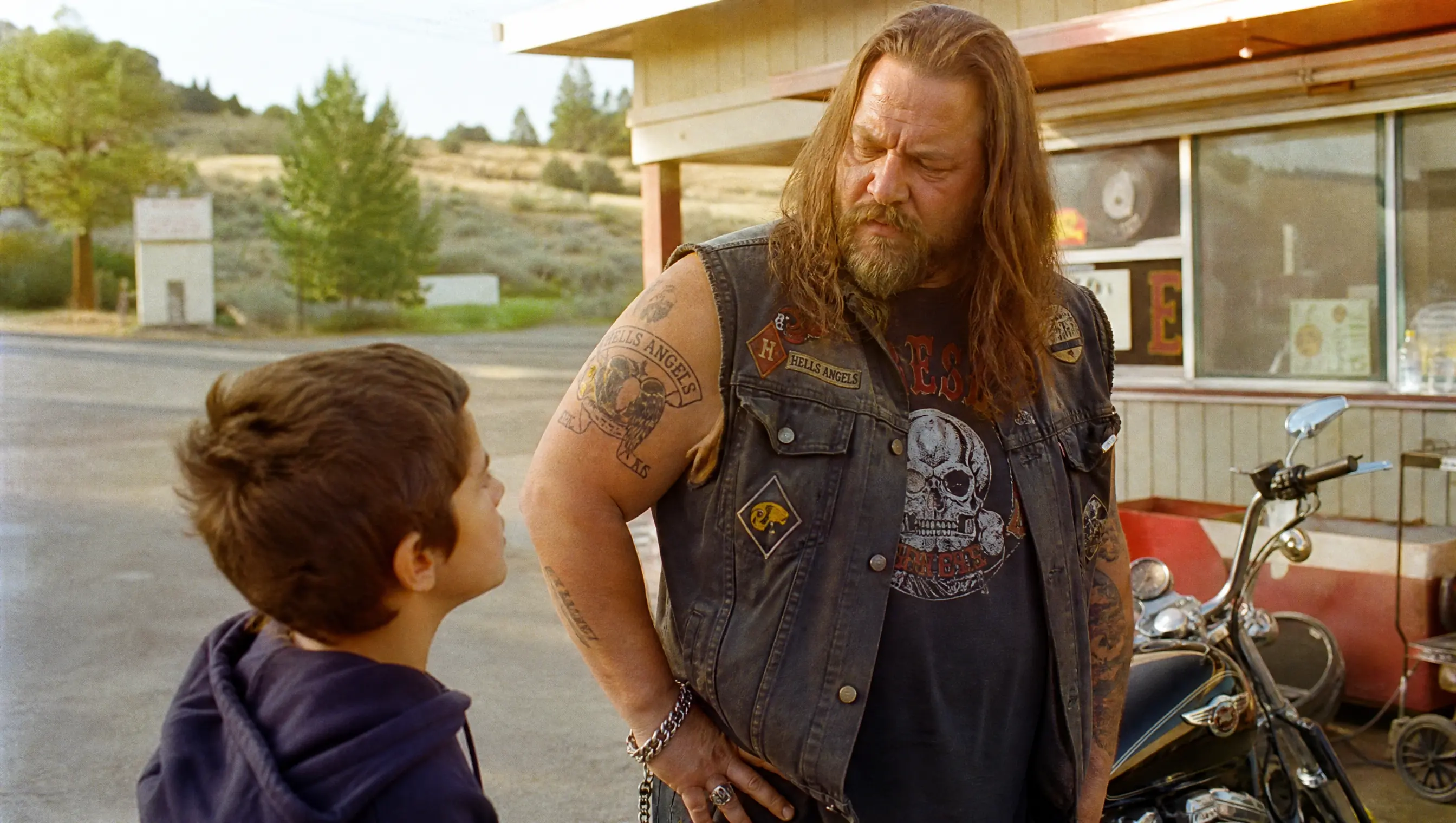
He watched it go, the taillights shrinking around the curve, and he sat on the bike in the lot under the gas canopy with the engine ticking and the rain hammering the metal roof above him, and he laughed at himself a little. An old man with a bad heart, jumping at headlights. He took off his helmet. His hair was gray and long enough to tie back, and his beard was gray, and his face in the dark window of the fuel office was the face of a man who had been out in the weather his whole life. He was six foot four and heavy through the shoulders and belly both, and he wore a leather vest over his rain jacket out of habit more than anything. The vest had been black once. Now it was the brown-gray of old leather, and on the back, if you looked closely in good light, you could still see the pattern of holes and darker leather where a set of patches had been cut away twenty-two years ago with a pair of tin snips. A top rocker, a center patch, a bottom rocker. The ghost of a skull with a crown on it. The ghost of the words HOLLOW KINGS and ERIE.
He had kept the vest because it fit, and because it was warm, and because throwing it away would have felt like pretending none of it had happened. Hollis did not believe in pretending.
He filled the tank, paid at the pump with the card that still worked, and walked the bike over to the side of the building where the overhang would keep the seat a little drier. Then he went inside.