The security camera at Rossy’s Diner captured everything the night a homeless man was about to receive what might have been his last meal from a struggling young server who barely had enough money to survive the week himself. Three days later, when the truth exploded across every news channel in America, nobody could believe it. The CEO of Morrison Industries, one of Chicago’s biggest companies, had been living on the streets. And the twenty-year-old waiter who helped him was about to see his life change in ways that felt impossible. But to understand why what happened next stunned the entire country, you need to understand how much Jamal Williams was carrying before he ever stepped toward that booth.
This was not some rich kid playing hero for attention. Jamal knew exactly what hunger felt like.
Every morning at five o’clock, Jamal’s alarm cut through the thin walls of the tiny studio apartment he shared with his sixteen-year-old sister, Kesha. He didn’t wake early because he wanted discipline or admired productivity quotes. He woke early because survival had a schedule. Their apartment was barely four hundred square feet. One bed that Kesha slept in while Jamal took the couch. A kitchenette with a mini-fridge that hummed louder than it cooled. A bathroom with cracked tile and a shower that only gave hot water when it felt charitable. Rent consumed most of what he earned every month.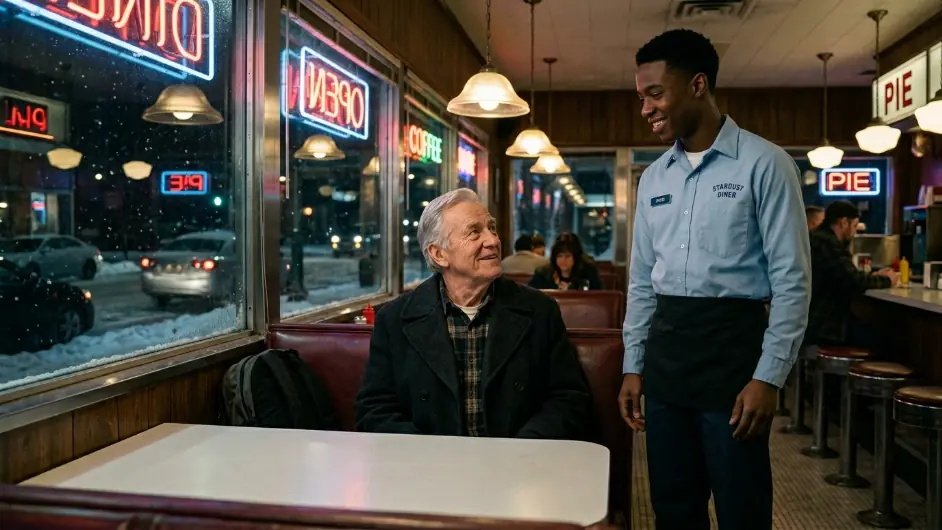
Six months earlier, their grandmother had died.
She was the woman who raised them after their parents were killed in a car accident when Jamal was twelve. She left them the apartment, but also left them alone in the world. At nineteen, Jamal had become Kesha’s legal guardian. College dreams went on hold. Full-time university was impossible. His future had to wait because his little sister’s present mattered more.
So he found another path.
Community college at night. Work during the day. Sleep whenever he could steal it.
His routine was brutal. Study from five-thirty to six-thirty in the morning while Kesha slept. Shower fast before the water turned cold. Take two buses across Chicago to Rossy’s Diner, where he worked long shifts serving coffee, carrying plates, wiping counters, calming impatient customers, and staying polite to people who thought kindness came with the tip they never left.
The work itself didn’t break him.
What hurt more was watching people his age living the life he should have been living.
College students came into the diner laughing about frat parties, spring break plans, and classes their parents were paying for. They ordered stacks of pancakes and complained dramatically about how hard life was because their phone battery died before noon.
They had no idea what it felt like to count every dollar.
Every afternoon Jamal would leave work, catch those same buses, and pick up Kesha from Jefferson High School. He’d help her with homework at the kitchen table that rocked because one leg was shorter than the others. They ate whatever was cheapest that week. Ramen noodles. Peanut butter sandwiches. Generic cereal that tasted like cardboard.
At seven p.m., Jamal kissed his sister on the forehead and headed back into the Chicago cold for classes at Harold Washington Community College. He studied business administration, not because it was his passion, but because it was practical. Maybe someday he could build something that got them out of this cycle.
His professors didn’t know he sometimes fell asleep during lectures because he’d been studying until two in the morning after work.
His classmates didn’t know he skipped study groups because coffee shops cost money.
They didn’t know he rotated the same three shirts because laundry quarters had to be budgeted like medicine.
But somehow Jamal kept going.
He held a 3.7 GPA.
He never missed work.
He made sure Kesha’s grades stayed high and that she had clean clothes for school, even if he had to wear worn collars and fading shoes.
The thing about Jamal was this.
He never complained.
When rude customers snapped fingers at him, he smiled and said, “I’ll be right with you.”
When classmates talked about vacations he would never afford, he asked about the beaches and mountains like curiosity was free.
He carried an old business card in his wallet from a motivational speaker who had visited his high school years earlier. The man had talked about paying it forward and how small acts of kindness could change the world. Jamal had kept that card through everything. Through his grandmother’s funeral. Through sleepless nights wondering how rent would be paid. Through taking custody of Kesha.
Because deep down, even when life felt impossible, Jamal believed good things happened to good people.
His grandmother had taught him that.
“Feed people when you can, baby,” she used to say. “The universe keeps track of everything.”
Lately, though, the universe seemed to be keeping a different kind of score.
That December night, Jamal had exactly twelve dollars left.
Not spending money.
Not extra cash.
Twelve dollars total.
It had to last until Friday when he got paid. Three more days. No lunch tomorrow. No emergency bus fare if Kesha needed something. No room for surprises.
He had planned to use two dollars for a cup of coffee at Rossy’s after shift and sit in the warm dining room before evening class began.
Rossy’s was known in the neighborhood for letting people stay if they ordered something small. Maria, one of the senior waitresses, had always been kind to him. Mr. Rossi, the owner, acted gruff but had quietly fed more struggling people than most churches.
When Jamal pushed through the heavy glass door after finishing cleanup, warmth hit his face like mercy. The smell of coffee, onions, butter, and fried potatoes made his stomach growl. He hadn’t eaten since breakfast.
Two pieces of toast.
Peanut butter scraped thin.
But what he saw in the corner booth made his own hunger feel unimportant.
An older white man sat alone, maybe sixty-five, silver hair, tired face, shoulders held straight in the strange way of someone trained by decades of responsibility. His clothes were worn but clean. A wool coat frayed at the cuffs, yet once expensive. A sweater with a tiny hole near the collar, but made from quality fabric that outlived trends.
And on his left wrist, partly hidden beneath the sleeve, was a watch.
Not an ordinary watch.
Even from across the room, Jamal could tell it was expensive. The kind that caught light in a quiet flash. The kind worth more than Jamal made in months.
The man had been staring at the menu for twenty minutes.
Not reading it.
Calculating prices.
Maria had approached twice.
Each time he politely waved her off.
“Just a few more minutes, if you don’t mind.”
“I appreciate your patience, miss.”
His voice was soft. Educated. The kind of voice usually heard in offices with glass walls and people who say things like circle back next quarter.
That’s when Jamal understood.
The man was hungry.
Really hungry.
And broke.
Outside, the wind slammed snow against the windows. Chicago weather reports had warned people to stay inside. Shelters were already full. This wasn’t a night anyone should be wandering streets alone.
Inside the diner, it got busier. Customers kept coming in, shaking off snow, stamping boots, ordering hot food before heading somewhere warm.
The older man searched his coat pockets.
Then his pants pockets.
Then the coat again.
Each attempt more desperate than the last.
His shoulders dropped a little lower every time his hands came up empty.
Then he started coughing.
Not a small cough.
Deep chest coughs that made people glance over with concern.
He tried to hide it in his sleeve.
Tried to shrink into the booth.
Tried to disappear.
Maria noticed and brought him a glass of water.
“On the house,” she whispered.
The gratitude in the man’s eyes was too large for something so small.
“Thank you, miss. You’re very kind.”
Even his thank-you sounded formal.
Jamal did the math automatically.
The meatloaf special was eight dollars.
Coffee and tax maybe more.
If he bought the man dinner, he would have nothing left.
Actually less than nothing, because hunger tomorrow would become debt somehow.
His grandmother’s voice returned.
Feed people when you can, baby.
But could he?
The man slowly stood from the booth, preparing to leave. He swayed once and caught himself on the table. The sound he made was part exhaustion, part defeat.
Jamal felt sweat on his forehead despite the cold outside.
This wasn’t about money anymore.
This was about life and death.
A sick, hungry man was about to walk into a Chicago winter that could kill him.
Every practical thought screamed for Jamal to stay seated.
Think about Kesha.
Think about rent.
Think about tomorrow.
But his feet were already moving.
He crossed the diner floor.
Each step louder than it should have been.
“Excuse me, sir.”
The man turned.
Up close, his eyes were the brightest blue Jamal had ever seen. Intelligent, alert, but tired in a way sleep alone couldn’t fix.
“Yes, son?”
That single phrase confirmed everything. This man spoke like someone used to being listened to.
“I wondered if you’d like to join me for dinner.”
The man blinked, genuinely surprised.
“Oh, son. I couldn’t impose.”
“You’re not imposing. I’m inviting you. Please.”
The word please seemed to affect him.
He studied Jamal’s face for a long moment.
“That’s very kind of you, but I’m afraid I can’t.”
“Sir, it’s fifteen degrees outside. You’re coughing like you’re getting sick. Please let me buy you dinner.”
Another pause.
Then the man nodded.
“All right. Thank you. That’s extraordinarily kind.”
They sat together at a small table by the window.
Maria came over immediately, smiling.
“What can I get you gentlemen tonight?”
Jamal didn’t look at the menu. Looking at prices might weaken courage.
“Two meatloaf specials, please. With coffee. And apple pie after.”
Maria’s eyes softened, but she wrote it down without comment.
As she walked away, the man looked directly at Jamal.
“Son, that’s going to cost.”
“Don’t worry about it.”
“I should tell you, I can’t pay you back right now.”
“I’m not asking you to.”
The man fell silent.
He folded his hands on the table and simply stared, not rudely, but as if Jamal represented something he had forgotten existed.
“What’s your name?” Jamal asked.
“William,” he said after the slightest hesitation. “William Morrison.”
“I’m Jamal. Jamal Williams.”
William extended his hand.
“Pleased to meet you, Jamal.”
The handshake was firm, practiced, confident.
The handshake of a man used to closing deals.
When the food arrived, William thanked Maria like she had delivered a royal banquet.
Then he ate.
Not greedily.
Not like a man trying to impress hunger.
He ate like someone who had spent his life learning table manners and now could no longer afford to let desperation erase them.
Small bites.
Chewed fully.
Napkin in lap.
Coffee lifted carefully with both hands to warm his fingers.
Jamal watched without meaning to.
Most people would have attacked that plate.
William carried himself with habits too deeply rooted to collapse overnight.
“You from Chicago?” Jamal asked.
“Long time now,” William said. “Though I’ve lived in many places.”
“You got family around?”
William’s fork paused.
“Not the kind that would notice if I missed dinner.”
There was no bitterness in the sentence.
That made it sadder.
They talked between bites.
Jamal learned William had worked in manufacturing and logistics for decades. He knew supply chains, labor disputes, shipping routes, steel pricing, and why so many American factories had vanished.
He spoke about business the way professors spoke about history.
With ownership.
With texture.
When Jamal mentioned studying business administration at night, William’s eyes sharpened.
“What courses?”
“Accounting this semester. Intro marketing. Operations next.”
“Operations matters,” William said immediately. “Everyone glamorizes ideas. Ideas are cheap. Execution is where fortunes live or die.”
Jamal laughed.
“You sound like one of my professors.”
“I’ve had a few meetings in my life.”
That answer carried layers.
Then William asked questions no stranger usually asks.
How much was tuition?
How many hours did Jamal work?
Who watched Kesha when he had class?
What were his grades?
What did he actually want, if money wasn’t the issue?
No one had asked Jamal that last question in years.
He stared at his plate.
“I think… I’d like to own something someday. A place that hires people who need a chance.”
William nodded slowly as if filing away an important number.
“Good answer.”
When dessert came, Jamal almost told Maria to cancel one pie.
He had forgotten the bill would be real soon.
But Maria set two warm slices down and whispered:
“Already taken care of.”
Jamal looked up.
She only winked and walked off.
Even generosity had allies tonight.
William noticed everything.
“She did that for you,” he said.
“She did that for us.”
William smiled for the first time.
It transformed his whole face.
Under the fatigue, under the rough week etched into his skin, there was charisma.
The kind some men spend fortunes trying to imitate.
After they finished, Jamal paid for the dinners and coffee with shaking hands.
Nine dollars and change.
Then added the little cash left for tip.
His wallet now held two wrinkled one-dollar bills and coins.
Maria tried to refuse the tip.
He insisted.
Outside, the storm worsened.
Jamal zipped his thin jacket and said:
“You know where you’re staying tonight?”
William looked at the snow for a long moment.
“Still evaluating options.”
Meaning nowhere.
Jamal swallowed hard.
His apartment lease technically forbade guests for extended stays, but one night wasn’t extended.
And if management found out?
That was tomorrow’s fear.
Tonight had enough of its own.
“I got a couch,” Jamal said.
William turned sharply.
“Absolutely not. You’ve done more than enough.”
“It’s either that or you sleep outside.”
“I’ve handled worse.”
“Maybe. But not tonight.”
William studied him again.
“You have your sister at home.”
“How do you know?”
“Because every decision you make has another person in it.”
Jamal didn’t know what to say to that.
Finally William nodded once.
“One night. And I’ll leave before sunrise.”
They took the bus together.
Passengers stared.
A young Black waiter in a diner apron beside an older white man with the posture of a CEO and the coat of a drifter.
Chicago teaches people not to ask questions.
Kesha opened the apartment door with one eyebrow raised.
“Jamal, who—”
“This is Mr. William. Rough night. He needs the couch.”
Kesha looked at William for exactly three seconds.
Then stepped aside.
“Take your shoes off. Floor gets cold.”
William laughed softly.
“Yes, ma’am.”
That night Jamal gave William his own blanket and took the floor.
At three a.m. he woke to hear quiet movement.
William stood by the tiny kitchen sink, staring at a framed photo of Jamal, Kesha, and their grandmother.
“She raised us,” Jamal whispered.
William didn’t turn.
“She looks like strength.”
“She was.”
“She’d be proud of you.”
Jamal almost cried from exhaustion alone.
By morning William was gone.
Blanket folded.
Couch straightened.
A handwritten note on notebook paper:
Thank you for reminding me who I wanted to be.
No signature.
Jamal shrugged it off as one strange night in a life already full of survival.
Then three days later America exploded.
Rossy’s Diner had a television mounted over the pie case usually tuned to sports or weather. That Friday every channel showed the same breaking news banner.
WILLIAM MORRISON FOUND SAFE AFTER 72-HOUR DISAPPEARANCE.
Jamal froze carrying a tray of coffee.
On screen appeared the same blue eyes.
The same controlled posture.
The same man from his couch.
Only now he wore a navy overcoat worth more than Jamal’s yearly rent and stood behind a podium flanked by lawyers, executives, and reporters.
William Morrison.
Founder and CEO of Morrison Industries.
Net worth estimated 2.4 billion dollars.
Manufacturer of industrial components supplying half the Midwest.
Missing for three days after what sources described as a personal security breach and voluntary disappearance following a board dispute.
Reporters shouted questions.
William raised one hand.
“I’m safe. I’m healthy. And before I address corporate matters, I need to find a young man named Jamal Williams.”
The tray nearly slipped from Jamal’s hands.
The diner went silent.
Maria slowly turned to look at him.
Mr. Rossi emerged from the kitchen wiping his hands.
On television William continued:
“He fed me when I was hungry. Sheltered me when I had nowhere to go. Treated me with dignity when he believed I was no one of consequence. If anyone knows where Jamal Williams is, please tell him I owe him breakfast.”
Every customer in Rossy’s stared.
Then Maria screamed.
“JAMAL!”
Phones came out instantly.
Someone was already livestreaming.
Mr. Rossi grabbed Jamal by both shoulders.
“What did you do?”
“I bought him meatloaf,” Jamal said weakly.
Within twenty minutes satellite vans were outside the diner.
Reporters crowded the sidewalk.
Neighbors texted.
Kesha called crying and laughing simultaneously.
“You let a billionaire sleep on our couch?”
“I didn’t know!”
“That couch got springs poking out!”
A black sedan arrived at noon.
Driver in a tailored coat.
Two security professionals.
Inside sat William Morrison himself.
He entered Rossy’s like a man who owned towers but preferred diners.
The room erupted in applause.
William ignored everyone until he reached Jamal.
Then he embraced him.
Not a handshake.
An actual hug.
“You saved my life,” William said quietly.
“I bought you dinner.”
“You did much more than that.”
The cameras loved it.
America loved it more.
But the truth behind William’s disappearance was stranger than headlines knew.
His board had been trying to push him out after he opposed plant closures that would cut ten thousand jobs. During a private retreat he walked away from security to clear his head, intending one night alone. Then his wallet was stolen on the train. Phone battery died. Pride kept him from calling anyone publicly.
Three days later, hunger and exhaustion had reduced one of America’s richest men to searching coat pockets in a diner booth.
And the first person who saw a human being instead of a headline was Jamal.
That afternoon William asked for privacy.
He, Jamal, Maria, Mr. Rossi, and Kesha sat in the closed diner after lunch service.
Snow melted outside.
Coffee steamed between them.
William spoke plainly.
“Jamal, I investigated you before coming here today.”
Kesha stiffened.
William raised a calming hand.
“Only enough to know whether your kindness was performance. It wasn’t.”
He slid a folder across the table.
Inside were scholarship documents.
Full tuition to complete Jamal’s degree anywhere in Illinois.
Housing stipend.
Books covered.
Transportation covered.
Paid internship at Morrison Industries each summer.
Jamal couldn’t breathe.
William continued.
“For Kesha, college savings trust beginning immediately.”
Kesha burst into tears.
Maria started crying too.
Mr. Rossi pretended something was in his eye.
Then William slid a second folder.
Business incorporation papers.
Seed funding commitment: $250,000.
For future use.
When Jamal was ready to build the company he had described over meatloaf.
“No pressure,” William said. “Use it in ten years if needed. But the dream should not die because rent was due.”
Jamal’s hands shook so hard papers rattled.
“Why?” he whispered.
William answered without hesitation.
“Because character revealed under no audience is the rarest asset on earth.”
News of what happened at Rossy’s spread faster than anything Morrison Industries had launched in years.
Morning shows replayed the diner footage.
Business channels analyzed William Morrison’s disappearance, then abandoned spreadsheets to discuss Jamal Williams.
Social media turned the phrase “I bought him meatloaf” into a national slogan for unexpected kindness.
People mailed envelopes of cash to Rossy’s for Jamal.
Mr. Rossi returned every dollar with a handwritten note:
He’s taken care of. Help someone near you instead.
That gesture alone made the diner famous.
Lines formed around the block for weeks.
But the real changes happened where cameras could not see them.
Jamal moved more slowly for a while, as if sudden hope required balance.
He still woke at five.
Still made sure Kesha got to school.
Still folded blankets.
Still apologized when bumping into tables.
Trauma doesn’t vanish because opportunity arrives.
It learns new rooms.
William understood that better than most.
He assigned Jamal no handlers, no image consultants, no fake mentorship dinners built for publicity.
Instead, every Wednesday at 6:30 a.m., before Jamal’s shift or class, William met him at a small café downtown.
No cameras.
No entourage.
Two coffees.
One yellow legal pad.
They talked business.
Cash flow.
Vendor leverage.
Margins.
Hiring culture.
Why some leaders confuse fear with efficiency.
Why debt can be a tool or a prison depending on who writes the terms.
Why gratitude should never replace negotiation.
Jamal took notes like a starving man given books.
He also asked questions others were too proud to ask.
“What if people hear how I started and never take me seriously?”
William answered instantly.
“Then they’re not worth doing business with.”
“What if I fail after all this?”
“You will fail at some things,” William said. “The goal is to survive your mistakes faster than others survive their arrogance.”
Meanwhile Kesha transformed quickest.
The constant tension left her shoulders.
She stopped pretending not to need things.
Bought new shoes without apologizing.
Joined debate club.
Started talking about universities in full sentences instead of whispers.
She told Jamal one night while doing homework:
“I used to think dreams were rude when bills existed.”
That sentence stayed with him.
William also quietly handled practical problems.
The landlord who had ignored mold complaints for months suddenly scheduled repairs.
A better apartment became available in the same neighborhood at lower rent through a housing partner connected to Morrison charitable programs.
Jamal initially resisted.
“I don’t want charity.”
William corrected him.
“Then call it leverage.”
So they moved.
Two bedrooms.
Real heat.
Windows that sealed properly.
A kitchen table that didn’t wobble.
Kesha cried the first night because silence in safe homes can feel loud.
Jamal continued working at Rossy’s through the semester.
He refused to quit abruptly.
Mr. Rossi refused to let him stay full shifts.
“You got boardrooms now,” the old man grumbled. “Take table seven and go study.”
Maria began introducing every new customer to him whether he wanted it or not.
“This is the boy who fed the billionaire.”
“I’m twenty,” Jamal would say.
“You’re a boy until I say otherwise.”
America eventually moved on to fresher headlines.
It always does.
Jamal did not mind.
He had no interest in being famous.
He wanted competence.
By the second year William placed him inside Morrison Industries operations planning.
Not ceremonial shadowing.
Real work.
Warehouse bottlenecks.
Supplier disputes.
Missed delivery penalties.
Underperforming regional managers.
Jamal discovered something important.
He was good at chaos.
Years of balancing rent, school, buses, and guardianship had trained him to prioritize under pressure better than polished MBA interns who panicked when printers jammed.
He listened well.
Remembered names.
Noticed waste.
Spoke carefully.
Factory supervisors liked him because he respected labor.
Executives underestimated him because they saw diner origins before intelligence.
That lasted until meetings started going his way.
At twenty-four, degree completed debt-free, Jamal used part of the seed funding to launch First Table Hospitality Group.
The concept came from Rossy’s and from hunger.
Neighborhood restaurants in underserved areas offering affordable meals, fair wages, management training, and emergency community meal programs funded by premium catering contracts.
Simple model.
Serve regular people with dignity.
Make enough margin from corporate business to subsidize it.
William invested formally.
So did two other executives after he told them:
“If you pass on this, don’t ask me later.”
The first location opened on Chicago’s South Side.
Line out the door opening week.
Not because of celebrity.
Because the food was good, prices fair, and staff treated customers like neighbors.
Every store hired at least five workers facing barriers to employment.
Formerly incarcerated applicants.
Single parents needing schedules.
Students carrying families the way Jamal once had.
By twenty-eight, Jamal had six locations.
By thirty, twelve.
He put Kesha through Northwestern.
She became an attorney specializing in housing rights.
At her graduation she hugged William first, then Jamal, then scolded both for crying publicly.
William’s own company changed too.
The board fight that triggered his disappearance ended with three directors resigning after shareholders backed him decisively.
He kept the plants open longer than analysts wanted and modernized them instead of gutting them.
Profits dipped short-term.
Then surged.
Turns out loyalty from workers who know you fought for them carries financial value spreadsheets miss.
Every December twenty-first, no matter where they were in the world, Jamal and William met at Rossy’s Diner.
Same booth.
Same order.
Two meatloaf specials.
Coffee.
Apple pie.
Mr. Rossi eventually framed the original receipt on the wall.
Amount due: $9.42
Tip: $2.58
Total cash in Jamal’s pocket afterward: almost nothing.
Value created: immeasurable.
When Mr. Rossi retired, Jamal bought Rossy’s anonymously through an intermediary, renovated the kitchen, raised wages, and kept every employee who wanted to stay.
Only after paperwork closed did he tell the old man.
Mr. Rossi cursed at him affectionately for five straight minutes.
Maria became general manager.
She still bosses everyone.
William aged with grace and stubbornness.
He never fully enjoyed public praise, but privately loved watching Jamal outgrow gratitude and become formidable.
One morning over coffee he said:
“You don’t owe me loyalty forever, you know.”
Jamal smiled.
“Good. Because what I feel isn’t loyalty.”
“What is it?”
“Family with better accounting.”
William laughed so hard other customers stared.
The nation remembered their story whenever some outlet recycled feel-good news.
They always focused on the billionaire rescued by kindness.
They missed the deeper truth.
William did not transform Jamal.
He recognized him.
The discipline, sacrifice, intelligence, and character were already there in a twenty-year-old waiter taking two buses to work, raising his sister, studying by dawn light, and still spending his last dollars on a stranger.
Money can accelerate destiny.
It cannot manufacture it.
Years later Jamal stood before a graduating class invited to give a commencement speech.
He told no dramatic version.
No polished myth.
He simply said:
“I thought I was buying dinner for a hungry man. Really, I was protecting the kind of person I wanted to remain.”
Then he paused.
“If success ever comes, make sure it lands on someone already practicing generosity before they had proof it would pay.”
After the speech, students lined up for photos.
One young server working part-time through school waited until last.
He looked nervous.
“Mr. Williams,” he said, “sometimes I’m so tired I stop believing any of it matters.”
Jamal knew that face.
He had worn it.
So he reached into his wallet and handed the young man an old weathered business card, edges soft with years.
The same card he had carried since high school.
The motivational speaker’s faded words still readable.
Pay it forward. Small kindnesses change worlds.
Jamal smiled.
“Keep this until life proves it.”
That winter snow fell again over Chicago.
Inside Rossy’s, warm lights glowed against the windows.
At the corner booth two men ate meatloaf slowly, talking operations, family, and whether pie quality had declined since 2019.
Maria yelled from the counter that both were wrong.
Some miracles look like headlines.
The best ones look like dinner.
People told the story for years as if it were about luck.
A homeless stranger.
A hidden billionaire.
One dinner.
One impossible break.
But luck was only the surface.
The real story began long before Rossy’s Diner.
It began in a four-hundred-square-foot apartment where a young man woke before sunrise to study while everyone else slept.
It began on freezing bus stops, late-night classes, overdue bills, and the quiet decision to keep going without applause.
It began every time Jamal chose responsibility when no one would have blamed him for choosing escape.
That night in the diner, he did not become extraordinary.
He revealed what he had already been.
William Morrison understood that immediately.
Boardrooms had shown him ambition.
Markets had shown him greed.
Luxury had shown him performance.
But hunger showed him character.
And when character appeared wearing a cheap uniform and tired eyes, he recognized value faster than any analyst ever could.
Jamal’s last dollars bought more than meatloaf.
They bought proof.
Proof that hardship had not made him selfish.
Proof that pressure had not made him cruel.
Proof that generosity can survive even when comfort does not.
The money, the business, the headlines, the opportunities that followed were not rewards for one kind act.
They were doors opened for a man who had been knocking through discipline for years.
Kesha often said the best part was not the scholarships or the apartments or the restaurants.
It was watching her brother finally live at the age he actually was.
Not a substitute parent.
Not a frightened provider.
Not a teenager carrying adult weight.
Just Jamal.
William’s greatest gift may not have been money either.
It was interruption.
He interrupted a cycle that had trapped two siblings in survival mode.
And Jamal, in return, interrupted something in William.
He reminded a billionaire what dignity feels like when it comes from someone who needs nothing back.
Rossy’s still keeps the framed receipt on the wall.
Customers point at the number and smile.
$9.42.
Small bill.
Huge return.
But the receipt misses the true cost.
Jamal spent courage he could barely afford.
He spent trust in a world that had not always earned it.
He spent compassion on a stranger during a week when he himself needed saving.
That is why the story lasts.
Because deep down everyone knows fortunes are built in many ways, but humanity is built one choice at a time.
And sometimes the most important investment ever made is buying dinner when logic says don’t.