At 7:43 on Christmas Eve, Caleb Morgan was told to turn off the last light at the Pine Lantern Diner. Three minutes later, he saw three figures moving through the white wall beyond the windows, and he knew that if he obeyed the order, somebody might die before morning.
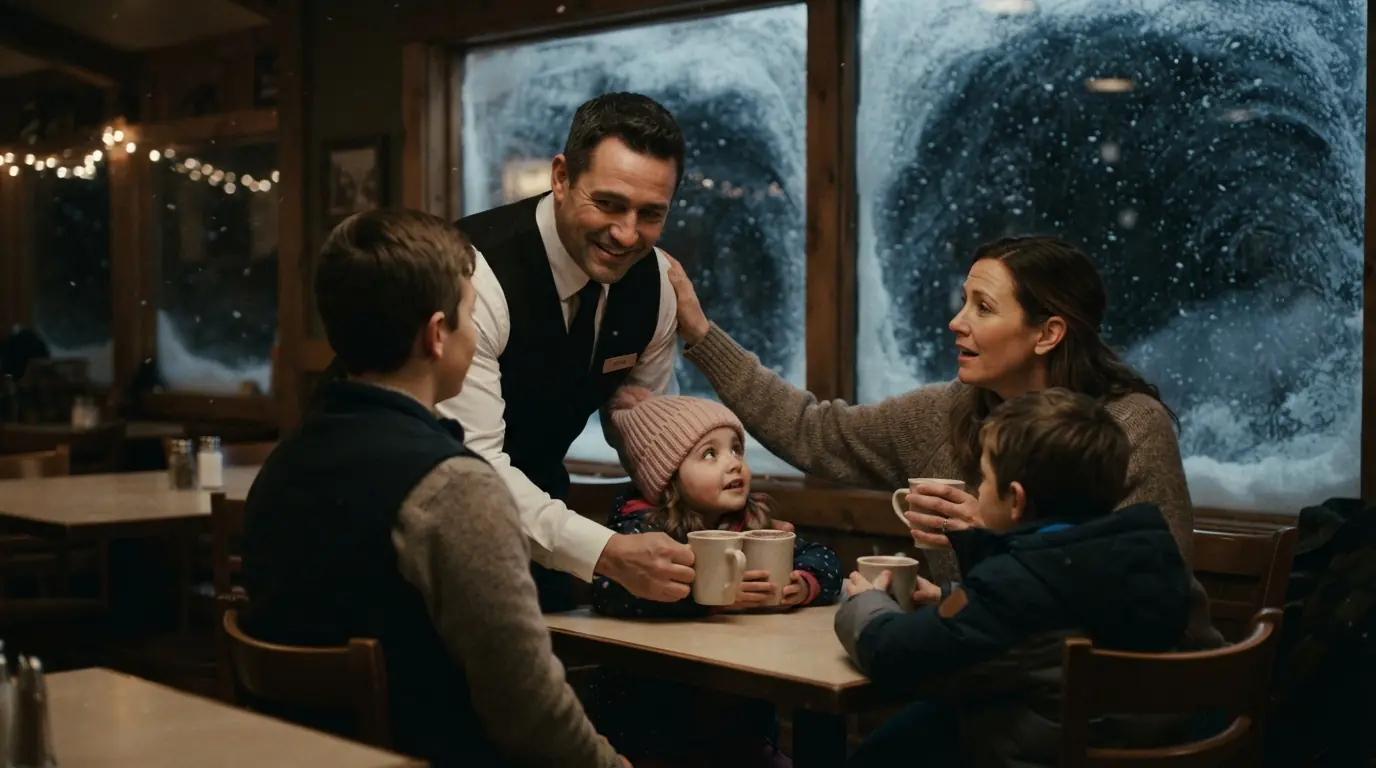
The blizzard had arrived six hours earlier than the forecast promised, swallowing the highway through northern Montana so completely that even the diner’s red sign had become a dull smear against the snow. Inside, Christmas garlands sagged above the windows, the coffee machine hissed in the empty dining room, and a small iron stove gave off the kind of heat Caleb remembered from childhood.
He was thirty-six, with dark hair that never stayed neatly combed, a white work shirt rolled to the elbows, and brown suspenders stretched over a back made tired by too many double shifts. He had been serving breakfast, lunch, and supper at the Pine Lantern for nearly twelve years, long enough to know which truck drivers wanted their eggs hard and which lonely regulars preferred conversation to a refill.
The diner was not his, though its chipped counter and narrow red booths sometimes felt more like home than the rented apartment above the pharmacy. Diane Porter owned the building, and earlier that evening she had called from her sister’s house to say the county was closing the pass and that Caleb needed to secure the doors before the weather became dangerous.
“Insurance doesn’t cover a whole town camping in my dining room,” she had said, sounding more frightened than unkind. “Go home while there’s still a chance.”
Caleb had looked at the snow building against the entrance and answered, “There isn’t a chance now, Diane. I’ll stay until the plows come through.”
He had not told her that going home would mean crossing the narrow bridge above Fox Creek, or that the bridge had already disappeared into blowing snow. He also had not told her that, twenty-seven years earlier, another man named Morgan had heard an order to stay off a dangerous road and had driven onto it anyway.
The memory of his father was a thing Caleb kept folded away, like a letter too painful to read and too important to throw out. His father, Elias Morgan, had operated a county snowplow, and the last time eight-year-old Caleb saw him, Elias had stood in their kitchen buttoning an orange coat while Caleb’s mother pushed a thermos of coffee into his gloved hand.
“You keep the porch light on for me, buddy,” Elias had said. “I’ll find my way back.”
He never did. The county report said his truck had left its assigned route during a storm, overturned near the old quarry road, and gone into a ravine where rescuers could not reach it until daylight.
Caleb’s mother refused to let anyone call her husband a fool, but the phrase unauthorized deviation remained on the paper the county mailed her. By the time Caleb was old enough to understand those two words, he understood something else as well: a sentence written by strangers could change the way a town remembered a dead man.
He was reaching for the switch beside the front door when the movement outside caught his eye. At first he thought a branch was sliding across the snow; then a flash of red appeared, followed by the bowed shapes of two adults trying to shelter a small child between them.
Caleb pulled the door open, and the wind struck him hard enough to bend him backward. “In here!” he shouted, although his voice seemed to vanish in the roar. “Follow my hand. Just keep coming.”