It rained the way it only rains at the mouth of the Columbia, sideways and from below, so that an umbrella was a kind of joke you told yourself on the way to the car. That was Tuesday, the twelfth of October, 1982. I know the date because it was twenty years to the day since the Columbus Day Storm, and every man who sat down at my counter that morning wanted to tell me where he'd been in '62 when the wind took the roof off the Safeway or put a Sitka spruce through his brother-in-law's Buick.
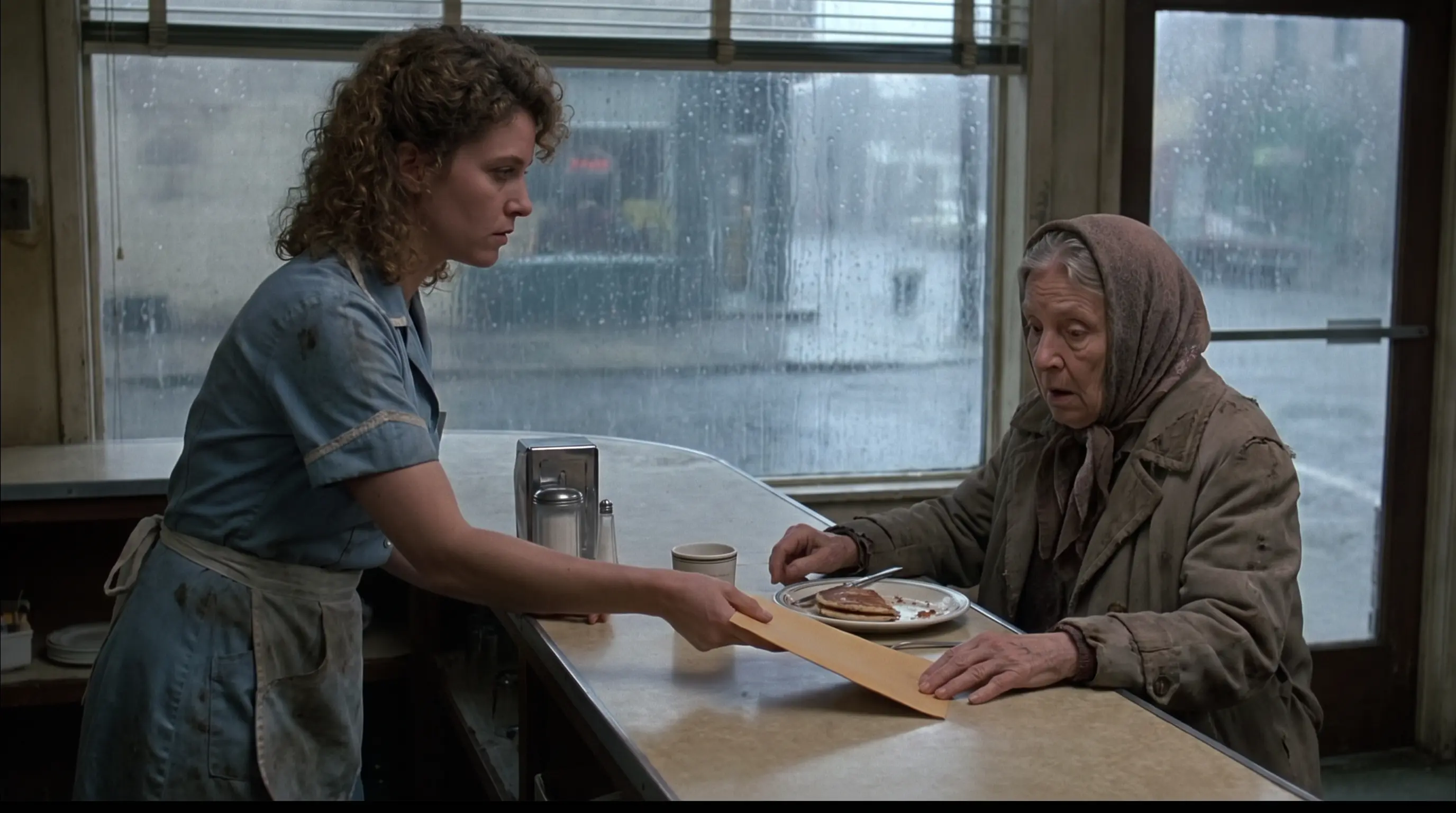
I'd been nineteen in '62, three weeks into a job I'd only meant to keep for the winter, and I had spent that storm under a booth table at the Sandbar Cafe with a coffee pot in my lap because I was afraid to set it down. I was still at the Sandbar in 1982. I'd been there so long I could tell you by the sound of a man's boots on the mat whether he wanted the menu or just the coffee.
The Sandbar sat on Marine Drive in Astoria, Oregon, on the river side, propped up on old pilings like most of the waterfront, so that on a big tide you could feel the floor breathe a little under your shoes. It had been a net loft before it was a cafe, and Toivo Huhta, who owned it and cooked in it, had never seen any reason to hide that. There were still iron hooks in the ceiling beams, painted over in a green that Irja, his wife, called sea foam and everybody else called hospital. There were fourteen stools at the counter, chrome and red, and seven booths down the window wall, and from every one of those booths you could look out across the gray water to the bridge, four miles of it, swooping up at our end high enough for the freighters to pass under and then running low and flat across the river to Washington like somebody had gotten tired of building it halfway. On a clear day it was the most beautiful thing in Clatsop County. On a day like that Tuesday you could see the first two piers of it, and then nothing, just rain and the idea of a bridge.
By ten in the morning the breakfast rush, such as it was in 1982, had come and gone. Bumble Bee had closed the big cannery in 1980, and the plywood mill in Warrenton had cut its second shift in the spring, and the gillnetters were talking about the fish counts the way people talk about a relative in the hospital. On the little Zenith television Irja kept on a shelf by the register, the morning news out of Portland had said the national unemployment rate was over ten percent for the first time since before the war, and Eino Saari, who had been a bar pilot for thirty years and now sat on the end stool every day from six until the pinochle game started at the Moose Lodge, had said, "Ten percent where? Not here. Here it's twenty," and nobody had argued with him.
The other thing on the Zenith that week was Tylenol. Some lunatic in Chicago had put cyanide in the capsules and seven people were dead, and every station was showing the same footage of men in white coats pulling bottles off drugstore shelves. That's the kind of fall it was. You couldn't trust a headache pill, there was no football because the players had gone on strike, and the jukebox, which Toivo had bought used from a tavern in Seaside in 1971 and which still took a quarter for three songs, played "Jack and Diane" so many times a day that Toivo had threatened to pull the record and nail it to the wall.
I mention all that so you'll understand what the money was like. I was thirty-nine years old. I had a daughter, Jodie, who was seventeen and a senior at Astoria High, and a son, Petey, who was ten and needed braces in the way that a house needs a roof, which is to say the dentist had used the word eventually in a tone that meant soon. My husband, Keith, had been my ex-husband since 1975 and was supposed to send two hundred dollars a month from Kodiak, where he worked on a crabber, and sometimes he did. I rented the bottom half of a house in Uniontown, up the hill from the bridge approach, for two hundred and ten a month, from an old Finnish widow named Mrs. Lahti who lived upstairs. My car was a 1973 Pinto wagon with a heater that worked only when it wanted to. I made a dollar and seventy-five an hour plus tips, and the tips in October 1982 were the kind of tips you got from men who were afraid of their own mailboxes. A good day was twenty dollars. That Tuesday I'd made six dollars and forty cents by ten o'clock, and two of those dollars were Eino's, who tipped me the same two dollars every day because he said it was cheaper than a wife.
So I wasn't flush. I want that clear, because later on Irja made a story out of what I did, and in her story I was some kind of saint with a pocketful of change, and I wasn't. I was a tired woman with a stack of bills under the sugar canister at home and one thing on my mind besides money, and that thing was my daughter.
Jodie had been going with a boy named Darrell Tolan since July. He wasn't a boy, exactly. He was twenty-two, and he'd been laid off from a gyppo logging outfit up the Lewis and Clark River in the spring, and he drove a 1972 Chevelle the color of a ripe plum, which he kept cleaner than I'd ever kept anything in my life, including my children. He had good manners. That's what I remember thinking the first time she brought him to the house, that he had very good manners, that he called me Mrs. Hakala even though I'd told him twice I'd gone back to using it only because it was on the kids' school forms, that he stood up when I came into the room and took his cap off at the table and asked Petey about his baseball cards like he actually wanted to know. He brought me chrysanthemums from the Safeway once, the price sticker peeled off. He lived with his grandmother out in Brownsmead, on the dairy flats east of town, and he talked about her a great deal, how she'd raised him after his mother left, how she was getting on, how he worried about her. I liked that. A young man who worries about his grandmother.