The cafeteria at St. Anne's Medical Center was crowded when the man at the far table finally began to cry. He did not make a sound. He sat with his shoulders bent beneath an old brown jacket, one arm carefully supporting a little girl's head against his shoulder, and watched a young food-service worker slide a tray of hot food in front of him.
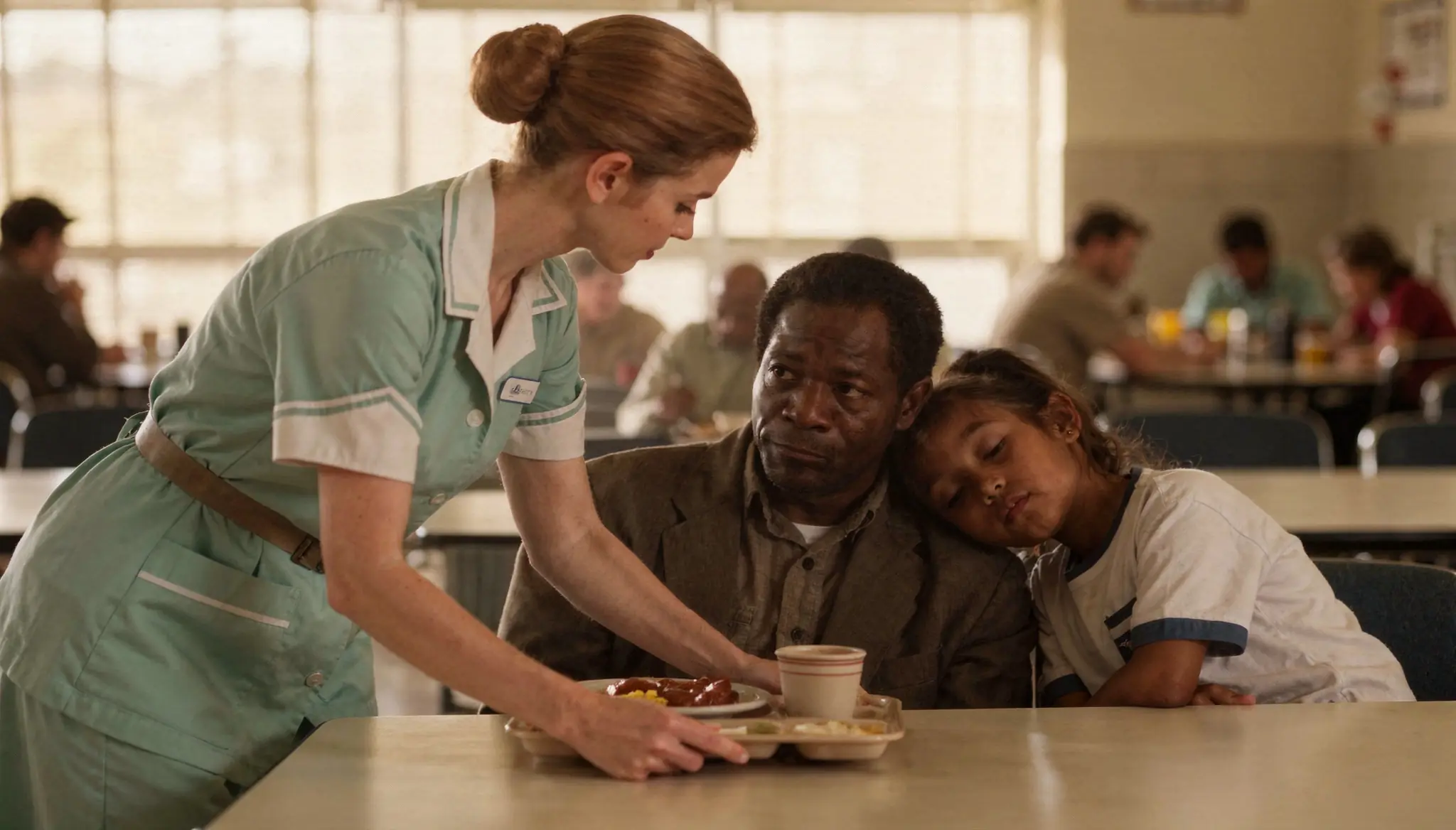
There was meatloaf, corn, mashed potatoes, a paper cup of milk, and two packets of crackers. Nothing expensive. Nothing anyone else in the room would remember eating the following day. Yet the man's mouth trembled as though the woman had placed something priceless before him.
"I didn't order this," he whispered.
"I know," she said. "Eat while it's warm. I'll bring a smaller plate when your granddaughter wakes up."
The girl's braids rested against his collar. Her fingers were still wrapped around the strap of a faded purple backpack, even in sleep. He looked at the tray, then at the young woman, and tried to speak again. All that came out was a breath that broke in the middle.
Across the room, a woman in a white medical coat stopped so suddenly that a nurse carrying charts nearly walked into her. The woman was Dr. Miriam Park, chief medical officer of St. Anne's, a physician known for remembering a patient's diagnosis after hearing it once and for rarely allowing anything to interrupt her rounds.
She stared at the man in the brown jacket. Her face lost its color.
"That can't be him," she said.
The nurse beside her followed her gaze. "Doctor? Do you know that family?"
Dr. Park stepped forward, then stopped again. The man lowered his face toward the sleeping girl as if to shield her from the noise around them. There was something in that movement, an instinctive protection she had seen once before, that made the years between then and now seem to collapse.
Forty hours earlier, Walter Brooks had been in his kitchen trying to convince his seven-year-old granddaughter, June, that pancakes counted as dinner when eaten after sunset. June sat at the table with her homework open and a pencil tucked into one of her braids. Her mother, Tessa, was late getting home from work.
Tessa worked at a rehabilitation center on the other side of Dayton, Ohio, where she helped patients relearn the practical things that injury or illness had taken from them. She was the sort of person who could explain the same exercise twelve times without sounding impatient, but she was terrible at remembering to charge her phone. Walter knew that about his daughter. He also knew the roads had been wet all afternoon.
At seven twenty-three, he called her. The call went straight to voicemail. At seven forty, he tried again. June looked up from her spelling list each time he crossed the kitchen.
"Mama's probably helping someone," she said.