A smith learns early that iron remembers. You can beat it, draw it, upset it, fold it back on itself and weld it shut, and it will look to any man who has not worked it as though it has forgotten everything that was done to it before.
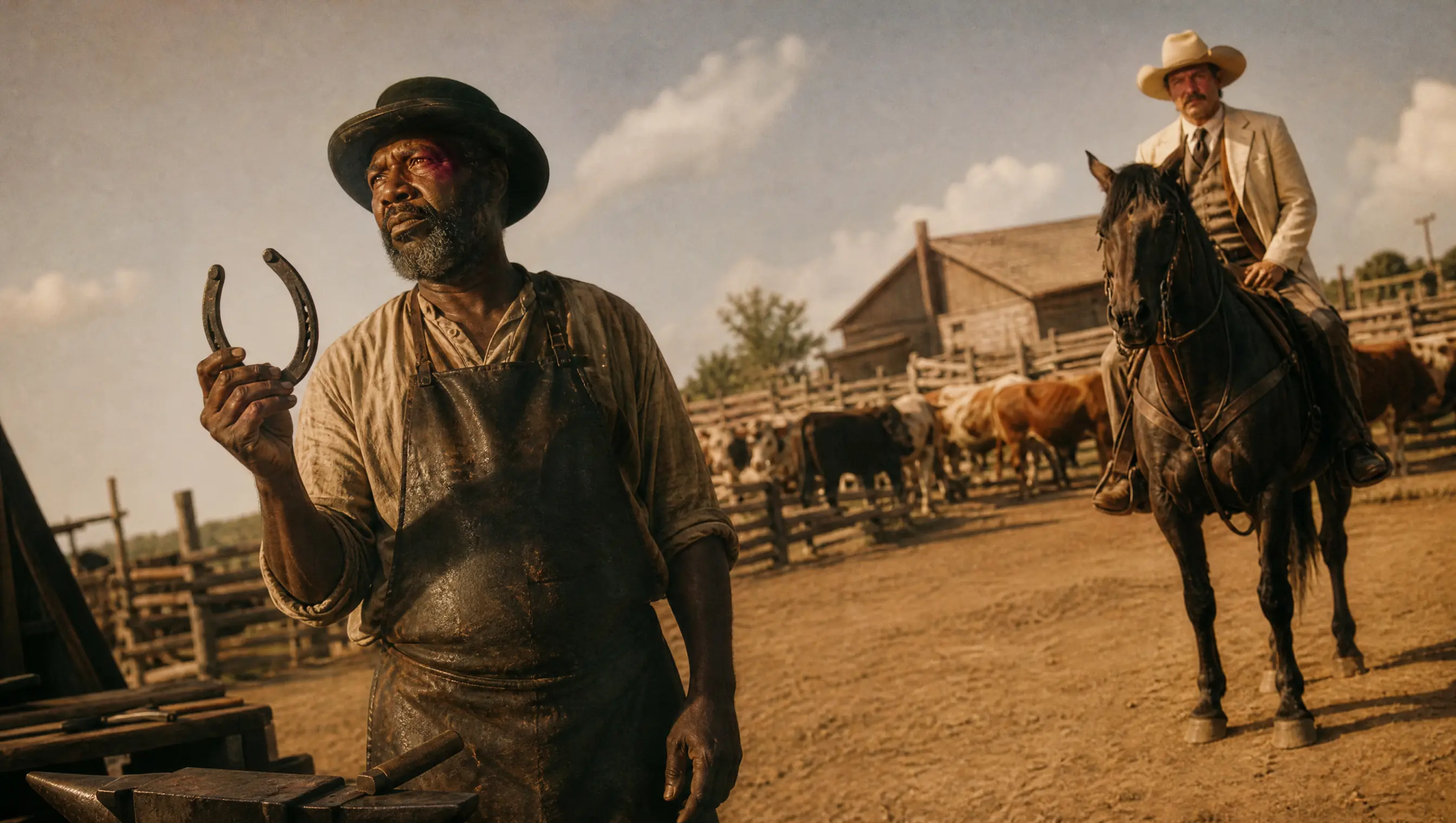
But put it back in the fire and bring it up to a cherry red, and the old bends will show themselves as shadows in the color, and the places where it was cracked and healed will go a different shade from the rest, and if you are fool enough to hit it there it will open for you like a mouth.
My master in the railroad shops at Altoona used to say that iron was the only honest witness in Pennsylvania. I did not know, when I was nineteen and pumping his bellows, that I would one day stand in a cattle pen in Wyoming Territory and stake everything I owned on him being right.
My name is Emlyn Vaughan. I was born in Merthyr Tydfil in the year 1834, came to America at twelve with my father, who puddled iron until it killed him, and served my time at Altoona under a German named Kreuzer who could forge a locomotive crank and write a love letter in the same afternoon, and did both, frequently. In 1868 I came west with the Union Pacific as a track-gang smith, sharpening picks and resetting spikes and shoeing the mules of the grading crews, and when the rails went on past the Laramie Plains I got off them at a water stop called Halfmoon Station and did not get back on. There was a creek there, and a section house, and a stock pen the railroad had built for the cattle that were just then beginning to come up from Texas onto the grass, and there was no smith for forty miles in any direction. I built a shop out of ties and sod. My wife, Angharad, came out from Pennsylvania the next spring and said it was the ugliest place God ever left a man in, and she lived there with me twelve years and never once asked to leave.
By the autumn I am going to tell about, which was the autumn of 1883, Halfmoon Station had become a town of perhaps three hundred souls, two saloons, a hotel with a porch, a general store, a Methodist church that the Baptists borrowed on alternate Sundays, and a set of shipping pens that could hold a thousand head and load forty cars a day when the railroad would give them. I had a stone shop by then, on the corner of Front Street and the road that went north to the Sybille country, with two forges and a good Peter Wright anvil of two hundred and forty pounds that had come out from Philadelphia in a crate, and a striker named Zeke Hatchett who was sixteen years old and could swing a ten-pound sledge all morning without missing the spot I pointed at. Angharad had been dead two years. The first shop had burned the same winter she died, which is a thing I will come to. The stone shop had been built on borrowed money, which is the other thing I will come to.
It was the second Tuesday in October when Alasdair Ballantyne rode in to have his horse shod, and I mark the beginning of it from there, though I know now that the beginning had come three months earlier and I had stood right in the middle of it with a hammer in my hand.
Mr. Ballantyne always brought his own horse. A man who owned eleven thousand head of cattle on paper, and who managed the Laramie and Sybille Cattle Company, Limited, of Dundee, Scotland, which owned considerably more than that, might have been expected to send a hand to town with the animal, but he did not, not with that horse. It was a tall bay gelding called Lochiel with one white stocking and feet like teacups, and Mr. Ballantyne held each foot for me himself while I worked, standing at the horse's shoulder in a good gray coat with his sleeves turned back, which was not a thing that most men in his position would have done, and not a thing he did to impress anybody, because there was nobody in my shop to impress but me and Zeke.