At six o’clock on a Wednesday morning, eight-year-old Maisie Callaway was digging through the Hendersons’ trash can.
Not for food.
Not for cans.
Not for anything she could sell.
She reached beneath a torn feed sack, pulled out a cracked green garden hose, shook a coffee filter off one end, then coiled the hose over her shoulder like a rope.
Mr. Henderson watched from his porch in a bathrobe.
His coffee mug stopped halfway to his mouth.
“You want that old thing?”
Maisie looked up.
“Yes, sir.”
“It’s split almost down the middle.”
“I know.”
“Leaks everywhere.”
“I know.”
Henderson frowned.
“Then what in the world are you going to do with it?”
Maisie adjusted the hose across her shoulder.
“Use it.”
Then she walked away.
Mr. Henderson remained on the porch long after she disappeared down the road.
By the end of that week, Maisie had eleven broken hoses stacked behind her family’s barn.
Green ones.
Black ones.
One yellow hose sun-bleached nearly white.
One that old man Webber had backed over with a tractor.
Two with fittings rusted solid.
Three that leaked from so many places their owners had thrown them away rather than bother trying to repair them.
Maisie repaired none of them.
That was what confused everybody.
She never carried tape when she collected them.
Never brought glue.
Never patched the cracks.
She did not cut them into crafts.
Did not sell the rubber.
Did not haul them to the recycling depot ten minutes away.
She simply brought every hose behind the barn, uncoiled it across the dirt, studied it for a while, then added it to her growing pile.
Her older brother Tucker finally cornered her beside the chicken coop.
He was sixteen and believed every question should have a simple answer.
He pointed toward the barn.
“People think you’ve lost your mind.”
Maisie scooped feed from a bucket.
“Okay.”
“Mrs. Pruitt called you a strange little collector.”
Maisie shrugged.
Tucker stared.
“That doesn’t bother you?”
“Should it?”
“I don’t know. Maybe.”
She scattered feed.
The chickens rushed forward.
Tucker followed her.
“What are you doing with them?”
“With what?”
“The hoses, Maisie.”
She looked at him.
“Something.”
“That is not an answer.”
“It’s the answer I have.”
Then she walked toward the barn.
Tucker groaned.
By Sunday, most of the town had heard about the Callaway girl collecting trash.
Three women whispered near the church coffee urn after service.
“She took the Henderson hose.”
“And Webber’s.”
“The one his tractor ran over?”
“That one.”
Mrs. Pruitt stirred sugar into her cup.
“Bless that child’s heart, but what can anybody do with eleven ruined garden hoses?”
Nobody knew.
Not Mrs. Pruitt.
Not Henderson.
Not the farmers who had worked Nebraska ground for sixty years.
Not even Maisie’s parents.
Her mother, Renata, had watched her daughter drag one hose after another behind the barn and had decided, for the moment, not to interfere.
Her father, Daniel, was less certain.
“There’s got to be bugs living in half that junk.”
“She’s not bringing it in the house.”
“That’s not what I’m worried about.”
Renata glanced through the kitchen window.
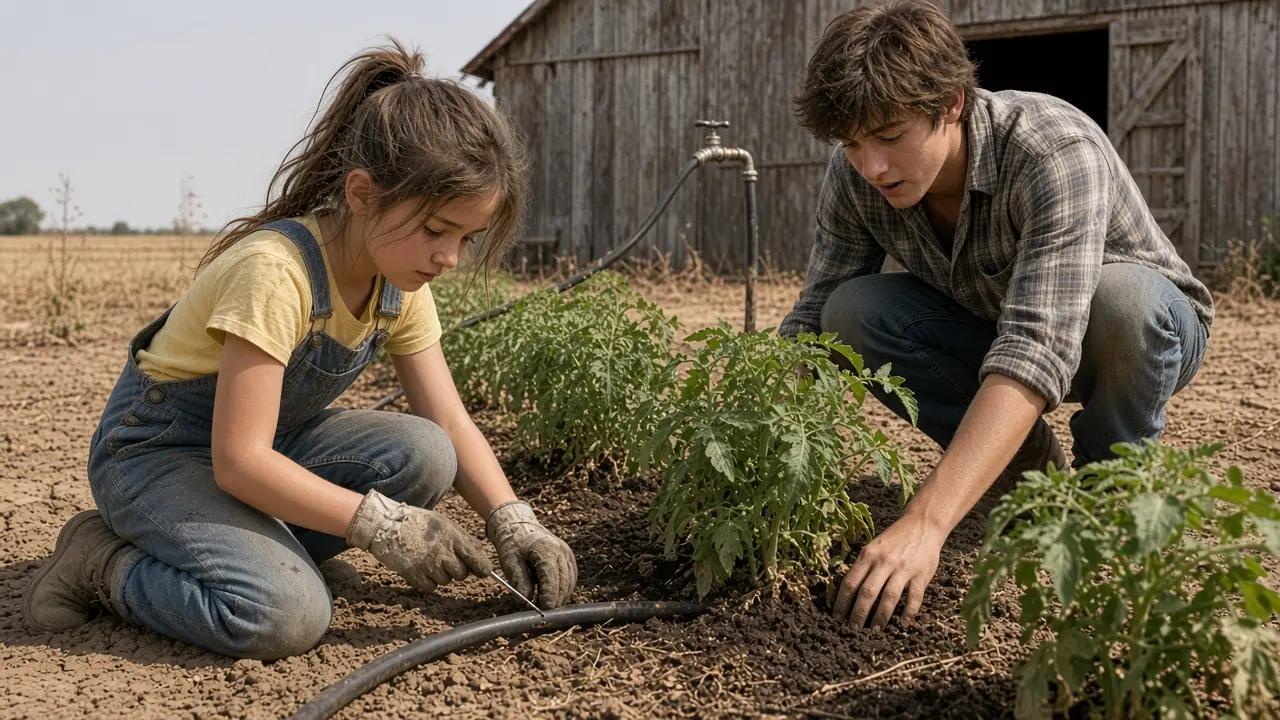
Maisie was on her knees behind the barn, arranging hose sections in long parallel lines.
“She isn’t playing.”
Daniel watched.
“No.”
“She’s working something out.”
“With garbage.”
Renata smiled faintly.
“You married into farming. You should be used to making things work longer than they’re supposed to.”
Daniel did not smile.
That summer, very little on Callaway Farm felt funny.
The farm sat on sixty acres of Nebraska soil that had baked hard beneath nearly a month without meaningful rain.
By noon, the wind carried heat instead of relief.
The vegetable beds looked tired.
The bean plants had begun curling their leaves inward.
The corn made a dry rattling sound whenever wind moved through it.
The tomato rows worried Daniel most.
For three years, he and Renata had supplied tomatoes and peppers to a regional produce cooperative.
It was the first dependable account Callaway Farm had managed to secure.
Lose the contract, and the farm would lose more than one harvest.
It would lose the closest thing it had to financial breathing room.
One evening Daniel sat at the kitchen table studying numbers.
“We lose the tomatoes, we lose the co-op.”
Renata stood at the stove.
“They won’t cancel after one bad season.”
“They can replace us after one bad season.”
“Fletchers are using soaker hose.”
“I know.”
“They say they cut water use almost in half.”
Daniel rubbed both hands over his face.
“Soaker hose costs money.”
“How much?”
“For enough acreage? More than we have.”
Renata turned.
“And the pump?”
“Can’t keep running it all afternoon either.”
Their well was not dry.
That was not the problem.
The problem was how inefficiently they were using what they had.
The Callaways irrigated much of the vegetable ground with overhead sprinklers.
Water shot high into the summer air.
Wind carried some away.
Heat took more.
Some landed between rows where no crop needed it.
Some ran across hard ground before soaking in.
Daniel knew it was wasteful.
Knowing and affording a better system were different things.
At the end of the table sat Renata’s father, Earl Mercer.
Everyone called him Grandpa Earl.
Seventy-one years old.
Thin as a fence post.
Hands permanently bent from decades of farm work.
He had survived droughts in the 1970s that people in the county still talked about.
He listened while Daniel and Renata discussed money.
He said nothing.
But every few minutes, his pale blue eyes moved toward the barn.
Toward Maisie.
Grandpa Earl had noticed something nobody else had.
The child wasn’t collecting hoses for fun.
She was measuring them.
Marking them.
Sorting them by diameter.
She carried a notebook now.
Sometimes a ruler.
Once he saw her hold one end of a broken hose up to the sunlight and study the cracks.
Earl recognized that kind of concentration.
He had worn it himself as a younger man whenever machinery failed and replacement parts were too expensive.
Renata had already tried asking.
Two days earlier, she found Maisie washing dirt from her hands at the outdoor spigot.
“What are you building back there?”
Maisie looked down at her muddy fingers.