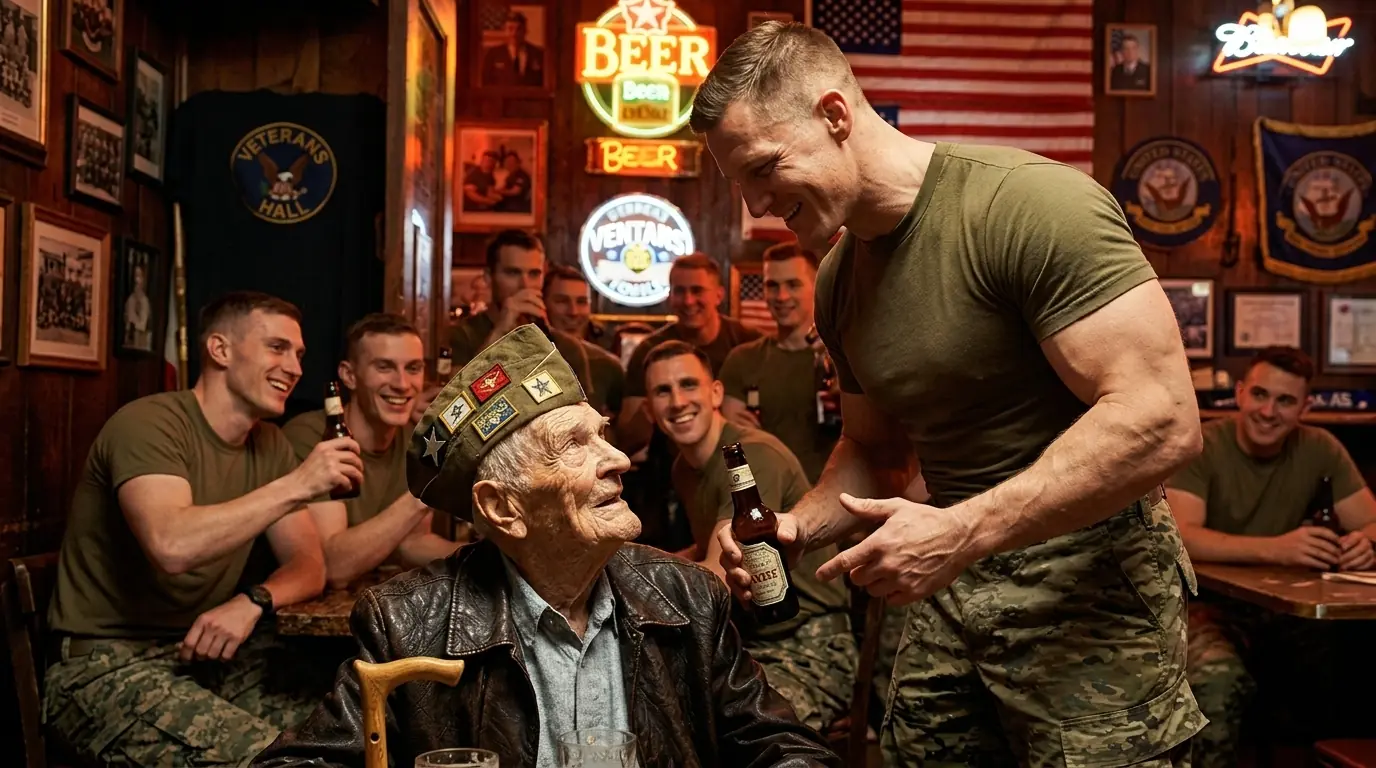
“Hey, old timer. You ever actually serve, or do you just wear that hat for free drinks?”
The voice cut across the bar loud enough to make three pool balls stop rolling.
A young Marine corporal stood near the far table with a beer in one hand and too much confidence in the other. His sleeves were tight around fresh muscle, his haircut was sharp, and his smile had the careless cruelty of someone who had not yet learned how quickly a room can turn against a man.
His friends laughed because that was what friends did before wisdom arrived.
The old man sat alone near the back wall in a wheelchair, half-hidden beneath the dim neon beer signs and the smoke-stained photographs of Marines long retired or long buried. A faded Marine Corps cap rested low over his white hair. A wool blanket covered what remained of his legs below the knee.
He did not flinch.
He lifted his glass of whiskey, looked at it for a moment as though considering whether the night was worth answering, then set it back down untouched.
“You could say I wore the uniform,” he said.
The corporal grinned wider.
“Yeah? Then what was your call sign?”
The old man’s pale eyes rose slowly.
“Ghost Six.”
The laughter died.
Not all at once.
First the older Marines near the bar stopped smiling. Then a staff sergeant at the pool table lowered his bottle. Then a retired gunny in a leather jacket turned fully around, his face losing color as if a name from a funeral program had just spoken from the corner.
The corporal, Ryan Doyle, looked around.
“What?” he said, still trying to laugh. “That supposed to mean something?”
The staff sergeant stood up.
His chair scraped hard against the wooden floor.
“What did you say your call sign was?”
The old man turned toward him.
“Ghost Six.”
The staff sergeant’s voice dropped.
“Operation Black Lantern.”
The words moved through the tavern like cold wind under a door.
Ryan frowned.
“That’s not real. That’s one of those barracks stories guys tell boots to scare them.”
“No,” the staff sergeant said. “It isn’t.”
He stared at the man in the wheelchair as if the room had suddenly become a chapel.
“Ghost Six was the team leader who kept an extraction corridor open after his unit got cut off near the border. They said he walked two hostages and three wounded Marines through miles of hostile ground after command abandoned the mission.”
Ryan swallowed.
The joke was already dying in his mouth, but pride kept trying to breathe life into it.
“They also said Ghost Six died.”
The old man looked toward the rain tapping against the dark front windows.
“They said many things.”
Before anyone could answer, the tavern door opened.
Cold air swept inside.
A tall Marine general stepped in wearing dress blues darkened at the shoulders by the storm. Every conversation stopped. Even the jukebox seemed suddenly too loud, and the bartender reached over to turn it down.
Major General Victor Langley removed his cover.
He did not look at the young corporal.
His eyes went straight to the man in the wheelchair.
For several seconds, neither of them spoke.
Then the general said, “Ghost Six.”
The old man’s fingers tightened around the armrest.
“Langley.”
“You’re supposed to be dead.”
The old man gave a tired smile.
“I’ve been hearing that for twenty-two years.”
General Langley turned slowly toward the room.
“Everyone out.”
No one asked why.
Chairs moved. Bottles were set down. Pool cues went back into the rack. Marines who had arrived loud and loose only an hour earlier now walked past the general in silence, as if they were leaving a church service instead of a bar.
Within a minute, only four people remained inside.
The general.
The old man.
The bar owner.
And Ryan Doyle, who stood near the pool table with his beer forgotten in his hand, too stunned to realize the order had included him.
The general looked at him.
“You too, Corporal.”
Ryan set the bottle down fast.
“Yes, sir.”
He was nearly at the door when the old man spoke.
“Let him stay.”
Langley’s eyes narrowed.
“He insulted you.”
“He asked a question.”
Ryan’s throat tightened.
For the first time that night, he understood that the old man had not been too weak to answer him.
He had been too tired of children mistaking noise for courage.
The bar was called The Anchor Room, though no one near Camp Pendleton ever used the full name. To generations of Marines, it was just Marty’s, because Martin Salazar had owned it since before half the officers on base had learned to salute properly. The place sat less than two miles from the south gate, squeezed between a pawn shop, a tire repair place, and a taco stand that stayed open until two in the morning.
The walls were crowded with unit photographs, challenge coins, signed flags, old newspaper clippings, and framed patches from deployments most civilians had already forgotten.
Young Marines came there on Fridays with money in their pockets and stories that grew stronger every time they were told. Older veterans sat closer to the walls, drank slower, and laughed less. The youngest ones talked about what they had done. The old ones mostly remembered who did not come home.
The man in the wheelchair had been coming to Marty’s for five years.
He always sat in the same back corner.
He paid cash, tipped more than he drank, and never stayed past midnight. His name, at least the name he used, was Caleb Rowan. He spoke politely to Marty, nodded to regulars, and ignored almost everyone else unless someone near him was about to make a dangerous mistake.
Marty knew more than Caleb thought.
He knew the old man woke from nightmares when fireworks went off near the beach. He knew two men in dark suits came every year around the same rainy week, spoke with Caleb for less than ten minutes, and left without touching a drink. He knew the scars crawling up Caleb’s back were not from any highway accident, no matter how many times Caleb claimed otherwise.
Marty never asked.
A bar like his survived on silence.
That night, Ryan Doyle had been celebrating his first deployment homecoming.
It had been six months overseas, mostly at a secured installation where the biggest danger came from bad decisions, bad wiring, and young men trying to make boredom sound like war. That did not stop Ryan from telling the story bigger each time his friends laughed.
Then he saw Caleb in the wheelchair.
The old cap.
The blanket.
The untouched whiskey.
The silence.
Ryan mistook all of it for weakness.
General Langley pulled a chair across from Caleb and sat down slowly.
Marty remained behind the bar, arms crossed.
Ryan stood near the wall, rigid and pale.
Caleb looked at him.
“Sit down, Corporal. If you’re going to learn something, your knees shouldn’t be locked.”
Ryan sat.
Langley placed a sealed envelope on the table.
Caleb did not touch it.
“I came to bring you in,” Langley said.
Caleb looked toward the rain.
“You boys waited long enough.”
“This is not a courtesy visit.”
“I didn’t think you came in dress blues because you missed me.”
Langley’s jaw tightened.
“You were identified four days ago.”
“By who?”
“A facial-recognition sweep tied to a compartmented archive.”
Caleb smiled faintly.
“I’ve been drinking in a Marine bar for five years and a computer found me first.”
“The system was upgraded.”
“That seems to be everyone’s excuse now.”
Langley looked down.
“Caleb—”
“No,” the old man said. “Don’t use the name like we survived together.”
The general absorbed that without answering.
Marty stepped closer.
“What happened to him?”
Langley looked at Caleb.
Caleb did not stop him.
The general leaned back and spoke as if every word had weight because it had been locked away too long.
“In November 2003, a joint recovery team crossed a border on a classified extraction mission. Target was a defecting weapons scientist and his twelve-year-old son. Intelligence said the compound had fifteen armed guards.”
Marty’s eyes narrowed.
“How many?”
Caleb answered.
“One hundred and twenty when counting still mattered.”
Ryan stared at him.
Langley continued.
“The team entered before command confirmed the intelligence failure. Their extraction route collapsed. Air support was redirected after another unit reported casualties seventy miles west.”
Marty’s face darkened.
“You left them.”
“I was the communications officer at forward command,” Langley said quietly. “I relayed what I was told.”
Caleb looked at him.
“You told me birds were inbound for six hours.”
“I believed they were.”
“And when they weren’t?”
Langley had no answer.
Operation Black Lantern had sent nine operators under Marine command into a place that would later disappear from every public map. Caleb Rowan led the ground team under the call sign Ghost Six. His intelligence specialist was a lieutenant named Mara Ellis. Langley, then a major, handled communications from a forward post.
The team reached the scientist and his son shortly before midnight.
Then the desert woke up around them.
Vehicles arrived from the east and south. Searchlights cut through the compound. The first evacuation helicopter took fire before reaching the landing zone. The second was redirected. The third never launched.
Command ordered Caleb to hold position.
Caleb disobeyed.
He knew a fixed position would become a grave.
He moved the hostages and his team through a dry riverbed under moonless sky. For thirty-eight hours, they walked, crawled, fought, carried the wounded, buried the dead only when they had seconds to spare, and followed a broken compass toward friendly territory.
Three Marines died.
Two were gravely wounded.
One disappeared during the final night.
Caleb reached a border checkpoint with the scientist’s son on his back and a bullet lodged near his spine.
By then, Operation Black Lantern had officially ended.
The team had already been listed as killed in action.
The hostages were politically inconvenient. The intelligence failure threatened men who had stars on their shoulders and friends in rooms with no windows. Instead of correcting the record, officials created a sealed recovery program and divided the survivors.
New names.
New locations.
Permanent silence.
Caleb refused.
“They gave me a choice,” Caleb said. “Disappear, or stand trial for disobeying a direct order, exposing classified routes, and abandoning sensitive equipment.”
Marty’s face had gone hard.
“So they made you dead.”
“They didn’t make me dead,” Caleb said. “They asked me to stay dead.”
Ryan could barely breathe.
He had heard stories about men erased by classified missions. Everyone had. In barracks, they were always legends, half-jokes, half-threats, the kind of stories young Marines repeated at midnight because they liked feeling close to danger without touching it.
Now one of those stories was sitting ten feet away with a blanket over his missing legs.
Marty looked at the wheelchair.
“What happened after?”
Caleb’s expression changed.
“Black Lantern didn’t end at the border.”
After the checkpoint, Caleb had been taken to a covert facility under a false medical code. Officials demanded he sign a permanent secrecy statement. He refused unless the dead Marines’ families received full benefits and truthful service records.
For weeks, the argument continued behind doors nobody admitted existed.
Then the convoy moving him between facilities exploded on a coastal road.
The official explanation, somewhere in a classified file, called it an accident.
Caleb remembered the blast.
He remembered the vehicle flipping.
He remembered men approaching through smoke with rifles and no uniforms.
He escaped because dying men can still become difficult when they refuse to cooperate.
Shrapnel shredded his lower spine.
A civilian doctor treated him under another name.
By the time Caleb could sit upright, every document proving he was alive had vanished.
For years, he moved between rooms that did not belong to him.
He avoided military hospitals.
He avoided old teammates.
He watched a recording of his own memorial service mailed anonymously to a post office box.
His wife stood beside an empty casket and accepted a folded flag.
Ryan whispered, “You never told her?”
Caleb looked at him.
“She rebuilt her life.”
“But you were alive.”
“She had already buried me.”
The young corporal had no answer.
Rain ran in long silver lines down the window.
Langley pushed the envelope closer.
“The sealed archive has been reopened.”
Caleb looked at it.
“Why?”
“Someone is killing the remaining witnesses.”
Marty stepped away from the bar.
“How many survived?”
“We believed five,” Langley said.
Caleb’s eyes sharpened.
“Believed?”
“Two are confirmed dead in the last seven months.”
“Names.”
“Rivas and Holloway.”
Caleb’s jaw tightened.
Ryan watched something pass through the old man’s face.
Not shock.
Not fear.
Recognition of a debt getting heavier.
“What kind of deaths?” Caleb asked.
“Rivas died in a marina fire. Holloway’s death was ruled suicide.”
Caleb’s voice went flat.
“Holloway hated water and loved attention. He didn’t kill himself quietly.”
“That is why I am here.”
“And the others?”
Langley hesitated.
“Mara Ellis is alive.”
Caleb went completely still.
“Mara died in the riverbed.”
“No body was recovered.”
“I saw the ridge fall.”
“She survived.”
Caleb’s fingers gripped the armrest until his knuckles whitened.
“Where?”
Langley looked toward the front window.
“Closer than you think.”
Headlights cut across the rain outside.
Three black SUVs rolled into the parking lot, engines low, tires hissing over wet asphalt.
Marty reached under the bar and wrapped his hand around the shotgun he kept there.
Caleb raised one hand.
“Not yet.”
Men in dark suits stepped out first, moving with the careful speed of people trained to expect doors to become danger. Then a woman emerged from the last vehicle wearing a dark military raincoat with the hood pulled low.
She stepped into the bar behind them.
Water dripped from the hem of her coat.
When she removed the hood, Caleb stopped breathing.
Her hair had gone partly silver. Lines marked the corners of her eyes. Time had altered the surface, but not the way she stood, not the way she measured a room, not the old terrible focus in her face.
“Mara,” he said.
Lieutenant Colonel Mara Ellis looked at him.
“Hello, Ghost.”
The man leading the group placed a black folder on the table.
“Caleb Rowan, my name is Director Nolan Pierce. Joint Security Directorate.”
Caleb’s eyes stayed on Mara.
“That office didn’t exist when they buried us.”
“It exists now,” Pierce said.
Mara took two steps closer.
Caleb looked at her as if the space between them were not ten feet but two decades of silence.
“You were alive.”
“Yes.”
“You let me think you died.”
Her face tightened.
“You let your wife think you died.”
That hit harder than anything else in the room.
Marty looked down.
Ryan did not move.
Caleb’s voice dropped.
“I protected her.”
“That is what I told myself too.”
Director Pierce opened the folder.
“Your reunion can continue after we survive the night.”
Marty lifted his eyes.
“Careful how you speak in my place.”
Pierce ignored him and removed the first page.
At the top were two words stamped in red.
GHOST LEDGER.
Below them were photographs of Caleb, Mara, Langley, and the rest of the Black Lantern team.
“The archive breach occurred eight months ago,” Pierce said. “Someone removed survivor identities, medical records, and sealed relocation files linked to the mission.”
Caleb looked at Langley.
“Who had access?”
“Senior defense officials, oversight counsel, and the original command chain,” Pierce said.
“Him?”
Langley did not react.
“I had partial access.”
Caleb looked at Mara.
“And you?”
She nodded.
“I was assigned inside the program after recovery.”
“You worked for them.”
“I worked near them,” Mara said. “There is a difference.”
“Not always.”
“I stayed because someone had to find who ordered the cover-up.”
Caleb’s eyes narrowed.
“Did you?”
“Almost.”
Pierce slid another photograph onto the table.
General Conrad Wexler.
Caleb stared at it for a long moment.
Wexler had commanded the regional task force during Black Lantern. He later became a defense adviser, a television analyst, and the kind of retired general politicians invited on stage to prove they loved the military.
“He signed the hold order,” Caleb said.
Mara nodded.
“And the transport order.”
The room fell silent.
Langley turned pale.
“What transport order?”
Mara’s eyes did not leave Caleb.
“The convoy explosion was not an accident.”
Caleb’s face remained still.
No one in the room mistook that for peace.
Pierce continued.
“Wexler disappeared from his residence this morning. We believe he is eliminating remaining witnesses because an inspector general outside his influence reopened Black Lantern.”
Ryan finally found his voice.
“Why now?”
Mara looked at him for the first time.
“Because secrets don’t stay buried forever. They wait for someone careless to move dirt.”
Her gaze returned to Caleb.
“The person hunting survivors believes one of us still has the final mission recording.”
Langley looked sharply at Caleb.
“You told the review board the recorder was destroyed.”
“It was.”
Mara’s eyes narrowed.
“No. It wasn’t.”
Caleb looked at her.
“You always hated when I lied badly.”
“You were holding it when we crossed the riverbed.”
“I lost everything after the convoy attack.”
“Not everything.”
Pierce leaned forward.
“If that recorder exists, it proves command knowingly abandoned your team and falsified the after-action report. It may also identify the officer who ordered the transport attack.”
Marty looked at Caleb.
“Do you have it?”
Caleb did not answer.
Outside, a faint mechanical whine drifted over the rain.
Mara turned toward the window.
“Drone.”
A red dot appeared on the wall behind Caleb’s chair.
“Down!” Mara shouted.
The front window shattered.
Glass exploded across the bar.
Ryan hit the floor without thinking. Marty dropped behind the counter. Langley rolled behind the pool table. Pierce’s agents moved toward the entrance with weapons drawn.
A second round tore through the table where Caleb had been sitting.
Mara grabbed the wheelchair handles and pulled him backward toward the hallway.
Caleb pointed behind the storage room.
“Maintenance tunnel.”
Pierce shouted, “You have an escape route?”
Caleb said, “I chose this bar for a reason.”
Marty moved fast for a man who had spent the last decade pretending his knees were still young. He locked the office door, grabbed a flashlight, and followed them into the rear corridor as smoke drifted through the bar behind them.
An explosion shook the front wall.
Shelves collapsed.
Bottles burst against tile.
The lights died.
Mara shoved open a metal hatch hidden behind stacked beer crates. A narrow concrete passage dropped beneath the alley, damp and low-ceilinged, smelling of rust, saltwater, and old storms.
“What the hell is this?” Ryan whispered.
“Old drainage tunnel,” Marty said. “Built before the highway widened.”
Caleb glanced back toward the noise above them.
“Move.”
The tunnel led beneath two blocks of shuttered storage units and an abandoned boat-repair shop. Caleb knew every turn. Mara pushed his chair over cracked concrete while Pierce’s agents covered the rear.
“You built an escape plan from a tavern?” Mara asked.
“No,” Caleb said. “I built a life near an exit.”
“You always expected them.”
“I expected somebody.”
At the far end of the tunnel, Langley reached for his phone.
“I need to call the base commander.”
Pierce grabbed his wrist.
“Not on an unsecured line.”
“You think Camp Pendleton is compromised?”
“I think someone just fired into a public bar two miles from the gate using military-grade surveillance support,” Pierce said. “So yes, General, I think caution has earned its place.”
They emerged inside the old boat shop.
Rain hammered the corrugated roof.
Marty lit a lantern while the agents secured doors and windows. Ryan stood near a stack of broken fishing nets, still shaking, his earlier arrogance gone so completely it seemed to have belonged to another person.
Caleb rolled to the center of the room.
“Everyone wants the recording.”
Pierce nodded.
“Where is it?”
“Safe.”
“Men are dead.”
“They are dead because someone inside your world leaked them.”
“That was not my office.”
“You do not know that.”
Mara crouched in front of Caleb.
“Ghost, listen to me. The recording ends this.”
“It may end us first.”
“Hiding didn’t save Rivas or Holloway.”
“No,” Caleb said quietly. “It saved you.”
Mara looked away.
That one hurt because it was partly true.
For twenty-two years, she had lived under another name. She became an analyst, then an officer attached to compartmented oversight. She built a career near classified rot, collecting fragments whenever assignments brought her close enough to steal truth without leaving fingerprints.
But she had never found the final recording.
Without it, Black Lantern remained suspicion.
With it, the cover-up became a crime.
“I found the transport order,” she said.
Caleb’s eyes narrowed.
“Signed by Wexler?”
“Yes.”
“And Langley?”
The general looked up sharply.
Mara shook her head.
“No.”
Caleb looked at Langley.
The general did not defend himself.
That was new.
“I signed the false report,” Langley said.
“Yes,” Caleb replied.
“I believed the mission had already been sealed above me.”
“You believed obedience would make you less guilty.”
Langley stared at the floor.
“I was a coward.”
No one corrected him.
Ryan watched that too.
A general with stars on his uniform admitting cowardice in an abandoned boat shop while a man in a wheelchair held the room without raising his voice.
That taught him more than any briefing he had ever attended.
Pierce held out his hand.
“The recording, Mr. Rowan.”
Caleb reached beneath his blanket and pulled out a worn set of dog tags.
One belonged to him.
The other belonged to Sergeant Luis Mercado, the first Marine killed during Black Lantern.
Caleb pressed the edge of Mercado’s tag with his thumb.
A hidden seam opened.
Inside was a storage wafer no larger than a fingernail.
Langley’s breath caught.
“You carried it all these years.”
Caleb closed his fingers around the tag.
“I carried him all these years.”
Pierce extended his hand again.
“No.”
“This cannot remain with you.”
“It will not enter your system.”
“Then how do you propose exposing Wexler?”
Caleb looked toward the rain-streaked window.
“We make him come for it.”
Mara understood first.
“You want to bait him.”
“He already knows we’re together. The bar attack proved that.”
“You are in a wheelchair.”
“I was in one yesterday too.”
“You cannot outrun shooters.”
Caleb’s eyes settled on her.
“I did not survive Black Lantern because I outran anyone.”
By dawn, they had a plan.
Pierce contacted a federal judge through a channel outside the compromised defense network. Mara arranged a controlled transmission falsely stating that the complete Black Lantern audio would be released at noon from an abandoned coastal communications facility near the base. Langley notified only one counterintelligence unit he trusted more than himself, which, Caleb remarked, was a low bar but still progress.
Ryan Doyle should have been sent away.
He knew that.
Everyone knew that.
But when Pierce told him to return to base and give a statement later, Ryan looked at Caleb and said, “Sir, I started this.”
Caleb raised an eyebrow.
“You think mocking a crippled old man started a twenty-two-year cover-up?”
Ryan flushed.
“No. But I was the reason you said the call sign out loud.”
Caleb studied him.
“And now you want to help?”
“I want to stop being what I was last night.”
Marty leaned against a workbench.
“That’s not a one-night project, kid.”
“I know.”
Caleb looked at him for a long moment.
Then nodded toward Pierce.
“Let him watch. Not fight. Watch.”
At 11:45 a.m., Caleb sat inside the abandoned communications facility overlooking the wet gray coast.
The building smelled of dust, salt, and dead wires. Old consoles lined the walls. A broken radar screen sat in the corner like a blind eye. Pierce’s agents were hidden outside. Mara waited in a side room. Langley sat at the command post, listening through a secure channel.
Ryan stayed with Marty behind the secondary barrier.
“You scared?” Marty asked him.
Ryan nodded.
“Good,” Marty said. “That means your head finally caught up.”
At 11:58, an unmarked sedan approached.
One man stepped out.
General Conrad Wexler had aged into the kind of dignity money and influence can purchase for a while. He was seventy-three, tall, sharp, wearing a tailored raincoat and polished shoes inappropriate for a wet abandoned facility. He entered alone, but no one believed he had arrived that way.
Caleb waited at the table with Mercado’s dog tags in front of him.
Wexler stopped in the doorway.
“Rowan.”
“General.”
“I was told the explosion solved this problem.”
“You trusted the wrong men.”
Wexler smiled faintly.
“I often did.”
He walked inside slowly.
“You created a lot of trouble for a dead man.”
“You created a lot of graves for a living one.”
Wexler’s smile disappeared.
“You have no idea what Black Lantern protected.”
“A weapons transfer that armed the same men shooting at us.”
Wexler’s eyes cooled.
“So Mara found the paperwork.”
“She found enough.”
Caleb touched the dog tags.
“The rest is here.”
Wexler looked at the metal.
“You believe one recording will restore your life?”
“No.”
“Your wife is dead. Your team is broken. Your legs are gone. The country has forgotten the mission.”
“Then why did you come?”
Wexler’s jaw tightened.
Caleb leaned forward.
“Because dead men on tape still speak.”
Wexler stepped closer.
“Give me the recording.”
“No.”
“I can restore your name. Full honors. Compensation. Public correction. Your men can be remembered properly.”
Caleb’s eyes did not move.
“You mean the men you left.”
“War requires decisions.”
“So does murder.”
Wexler’s face hardened.
“You disobeyed a direct command.”
“I brought people home.”
“You exposed an operation above your clearance.”
“I exposed nothing. I stayed dead for twenty-two years.”
“And now?”
Caleb looked at him calmly.
“Now I’m tired.”
Wexler reached inside his coat.
Mara stepped out of the side room with her weapon raised.
“Hands where we can see them.”
Agents entered from both sides.
Wexler froze.
Slowly, he withdrew a phone instead of a gun.
Director Pierce approached.
“General Conrad Wexler, you are being detained under federal authority.”
Wexler stared at Caleb.
“You think this changes history?”
Caleb picked up the dog tags.
“No,” he said. “It changes who owns it.”
The Black Lantern recording became evidence in the largest military misconduct investigation of that decade.
It captured command repeatedly promising extraction while aircraft were secretly redirected elsewhere. It preserved Caleb warning that the intelligence had been falsified. Most damning of all, it recorded Wexler’s voice ordering the team to hold position because recovering them could expose an unauthorized weapons-transfer operation involving senior allies and defense contractors.
A second investigation tied Wexler to the convoy attack and to the deaths of surviving witnesses.
The prosecution lasted years.
Some charges collapsed under time, missing records, and men who had died conveniently before subpoenas found them. Others held. Wexler lost his decorations, his pension privileges tied to fraudulent claims, and his carefully polished legacy. He received a federal prison sentence for conspiracy, obstruction, and arranging violence against witnesses.
Several former officials were censured or charged.
The government corrected the service records of every member of Caleb’s team.
The dead were no longer listed as casualties of a failed training exercise.
They had died rescuing hostages after being deliberately abandoned.
Their families received the truth.
Not enough truth to heal everything.
But enough to stop the lie from standing alone.
Ryan Doyle returned to Marty’s three months later.
Alone.
No cheering friends.
No beer in his hand.
Caleb sat in the same back corner. A new display case hung on the wall behind him, filled with photographs of the Black Lantern team, corrected citations, and a small brass plaque bearing the names of those who had died.
Ryan stopped several feet away and removed his cover.
“Mr. Rowan?”
“Caleb.”
“I came to apologize.”
Caleb waited.
“I was drunk.”
“That explained your breath.”
“It doesn’t excuse what I said.”
“No.”
Ryan looked toward the wheelchair.
“I saw the chair and thought it told the whole story.”
“Most people do.”
“I wanted my friends to laugh.”
“They did.”
Ryan swallowed.
“I made you into a prop for my ego.”
Caleb’s eyes narrowed slightly.
“That sentence sounds rehearsed.”
“My staff sergeant made me write the apology six times.”
“Good man.”
“I’m trying to mean it without the paper.”
Caleb gestured toward the chair across from him.
“Sit down.”
Ryan sat.
For a while, neither spoke.
Then Ryan looked at the display case.
“Was Ghost Six really the name they whispered about in the barracks?”
“Yes.”
“Did you wipe out an entire enemy column by yourself?”
“No.”
Ryan looked surprised.
“But everyone says—”
“Everyone likes legends because legends are simple. One impossible hero. One impossible night. Clean ending.”
Caleb looked toward the photographs.
“The truth is messier. Mercado held the east wall after being hit twice. Sullivan carried a hostage with a broken hand. Mara walked nineteen miles on a fractured ankle. Holloway kept the radio alive using wire stripped from his own vest.”
He turned back to Ryan.
“That is the truth. It is better than the legend.”
Ryan nodded slowly.
“Can I buy you a drink?”
Caleb pushed the untouched whiskey toward the middle of the table.
“You can buy Marty a new bottle. He’s been pouring me this same glass for five years.”
For the first time since Ryan had met him, Caleb smiled.
A year later, the Marine Corps held a private ceremony at Camp Pendleton.
The surviving members of Black Lantern stood before the families of the dead. Mara wore her uniform. Langley attended without speaking. Caleb sat at the center in his wheelchair, his Marine cap resting on his lap.
A young officer read the corrected citation.
No one interrupted.
No one looked away.
When the ceremony ended, a woman in her twenties approached Caleb. She had Mercado’s eyes, though she had been born years after he died.
“My mother said you carried my grandfather’s tags.”
Caleb removed the worn tag from his pocket.
“I did.”
“Why?”
“Because somebody had to bring him home.”
He placed it in her hand.
She closed her fingers around it and began to cry.
Caleb looked past her toward the line of Marines standing at attention.
For twenty-two years, he had believed coming home meant returning to the life stolen from him.
He understood now that home was not always a place, or a marriage, or a body that still obeyed.
Sometimes home was the truth finally reaching the people who had waited for it without knowing what they were waiting for.
Langley found him near the parade field afterward.
“You could have buried me with Wexler,” the general said.
Caleb looked at the ocean.
“You helped bury yourself for twenty-two years.”
“I signed the report.”
“Yes.”
“I repeated their lie.”
“Yes.”
“Why didn’t you push for prosecution?”
“That wasn’t my call.”
“You could have asked.”
Caleb adjusted the blanket over his legs.
“You spent twenty-two years knowing what you did. That is not justice, but it is not freedom either.”
Langley nodded slowly.
“I’m retiring.”
“That is probably overdue.”
“I want to help the families.”
“Then help them,” Caleb said. “But do it because they need help, not because you need forgiveness.”
Langley accepted the words.
“Still giving orders, Ghost?”
Caleb almost smiled.
“Professional advice.”
Marty’s remained crowded every Friday.
Young Marines still told stories too loudly. Older veterans still sat near the walls. The jukebox still played too much old rock, and Marty still watered down nothing except the rumors people brought in already drunk.
The difference was the corner table.
It was no longer ignored.
Some Marines approached Caleb to shake his hand. He disliked that and usually made it obvious. Others asked for advice. He told most of them to drink less, listen more, and never mistake being loud for being ready.
One Friday, Ryan entered with three new Marines.
A private noticed Caleb and whispered something about the wheelchair.
Ryan turned sharply.
“That man carried Marines home before your father learned to shave.”
Caleb heard him.
“So did men whose names you don’t know,” he called.
Ryan smiled.
“Yes, Caleb.”
“Better.”
Marty placed the familiar whiskey on Caleb’s table.
Caleb looked around the bar.
Twenty-two years earlier, powerful men had declared him dead because the truth was inconvenient. For decades, he accepted the role of ghost because the lie seemed safer for everyone but him. Then one careless question from a young corporal forced an old name into the air.
Ghost Six.
The call sign did not restore his legs.
It did not give back his wife.
It did not return Mercado, Sullivan, Rivas, Holloway, or the years spent hiding from a country that thanked heroes loudly and buried inconvenient ones quietly.
But it opened the door.
Caleb once believed a Marine died twice.
First when the body failed.
Again when the name disappeared from memory.
He had been wrong.
There was another kind of death.
It happened when a survivor let powerful men own the story of what survival cost.
He lifted his glass toward the photographs on the wall.
“To the team.”
Marty raised his coffee.
Ryan and the Marines lifted their bottles.
No one cheered.
No one laughed.
For one quiet moment, the room simply held the names.
And for the first time since Operation Black Lantern, Ghost Six was no longer carrying them alone.