Private Cole Bennett made his biggest mistake before he ever raised his fist.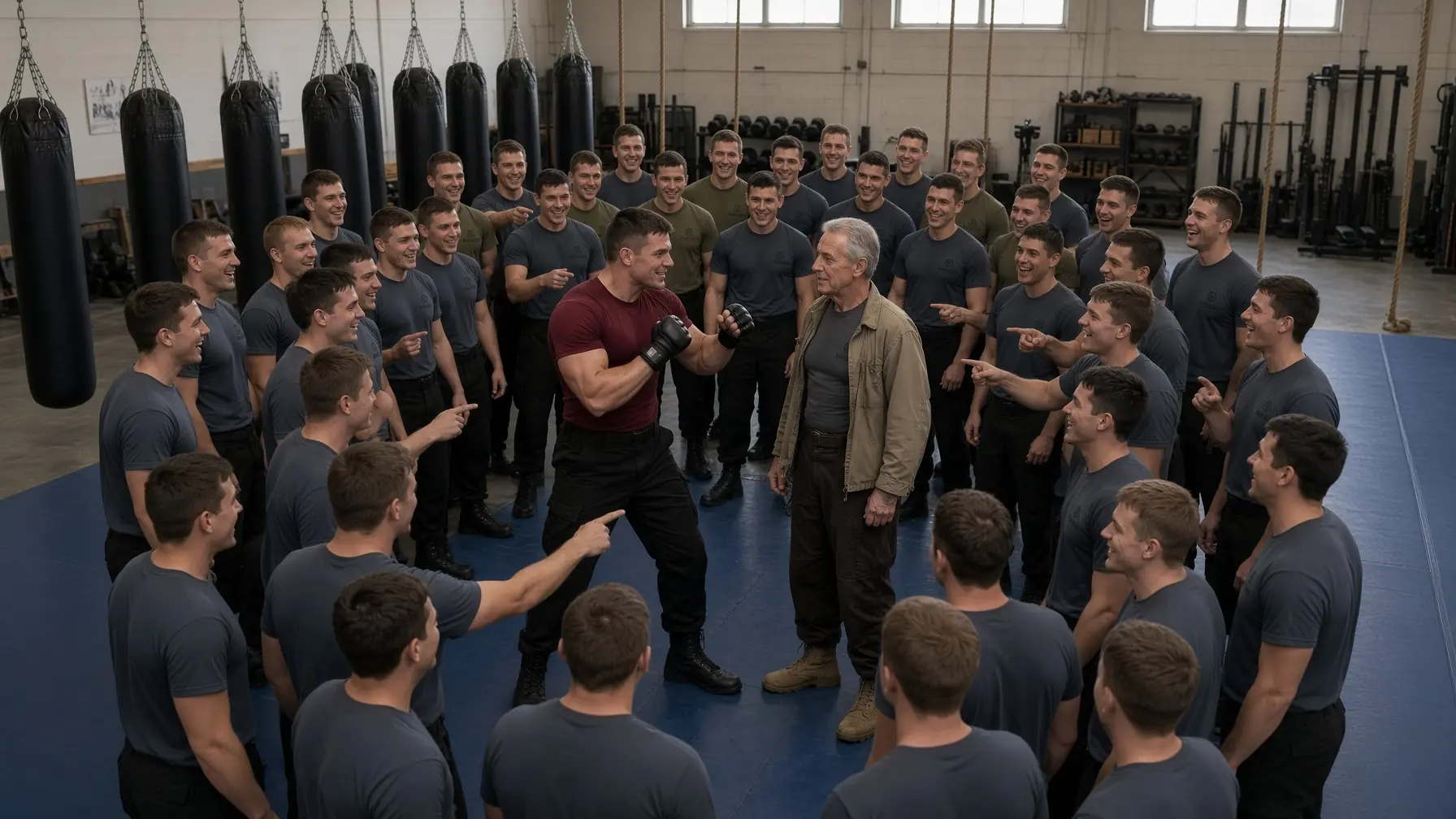
He made it the moment he looked at the old man standing near the edge of the training mat and decided age had already beaten him.
The old man had silver hair, narrow shoulders, and a faded field jacket that looked older than some of the soldiers in the room. His boots were scuffed and repaired along the soles. He wore no medals, no unit hat, no patches, nothing that announced rank or history.
To Cole, that meant he was nobody.
The combat training gym at Fort Whitaker was loud that Thursday morning. Heavy bags swung from chains along the concrete wall. Ropes hung from the rafters. Free weights clanged near the back corner, and forty young soldiers moved through final hand-to-hand assessments before deployment certification.
The air smelled of sweat, rubber mats, old canvas, and disinfectant.
At the center of the gym stood Cole Bennett.
He was twenty-four, six feet three, thick through the shoulders, and built like a man who had spent years learning how to make a room notice him. His olive training shirt clung to his chest. Black gloves covered hands that had knocked three soldiers down that morning alone.
Cole was fast.
He was strong.
He knew it.
The instructors praised his power. The younger recruits copied the way he wrapped his hands and stretched his neck before sparring. Somewhere along the way, Cole had started confusing attention with respect and fear with proof.
Then the old man stepped too close to the mat.
Cole had just thrown another soldier onto his back when he noticed him. The visitor stood quietly near the boundary line, gray eyes moving across the training floor with calm attention. He did not look impressed. That bothered Cole more than it should have.
“You lost, sir?” Cole called.
Several soldiers turned.
The old man looked around the gym once.
“No.”
“This area is for active personnel.”
“I can read signs.”
A few recruits laughed.
Cole smiled, but it was not friendly. He pulled out his mouthguard and let it hang from one gloved hand. The old man had answered too calmly, as if Cole’s size, sweat, and victory in the ring did not mean anything to him.
“You’re standing close to the mat,” Cole said.
The old man took half a step back.
“Better?”
More laughter came from the circle.
Cole walked toward him.
“You think something’s funny?”
“No.”
“You came here to watch real soldiers train?”
The old man’s eyes moved over Cole’s stance.
Feet planted too wide.
Shoulders high.
Chin lifted.
Hands strong, but pride stronger.
“I came to see what had changed,” the old man said.
Cole spread his arms.
“And?”
“The equipment is better.”
The room waited.
Cole leaned closer.
“What about the soldiers?”
The old man held his gaze.
“That depends on the soldier.”
The laughter died.
Cole stepped forward until only a foot of space remained between them. He was used to men stepping back when he closed distance. The old man did not.
“You should watch how you talk in here,” Cole said.
“Why?”
“Because you’re surrounded by men trained to fight.”
The old man looked across the gym.
“I have stood among fighting men before.”
“Sure you have.”
The old man turned as if the conversation had ended.
Cole reached out and put one gloved hand on his shoulder.
“We’re not done.”
The old man looked down at the hand.
“Remove it.”
The words were quiet.
That made them worse.
A few soldiers shifted uncomfortably. Nobody talked to Cole Bennett that way, especially not in front of the younger men who admired him.
Cole tightened his grip.
“Or what?”
The old man raised his eyes.
“Or you’ll learn something your strength has been hiding from you.”
Cole shoved him.
The old man stumbled backward onto the edge of the mat. One boot slipped on the padded surface, but he recovered before falling. Three soldiers laughed because they thought that was what they were supposed to do.
Others did not.
Sergeant Mateo Ruiz, the assistant combat instructor, heard the movement from near the equipment cages. He turned and saw Cole standing over the elderly visitor with one fist raised.
Ruiz started toward them immediately.
“Bennett,” he snapped. “Step back.”
Cole did not look away from the old man.
“We’re just talking, Sergeant.”
“You shoved a guest.”
“He says he’s been around fighting men.”
The old man corrected him.
“I said I had stood among them.”
Cole grinned.
“Then let him prove it.”
Ruiz stepped between them.
“No. Move to the wall.”
The old man reached slowly for the zipper of his field jacket.
“Sergeant,” he said, “give him one controlled exchange.”
Ruiz turned toward him.
“Sir, I can’t allow that.”
The old man removed the jacket and placed it beside the mat.
The gray shirt beneath it changed the room.
He was not large. Age had thinned him in places. But he was not soft, and he was not fragile. His forearms were lean and corded. Pale scars crossed his ribs. A burn mark curved under his left arm. A long surgical line ran from his collarbone toward his chest.
Just below his heart was a small round scar.
The laughter stopped completely.
Cole saw the scars and felt something in himself hesitate.
Then pride covered the hesitation.
“Scars don’t make you dangerous,” he said.
The old man stepped fully onto the mat.
“No,” he said. “What caused them did.”
Ruiz placed a hand between them.
“Sir, with respect, he outweighs you by almost eighty pounds.”
“I can see him.”
“He’s twenty-four.”
“I heard him.”
“He’s angry.”
“That is what makes this useful.”
Cole stepped onto the mat.
The soldiers widened into a circle.
Ruiz understood the trap. If he removed Cole, the private would learn nothing and tell himself the old man had been protected. If he allowed even one exchange, the old man could be hurt badly, and Ruiz would own the decision.
The senior instructor, Captain Owen Price, had left for a meeting with command ten minutes earlier.
Ruiz was alone with the moment.
“One controlled exchange,” he said finally. “No full-power strikes. No head shots. I stop it the second I say stop.”
Cole smiled.
The old man did not.
Ruiz pointed at Cole.
“You understand me?”
“Yes, Sergeant.”
“Touch gloves.”
Cole extended one glove.
The old man looked at it.
Then at him.
“Stop performing.”
Several soldiers inhaled sharply.
Cole’s smile vanished.
He moved first.
The jab was fast, more insulting than dangerous. The old man shifted his head just enough for the glove to pass beside his cheek. Cole followed with a right hand.
The old man moved one foot.
The second punch missed too.
Before Cole could reset, the old man placed two fingers beneath Cole’s ribs.
Not a punch.
A marker.
“That would have emptied your lungs.”
Cole slapped the hand away.
“Do it for real.”
Ruiz stepped closer.
“Control yourself.”
Cole barely heard him.
The old man’s movement had been too small, too calm, too clean. Around the circle, the soldiers were no longer laughing at the old man. They were watching Cole.
That was what angered him.
He charged.
Cole threw a wide left hook and drove forward with his shoulder, intending to knock the old man across the mat. The old man stepped inside the punch, caught Cole’s wrist, touched his elbow, and turned his hips.
Cole’s own momentum did the rest.
He hit the mat on one hand and one knee.
Silence spread through the gym.
The old man stood behind him.
He had not thrown a single strike.
Cole jumped up, face burning.
“Lucky.”
The old man tilted his head.
“Again.”
Ruiz stepped between them.
“Enough.”
Cole pushed past him.
That changed the whole room.
It was no longer a lesson.
It was a young soldier losing control in front of everyone.
Cole lowered his shoulder and rushed.
The old man waited until the last possible second. Then he caught Cole’s forward arm, shifted sideways, and swept one foot behind Cole’s ankle. The movement was so simple that half the soldiers missed it until Cole was already falling.
He hit the mat flat on his back.
Air exploded from his lungs.
Before he could move, the old man knelt beside him. One forearm rested lightly across Cole’s upper chest. Two fingers touched the side of his neck.
A little more pressure, and the position would have stopped being training.
The old man spoke quietly.
“Strength without discipline is a weapon pointed in the wrong direction.”
Cole stared up at him.
No one laughed.
Then a voice came from the entrance.
“Where did you learn that transition?”
The old man froze.
Every soldier turned.
Major General Everett Shaw stood at the gym doors with Captain Price and two senior officers beside him. Shaw was sixty-two, tall, severe, and sharp-eyed in the way career commanders become after decades of carrying other men’s mistakes on their shoulders.
But he was not looking at Cole.
He was staring at the scar below the old man’s collarbone.
The old man reached for his jacket.
General Shaw crossed the gym before he could put it on.
Sergeant Ruiz started speaking.
“Sir, I can explain.”
Shaw raised one hand.
The gym fell silent.
He stopped a few feet from the old man.
For a moment, neither of them spoke.
Then Shaw said one name.
“Gray Lantern.”
The old man’s face changed.
Only slightly.
But enough.
“That name should have stayed buried.”
Shaw looked at him as if a ghost had stepped out of a file he had never been allowed to keep.
“I was told you died.”
“That story was convenient.”
“April 9, 1984. Nuristan Ridge.”
The old man looked away.
“You remember too much.”
“I remember the man who carried six of us out of a burning compound.”
The soldiers did not move.
Cole was still on one knee, one hand against his chest where the air had only just returned.
Captain Price looked from Shaw to the old man.
“General, who is he?”
Shaw did not take his eyes off him.
“Colonel Elias Grant.”
The old man sighed.
“Retired.”
“He commanded a classified reconnaissance and recovery unit during the final years of the Cold War.”
Grant’s jaw tightened.
“That history remains sealed.”
“Parts of it,” Shaw said.
Then he turned toward the room.
“In 1984, my team was attached to an operation that officially involved no American presence. We were compromised before sunrise. Communications failed. Our position was hit from three sides.”
The gym listened as if even the heavy bags had stopped moving.
“Four men died in the first assault. The rest of us were trapped inside a stone compound that caught fire after a rocket strike. Command denied extraction because the route was considered impossible.”
Grant lowered his eyes.
“Everett.”
Shaw ignored the warning.
“This man entered alone after his guide was killed on approach. He carried two wounded soldiers down the mountain. Then he went back for two more. Then he went back again.”
Captain Price stared at Grant.
“Alone?”
“Yes,” Shaw said. “Shot beneath the collarbone. Burned across the ribs. Shrapnel near the heart.”
The general touched his own chest.
“He came back for me last.”
Cole looked at the scars again.
They no longer looked like marks on an old body.
They looked like a map of lives that had made it home.
Shaw turned toward Cole.
“What happened here?”
No one answered at first.
Ruiz did.
“Private Bennett challenged him, sir.”
“Why?”
Grant interrupted before Ruiz could finish.
“He misunderstood who belonged in the room.”
Shaw looked at Cole.
“Did you put hands on him?”
Cole swallowed.
“Yes, sir.”
“Did he threaten you?”
“No, sir.”
“Did he provoke you?”
Cole glanced at Grant.
“No, sir.”
“How long have you served?”
“Eleven months, sir.”
“And after eleven months, you decided this training hall belonged more to you than to a man who wore the uniform before your father was grown?”
Cole looked down.
“No, sir.”
“That is exactly what you decided.”
The words hurt more than the throw.
Shaw turned to the entire room.
“Strength is useful. Speed is useful. Aggression can be useful when controlled and directed toward the right threat.”
Then his eyes returned to Cole.
“But arrogance makes a soldier dangerous to everyone standing beside him.”
Cole’s gloves suddenly felt ridiculous on his hands.
Shaw faced Grant again.
“What brought you here?”
Grant looked toward the far wall.
A memorial display stood half-hidden behind a rack of padded shields. Dark plaques carried names of soldiers killed in action. Near the lower right corner was one name in brass lettering.
Staff Sergeant Caleb Grant
1991–2020
Grant’s eyes settled there.
“My grandson trained here.”
The room changed again.
Captain Price stepped forward.
“Staff Sergeant Grant was your grandson?”
“Yes.”
“He trained my first class here,” Price said quietly. “One of the best men we had.”
Grant nodded.
“He wrote about this gym.”
Staff Sergeant Caleb Grant had died overseas after pulling two soldiers from a disabled vehicle under fire. He survived the first blast and returned for a third man when the second explosion hit. His story had become part of Fort Whitaker’s training history.
Cole knew the name.
Worse, he knew the man.
Caleb Grant had trained Cole during his first month on base. He had been patient, demanding, and impossible to impress with ego. He corrected mistakes without humiliating anyone, but he turned cold the instant carelessness put another soldier at risk.
Cole remembered one sentence he used often.
A strong soldier can control a fight.
A disciplined soldier controls himself.
Until that moment, Cole had never wondered where Grant learned it.
Elias Grant reached inside his jacket and removed a worn unit patch.
“My daughter couldn’t come tomorrow,” he said. “She asked me to place this beneath his name.”
The soldiers moved aside without being ordered.
Grant walked to the memorial wall and pressed the patch beneath his grandson’s plaque.
For several seconds, he stood in silence.
Then he removed a folded letter from his pocket.
Captain Price recognized it.
“That was recovered with his personal effects?”
Grant nodded.
“My daughter gave it to me after the funeral. Caleb wrote this two days before he died.”
He looked back at the young soldiers.
“There is a part he would have wanted you to hear.”
He unfolded the letter carefully.
“Granddad,
“You told me once that the Army can teach a man how to fight, but only character teaches him when not to.
“I understand that now.
“The young ones come in thinking courage always means moving forward. Sometimes it does.
“But most days, courage is patience. It is asking for help before pride hurts someone. It is controlling your hands when anger gives them instructions.
“I hope I can teach them before the world teaches them harder.”
Grant lowered the letter.
The room stayed quiet.
Cole looked at the mat where he had shoved the old man.
Staff Sergeant Caleb Grant had tried to teach him the same lesson.
Cole had repeated the words in training.
He had not lived them.
General Shaw dismissed the soldiers to the opposite side of the gym.
Cole stayed where he was.
Grant began folding the letter.
“Sir,” Cole said.
Grant looked at him.
“I owe you an apology.”
“Yes.”
The answer was immediate.
Cole blinked.
“I disrespected you.”
“Yes.”
“I put my hands on you.”
“Yes.”
Cole swallowed.
“I thought because you were old, you were harmless.”
Grant studied him.
“You believed weakness was visible.”
Cole nodded.
“Yes, sir.”
“Sometimes it is,” Grant said. “But age is not the same thing as defeat.”
“I understand.”
“No,” Grant said. “You are embarrassed. Understanding takes time.”
Cole accepted that because he knew it was true.
“What should I do?”
Grant looked toward the memorial wall.
Then back at him.
“Tomorrow morning, report to the veterans rehabilitation center outside the south gate.”
Cole frowned.
“For punishment?”
“For work.”
“What kind of work?”
“Whatever they ask.”
General Shaw stepped closer.
“You will report there at 0700 every morning for thirty days.”
“Yes, sir.”
Grant picked up his jacket.
Cole called after him.
“Colonel?”
Grant stopped.
“When I said one punch would be enough…”
Grant waited.
“Could you have taken it?”
For the first time, Grant’s mouth almost became a smile.
“No.”
Cole looked up.
Grant added, “I would have made certain you missed.”
The next morning, Cole arrived at the rehabilitation center expecting humiliation.
Instead, he found something harder.
Patience.
His first assignment was helping a retired cavalry officer named Henry Knox transfer from a wheelchair to a low platform. Henry was seventy-two, sharp-tongued, and recovering from a stroke that had left his right side weak.
Cole stepped forward and tried to lift him.
The physical therapist stopped him immediately.
“He does not need you to carry him.”
Cole looked confused.
“He’s struggling.”
“He is working,” she said. “Your job is to stand close enough that he can risk doing it himself.”
Henry looked up from the chair.
“You touch me before I ask, and I’ll bite you.”
Cole stepped back.
“Yes, sir.”
The transfer took almost two minutes.
Henry’s arms shook.
His face reddened.
Every instinct Cole had told him to reach down and finish the movement for him.
He did not.
When Henry finally made it onto the platform, he was breathing hard and smiling like he had taken a hill.
“You see that?” Henry asked.
Cole nodded.
“Yes, sir.”
“No, you don’t,” Henry said. “But maybe someday.”
Over the next month, Cole worked beside people whose strength did not look like the strength he had admired.
A young sergeant with one prosthetic leg practiced stepping over a rubber block.
A former medic relearned how to close her left hand around a cup.
A retired Marine took ten minutes to stand without using the parallel bars.
A woman injured during a training accident learned to turn her head without losing balance.
None of them wanted pity.
They wanted time.
They wanted room.
They wanted someone nearby who did not mistake helping for taking over.
Grant visited twice each week.
He sat near the wall with coffee in a paper cup and watched.
For the first few days, Cole avoided him.
By the third week, he sat beside him after therapy.
“I understand more now,” Cole said.
Grant watched the young sergeant reset his prosthetic foot between the bars.
“How much more?”
“Enough to know I didn’t understand before.”
Grant nodded.
“That is a useful beginning.”
Cole rested his elbows on his knees.
“Why didn’t you tell me who you were?”
“You did not ask.”
“I asked if you had trained.”
“No,” Grant said. “You told me I did not belong.”
Cole lowered his eyes.
“Yes, sir.”
Grant took a sip of coffee.
“A uniform can create authority. It cannot create character.”
They watched the sergeant fall against the harness, curse softly, then try again.
Cole asked, “Were you really going to fight me?”
“No.”
“You stepped onto the mat.”
“I allowed you to reveal yourself.”
“And if General Shaw hadn’t walked in?”
Grant glanced at him.
“You would still have ended up on your back.”
Cole smiled despite himself.
Grant did too.
Thirty days ended.
Cole kept going.
At first, he told himself he was doing extra work to repair his reputation. Then he realized reputation had become the least important part of it. He began arriving early to set up mats. He learned how to adjust harness straps, move wheelchairs correctly, clean equipment, and wait without rushing someone else’s progress.
Back in his unit, he changed slowly.
He still trained hard.
Still hit heavy bags until sweat ran down his jaw.
Still finished near the front on the obstacle course.
But he stopped laughing when smaller soldiers struggled. He stopped treating sparring as a stage. When tempers rose, he stepped between men before pride turned practice into injury.
Sergeant Ruiz noticed.
Captain Price noticed.
The soldiers noticed too.
Their admiration changed.
It became quieter.
Better.
One year later, Cole deployed overseas.
During a convoy movement through a narrow road, an explosive device hit the lead vehicle. Smoke swallowed the front of the column. Gunfire cracked from a broken wall near the hillside.
Cole’s first instinct was to move toward the shooters.
Then he saw Private Aaron Lee trapped beside the disabled vehicle.
Aaron was nineteen, slight, and the kind of soldier Cole once would have dismissed as too small for war. His leg was caught under twisted metal. He was pale, bleeding, and trying not to scream.
Cole had a choice.
Move forward toward the fight.
Or turn back toward the man who could not move.
In the smoke, Grant’s voice returned to him.
Strength gives you choices.
Discipline decides whether you deserve them.
Cole ran toward Aaron.
Rounds struck the road behind him.
Aaron looked up, eyes wide.
“Leave me,” he gasped. “Get them.”
Cole dropped beside him.
“Not happening.”
“The frame’s got my leg.”
“I see it.”
“Go.”
“Save your breath.”
Cole shoved his hands beneath the bent metal and lifted. Pain tore through his shoulder. The frame moved barely two inches, but two inches was enough. Aaron dragged his leg free with a cry that sounded more like fury than fear.
Cole pulled him backward.
A second explosion hit the road.
Heat and gravel struck him from behind.
Shrapnel tore into his side.
He turned his body over Aaron before he understood he had decided to do it.
Both men survived.
Cole woke in a field hospital with bandages around his ribs and one arm strapped tight against his chest.
A letter waited beside the bed.
The handwriting was firm, uneven, and familiar.
“Bennett,
“I heard you turned back when moving forward would have made you look braver.
“Now you understand.
“Elias Grant.”
Cole read the letter three times.
Then he closed his eyes.
For the first time, he understood why the old man had not needed to win the fight.
He had been trying to save the soldier.
Years passed.
Cole Bennett became an instructor at Fort Whitaker.
He grew older, broader, quieter. He still moved like a man who could hurt someone if necessary, but he no longer moved like a man eager to prove it. New recruits feared him at first because of his size. They trusted him later because he never used that size as a substitute for teaching.
The gym changed.
New mats replaced old ones.
The heavy bags were moved to the opposite wall.
The memorial display grew.
One day, a new plaque appeared beside Staff Sergeant Caleb Grant’s name.
Colonel Elias Grant
1946–2026
Gray Lantern
The classified details of his missions remained sealed.
The lesson did not.
On a Thursday morning years after his own humiliation, Cole stood in the same training gym with a new class gathered around the mat.
One recruit was larger than the others.
He laughed when paired with a smaller soldier.
Cole stopped the exercise.
“You think size decides what a man can survive?”
The recruit shrugged.
“It helps, Sergeant.”
“It does.”
Cole walked toward the memorial wall.
“The strongest man I ever challenged was sixty-eight years old.”
A few recruits smiled.
Cole did not.
“I shoved him because I thought time had taken his strength.”
The room grew quiet.
“He put me on the mat without throwing a punch.”
One recruit raised his hand.
“What technique did he use?”
Cole looked toward Elias Grant’s plaque.
“The one most of you haven’t learned yet.”
“What is it?”
“Discipline.”
The word settled over the mat.
Cole stepped back into the center of the circle.
“Strength gives you options,” he said. “Discipline tells you which one is worth taking.”
Morning light came through the high windows.
The heavy bags moved softly on their chains.
The young soldiers raised their gloves and prepared to train.
Years earlier, Cole Bennett had looked at Elias Grant and seen only what age had taken away.
He later understood that the old colonel carried what time leaves behind when a man has lived correctly.
Judgment.
Patience.
Control.
And the knowledge that the most dangerous person in a room is rarely the one trying hardest to prove it.