The blast lifted Caleb Monroe off the road and slammed him into the armored side of the second convoy truck.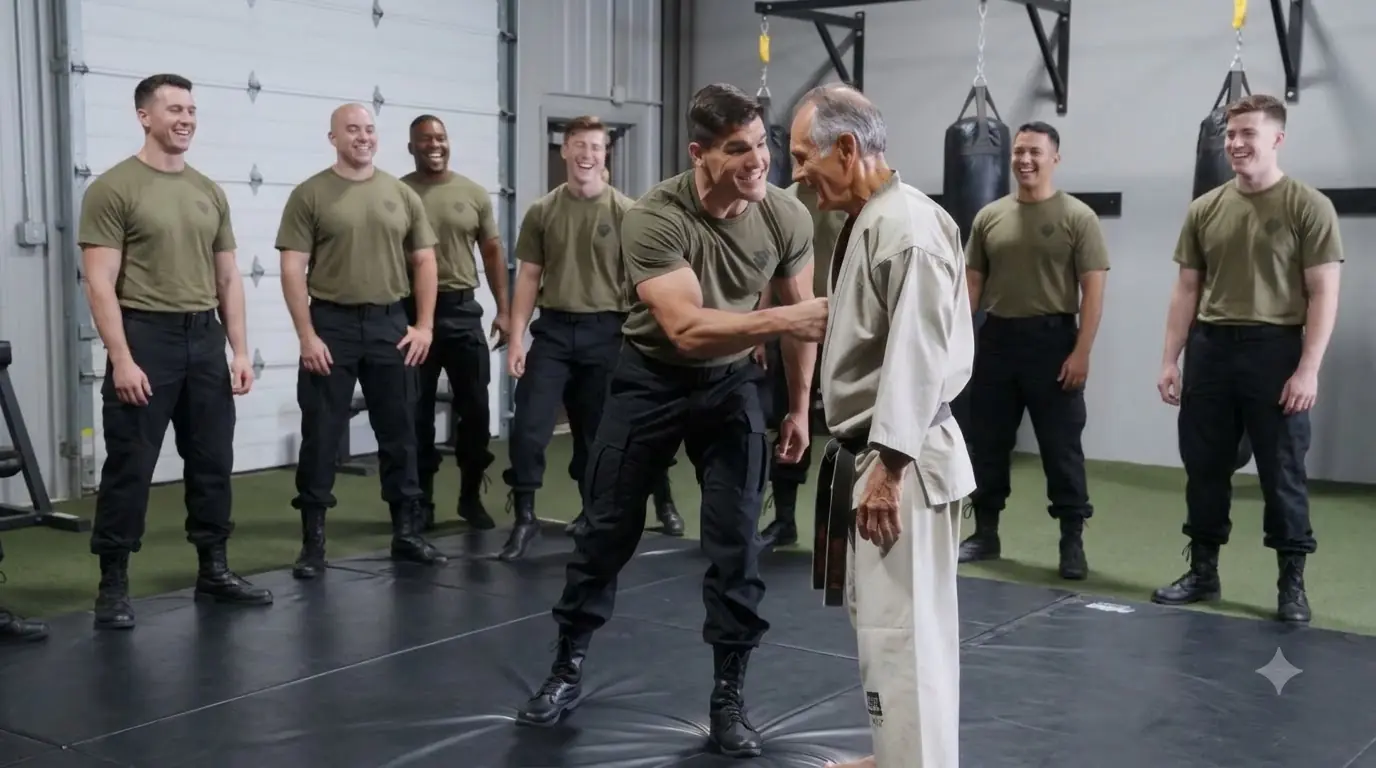
For a few seconds, the world disappeared.
No gunfire.
No shouting.
No orders.
Only a sharp ringing in his skull and the taste of dust in his mouth.
When sound returned, it came in broken pieces. Someone was screaming for a medic. Someone else was calling contact from the left ridge. The lead vehicle sat crooked in the narrow road, its front axle torn open, black smoke pouring from beneath the hood.
Caleb pushed himself onto one knee.
Pain tore through his right shoulder.
Rounds slapped the dirt near his boots, throwing little bursts of stone into the air. His team fired back from behind the convoy while the squad leader called for air support. Caleb saw three enemy fighters retreating toward a line of abandoned houses on the hill.
His body wanted to follow.
Move forward.
Close the distance.
End the threat before it regrouped.
That was what he had always believed strong soldiers did.
Then he heard a voice from beside the wrecked vehicle.
“Monroe!”
Private Eli Dawson was pinned near the front wheel. He was nineteen years old, thin through the shoulders, still soft in the face in a way young soldiers hate being noticed for. Blood covered the left side of his uniform, and one leg was trapped beneath a twisted piece of the vehicle frame.
The enemy was getting away.
Eli was exposed.
Caleb had maybe three seconds to choose.
One year earlier, the choice would have been easy.
He would have chased the shooters and told himself someone else could pull Eli out. That was how Caleb used to think. The strongest man went toward the fight, and the weaker man waited for help.
But as Caleb looked at Eli’s pale face, another place rose inside his memory.
A training gym.
Rubber mats.
Heavy bags hanging from chains.
Forty young soldiers watching an old man stand at the center of a circle.
And a calm voice saying, “Strength gives you options. Discipline tells you which one is worth taking.”
Caleb lowered his rifle.
Then he ran toward Eli.
Bullets struck the road behind him.
Eli looked up, eyes wide with pain.
“Leave me,” he gasped. “Get them.”
Caleb dropped beside him.
“Not happening.”
“The frame’s got my leg.”
“I noticed.”
Caleb shoved his hands under the bent metal and lifted.
Nothing moved.
Another round struck the vehicle.
Eli flinched and cursed through his teeth.
“Monroe, go.”
“Save your breath.”
His squad leader shouted over the radio, ordering him back to cover.
Caleb ignored him for five more seconds.
He shifted his feet, lowered his hips, locked both hands under the jagged edge of the frame, and lifted again. The metal rose barely two inches, but two inches was enough. Eli dragged his leg free with a cry that sounded more like anger than pain.
Caleb pulled him against his chest and started moving backward.
Then the second explosion hit.
It struck the road behind them and threw heat, gravel, and shrapnel through the air. Caleb turned his body before he understood he had decided to do it. Metal entered his shoulder and side. The force knocked both men into the dirt.
When Caleb opened his eyes again, he was lying in a field hospital with his torso wrapped in bandages and his right arm strapped tight against his body.
Eli Dawson was alive.
The fighters who ran from the ridge had been captured two hours later.
On the small table beside Caleb’s bed sat an envelope.
The handwriting across the front was firm, uneven, and old-fashioned.
Caleb recognized it immediately.
He opened the letter with his left hand.
There were only three lines inside.
Monroe,
I heard you turned back when moving forward would have been easier.
Now you understand.
Nathaniel Graves.
Caleb closed his eyes.
He was twenty-four again, standing inside the combat training gym at Fort Ashford, believing no man in the room could teach him anything.
It had started at 10:40 on a Wednesday morning.
Nearly forty soldiers were finishing their final hand-to-hand assessment before deployment certification. Heavy bags swung along the far wall. Climbing ropes hung from steel beams. Training pads, medicine balls, free weights, and protective helmets were stacked in organized rows around the big padded floor.
The air smelled like sweat, rubber, disinfectant, and old canvas.
At the center of the mat stood Specialist Caleb Monroe.
He was six feet three, twenty-four years old, broad through the chest, with arms built from years of lifting and a temper built from years of being praised for it. His training shirt stuck to his back. Black gloves covered his hands. Sweat ran from his jaw after three straight sparring matches.
He had won all three.
That month, Caleb had beaten every soldier paired against him.
He put bigger men down with body shots.
He tossed quick men off balance.
He finished the obstacle course faster than anyone in his company.
Instructors praised his athleticism.
Younger soldiers watched him with open admiration.
Caleb took both reactions as proof that he had already become the kind of soldier others were trying to become.
That morning, Fort Ashford had opened the training facility to a small group of retired service members attending the base heritage program. Most of the visitors stood near the observation area, drinking coffee, speaking with officers, and watching young soldiers train. One man wandered closer to the edge of the mat.
His name was Nathaniel Graves.
He was sixty-nine years old, with short silver hair, sun-darkened skin, and calm gray eyes that gave nothing away. A faded field jacket hung over his narrow frame. Beneath it, he wore a plain white shirt, dark work pants, and old brown combat boots repaired along the soles.
He wore no medals.
No veteran’s cap.
No unit patch.
Nothing announced what he had been.
To Caleb, he looked like an old civilian who had drifted too close to a place he did not belong.
Nathaniel stopped beside the open edge of the sparring area.
He watched quietly.
Caleb had just thrown another soldier to the mat when he noticed him.
“You lost, sir?”
Several recruits turned.
Nathaniel glanced toward the door.
“No.”
“This area is for active personnel.”
“I can read signs.”
A few soldiers laughed.
Caleb smiled, but there was irritation underneath it. The old man had answered too calmly, as if Caleb did not matter enough to impress or intimidate him.
“You’re standing close to the mat.”
Nathaniel took half a step back.
“Better?”
The laughter grew.
Caleb pulled out his mouthguard and tossed it toward his gear bag.
“You think this is funny?”
“No.”
“You came to watch real soldiers train?”
Nathaniel’s eyes moved over Caleb’s stance.
His feet were too wide.
His shoulders were too tight.
His chin sat high because most men backed up before he had to protect it.
“I came to see what had changed,” Nathaniel said.
Caleb spread his arms.
“And?”
“The equipment is better.”
The soldiers around them smiled again.
Caleb tilted his head.
“What about the soldiers?”
Nathaniel met his eyes.
“That depends on the soldier.”
The smiles disappeared.
Caleb crossed the mat until he stood a foot from the old man.
“You should be careful how you talk in here.”
Nathaniel did not move.
“Why?”
“Because you’re surrounded by men trained to fight.”
The old man looked around the gym.
“I have been surrounded by fighting men before.”
Caleb laughed.
“Sure you have.”
Nathaniel turned as if the conversation had ended.
Caleb placed one gloved hand on his shoulder.
“Did I say you could walk away?”
Nathaniel looked down at the hand.
“Remove it.”
He did not raise his voice.
That made the order feel heavier.
A few soldiers exchanged glances.
People did not speak to Caleb that way often.
Caleb tightened his grip.
“Or what?”
Nathaniel raised his eyes.
“Or you may learn something your instructors have not managed to teach you.”
Caleb shoved him.
The old man stepped backward onto the edge of the mat. One boot slid over the padded floor, but he caught himself before falling. Laughter broke out behind Caleb, loud enough to carry toward the equipment room.
Not everyone laughed.
Sergeant Marco Alvarez, one of the assistant combat instructors, turned from the far wall.
He saw Caleb standing over the elderly visitor and immediately started toward them.
Before Alvarez reached the circle, Caleb lifted one fist.
“You’re too old to stand in my gym.”
Nathaniel brushed the front of his jacket.
“Your gym?”
Another recruit laughed.
Caleb mistook the sound for support.
“One punch,” he said. “That’s all it would take.”
Nathaniel looked at the growing circle of soldiers.
Two men held phones low by their thighs, recording even though base rules prohibited it. Others watched with the hungry expressions people wear when they expect a harmless humiliation and have not considered what it makes them.
Sergeant Alvarez pushed between them.
“Monroe, step back.”
Caleb kept his eyes on Nathaniel.
“We’re talking.”
“You put hands on a guest.”
“He says he’s been around fighting men.”
Nathaniel corrected him.
“I said I had stood among them.”
Caleb grinned.
“Then let him prove it.”
Alvarez pointed toward the wall.
“Specialist, move.”
Nathaniel slowly reached for the zipper of his field jacket.
“No.”
The sergeant turned toward him.
“Sir?”
Nathaniel removed the jacket.
He laid it beside the mat.
The shirt beneath revealed a body no one had expected. He was lean, not large, but age had not made him fragile. Hard muscle still shaped his shoulders and forearms. Scars crossed his ribs in pale lines. One burn scar ran from beneath his collarbone toward his chest.
There were surgical marks.
Shrapnel marks.
And one small round scar just below his heart.
The laughter died.
Caleb’s expression changed for less than a breath.
Then pride repaired it.
“Scars don’t make you dangerous.”
“No,” Nathaniel said.
He stepped fully onto the mat.
“Surviving what caused them does.”
Alvarez moved in front of him.
“Sir, I cannot allow this.”
“Then control your soldier.”
“He’s twenty-four.”
“I heard him.”
“He outweighs you by seventy pounds.”
“I can see him.”
Caleb stepped onto the mat too.
The circle widened.
Sergeant Alvarez understood the trap.
If he dragged Caleb away, the young soldier would learn nothing. He would spend months telling everyone that the old man had been protected. If he allowed the exchange, Nathaniel could be hurt badly, and Alvarez would own that decision.
Captain Melissa Grant, the senior training officer, had just left for a briefing with command.
Alvarez was alone with the moment.
“One controlled exchange,” he said finally. “No full-power strikes. No head shots. I stop it immediately.”
Caleb smiled.
Nathaniel did not.
Alvarez pointed at Caleb.
“Do you understand?”
“Yes, Sergeant.”
“Touch gloves.”
Caleb extended one glove.
Nathaniel looked at it.
Then at him.
“Stop performing.”
Several soldiers inhaled sharply.
Caleb’s smile vanished.
He moved first.
The jab was fast but controlled, meant to embarrass, not injure. Nathaniel shifted his head a few inches. The glove passed beside his cheek. Caleb followed with a right hand.
Nathaniel moved one foot.
The second punch struck nothing.
Before Caleb reset, Nathaniel placed two fingers beneath Caleb’s extended ribs.
Not a hit.
Just a marker.
“That stops your breathing,” Nathaniel said.
Caleb slapped the hand away.
“Do it for real.”
Alvarez stepped closer.
“Control yourself.”
Caleb barely heard him.
The old man’s movement had been too small.
Too clean.
Too easy.
And the soldiers were no longer smiling at Caleb.
That was the true insult.
He charged.
This time, the left hook carried real force. Nathaniel stepped inside the arc, caught Caleb’s wrist, touched the elbow with his other hand, and turned his hips. Caleb’s own momentum carried him forward. He hit the mat on one hand and one knee.
The gym went silent.
Nathaniel stood behind him.
He had not thrown a punch.
Caleb rose immediately.
His face had gone red.
“You got lucky.”
Nathaniel tilted his head.
“Try again.”
Sergeant Alvarez stepped between them.
“Enough.”
Caleb shoved past him.
That changed everything.
The soldiers were no longer watching a challenge.
They were watching a man lose control.
Caleb lowered his shoulder and rushed.
Nathaniel waited until the last possible second. He caught Caleb’s forward arm, shifted sideways, and swept one foot behind Caleb’s ankle. The move was so simple that half the room missed it until Caleb was already falling.
He hit the mat flat on his back.
Air exploded out of his lungs.
Before he could recover, Nathaniel knelt beside him. One forearm rested lightly across Caleb’s upper chest. Two fingers touched the side of his neck. With a little more pressure, the position could have become something much worse.
Nathaniel spoke quietly.
“Strength without discipline makes you dangerous to the people beside you.”
Then he released him and stood.
No one laughed.
A new voice came from the entrance.
“Who taught you that transition?”
Nathaniel froze.
Every soldier turned.
Major General Thomas Harlan, commanding officer of Fort Ashford, stood near the doors beside Captain Grant and two senior officers. He was sixty-two, tall, sharp-faced, and severe in the way men become when command has followed them too long. His eyes were not on Caleb.
They were fixed on the scar beneath Nathaniel’s collarbone.
Nathaniel reached for his jacket.
General Harlan crossed the gym before he could put it on.
Sergeant Alvarez began speaking.
“Sir, I can explain.”
Harlan raised one hand.
Silence followed.
He stopped a few feet from Nathaniel.
For a moment, neither man spoke.
Then the general said two words.
“Black Meridian.”
Nathaniel’s face changed.
It was the first clear emotion he had shown all morning.
“Not a name spoken in public.”
“I was told you died.”
“That was useful.”
Harlan stared at him.
“September 14, 1987. Kunar valley.”
Nathaniel pulled the jacket around his shoulders.
“You remember things you were ordered to forget.”
“I remember the man who carried seven Americans out of a burning compound.”
The gym became still.
Caleb remained on one knee.
Captain Grant looked between the two men.
“General, who is he?”
Harlan did not look away from Nathaniel.
“Colonel Nathaniel Graves.”
Nathaniel sighed.
“Retired.”
“He commanded a classified reconnaissance and recovery unit during the final years of the Cold War.”
Nathaniel’s jaw tightened.
“That history remains sealed.”
“Parts of it.”
The general turned slightly toward the soldiers.
“In 1987, my team was attached to an operation that officially did not exist. Our position was compromised before sunrise. Communications went down. Four men were killed in the first assault.”
Nathaniel lowered his eyes.
“Thomas.”
Harlan ignored the warning.
“The remaining seven were trapped inside a stone compound that caught fire after a rocket strike. Command denied extraction because the route was considered impossible.”
Captain Grant stared at Nathaniel.
“And he went in?”
“He entered alone after his local guide was killed on approach.”
The words settled over the room like weight.
“He carried two wounded men down the mountain. Then he went back. He carried three more on the second trip.”
Harlan’s voice roughened.
“On the third trip, he was shot beneath the collarbone, burned across his ribs, and struck by shrapnel near the heart.”
He touched his own chest.
“He still returned for me.”
Caleb looked at the scars again.
They no longer looked like old injuries.
They looked like a map of what courage had cost.
General Harlan continued.
“Colonel Graves refused evacuation until every living man was aboard the helicopter. Mission files listed him as missing for six days. Some reports listed him dead.”
Nathaniel put his jacket on.
“I survived.”
“You saved us.”
“I completed the work.”
The general turned to Caleb.
“What happened here?”
No one answered at first.
Sergeant Alvarez did.
“Specialist Monroe challenged him, sir.”
“Why?”
Nathaniel interrupted before Alvarez could continue.
“He misunderstood who was welcome.”
Harlan’s eyes moved to Caleb.
“Did you put hands on Colonel Graves?”
Caleb swallowed.
“Yes, sir.”
“Did he threaten you first?”
“No, sir.”
“Did he provoke you?”
Caleb looked toward Nathaniel.
“No, sir.”
“How long have you served?”
“Eleven months.”
“And in eleven months, you decided this building belonged more to you than to a man who wore the uniform before your father met your mother?”
Caleb lowered his eyes.
“No, sir.”
“That is exactly what you decided.”
The words struck harder than the mat had.
Harlan turned to the gathered soldiers.
“Physical strength is useful. Aggression is useful. Confidence is useful. Under discipline, those things can save lives.”
He looked back at Caleb.
“Without discipline, they become a danger to your unit.”
Caleb’s gloved hands hung at his sides.
The gloves suddenly felt childish.
General Harlan turned back to Nathaniel.
“What brought you here?”
Nathaniel looked toward the far wall.
A memorial display stood partly hidden behind a rack of training shields. Names of soldiers killed in action had been engraved into dark panels. Near the lower right corner was one name.
Staff Sergeant Aaron Graves
1992–2021
Nathaniel’s eyes settled there.
“My grandson trained here.”
Captain Grant stepped forward.
“Aaron Graves was your grandson?”
“Yes.”
“He was one of our best instructors.”
“So his mother tells me.”
Staff Sergeant Aaron Graves had died during a deployment after pulling two soldiers from a disabled vehicle. He survived the first blast and went back for another man when a secondary explosion hit the convoy. His actions had become part of Fort Ashford’s modern history.
Nathaniel rarely spoke of him.
Harlan followed his gaze.
“You came for the memorial ceremony tomorrow.”
Nathaniel nodded.
“My daughter could not attend. She asked me to place Aaron’s old unit patch beneath his name.”
He removed a worn cloth patch from inside his jacket.
Caleb stared at it.
Aaron Graves had trained his class during their first weeks at Fort Ashford. He had been demanding without cruelty. Patient without being soft. He corrected mistakes firmly, but never humiliated a soldier for needing correction.
Caleb remembered one sentence Aaron repeated more than once.
“A strong soldier can control a room. A disciplined soldier controls himself.”
Until that moment, Caleb had not known where Aaron learned it.
“Sir,” Caleb said quietly, “I knew Staff Sergeant Graves.”
Nathaniel looked at him.
“Did you?”
“He trained us.”
“Then you did not listen.”
The words hit Caleb harder than both takedowns.
He lowered his head.
“No, sir.”
Nathaniel walked toward the memorial wall.
The soldiers moved aside without being told.
He stopped before Aaron’s name and pressed the old patch beneath the engraved letters. For several moments, he stood in silence. The room respected it.
Then Nathaniel removed a folded letter from his pocket.
Captain Grant recognized the envelope.
“That was returned with his personal effects?”
“Yes.”
Nathaniel unfolded it carefully.
“My daughter gave this to me after the funeral. Aaron wrote it two days before he died.”
He turned toward the young soldiers.
“There is a section I believe he wrote for men like you.”
Then he read.
Granddad,
You told me once that the Army can teach a man how to fight, but only good people can teach him when not to.
I understand that now.
Young soldiers arrive thinking courage always means moving toward danger. Sometimes it does. But most days, courage is patience. It is admitting fear. It is asking for help. It is controlling your hands when anger wants to use them.
I hope I teach them before the world teaches them harder.
Nathaniel lowered the letter.
No one spoke.
Caleb looked at the place on the mat where he had shoved the old man.
Aaron had tried to teach him that exact lesson.
Caleb had admired the strength and missed the meaning beneath it.
General Harlan ordered the other soldiers to resume training on the far side of the gym.
Caleb stayed where he was.
“Colonel Graves?”
Nathaniel folded the letter.
“Yes.”
“I owe you an apology.”
“Yes.”
That directness surprised him.
“I disrespected you.”
“Yes.”
“I put my hands on you.”
“Yes.”
Caleb swallowed.
“I thought because you were old, you were harmless.”
Nathaniel looked at him.
“You thought weakness was always visible.”
Caleb nodded.
“Yes, sir.”
Nathaniel returned the letter to his pocket.
“Sometimes weakness is visible. Sometimes strength is hidden. The mistake is believing your eyes are wise enough to know the difference immediately.”
“I understand.”
“No.”
Caleb looked up.
“You are embarrassed. Understanding takes time.”
The private accepted that.
“What should I do?”
Nathaniel considered him.
It would have been easy to tell him to be humble, but humility is rarely born from instruction. It usually comes from work, failure, and standing near people who do not need your performance.
“Tomorrow morning,” Nathaniel said, “report to the veterans rehabilitation center outside the east gate.”
Caleb frowned.
“For punishment?”
“For work.”
“What kind?”
“Whatever they ask.”
General Harlan stepped closer.
“You will report there at 0700 every morning for thirty days.”
“Yes, sir.”
Nathaniel turned away.
Caleb called after him.
“Colonel?”
The old man stopped.
“When I said one punch would be enough.”
Nathaniel waited.
“Could you have taken it?”
For the first time, Nathaniel’s mouth almost moved into a smile.
“No.”
Caleb blinked.
“I would have made certain you missed.”
The next morning, Caleb reported to the rehabilitation center expecting humiliation.
Instead, he found work that made humiliation look useless.
His first assignment involved a seventy-two-year-old Vietnam veteran named Howard Pike. Howard was learning how to move from his wheelchair onto a low training platform after a stroke weakened half his body. He had one stubborn eye, one useless hand, and the kind of temper that had probably helped keep him alive.
Caleb stepped forward immediately.
“I can lift him.”
The physical therapist stopped him.
“He does not need to be carried.”
Howard glared up from the chair.
“I can speak for myself.”
Caleb stepped back.
“What do you need?”
“Stand close enough to catch me if I fall.”
“That’s all?”
Howard snorted.
“That’s plenty.”
He placed both hands on the wheelchair arms and began lifting himself.
His legs trembled.
The movement took nearly a full minute.
Every instinct Caleb had told him to reach down and finish the job for him.
He did not.
Howard transferred onto the platform without assistance.
He was breathing hard when he finished.
“You see?” Howard asked.
Caleb nodded.
“I see.”
“No,” Howard said. “But maybe you will.”
Over the next weeks, Caleb worked beside people whose bodies had lost things he had never appreciated.
A former infantry officer practiced closing a damaged hand around a plastic cup.
A young sergeant with two prosthetic legs took twelve steps between parallel bars and cried from anger when he could not manage thirteen.
A retired medic relearned how to form complete sentences after a stroke.
A woman injured during a training accident practiced turning her head without losing balance.
None of them wanted pity.
They wanted patience.
They wanted Caleb near enough to help without stealing the work from them.
That was harder than lifting weight.
Nathaniel visited several times.
He sat near the wall with a paper cup of coffee and watched without comment. During the first week, Caleb avoided him. By the third, he sat beside the old colonel after morning therapy ended.
“I understand more now,” Caleb said.
Nathaniel looked toward the young sergeant between the parallel bars.
“How much more?”
“Enough to know I didn’t understand before.”
“That is a useful beginning.”
Caleb rested his forearms on his knees.
“Why didn’t you tell me who you were?”
“You did not ask.”
“I asked if you had trained.”
“No. You told me I did not belong.”
Caleb looked at the floor.
“Were you really going to fight me?”
“No.”
“You stepped onto the mat.”
“I allowed you to reveal yourself.”
“And if General Harlan had not walked in?”
“You would still have landed on your back.”
Caleb smiled despite himself.
Nathaniel did too.
Thirty days passed.
General Harlan told Caleb his assigned service was complete.
Caleb kept going.
At first, he did not tell anyone. He arrived before the therapists, helped set up equipment, learned how to secure harnesses, adjusted wheelchairs, cleaned mats, carried water, and listened more than he spoke. Over time, the people there stopped treating him like a punishment case and started treating him like a person useful enough to be trusted.
Inside his own unit, Caleb changed too.
He was still the strongest soldier in his class.
He simply stopped making strength the most important fact about himself.
When smaller soldiers struggled, he corrected them without laughter. When sparring heated into ego, he stepped between men before pride turned training into injury. When someone fell behind during a field exercise, he carried gear instead of mockery.
Sergeant Alvarez noticed.
Captain Grant noticed.
The other soldiers noticed too.
Their admiration became quieter.
Better.
Before deployment, Nathaniel gave Caleb a small object wrapped in cloth.
Caleb unfolded it and found an old metal whistle.
“I can’t take this.”
“You can.”
“It was Aaron’s?”
“Yes.”
“Then I really can’t.”
“That is why you should.”
Caleb held it carefully.
“What did he use it for?”
“Stopping young men before pride turned training into damage.”
Nathaniel looked at him.
“You may need it.”
Caleb carried the whistle overseas.
Months later, after the convoy attack, doctors removed six pieces of shrapnel from his shoulder and side. Eli Dawson visited him on crutches two days after surgery. His trapped leg had been saved, though he would walk carefully for months.
“You should have gone after the shooters,” Eli said.
Caleb looked at him.
“You were the mission.”
Eli lowered his eyes.
“I thought you hated me.”
“I thought you were weak.”
The young private looked up.
“Was I?”
Caleb considered the question.
“You were trapped under a vehicle and still told me to leave you so the unit could move.”
Eli waited.
Caleb shook his head.
“No. I was wrong.”
After returning to the States, Caleb visited Nathaniel at a small house in western Montana.
The place stood at the end of a gravel road, surrounded by pine trees, chopped wood, and a vegetable garden arranged with military precision. Nathaniel opened the door before Caleb knocked.
“You walk loudly.”
Caleb looked down at his boots.
“I’m trying to improve.”
“Not at walking.”
They drank coffee on the porch while the afternoon light moved through the trees.
Caleb handed him the letter.
Nathaniel did not take it.
“It was written for you.”
“You already knew what happened.”
“General Harlan called.”
Caleb looked toward the tree line.
“When I saw Eli under that frame, I heard your voice.”
“During the attack?”
“Not literally.”
“That is fortunate.”
“I wanted to chase the men who hit us.”
“Why?”
“Because they were the enemy.”
“And Eli?”
Caleb swallowed.
“He was my responsibility.”
Nathaniel nodded once.
“That is the difference.”
“Between what?”
“Fighting and serving.”
Years passed.
Caleb Monroe became an instructor at Fort Ashford.
He grew older, broader, quieter. He still moved like a man capable of violence, but no longer like a man eager to prove it. New soldiers feared him at first because of his size, then trusted him because he never used that size as a substitute for teaching.
The gym changed.
New mats replaced old ones.
Heavy bags were moved to the opposite wall.
The memorial display grew.
One plaque was eventually added beside Aaron Graves’s name.
Colonel Nathaniel Graves
1955–2025
Black Meridian
The details of his missions remained sealed.
The lesson did not.
On a Thursday morning, a new class gathered around the mat.
One recruit was larger than the others. He laughed when paired with a shorter soldier and rolled his shoulders the way young strong men do when they think the room owes them attention.
Caleb blew Aaron’s whistle.
The sound cut through the gym.
“Do you believe size determines what a man can survive?”
The recruit shrugged.
“It helps, Sergeant.”
“It does.”
Caleb walked toward the memorial wall.
“The strongest man I ever challenged was sixty-nine years old.”
Several recruits smiled, waiting for the joke.
Caleb did not smile.
“I shoved him because I thought age made him harmless.”
The room quieted.
“He put me on the floor without throwing a punch.”
One soldier raised a hand.
“What technique did he use?”
Caleb looked toward Nathaniel’s plaque.
“The one most of you haven’t learned yet.”
“What is it?”
“Discipline.”
He stepped back onto the mat.
“Strength gives you options. Discipline tells you which one is worth taking.”
Morning light came through the high windows.
The heavy bags moved slowly on their chains.
Young soldiers raised their gloves and prepared to train.
Years earlier, Caleb had believed the old man in the field jacket represented everything time had taken away. Speed. Power. Authority. Danger. He later understood that Nathaniel Graves represented what time leaves behind when a man has lived correctly.
Judgment.
Patience.
Control.
And the knowledge that the most dangerous person in a room is rarely the one trying hardest to prove it.