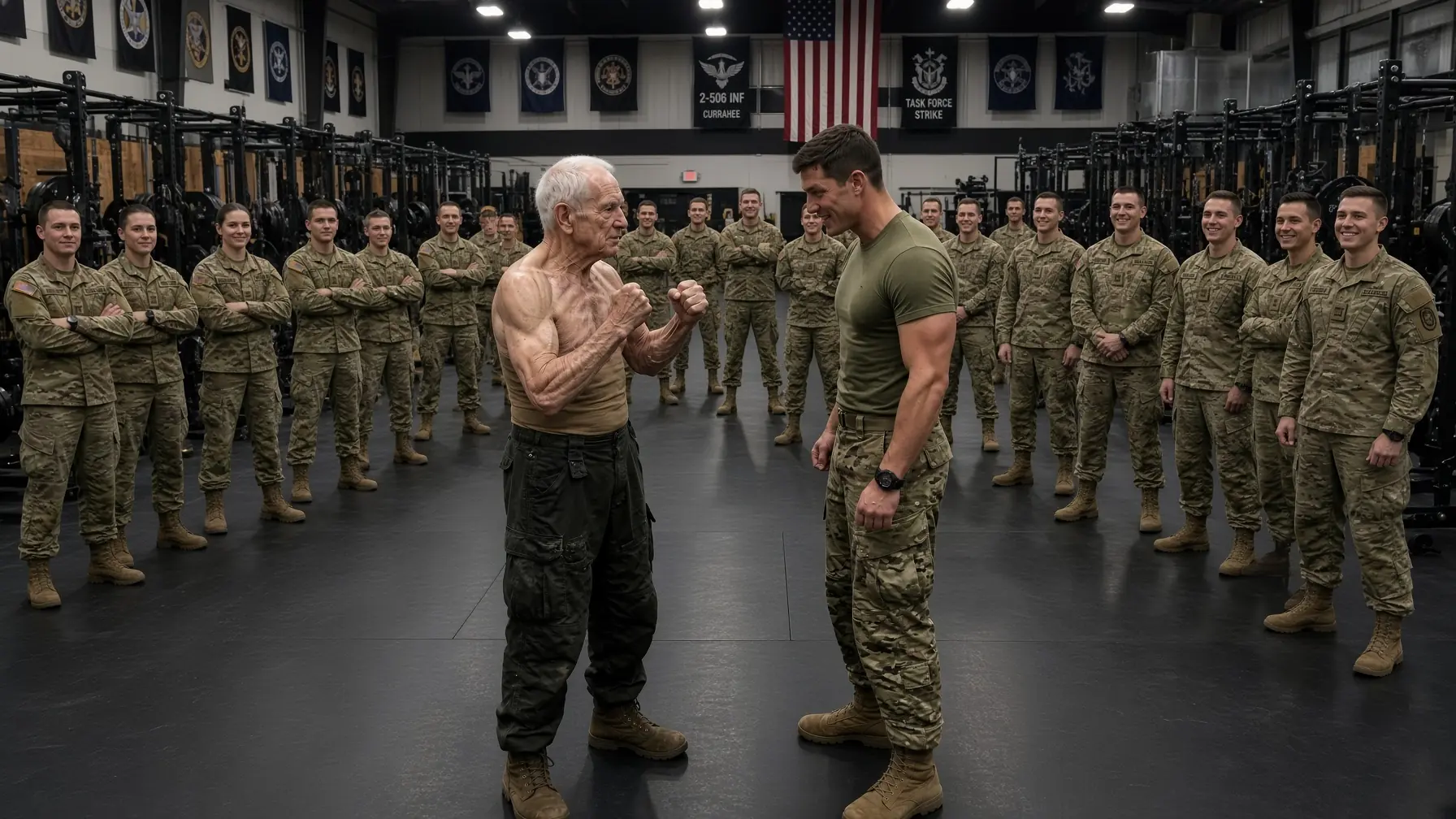
Private Nolan Pierce made his mistake before he ever threw a punch.
He looked at the old man’s gray hair, thin frame, repaired boots, and faded field jacket, and decided the story was already over. To Nolan, age meant weakness. Silence meant fear. A man without medals on his chest was simply a man who had nothing worth remembering.
The confrontation began at 10:42 on a cold Friday morning inside the combat training gym at Fort Mason Ridge, South Carolina.
Nearly fifty soldiers were finishing their final week of close-combat evaluation before deployment certification. Heavy bags hung from steel beams, rubber mats covered the center floor, and ropes swung slightly from the ceiling every time the loading bay doors opened. The whole building smelled of sweat, disinfectant, canvas, and the sharp rubber scent of new training gear.
At the center of the mat stood Private First Class Nolan Pierce.
He was twenty-three, tall, broad-shouldered, and proud of both facts. His green training shirt stretched across his chest, and his black gloves looked almost too small for his hands. He had won every match that week, and by Friday morning, he had begun walking around the gym like the victory belonged to him before anyone touched gloves.
Nolan was strong.
That was never the problem.
The problem was that he had started believing strength was the same thing as authority.
His instructors had warned him twice. Staff Sergeant Mateo Cruz told him he had talent but no brakes. Captain Adrian Wells told him that confidence without restraint became a liability under pressure. Nolan heard the words, nodded respectfully, then walked away believing older men said those things because they could not do what he could do anymore.
That morning, the base had invited several retired service members to tour the training facility as part of a heritage program.
Most of the visitors stayed near the observation line, speaking quietly with officers and watching the young soldiers train. One man wandered closer to the mat. He moved slowly but not uncertainly, his right hand resting inside the pocket of an old dark-green field jacket, his eyes following footwork more than strikes.
His name was Elias Crowe.
He was sixty-nine years old, narrow through the waist, with silver hair cut short and a weathered face that looked carved by wind, sun, and too many nights without sleep. He wore a plain gray shirt under the jacket, dark work pants, and brown combat boots with one sole repaired in a different shade of leather.
There was no veteran’s cap.
No ribbon rack.
No pin.
Nothing on him asked to be recognized.
Nolan noticed him after throwing another soldier to the mat.
“You lost, sir?” Nolan called.
A few soldiers turned.
Elias looked around once, as if checking whether someone else had been addressed. Then his gaze returned to Nolan.
“No.”
“This side of the building is for active personnel.”
“I can read signs.”
A few recruits laughed.
Nolan smiled, but the answer bothered him.
Not because it was rude.
Because it was calm.
Calm always irritated Nolan when he thought someone should be impressed by him.
“You’re standing close to the mat,” Nolan said.
Elias stepped half a pace back.
“Better?”
The laughter grew.
Nolan heard it and mistook it for approval.
He walked toward the old man, still wearing his training gloves, sweat darkening the front of his shirt.
“You got a comment on the training?”
Elias looked at the mat.
“I came to see whether it had improved.”
Nolan spread both arms.
“And?”
“The mats are better.”
Someone near the ropes laughed harder than they should have.
Nolan’s face tightened.
“What about the soldiers?”
Elias studied him for a moment.
“That varies.”
The gym quieted.
Nolan stepped closer until only a foot separated them.
“You always talk like that to men who can drop you?”
Elias did not blink.
“Only when they need to hear it.”
Nolan laughed loudly, but there was heat under it now.
The kind that comes when pride feels eyes on its back.
“You think you know something about fighting?”
“I know enough to dislike what you’re practicing.”
“What’s that supposed to mean?”
Elias looked at Nolan’s hands.
“You strike like a man trying to prove he’s dangerous.”
Nolan’s smile vanished.
Staff Sergeant Cruz had been near the equipment room reviewing scores when the tone shifted. He turned, saw Nolan crowding the elderly visitor, and started across the gym. He moved fast, but not fast enough to stop Nolan from placing one gloved hand against Elias Crowe’s shoulder.
“Conversation isn’t done,” Nolan said.
Elias looked down at the hand.
“Remove it.”
The words were quiet.
Every soldier nearby heard them.
Nolan tightened his grip.
“Or what?”
Elias lifted his eyes.
“Or you will learn the difference between force and control.”
Nolan shoved him.
Not hard enough to throw him across the room.
Hard enough to show everybody who owned the space.
Elias slid backward onto the edge of the mat. One boot crossed the rubber surface, his body shifted with it, and for a second several soldiers expected him to fall. He did not. His weight settled cleanly, almost silently, like he had been placed there rather than pushed.
The laughter faded.
Cruz stepped between them.
“Pierce, back off.”
Nolan kept his eyes on Elias.
“We’re fine, Sergeant.”
“You shoved a guest.”
“He’s got opinions.”
Elias brushed one sleeve of his jacket.
“I have observations.”
Nolan pointed at him.
“You want to observe from the mat? Come on, then. Show us what you’ve got.”
Cruz turned sharply.
“That is not happening.”
Elias slowly unzipped his jacket.
The small sound carried.
He removed the jacket and set it near the mat.
The gray shirt underneath revealed a body no one expected. Elias was lean, not large, but there was rope-hard muscle across his forearms and shoulders. Scars marked his body in pale, uneven lines. One ran from his left collarbone toward his chest. Another curved beneath his ribs. A round scar sat just below the sternum, small and terrible in its meaning.
The gym became still.
Nolan looked at the scars.
Then forced a smirk back onto his face.
“Old marks don’t make you special.”
Elias stepped fully onto the mat.
“No.”
He raised his hands.
“What survived those marks does.”
Cruz lowered his voice.
“Sir, I cannot allow you to spar with him.”
“Then remove him.”
“He’s twenty-three.”
“I noticed.”
“He has eighty pounds on you.”
“I noticed that too.”
Nolan moved onto the mat before Cruz could answer.
The surrounding soldiers widened the circle, drawn by that old human weakness for watching arrogance crash into consequence. Two soldiers had phones half-raised, though recording in the facility was prohibited. Cruz saw them and pointed sharply.
“Phones down.”
The phones disappeared.
But the eyes stayed.
Cruz looked toward the office, hoping Captain Wells would return from the command briefing.
He did not.
The sergeant made the kind of decision instructors hate making, the kind where every option feels wrong. If he dragged Nolan away now, the private would learn nothing except that command had protected an old man from him. If he allowed even a controlled exchange, Elias could be hurt.
“One exchange,” Cruz said finally. “Controlled. No head shots. No full-power strikes. I stop it immediately.”
Nolan grinned.
“Yes, Sergeant.”
Elias said nothing.
Cruz looked at him.
“Sir?”
Elias nodded once.
“Begin.”
Nolan stepped forward with a quick jab meant to embarrass rather than injure.
Elias shifted his head just enough.
The glove passed by his cheek.
Nolan threw a right hand, harder this time. Elias moved one foot, turned his shoulder, and let the punch cut through empty air. Before Nolan recovered, Elias placed two fingers lightly under his rib cage.
“That would have folded your breathing,” Elias said.
Nolan slapped his hand away.
“Do it for real.”
“Private,” Cruz warned.
But Nolan was already angry.
The old man had made him miss, and worse, made it look easy. The circle had seen it. Nolan could feel their opinion tilting, and a man addicted to admiration often becomes reckless the moment admiration begins to leave.
He rushed.
A wide left hook.
A shoulder drive.
All power, no patience.
Elias stepped inside the hook, guided Nolan’s wrist past him, touched the elbow, and turned his hips. Nolan’s own momentum carried him forward. His foot slipped. His knee hit the mat. His palm followed.
The gym went silent.
Elias stood behind him.
No punch thrown.
No strain on his face.
Nolan rose fast, cheeks red.
“Lucky.”
Elias tilted his head.
“Again?”
Cruz stepped in.
“Enough.”
Nolan shoved past him.
“No.”
That was the moment the atmosphere changed.
A soldier could be embarrassed.
A soldier could be corrected.
But tearing free from an instructor on a mat in front of the unit was something else.
Nolan charged again.
This time, he meant to hurt the old man.
Elias waited until the final step, then lowered his body, caught Nolan’s forward arm, swept his ankle from behind, and let gravity finish what pride had started. Nolan hit the mat on his back with a sound that emptied the air from his lungs.
Before he could move, Elias knelt beside him.
One forearm rested lightly across Nolan’s chest. Two fingers touched the side of his neck. It was not a choke. Not yet. But every soldier in the room understood how little would have to change before it became one.
Elias’s voice remained calm.
“Strength without discipline is just panic with muscles.”
Nolan stared up at him.
The old man released him and stood.
No one laughed.
No one even shifted.
Then a voice came from the gym entrance.
“Where did you learn that control hold?”
Everyone turned.
Brigadier General Marcus Ellison stood by the doors with Captain Wells and two senior officers. He was sixty-two, tall, decorated, and usually unreadable, but now his expression had changed completely. His eyes were fixed not on Nolan, but on the round scar beneath Elias Crowe’s chest.
Captain Wells stepped forward.
“General, we can explain.”
Ellison raised one hand.
He walked across the mat slowly.
Elias reached for his jacket, but the general reached him first.
The two men studied each other in silence.
Then Ellison said one word.
“Lantern.”
Elias’s face changed.
For the first time all morning, emotion passed through it.
“Not anymore.”
The general looked like he had seen a ghost step out of a uniform he thought history had buried.
“I was told you died.”
“So were the people who needed to think that.”
The soldiers looked from one man to the other.
Nolan remained on one knee, breathing hard.
Ellison’s gaze moved to the scars.
“Kandahar Ridge. February 1991.”
Elias looked away.
“You remember too much.”
“I remember the man who carried us out when command said no extraction was possible.”
The gym froze around them.
Captain Wells’s voice lowered.
“Sir, who is he?”
General Ellison turned toward the soldiers.
“Colonel Elias Crowe. Retired. Former commander of a classified reconnaissance element during the late Cold War and early Gulf period.”
Elias shook his head slightly.
“Some of that is still sealed.”
“Enough is not.”
Ellison faced the room.
“In 1991, my team was trapped in a collapsed compound after a night operation went bad. Communications failed. Two exits were burning. We had wounded men pinned under debris and no safe approach for a helicopter.”
Elias said quietly, “Marcus.”
The general ignored the warning.
“Colonel Crowe went in anyway.”
No one moved.
“He was shot through the upper chest, burned along the ribs, and took shrapnel near the heart. He carried one man out. Then went back. Then went back again. By the time we reached extraction, he had moved six wounded soldiers under fire.”
Nolan looked at the scars again.
They no longer looked like marks from an old life.
They looked like a map of lives that had continued because this man had refused to leave them behind.
General Ellison turned to Nolan.
“What happened here?”
The question was quiet.
That made it worse.
Cruz answered.
“Private Pierce put hands on him, sir.”
“Why?”
Nolan opened his mouth.
Nothing came.
Elias spoke first.
“He believed age made me out of place.”
Ellison’s eyes did not leave Nolan.
“Did Colonel Crowe threaten you?”
“No, sir.”
“Did he provoke you?”
“No, sir.”
“Did you shove him?”
Nolan swallowed.
“Yes, sir.”
The general stepped closer.
“How long have you served?”
“Ten months, sir.”
“And in ten months, you decided this gym belonged more to you than to a man who wore the uniform before your father was grown?”
Nolan’s face burned.
“No, sir.”
“That is exactly what you decided.”
The words settled across the mat.
No one rushed to rescue Nolan from them.
General Ellison looked toward Elias.
“What brought you here?”
Elias hesitated.
Then his eyes moved to the far wall.
A memorial wall stood partly behind training shields and folded mats. Names were engraved on a dark panel under the title: Fort Mason Ridge Fallen Instructors. Near the lower center was a name.
STAFF SERGEANT OWEN CROWE
1992–2020
Elias reached inside his jacket pocket and removed a small folded cloth.
“My grandson trained here.”
Captain Wells turned sharply.
“Owen Crowe was your grandson?”
“Yes.”
“Owen was one of the best instructors this facility ever had.”
“I know.”
Nolan looked toward the wall.
He knew that name.
Every soldier did.
Staff Sergeant Owen Crowe had died during a convoy recovery operation overseas after pulling two soldiers from a damaged vehicle. He had survived the first blast and returned for a third man before secondary fire hit the road.
Before deployment, Owen had taught combatives in this very gym.
Nolan had trained under him during his first month on base.
Owen had corrected him once for striking too hard during a controlled drill.
A strong man can hurt someone, Owen had said. A disciplined man knows when not to.
Nolan had laughed about it later with other recruits.
He was not laughing now.
Elias walked to the memorial wall.
The soldiers parted without command.
He unfolded the cloth in his hand.
It was an old unit patch, worn at the edges, its stitching faded from years of use. Elias pressed it beneath Owen’s name and held it there for a long moment.
Then he removed a folded letter from his jacket.
“Owen wrote this three days before he died,” Elias said. “His mother gave it to me after the funeral. I was going to leave it with the chaplain tomorrow.”
He turned toward the young soldiers.
“There’s a part you should hear.”
The room remained still.
Elias read.
Granddad,
You told me once that the Army would teach me to fight, but it would not automatically teach me when to stop.
I understand that now.
Young soldiers come in believing power lives in their hands.
I try to teach them that power actually begins before the hands move.
It begins when anger rises and a man refuses to let it command him.
If I teach them anything, I hope it is that courage is not always forward motion.
Sometimes courage is restraint.
Sometimes it is patience.
Sometimes it is being strong enough not to become cruel.
Elias lowered the letter.
No one spoke.
Nolan stared at the mat.
The lesson had been handed to him once by the grandson.
He had mocked it.
Then the grandfather had put him on his back without throwing a punch.
General Ellison dismissed the soldiers to the far wall, but Nolan did not move.
He stood slowly, removed his gloves, and looked at Elias.
“Sir.”
Elias folded the letter.
“I owe you an apology,” Nolan said.
“Yes.”
The direct answer hit him harder than kindness would have.
“I disrespected you.”
“Yes.”
“I put my hands on you.”
“Yes.”
“I thought because you were old—”
“You thought weakness was something you could see.”
Nolan lowered his eyes.
“Yes, sir.”
Elias placed the letter back in his jacket.
“Embarrassment is not understanding.”
“I know.”
“No, you are beginning to know.”
Nolan accepted that.
“What do I do?”
The old colonel looked at him for a long moment.
It would have been easy to give a speech about humility.
Elias did not waste words that could be replaced by work.
“Tomorrow morning, report to the recovery center outside the east gate.”
Nolan looked confused.
“The rehab center?”
“Yes. Injured veterans train there at 0700. Some are learning to walk again. Some are rebuilding grip strength. Some are learning how to stand without falling. You will show up and do whatever the therapists ask.”
Nolan glanced at General Ellison.
The general nodded.
“Thirty days,” Ellison said. “Every morning.”
“Yes, sir.”
Elias turned to leave.
Nolan spoke again.
“Colonel Crowe?”
Elias stopped.
“If I had landed that punch…”
“What about it?”
“Could you have taken it?”
Elias looked back.
“No.”
Nolan blinked.
“I would have made sure you missed.”
The next morning, Nolan arrived at the recovery center at 0650.
He expected punishment.
He found something harder.
Work that did not care about his pride.
His first assignment was to stand beside a retired medic named Harold Gaines while Harold practiced transferring from a wheelchair to a therapy platform. Nolan tried to lift him by instinct. The physical therapist stopped him immediately.
“He does not need you to carry him. He needs you close enough to risk doing it himself.”
Nolan did not understand at first.
He understood after the fifth try.
Harold’s arms shook. Sweat ran down his temple. His jaw clenched with the effort of moving six inches. Nolan stood beside him, hands ready but not touching, learning for the first time how difficult restraint could be.
Over the next month, he saw strength in forms he had never respected.
A former captain with nerve damage practiced closing his hand around a foam ball.
A young sergeant with two prosthetic legs took fourteen steps between parallel bars and cried afterward because last week he had only made nine.
A retired supply officer relearned speech after a stroke, repeating the word home until it stopped breaking in the middle.
No one wanted Nolan’s pity.
They wanted patience.
They wanted consistency.
They wanted someone strong enough to stand nearby without making their struggle smaller by rushing it.
Elias came several mornings and sat by the wall.
He did not correct Nolan every time.
He did not need to.
The room did that.
After three weeks, Nolan sat beside him during a break.
“I understand more now,” he said.
Elias watched a veteran adjust the straps on a prosthetic knee.
“How much more?”
“Enough to know I didn’t understand anything that day.”
“That is useful.”
“I thought strength meant taking control.”
“Sometimes it does.”
Nolan looked toward the therapy bars.
“But not always.”
“Not usually.”
They sat in silence for a while.
Then Nolan said, “Why didn’t you tell me who you were?”
Elias turned his face toward him.
“You did not ask who I was. You only told me where I did not belong.”
The words landed cleanly.
Nolan nodded.
“I did.”
“A uniform can put you in a room,” Elias said. “It cannot prove you deserve the room.”
Nolan carried that sentence with him.
Thirty days became three months.
When the official order ended, he kept volunteering.
His behavior in the unit changed slowly enough that no one could accuse it of being a performance. He still trained hard. He still won sparring matches. He still ran fast, lifted heavy, and moved with the confidence of a physically gifted soldier.
But he stopped humiliating weaker men.
He stopped laughing when someone failed.
He corrected footwork without making a show of it.
When a younger recruit panicked during a drill, Nolan was the first to slow the pace and talk him through the movement. Staff Sergeant Cruz noticed. Captain Wells noticed. The soldiers who once admired Nolan’s arrogance began trusting his judgment.
A year later, Nolan deployed overseas.
During a convoy movement through a narrow road outside a village, an explosive device struck the lead vehicle. Smoke filled the air. Small-arms fire came from a low building beyond the road. Nolan’s first instinct was to move toward the source and fight.
Then he saw Private Ellis Monroe trapped beside the disabled vehicle.
Ellis was nineteen, smaller than most of the unit, and nervous in the way young soldiers try to hide until danger removes all decoration. A piece of metal had pinned part of his gear, and he was exposed.
Nolan moved without waiting for applause.
He crossed open ground, reached Ellis, cut him free, and dragged him behind cover as rounds struck the dirt around them.
A second blast hit the road.
Nolan shielded Ellis with his own body and took shrapnel across his side and shoulder.
Both survived.
Weeks later, in recovery, a letter arrived.
The handwriting was firm but uneven.
Pierce,
I heard you controlled your hands when it mattered and used your strength where it belonged.
Owen would have respected that.
Elias Crowe
Nolan kept the letter folded inside his field notebook.
Years later, Sergeant Nolan Pierce stood in the same combat training gym at Fort Mason Ridge.
The bags were newer.
The mats had been replaced.
The memorial wall had grown by three names.
Beneath Staff Sergeant Owen Crowe’s name, the old unit patch had been sealed behind glass. Beside it, a new plaque had been added after Elias Crowe died quietly in his sleep at seventy-three.
COLONEL ELIAS CROWE
1951–2025
LANTERN
The missions stayed classified.
The lesson did not.
That morning, Nolan watched a large recruit laugh after throwing a smaller soldier too hard during a controlled drill. The smaller soldier tried to get up quickly, embarrassed, pretending the landing had not hurt.
Nolan stopped the class.
The room went quiet.
He walked toward the recruit.
“Do you think size decides who belongs on this mat?”
The recruit shrugged.
“It helps, Sergeant.”
“It does.”
Nolan pointed to the memorial wall.
“The strongest man I ever challenged was almost seventy.”
A few recruits smiled.
They thought it was a setup for a joke.
Nolan did not smile.
“I shoved him because I thought age had beaten him. He put me on my back without throwing a punch.”
The smiles disappeared.
One recruit asked, “What did he use?”
Nolan looked at Elias’s plaque.
“The technique most soldiers learn last.”
“What’s that?”
“Discipline.”
He stepped back onto the mat.
“Strength gives you options. Discipline decides whether you deserve them.”
The recruits listened differently after that.
Outside, morning light entered the high windows and fell across the rubber mats in pale squares. The heavy bags moved gently on their chains. Young soldiers raised their hands, waiting to begin again.
Nolan looked once more at the memorial wall.
He thought of the old man in the repaired boots.
The faded jacket.
The scars.
The letter.
The way Elias Crowe had stood in front of a room full of younger men and needed no one to know his history before he controlled the room.
People would tell the easy version of the story.
A cocky young soldier challenged an old man.
Then learned the old man was a legendary colonel.
That version had a clean twist.
It made pride fall fast and made justice look simple.
But Nolan knew the deeper truth.
The lesson was not that he had underestimated the wrong old man.
There was no right old man to shove.
No right guest to mock.
No right person to measure by age, silence, scars, or the absence of medals.
Elias Crowe did not become worthy when the general said his name.
He was worthy the moment he walked into the gym.
Before the scars were seen.
Before the story was told.
Before the rank was revealed.
Before the room understood what he had survived.
That was the part Nolan taught every class from then on.
Respect should not require a résumé.
Discipline should not require humiliation.
And the most dangerous person in a room is rarely the one working hardest to prove it.