By the time Celeste Morgan reached Red Hollow, someone had already painted a red X across the cemetery gate.
The mark was still wet, a bright slash against wood bleached gray by nearly a century of wind. Beyond the crooked gate, rows of small stone markers leaned beneath cottonwood trees, their names softened by dust and time. A yellow bulldozer waited less than fifty yards away, its steel blade lowered toward the earth as though it had been brought there to finish an argument.
Celeste stopped her rented truck beside the road and stared at it.
She had expected resistance.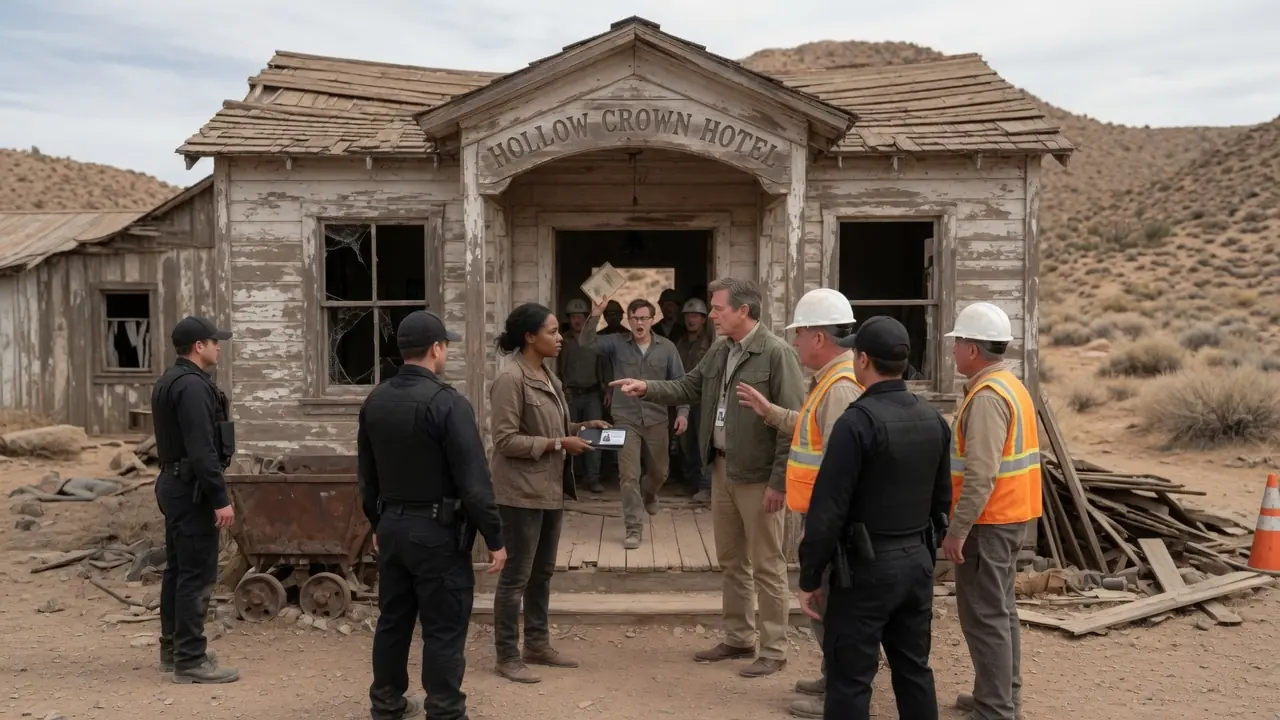
She had not expected them to move this quickly.
Red Hollow had been abandoned for almost eighty years, but the town had never truly disappeared. It remained in county maps, old railroad records, family Bibles, and faded photographs tucked inside kitchen drawers. A row of empty buildings still stood along Marrow Street, including a bank, a hotel, a chapel, and a general store with half its roof missing.
To most people, Red Hollow looked dead.
To Celeste, it looked like evidence.
She stepped from the truck wearing dusty boots, dark jeans, and a plain brown jacket over a white shirt. Her hair was pulled into a low bun, and the only jewelry she wore was a small silver watch that had belonged to her mother. Nothing about her clothing suggested that she was the founder and chief executive of Morgan Meridian Group, a development company valued at more than three billion dollars.
That was intentional.
For the past two months, polished reports had been arriving at her office claiming that the Red Hollow restoration project was moving exactly as planned. The historic buildings were supposedly being stabilized. The cemetery was supposedly being protected. Local families were supposedly being consulted before any construction began.
Then an unsigned envelope appeared on her desk.
Inside were photographs of survey stakes driven between graves.
There was also a handwritten note.
They are not restoring Red Hollow. They are erasing it.
Celeste had called no one before leaving headquarters.
She had not warned the regional directors, the architects, or the attorneys assigned to the project. She wanted to see Red Hollow before everyone had time to polish the truth. Most of all, she wanted to know which of her own people had decided that her instructions could be ignored.
The wind carried the smell of dry grass and diesel fuel across the road.
Celeste walked toward the cemetery.
A man in an orange safety vest stepped from behind the bulldozer. He was broad through the shoulders, sunburned across the neck, and carried a rolled blueprint beneath one arm. His white hard hat had the name HANK VOSS written across the front in black marker.
“You can’t be in here,” he called.
Celeste stopped beside the gate.
“I’m looking for the project meeting.”
Hank gave her a quick glance, taking in the rented truck, the dusty boots, and the lack of an identification badge.
“Meeting’s private.”
“I was told it was being held at the Hollow Crown Hotel.”
“That doesn’t make it public.”
Celeste looked beyond him toward the bulldozer.
“What is that machine doing beside the cemetery?”
Hank’s expression tightened.
“Site preparation.”
“For what?”
“A service road.”
Celeste turned her eyes toward the graves. “Through there?”
Hank lowered the blueprint.
“Lady, I don’t know who sent you, but you need to get back in your truck. This land belongs to a development company now. Nobody lives here, and nobody has lived here for generations.”
“The people buried here might disagree.”
“They’re dead.”
He said it casually, almost with boredom.
Celeste felt something cold settle beneath her ribs.
“Who authorized the road?”
Hank stepped closer. “I’m not discussing permits with a stranger.”
Before Celeste could answer, another vehicle rolled into town. It was a black utility truck with tinted windows and a silver company emblem on the door. Grant Mercer climbed from the driver’s side wearing an expensive field jacket that looked as though it had never touched dirt.
Grant was the regional development president for Morgan Meridian Group.
He had sat across from Celeste in executive meetings for four years.
He did not recognize her at first.
That was how rarely he looked directly at people he considered unimportant.
He shut the door, checked his phone, and frowned at Hank.
“Why is the equipment still sitting here?”
“This woman wandered onto the site,” Hank said. “She claims she’s looking for the meeting.”
Grant looked at Celeste.
His eyes paused on her face, but only for a second.
“Press?”
“No,” Celeste answered.
“Activist?”
“No.”
“Then what exactly are you doing here?”
Celeste nodded toward the cemetery. “Trying to understand why your crews are preparing to cut a road across protected graves.”
Grant gave a small laugh, the kind people used when they had already decided a question was foolish.
“These are not protected graves.”
“The project documents say they are.”
That caught his attention.
Grant studied her more carefully.
“What project documents?”
“The preservation plan.”
“You’ve been reading materials you don’t understand.”
“Perhaps you can explain them to me.”
Hank smirked.
Grant glanced at his watch.
“I don’t have time to educate every passerby who decides to become a historian. The town is being converted into a luxury heritage resort. Some structures will be restored, others will be removed, and the land will be reorganized for access and safety.”
“Reorganized?”
“Yes.”
Celeste looked again at the red X on the gate.
“Is that what you call moving the dead?”
Grant’s smile disappeared.
“No graves are being moved today.”
“Today?”
He took one step closer and lowered his voice.
“You need to leave before security arrives. This project has permits, investors, and legal approval. Whatever story you think you have found here, you haven’t.”
Celeste held his gaze.
“I would still like to attend the meeting.”
Grant looked at Hank, and the two men exchanged the brief, amused expression of people sharing a private joke.
“The meeting is for owners, contractors, and senior project staff,” Grant said.
“Then I should fit in.”
Grant’s mouth twisted.
“You don’t.”
He turned away.
Hank pointed toward the road. “Truck’s that way.”
Celeste did not move until Grant and Hank had started toward the center of town.
Then she looked down.
One of the survey stakes beside the gate had been driven through a small mound of earth. At its base was a broken stone no larger than a book. Most of the inscription had been buried, but a single carved word remained visible.
MORGAN.
Celeste crouched beside it.
She brushed the dust away with her fingertips.
Underneath the family name was a date: 1912.
Her grandmother had once mentioned relatives who disappeared after a mining settlement was burned and abandoned. She had called the place Hollow Red, though Celeste had assumed it was only a family expression. The stories had been incomplete, passed down in pieces no one fully understood.
A church bell ringing at midnight.
Families forced from their homes.
A cemetery left behind.
Celeste had never connected those stories to Red Hollow.
Not until now.
A voice came from behind the trees.
“You shouldn’t let them see you touching that.”
Celeste stood quickly.
An elderly man emerged from the shadows carrying a metal watering can. He was thin, with deep brown skin, a white beard, and a straw hat patched along the brim. His faded shirt was buttoned to the throat despite the heat.
“My name is Amos Reed,” he said. “I look after the graves.”
Celeste glanced toward the hotel.
“Are you the one who sent the photographs?”
Amos studied her face.
“I sent them to someone who might care.”
“You sent them to Morgan Meridian.”
“I sent them to Celeste Morgan.”
Celeste said nothing.
Amos’s eyes moved to her silver watch.
Then he smiled faintly.
“You have Lillian’s eyes.”
Celeste felt the wind leave her lungs.
“You knew my mother?”
“I knew her name. Her mother came here once, long ago. She stood where you’re standing and cried beside that same stone.”
Celeste looked down at the broken marker.
“Who is buried here?”
“Isaiah Morgan. Your great-great-grandfather.”
For several seconds, the town seemed to fall completely silent.
Even the bulldozer’s engine had stopped.
Celeste stared at the name, trying to connect the weathered stone to the stories she had heard as a child. Her grandmother had spoken of Isaiah only once, describing him as a carpenter who built homes for families no other town would accept. She had never said where those homes were.
Amos set down the watering can.
“Red Hollow was not always a ghost town,” he said. “It was a refuge.”
He explained that the settlement had been founded by Black railroad workers, widowed homesteaders, immigrant miners, and families pushed out of wealthier towns. They built a chapel, a school, and a small boardinghouse. Isaiah Morgan owned the lumber mill and helped purchase the surrounding land through a cooperative deed.
For nearly thirty years, Red Hollow survived.
Then silver was discovered beneath the ridge.
A company called Vale Crest Mining arrived with lawyers, armed guards, and documents claiming ownership of the mineral rights. When the families refused to leave, buildings were burned, wells were poisoned, and the railway platform was dismantled. County officials later described the town as having been abandoned because of “economic decline.”
“That was a lie,” Amos said.
“What happened to the families?” Celeste asked.
“Some escaped. Some disappeared. Eleven people were buried here during that final winter, but their names were never entered into the county record.”
Celeste looked toward the hotel where Grant had gone.
“And now my company wants to build a resort over them.”
“Your company promised to save the town.”
“It still does.”
Amos’s face hardened.
“Then your company has people in it who do not believe your promises matter.”
A door slammed in the distance.
Grant stood on the hotel porch speaking to a woman in a gray suit. Elaine Pike, the project’s legal director, had arrived. Beside her was Owen Bell, the chief surveyor, carrying a laptop case and several map tubes.
Celeste knew all three of them.
They were supposed to report directly to her executive committee.
None of them had told her about the road.
“The meeting starts in ten minutes,” Amos said. “Once they sign the revised site plan, the cemetery will be labeled an undocumented burial area. That gives them permission to remove the stones first and investigate later.”
“Who told you that?”
“A young surveyor named Noah Price. He objected, so they fired him.”
“Where is he?”
Amos nodded toward the chapel.
“Hiding from the men who took his field notes.”
Celeste looked at the Hollow Crown Hotel.
Its porch sagged in the center, and several windows had been boarded over. A new banner hung above the entrance showing an artist’s image of pools, glass cabins, riding trails, and a luxury lodge built against the ridge. At the bottom were the words RED HOLLOW LEGACY RETREAT.
There was no cemetery in the rendering.
Celeste reached into her jacket and removed her phone.
There was no signal.
“That isn’t an accident,” Amos said. “They installed a temporary blocker around the hotel. Grant says it keeps drones away.”
Celeste slipped the phone back into her pocket.
“Can you bring Noah to the meeting?”
“They won’t let either of us inside.”
“They may not have a choice.”
Amos looked at her plain jacket.
“They already stopped you once.”
Celeste stared at the banner.
“Then they can stop me in front of witnesses.”
The Hollow Crown Hotel had once been the most elegant building in Red Hollow. Its lobby still contained a long oak counter, a cracked mirror, and a staircase that curved toward a second floor no longer safe enough to use. Folding tables had been arranged beneath old chandeliers, and bottled water sat beside leather presentation folders.
Grant stood at the head of the room.
Elaine Pike sat to his right, reviewing documents. Owen Bell connected his laptop to a portable projector. Hank guarded the entrance with two private security officers wearing black shirts and sidearms.
Celeste walked onto the porch.
Hank blocked the doorway.
“I told you to leave.”
“I am here to attend the project meeting.”
“And I told you it’s private.”
Through the open door, several contractors turned to watch.
Celeste raised her voice slightly.
“Is this the meeting where you plan to approve construction across the Red Hollow cemetery?”
Grant looked up sharply.
Elaine’s pen stopped moving.
Hank reached for Celeste’s arm, but she stepped back before he could touch her.
“Don’t do that,” she said.
“Then walk away.”
A security officer moved beside him.
Grant approached the doorway.
“Enough. Remove her from the property.”
Celeste looked past him into the room.
“Before you do, perhaps everyone inside should ask why the official preservation map has been replaced.”
Owen Bell went pale.
Grant’s face remained controlled.
“There has been no replacement.”
“Then show me the original map.”
“You are not entitled to see anything.”
“I am asking in front of your contractors, your legal director, and your survey chief. Show me the map that identifies the cemetery boundary approved by Morgan Meridian’s board.”
Elaine stood.
“Grant, who is she?”
“No one,” he said.
Celeste smiled without warmth.
“That seems to be the answer you rely on most.”
Grant turned back toward her.
“You are trespassing on private corporate property.”
“Private corporate property owned by whom?”
“Morgan Meridian Group.”
“And who owns Morgan Meridian Group?”
Several people inside exchanged uncertain looks.
Grant’s jaw tightened.
“It is a publicly structured holding company.”
“That wasn’t my question.”
Hank reached for Celeste again.
This time, another voice cut through the lobby.
“Take your hand off her.”
Amos Reed stood at the bottom of the porch steps. Beside him was a nervous young man carrying a battered field notebook beneath his shirt. Noah Price looked barely thirty, with wire-framed glasses and dust on both knees.
Grant’s expression changed.
“You were terminated,” he said.
Noah swallowed.
“I was terminated because I refused to falsify the survey.”
A murmur moved through the contractors.
Owen Bell shut his laptop.
“That is a serious accusation,” Elaine said.
“I have the original coordinates,” Noah replied. “The cemetery extends another six acres beyond the visible stones. Ground scans show at least forty-three burial sites.”
Grant pointed toward the road.
“Get them both off the property.”
Celeste stepped into the doorway.
“No.”
For the first time, Grant’s composure broke.
“You do not have the authority to say no.”
Celeste reached into the inner pocket of her jacket and removed a slim black wallet. She opened it, revealing a company identification card bearing her photograph, name, and title.
Grant stared at it.
The color drained from his face.
Elaine whispered, “Oh, God.”
Celeste held the card where everyone could see it.
“My name is Celeste Morgan. I am the founder, chairwoman, and chief executive officer of Morgan Meridian Group.”
Silence filled the lobby.
Hank slowly lowered his arm.
One of the security officers stepped away from the door.
Grant’s mouth opened, but no words came out.
Celeste entered the hotel.
Her boots struck the old floorboards with a measured rhythm as she walked toward the head of the table. No one tried to stop her now. Contractors lowered their eyes, and Elaine closed the folder in front of her as though hiding the papers might make them disappear.
Celeste placed her identification card on the table.
“You were correct about one thing, Grant,” she said. “This is private corporate property.”
She looked around the room.
“It is mine.”
Grant recovered enough to straighten his jacket.
“Celeste, this is clearly a misunderstanding.”
“A misunderstanding is sending the wrong invoice. A bulldozer parked beside my family’s graves is not a misunderstanding.”
The words landed harder than she expected.
Amos remained in the doorway, holding his hat against his chest.
Grant glanced at the contractors.
“Perhaps we should discuss this privately.”
“No. You were comfortable excluding me in public. You can explain yourself the same way.”
Elaine cleared her throat.
“The cemetery boundary has been disputed. The regional team was reviewing several options based on updated archaeological guidance.”
“Show me the updated guidance.”
Elaine looked toward Owen.
Owen did not move.
Celeste pointed to the projector.
“Turn it on.”
No one responded.
She looked at Noah.
“Do you still have your field data?”
He stepped forward and placed the notebook on the table.
“They took my company tablet, but I copied the coordinates by hand. I also saved the ground-penetrating radar images on an external drive.”
Grant’s eyes flashed.
“That data belongs to the company.”
Celeste turned toward him.
“Yes. My company.”
Noah gave her the drive.
Owen Bell finally spoke.
“Celeste, I can explain the discrepancy.”
“You will.”
He connected the drive to the laptop with shaking hands.
The projector cast a map across the cracked wall. Blue lines showed the restoration zone, the proposed lodge, the access roads, and the official cemetery boundary. Then Noah opened a second layer.
Dozens of red circles appeared beneath the planned spa, parking lot, and eastern guest cabins.
The room went quiet again.
“Forty-three confirmed anomalies,” Noah said. “Possibly more. The soil composition and spacing are consistent with graves.”
Celeste looked at Grant.
“When did you receive this data?”
He hesitated.
“Preliminary scans can be unreliable.”
“When?”
“Six weeks ago.”
Her board had approved the next financing phase four weeks ago.
“You presented the board with a clean environmental report.”
“We presented the conclusions available at the time.”
“No. You presented the conclusions you needed.”
Grant’s voice grew firmer.
“The project was already under pressure. Investors were threatening to withdraw because of delays. We had to make a decision based on the economic future of the site.”
“The future of the site?”
“Red Hollow is empty, Celeste. It has been empty for generations. We can create hundreds of jobs, bring tourism into the county, and turn ruins into revenue. That matters more than preserving every patch of dirt because someone might have been buried there a century ago.”
Amos stepped into the lobby.
“They have names.”
Grant barely looked at him.
“Not in any legal record.”
“They have names,” Amos repeated.
Celeste watched Grant’s face.
There was no shame there.
Only impatience.
“You removed the cemetery from the resort rendering,” she said.
“We simplified the image for investors.”
“You moved the service road.”
“For efficiency.”
“You fired a surveyor.”
“For insubordination.”
“You blocked communications around the hotel.”
“For security.”
“And you painted a demolition mark on the cemetery gate.”
Grant glanced toward Hank.
“That was not my instruction.”
Hank stiffened.
Celeste noticed the exchange.
“Who gave the order?”
Hank looked at Grant, then Elaine.
No one spoke.
Celeste walked to the window and looked out at the bulldozer.
“Until this morning, I believed I was investigating unauthorized construction. Now I believe I am looking at fraud.”
Elaine stood quickly.
“Celeste, that word has legal implications.”
“That is why I used it.”
She returned to the table and opened one of the leather folders. Inside was a revised land-use agreement already signed by Grant, Elaine, and two representatives of Vantage Crest Capital, the project’s largest outside investor.
The document described the cemetery as a “nonverified cultural feature.”
It authorized removal of all surface markers.
At the bottom was a compensation clause.
If the resort opened before the end of the fiscal year, Grant Mercer would receive a six-million-dollar performance bonus. Elaine Pike would receive two million. Owen Bell would receive nine hundred thousand.
Celeste looked up.
“There it is.”
Grant’s face hardened.
“You think I risked my career for a bonus?”
“I think you risked other people’s dead for one.”
“That is not fair.”
“Neither is burying the truth twice.”
Grant leaned both hands on the table.
“You built your company by making hard decisions. Don’t pretend you reached the top by protecting every sentimental attachment you encountered.”
Celeste felt every eye in the room shift toward her.
He had changed tactics.
He was no longer denying what he had done.
He was challenging her to admit that she would have done the same.
Grant continued.
“You bought Red Hollow because it was undervalued. You wanted a landmark resort that would place Morgan Meridian ahead of every competitor in the heritage market. I am delivering exactly that.”
“No,” Celeste said. “You are delivering a cemetery with room service.”
A few contractors looked down to hide their reactions.
Grant’s anger sharpened.
“You approved the budget. You approved the investors. You approved the schedule.”
“I approved restoration.”
“Restoration does not pay for itself.”
“It was never supposed to.”
That stopped him.
Celeste closed the folder.
“The resort was the financial engine, not the purpose. The purpose was to preserve Red Hollow, document its residents, and return part of the property to their descendants.”
Elaine stared at her.
“That was not included in the regional brief.”
“It was included in the founder’s directive.”
Grant laughed once.
“A ceremonial statement attached to a board packet.”
“A binding directive attached to the land trust.”
No one moved.
Grant’s expression shifted from anger to uncertainty.
“What land trust?”
Celeste looked toward Amos.
The old man reached beneath his shirt and withdrew a folded oilcloth packet tied with string. He placed it on the table with both hands. The cloth was worn smooth from years of handling.
Inside was a deed.
The paper had browned along the edges, but the ink remained legible.
At the top were the words RED HOLLOW COOPERATIVE LAND COVENANT, dated more than a century earlier. Below them were the names of twelve founding families, including Isaiah and Ruth Morgan.
Grant stared at the document.
“That cannot be valid.”
“It is,” Amos said. “The original was recorded before the county courthouse fire. This is the family copy.”
Elaine put on her glasses.
She read the first page, then the second.
Her face changed.
“What does it say?” Owen asked.
Elaine did not answer.
Celeste took the deed and read the clause aloud.
“No burial ground, chapel ground, school ground, or common well within Red Hollow may be sold, transferred, excavated, or converted for private profit. Any attempted violation dissolves the commercial lease and returns control of the affected land to the surviving heirs of the original cooperative.”
Grant stared at Celeste.
She held his gaze.
“My grandmother’s legal team authenticated this covenant twelve years ago.”
“You knew?”
“I knew a family deed existed. I did not know Isaiah Morgan was buried here until this morning.”
Grant shook his head.
“Then why purchase the land through Morgan Meridian?”
“To reunite the parcels, clear the fraudulent mining claims, and place Red Hollow under one preservation structure.”
His voice dropped.
“This entire project was a trap.”
“No. It was an opportunity.”
“For what?”
“To see whether the people entrusted with history would protect it when they believed no one important was watching.”
The words settled over the room.
Hank looked toward the door.
Elaine sat down slowly.
Grant’s eyes moved from the deed to the map, then to the compensation agreement.
“You cannot cancel the development,” he said. “The investor penalties alone would cost tens of millions.”
“I am not canceling the development.”
Confusion flickered across his face.
Celeste touched the red circles projected on the wall.
“I am canceling your version of it.”
She explained that the lodge would be moved beyond the original town boundary. The spa would be eliminated. The parking area would be relocated near the county road, with electric shuttles bringing visitors into the restored district. The cemetery would become the center of a memorial landscape, not an obstacle hidden behind guest cabins.
The chapel would be rebuilt.
The schoolhouse foundation would be preserved beneath glass.
A research center would collect the names and stories of every Red Hollow family.
Grant gave a bitter smile.
“And you think investors will accept that?”
“The investors you invited will not be involved.”
Elaine looked up sharply.
Celeste removed a sealed envelope from her jacket.
Before driving to Red Hollow, she had instructed Morgan Meridian’s chief financial officer to freeze the regional project account if she failed to check in by noon. She had also authorized an independent forensic audit of every transfer approved by Grant’s division during the past eighteen months.
It was now twelve seventeen.
Grant’s phone began to ring.
Then Elaine’s.
Then Owen’s.
Around the room, contractors checked their screens as messages appeared.
The communications blocker had been disabled.
Grant looked at his phone.
His face went blank.
“All regional accounts suspended,” he whispered.
Celeste slid the envelope toward him.
“Your employment is terminated effective immediately.”
He did not touch it.
“You cannot make me the villain because I refused to let dead people destroy a living project.”
Celeste’s expression remained calm.
“You became the villain when you decided they were easier to move because they could not stop you.”
Grant looked toward the contractors as though expecting someone to defend him.
No one did.
Hank Voss stepped quietly away from the door.
Celeste turned to Elaine.
“You signed the revised agreement.”
Elaine’s hands trembled.
“Grant told me the burial findings were inconclusive.”
“Noah objected in writing.”
“I never saw his report.”
“It was emailed to you.”
Elaine looked at Grant.
He said nothing.
Celeste watched her carefully.
There was fear in Elaine’s face, but there was also confusion.
“Open your email,” Celeste said.
Elaine pulled out her laptop and searched.
The message was not there.
Noah gave her the date and subject line.
She checked the archive, then the deleted folder.
Nothing.
Owen Bell shifted in his chair.
Celeste noticed.
“Mr. Bell?”
Owen stared at the floor.
Grant’s voice became low and dangerous.
“Think carefully.”
Owen closed his eyes.
“I was instructed to redirect Noah’s reports through the regional server.”
“By whom?”
“Grant.”
“And the email to Elaine?”
“I deleted it before delivery.”
Elaine rose so quickly her chair fell backward.
“You let me sign that agreement.”
Grant’s expression turned cold.
“You knew what the project required.”
“I knew the boundary had changed. I did not know there were confirmed graves beneath the development zone.”
“You did not ask many questions.”
Elaine’s anger vanished as the truth of that sentence reached her.
Celeste looked at her.
“That does not absolve you.”
“I understand.”
“But it does distinguish negligence from conspiracy.”
Grant stepped away from the table.
“This meeting is over.”
Two security officers moved instinctively toward him.
For one strange second, Grant seemed to believe they were still following his authority.
Then the older officer blocked the exit.
“Sir, you need to remain here.”
Grant stared at him.
“On whose order?”
A woman’s voice answered from the porch.
“Mine.”
Sheriff Mara Dune entered the hotel with two county investigators. She was tall, silver-haired, and carried a leather case beneath one arm. Behind her walked Morgan Meridian’s chief counsel, Adrian Cole, still wearing the dark suit he had traveled in.
Grant looked at Celeste.
“You brought law enforcement.”
“I brought witnesses.”
Adrian placed several documents on the table.
The audit team had discovered payments from Vantage Crest Capital to a consulting company registered under Grant’s brother’s name. More than four million dollars had moved through the account during the Red Hollow approval process. The supposed investor bonus was only a small portion of what Grant expected to receive.
The resort was never the final plan.
Once the cemetery and old town were cleared, Vantage Crest intended to sell the mineral rights beneath the ridge to a private extraction company. Recent geological scans suggested a rare industrial deposit worth hundreds of millions.
The luxury resort was camouflage.
The graves were in the way.
Grant said nothing while Sheriff Dune read him his rights.
Hank Voss sat heavily on the edge of a table. Owen Bell covered his face with both hands. Elaine stared at the compensation agreement as though it had been written in a language she had only now learned to understand.
Celeste watched Grant being led toward the door.
He stopped beside her.
“You think this makes you righteous?”
“No.”
“You still bought the town.”
“Yes.”
“You still planned to make money from it.”
“Yes.”
“Then you are no different from me.”
Celeste looked through the open doorway toward the cemetery.
“There is a difference between building beside history and building over it.”
Grant’s eyes narrowed.
“People will forget this place again.”
“Not this time.”
Sheriff Dune escorted him outside.
The contractors remained silent until the vehicles disappeared down the road. Then the room seemed to exhale all at once. Chairs scraped, papers shifted, and someone shut off the projector.
Celeste turned to Noah.
“I owe you an apology.”
He looked startled.
“You did not know.”
“I built the system that allowed men like Grant to decide which warnings reached me. That makes it my responsibility.”
Noah glanced toward Amos.
“What happens now?”
“Now we begin again.”
For the next three hours, Celeste listened.
She listened to Amos describe the unmarked graves. She listened to Noah explain how the original survey had been altered. She listened to contractors admit which instructions had seemed wrong and why they had followed them anyway.
Some blamed Grant.
Others blamed deadlines.
A few simply admitted that they had not cared enough to ask.
Celeste wrote down every name.
As the sun lowered behind the ridge, she walked back to the cemetery with Amos. The bulldozer had been moved to the far side of town, and the red X on the gate had begun to dry. Amos opened a small toolbox and handed her a cloth soaked in mineral spirits.
Celeste rubbed at the paint.
The red streak faded slowly, revealing the old wood beneath.
“You do not have to do that yourself,” Amos said.
“Yes, I do.”
Together they cleaned the gate until only a faint stain remained.
Then Amos led her between the graves to Isaiah Morgan’s broken marker. Beside it stood another stone almost completely hidden beneath grass. Celeste pulled the weeds away and found the name Ruth Morgan carved across the face.
Below the name was a short inscription.
SHE KEPT THE DOOR OPEN.
Celeste touched the words.
“What does that mean?”
Amos smiled.
“During the final winter, Ruth Morgan hid families in the boardinghouse cellar. When the company guards searched the town, she stood in the doorway and told them the building was empty.”
“Was she believed?”
“No.”
“What happened?”
“She kept talking until everyone inside escaped through a tunnel beneath the kitchen.”
Celeste looked toward the ruined hotel.
“The Hollow Crown?”
“It was called Morgan House then.”
The revelation struck her harder than anything else that day.
The place where Grant had refused her entry had once belonged to her family.
The doorway he had guarded had been built by a woman who risked her life to keep it open for others.
Celeste began to laugh.
It was not a happy laugh, exactly.
It was the sound of something painful finally making sense.
Amos watched her.
“What is it?”
“They barred me from my own meeting inside my own family’s house.”
Amos smiled.
“History enjoys irony.”
The following morning, Morgan Meridian announced the suspension of the Red Hollow Legacy Retreat. News crews arrived by noon, followed by historians, preservation groups, and descendants who had spent years searching for proof that their families once lived there.
Celeste held no press conference in the hotel.
She spoke from the cemetery gate.
She did not describe herself as the rescuer of Red Hollow. She told the reporters that her company had nearly become the latest institution to profit from the town’s erasure. She named Noah Price as the employee who protected the truth and Amos Reed as the man who preserved it when no corporation cared.
Then she announced the new plan.
The property would be transferred into the Red Hollow Heritage Cooperative, governed jointly by descendants, historians, and community representatives. Morgan Meridian would finance the restoration but would never own the cemetery, chapel, school grounds, or historic town center.
The resort would be built two miles away.
Profits from it would support the archive, memorial, and descendant fund.
No grave would be moved.
No mineral rights would be sold.
No visitor would enter Red Hollow without first learning who had built it and why they had been forced to leave.
Reporters shouted questions as Celeste stepped away from the microphone.
One asked whether the project would still carry the Morgan name.
She looked back at Isaiah and Ruth’s stones.
“No,” she said. “It will carry all of theirs.”
Six months later, workers removed the false wall behind the Hollow Crown Hotel’s ruined kitchen. They found the tunnel Amos had described, narrow and dark, stretching beneath Marrow Street toward the dry creek bed.
Inside were buttons, children’s shoes, a rusted lantern, and a tin box wrapped in oilcloth.
The box contained thirty-seven letters.
Most had been written by families after they escaped Red Hollow. They described where they went, whom they lost, and the lives they tried to build afterward. One letter was addressed to Ruth Morgan.
It had never been delivered.
Celeste read it alone inside the restored chapel.
Miss Ruth,
You told us not to look back, but I did. I saw you standing in the doorway while the men came up the road. I thought they would kill you. Maybe they meant to.
My mother says we lived because you made them look at you instead of us.
One day, someone will come back for the town.
When they do, tell them we were here.
Celeste folded the letter carefully.
Outside, construction crews worked on the memorial path. Noah supervised a new ground survey, this time with descendants standing beside him. Elaine Pike, who had cooperated with investigators and surrendered her law license, had provided testimony that helped expose the full Vantage Crest scheme.
Grant Mercer eventually pleaded guilty to fraud, bribery, obstruction, and conspiracy to destroy protected burial grounds.
The bulldozer never crossed the cemetery gate.
A year after Celeste first arrived, Red Hollow reopened.
Visitors walked through the restored schoolhouse, the chapel, the carpenter’s shop, and Morgan House. In the old hotel lobby, a glass display preserved the altered maps, the secret compensation agreement, and the identification card Celeste had placed on the table that day.
Beside them hung a photograph.
It showed Celeste in dusty boots, standing outside the doorway while Grant Mercer told her she did not belong inside.
The caption beneath it contained only one sentence.
They believed she was a stranger on the land they planned to steal.
Across the room, another display held the original cooperative deed.
Twelve families had signed it.
Twelve families had claimed the right to build homes, protect their dead, and leave something behind for children they would never meet.
At the bottom of the final page was Isaiah Morgan’s signature.
Next to it was Ruth Morgan’s.
Celeste often stood there after the visitors had gone.
She thought about how close she had come to learning the truth too late. She thought about polished reports, closed meetings, and all the quiet ways powerful people made destruction appear reasonable.
Most of all, she thought about Ruth standing in the doorway.
A woman facing armed men.
A cellar full of frightened families behind her.
A door she refused to close.
On the first anniversary of Red Hollow’s reopening, Celeste met Amos at the cemetery just before sunset. He was older now, moving slowly with a carved wooden cane, but he still carried the same metal watering can.
They stopped beside Isaiah and Ruth’s graves.
“You kept your promise,” Amos said.
Celeste looked over the town.
Lights glowed inside the chapel windows. Children followed a guide toward the schoolhouse. Music drifted from Morgan House, where descendants from seven founding families were sharing dinner beneath the restored chandeliers.
“No,” Celeste said. “I almost broke it.”
“But you came.”
“Because you sent the photographs.”
“I sent photographs to a powerful woman. I did not know whether she would come herself.”
Celeste smiled.
“Neither did Grant.”
Amos laughed softly.
They stood together as the sun disappeared behind the ridge.
For decades, Red Hollow had been called a ghost town because the people who wrote the official history preferred ghosts to witnesses. Ghosts asked no questions. Ghosts filed no claims. Ghosts did not return with deeds, names, and memories.
But Red Hollow had never been empty.
Its people were in the stones, the letters, the tunnel, and the names carved into wood. They were in every descendant who walked through the gate and recognized a face in an old photograph.
And they were in Celeste Morgan.
The woman Grant Mercer had dismissed as a passerby.
The woman he had ordered removed from the meeting.
The woman whose family had built the hotel, protected the cemetery, and signed the deed beneath his feet.
He had believed she did not belong in Red Hollow.
The truth was far worse for him.
Red Hollow had been waiting for her to come home.