Officer Brian Mitchell’s cruiser came in so fast that the front tire jumped the curb.
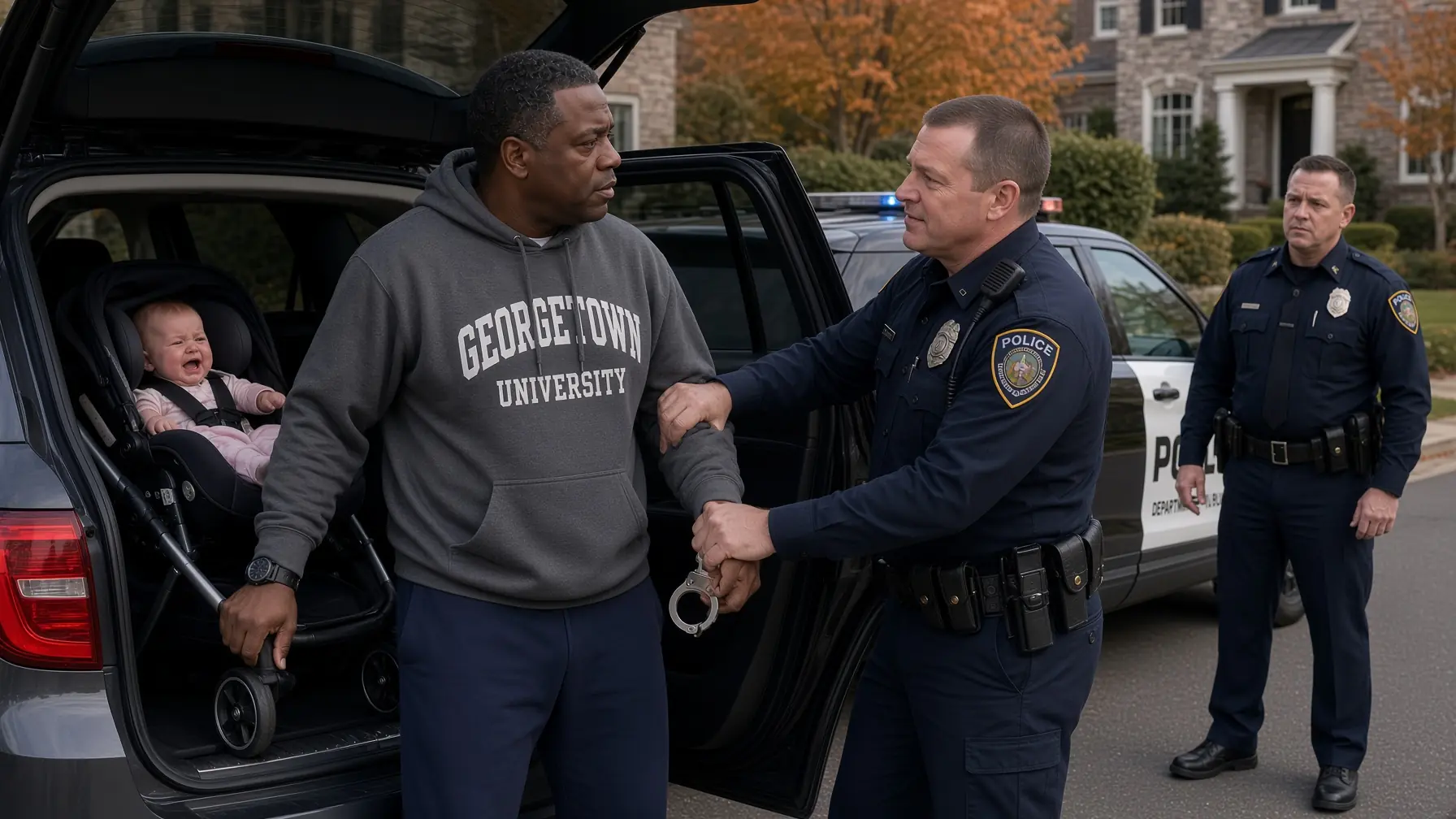
David Thompson heard the short burst of the siren behind him just as the baby stroller finally collapsed.
For almost ten minutes, the thing had refused to fold.
David had pushed one latch.
Pulled another.
Twisted the handle.
Muttered words he would never have allowed anyone to use in his courtroom.
Then, finally, the frame snapped into place.
“Victory,” he whispered.
Eight-month-old Chloe screamed from the back seat of his charcoal-gray Audi Q7 as if she strongly disagreed.
“I know, sweetheart.”
David lifted the stroller into the cargo area.
“Grandpa is clearly not qualified for modern engineering.”
That was when the police vehicle stopped at an angle behind him.
Red lights flashed against the white stone mailbox.
David turned.
The street was otherwise quiet.
Late October.
Tuesday afternoon.
Oakridge Estates.
A neighborhood of large homes, mature oaks, stone entryways, professional landscaping, and the particular silence that came from people paying enough money to live far from traffic.
Two officers got out.
The driver was a broad-shouldered white man in his early forties.
Officer Brian Mitchell.
Fifteen years on the department.
His partner, Officer Aaron Cole, was younger.
Maybe thirty.
Mitchell’s hand rested near his holster before he had taken three steps.
“Sir.”
David looked around once.
There was nobody else near the driveway.
“Me?”
“Step away from the vehicle.”
David frowned.
Behind him, Chloe cried harder.
He kept both hands visible.
“My granddaughter is in the back seat.”
“Step away from the vehicle.”
David did.
The stroller remained half inside the cargo area.
Mitchell moved closer.
“Whose car is this?”
“Mine.”
“Whose house?”
“My daughter’s.”
Mitchell glanced toward the front door.
Then toward the child in the back seat.
“Identification.”
David studied him for half a second.
“Can I ask what this is about?”
Mitchell’s expression tightened.
“I asked for identification.”
David had spent thirty years listening to people answer questions with questions.
Sometimes it meant avoidance.
Sometimes confusion.
Sometimes fear.
And sometimes it meant a person wanted to know why the government was demanding something from him.
Those were not the same thing.
David said:
“My wallet is in my right pocket.”
“Take it out slowly.”
David did.
Officer Cole remained several feet behind Mitchell.
His eyes kept moving between David, the Audi, and the house.
David removed his driver’s license.
Mitchell took it.
He looked at the name.
DAVID JEROME THOMPSON.
Then at David.
“Stay here.”
“I wasn't planning to go anywhere.”
Mitchell stopped.
“Don't get smart.”
David did not answer.
That was the moment he began paying closer attention.
Not because he was frightened yet.
Because the officer had stopped gathering information and started interpreting everything as resistance.
David knew that pattern.
He had watched it happen in court hundreds of times.
A person asked a question.
Someone in authority disliked the tone.
The disagreement became the evidence used to justify escalation.
Mitchell stepped toward the back door of the Audi.
David immediately said:
“Please don't open that door.”
Mitchell turned.
“Why?”
“My granddaughter is secured in a rear-facing car seat, and she's already frightened.”
“You said she’s your granddaughter.”
“She is.”
“We'll determine that.”
David’s eyes narrowed.
“Based on what?”
Mitchell looked at him for a moment.
Then:
“We received a call about a suspicious male removing property and possibly a child from this residence.”
David stared.
“Removing a child?”
“Yes.”
“That's my granddaughter.”
“You already said that.”
“And my daughter is inside.”
“Then we'll verify it.”
“Please do.”
Mitchell waited.
David gestured slightly toward the front door.
“Knock.”
Mitchell did not move.
That was the first thing David would remember later.
Not the lights.
Not the command.
Not even the threat of handcuffs.
The fact that the easiest verification in the world was twenty-five feet away—
and Mitchell seemed uninterested in it.
Twenty minutes earlier, a woman named Margaret Ellis had been walking her terrier two houses down.
Margaret had lived in Oakridge Estates for eleven years.
She knew most of the homeowners by sight.
Not all of them.
Sarah Thompson had moved into the neighborhood four months earlier after accepting a senior accounting position with a regional health company.
Margaret knew there was a woman living in the house.
She had seen Sarah twice.
She had never seen David.
So when Margaret saw a Black man in a gray hoodie standing beside an SUV, wrestling with a stroller while an infant cried inside the vehicle, she stopped.
She watched.
David opened the cargo hatch.
He loaded the stroller.
Then leaned briefly into the rear passenger area to check Chloe’s car-seat strap.
Margaret pulled out her phone.
The dispatcher later documented the conversation carefully.
“Do you see a weapon?”
“No.”
“Is anyone asking for help?”
“No.”
“Did you see him force entry into the home or vehicle?”
“No, but I don't think he lives there.”
“What makes you believe a crime is occurring?”
Margaret hesitated.
“I’ve never seen him.”
The dispatcher asked:
“Is he attempting to leave with the child?”
“He’s loading things.”
“Do you know whose child it is?”
“No.”
“Do you know whose vehicle it is?”
“No.”
Margaret then said the sentence that changed the tone of the call.
“I just think somebody should check.”
That should have meant exactly what it said.
Check.
Ask.
Observe.
Verify.
Instead, by the time the call reached Mitchell’s cruiser, it had become:
Suspicious person. Possible theft. Possible child-related concern.
Not an abduction.
Not a confirmed crime.
A concern.
But Brian Mitchell heard possibility and arrived prepared for certainty.
David stood beside his Audi with his hands visible.
Chloe continued crying.
Officer Cole finally spoke.
“Sir, what’s your daughter’s name?”
“Sarah Thompson.”
“Phone number?”
David gave it.
Cole stepped aside and began transmitting information.
Mitchell looked at David’s license again.
“Your address isn't here.”
“No.”
“So you don't live here.”
“I never said I did.”
“You said it was your daughter’s house.”
“It is.”
Mitchell glanced toward the property.
“You have proof?”
David looked at the officer.
“Proof my daughter lives in her own house?”
“Proof you have permission to be here.”
David almost laughed.
Not because it was funny.
Because sometimes an absurd question arrived dressed in official language and demanded more dignity than it deserved.
He stopped himself.
“My daughter is twenty-five feet away.”
Mitchell’s jaw shifted.
“I told you we'll handle verification.”
“Then verify it.”
“You need to stop telling me how to do my job.”
David became still.
Officer Cole looked over.
The phrase had changed the atmosphere.
David recognized it immediately.
It was no longer:
What happened here?
It was:
Who controls this interaction?
That was dangerous.
David said:
“I am not interfering with your work.”
Mitchell stepped closer.
“You're being argumentative.”
“No. I'm answering.”
“You're refusing simple instructions.”
“I gave you my identification.”
“And now I'm asking you to stand over there.”
He pointed toward the cruiser.
David looked at Chloe.
“No.”