An old woman leans into a courtroom microphone. Her hands are folded. Her collarbone is broken. Her voice is steady as stone.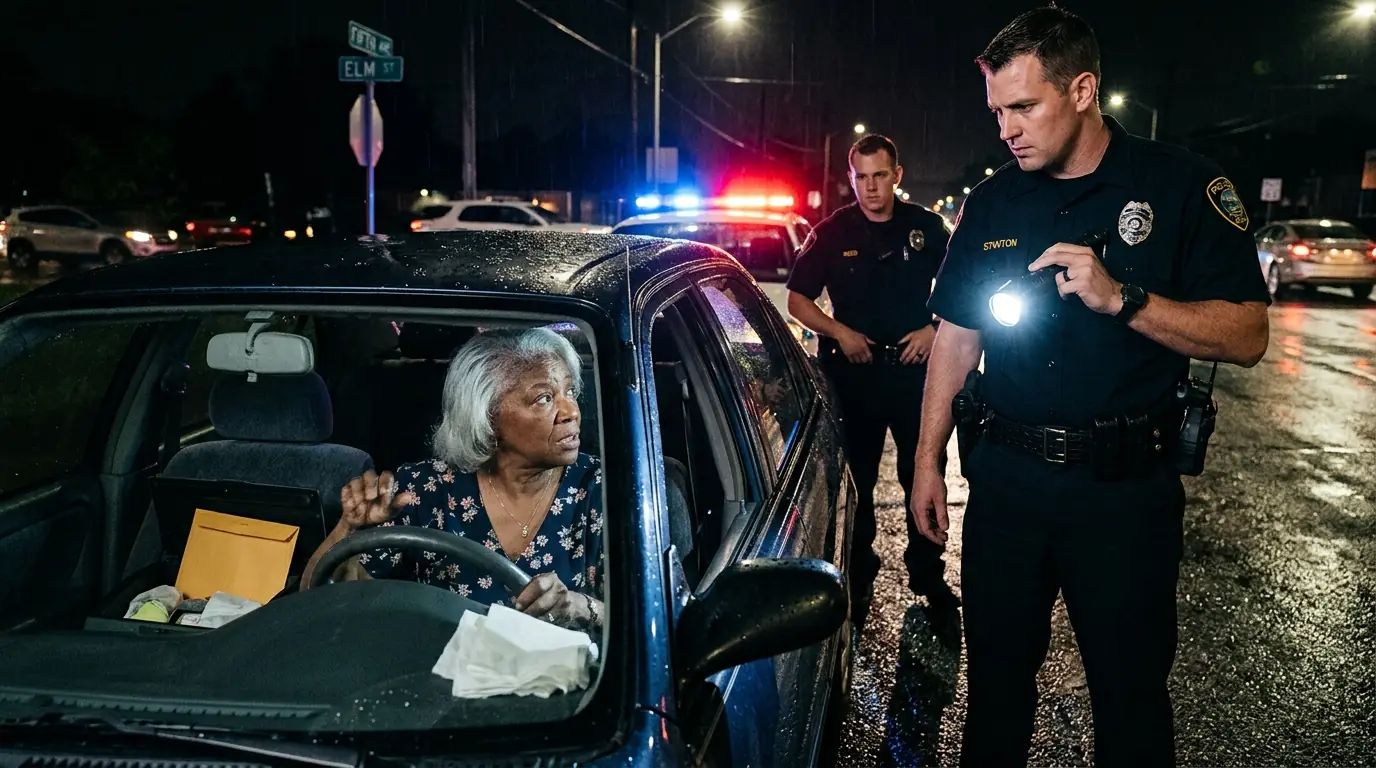
Across the aisle, two police officers refuse to meet her eyes. In the back row, silent and still, sits her son—a soldier trained to kill, watching, waiting, calculating. Nobody in that courtroom knows yet what waits beneath his calm. But before this day ends, badges will fall, lies will crack, and one phone call from a jail cell will decide who truly rules this city.
Courtroom 302 smelled of old wood and stale coffee. Fluorescent lights buzzed overhead, casting a pale yellow glow across rows of worn oak benches. A gavel had already struck once that morning, and the room still held its breath.
An aluminum cane tapped against the linoleum floor: tap, pause, drag. Beatrice May Hayes moved slowly toward the witness stand. She was 72 years old, with a halo of silver-white hair and a faded navy dress dotted with small white daisies. Long sleeves hid the dark bruises on her wrists. A thin cardigan hid the brace holding her shattered collarbone in place.
The bailiff reached out to help her up the single step. She ignored his hand, gripped the oak railing with her good arm, and pulled herself up alone. The leather chair groaned as she sat.
"State your name for the record," said Judge Wallace, his voice dry with fatigue.
She leaned toward the microphone. "Beatrice May Hayes."
Her voice did not shake. It was gravel and dust, smoothed by decades of choir practice and raising four sons.
At the prosecution table, District Attorney Robert Clark rose. His tie was slightly crooked, his files a mess, but his eyes were sharp. "Mrs. Hayes, thank you for being here. I know this is difficult."
"It's only difficult because I'm sitting down," she replied flatly. "My back..."
Jurors smiled. The two men at the defense table did not. Officer Thomas Stanton sat like carved stone, his eyes fixed just above her head. Officer David Reed's leg bounced beneath the table, a nervous, invisible rhythm.
In the back row of the gallery, apart from the murmuring crowd, sat a man in a charcoal suit. He had not moved since the trial began. His posture was perfectly straight, his hands flat on his thighs, his eyes dark and unreadable, fixed on Stanton. His name was Jackson Hayes, and he was listening to every word.
"Let's go back to the evening of August 14th," Clark said, pacing slowly in front of the jury box. "You were driving home from Mount Zion Baptist Church."
"Yes, Tuesday is Bible study."
"You were pulled over at the corner of Fifth and Elm. Did you know why?"
"No. I don't speed. I don't run lights. I thought maybe my taillight had gone out again. It's a '98 Corolla. Things break."
Clark flipped open a manila folder. "The officers approached your vehicle. What happened next?"
Beatrice took a slow, measured breath. A brief flash of pain crossed her face before she smoothed it away. She pointed a stiff finger across the aisle.
"The tall one came to my window. He shined a very bright flashlight into my eyes. I asked him to lower it so I could see. He didn't. He told me to keep my hands on the wheel. I did. Then he asked for my license and registration. I told him exactly what I was going to do. I said, 'Officer, I'm going to reach over to the glove box now.' That's what my husband taught our boys: announce your movements."
At the defense table, William Bradley clicked a silver pen, calculating his cross-examination, hunting for cracks in her memory.
"I leaned over," Beatrice continued, her voice dropping, losing its conversational ease. The courtroom seemed to lean with her. "The latch on the glove box is sticky. You have to pull it hard. I tugged it. It popped open. Some napkins fell out. I reached inside for the yellow envelope with my papers."
She stopped. The silence stretched, filled only by the hum of the air conditioning.
"Take your time, Mrs. Hayes," Clark said gently.
Beatrice looked directly at Stanton. "I didn't hear him tell me to stop. Maybe he did. My hearing isn't what it used to be. The next thing I knew, the driver's door was yanked open. A hand grabbed a fistful of my hair. Not my shirt—my hair."
A juror in the front row raised a hand to her mouth.
"I was pulled out of the car. I hit the pavement. It was wet. It had rained that afternoon." Beatrice looked down at her folded hands. "Someone put a knee in my back. I couldn't breathe. I told them I couldn't breathe. Then my arm was pulled up behind my shoulder."
She touched her collarbone, right over the brace.
"I heard it snap before I felt it. Sounded like stepping on a dry branch."
In the back row, Jackson Hayes did not move. But his heart rate, steady and disciplined, dropped to 55 beats per minute—the pulse of a man who had trained his body to go calm exactly when the world demanded chaos.
"Your Honor," Clark announced, "the state moves to enter Exhibit C: the body camera footage from Officer Stanton."
"Objection," Bradley said, rising. "The footage is highly prejudicial. The angle is distorted, and the audio is corrupted for the first thirty seconds."
"Overruled," said Judge Wallace without looking up. "The jury will decide what it reflects. Play the tape."
A technician wheeled a flat screen to the center of the floor. The lights dimmed. The timestamp blinked to life: 21:43:12.
The camera bobbed with Stanton's heavy footsteps approaching the old Corolla. A flashlight beam washed the screen white, then black.
"Keep your hands on the wheel!" Stanton's voice barked, loud and adrenalized.
A frail silhouette sat behind the wheel.
"License and registration!"
"They're in the glove box," came a faint, familiar voice.
"Hey, keep your hands where I can see them!" Stanton yelled on screen.
Beatrice was pulling at the stuck latch.
"Show me your hands!"
The door was yanked open with a violent metallic screech. The footage lurched into chaos—shouting, the rustle of fabric, a hand clamped down on gray hair.
"Gun! She's reaching!" That was Reed's voice, panicked, from the passenger side.