To understand Harrow Creek, you have to understand what it looked like before Cordell Delam arrived. In the spring of 1882, it had been a decent town. Not prosperous, not growing fast, but decent in the way that frontier towns occasionally managed to be decent. It had a functioning marshal's office, a schoolhouse with actual children in it, a weekly church service that most of the population attended, and a water-rights agreement that kept the small ranchers and homesteaders from killing each other over the Redstone Creek tributaries that fed the valley.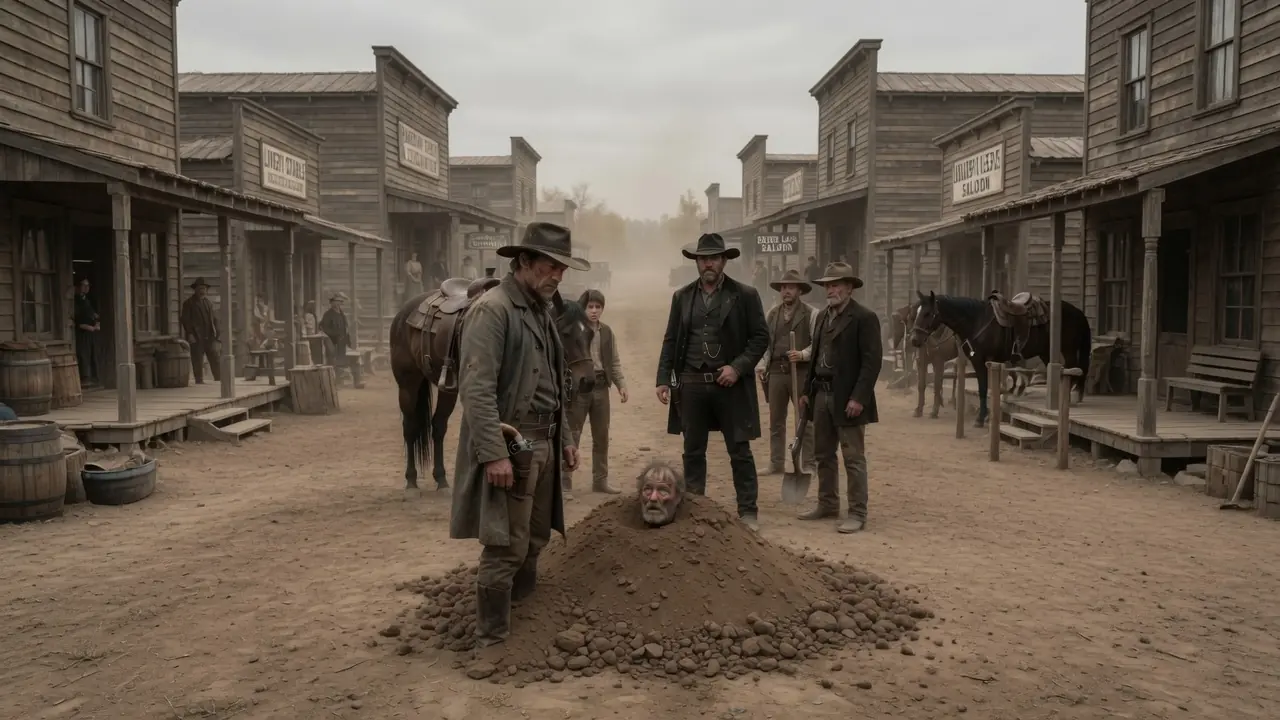
The town had a marshal named Eugene Pratt who had held the badge for 11 years without disgracing it. He was a compact, quietly stubborn man of 54 with a gray beard and bad eyesight, and the specific, durable courage of someone who had never once considered that the job might not be worth doing. Cordell Delam arrived in July of that year. He came representing the Southwestern Grazing Combine, a land consortium financed by cattle money out of Fort Worth and railroad speculation money out of Kansas City, and he came with paperwork, which was how men like Delam always came first. The paperwork concerned the Redstone Creek water rights.
The combine's lawyers had found an irregularity in the original territorial land grant, an ambiguity in the survey boundary lines that interpreted a certain way placed the primary irrigation tributary under the jurisdiction of a parcel that the combine had recently and quietly purchased from a bankrupt homesteader. Interpreted that certain way, every small rancher in the Harrow Creek Valley was drawing water they no longer had legal right to draw. Marshal Pratt had read the paperwork. He had sent for a territorial judge. The judge had taken 3 months to arrive and had, upon arrival, reviewed the documents and declared the combine's interpretation plausible pending further survey.
He had then written back to Santa Fe, leaving the valley in a legal twilight that favored whoever was willing to apply the most pressure. Cordell Delam was very willing. He was 38 years old, broad through the chest and narrow through the eyes, with a thick dark beard kept trimmed short and close, and hands that were large enough to suggest he had done physical work somewhere in his past before he had learned that other men's physical work was more profitable than his own. He wore a good coat, carried a .44-caliber Smith & Wesson Model 3 in a cross-draw holster on his left hip, and moved through a room with the particular unhurried authority of a man who has never once in his adult life walked into a situation he wasn't confident he could control. He had brought three men with him—not gunslingers in the theatrical sense, but working men who were experienced, cold, and practically violent.
The first was a former buffalo hunter named Tate, who was missing two fingers on his left hand and still shot accurately with the right. The second was a border enforcer named Cass, who had spent four years removing Mexicans from land that Texas cattle interests wanted and had developed a specific, clinical expertise in applying just enough violence to achieve compliance without triggering federal attention. The third was a young man named Doby, who did not have a history worth speaking of yet but had the flat, eager eyes of someone actively building one. Within two weeks of their arrival, three homesteaders had signed over their water access agreements. They had not done it because they wanted to, but because Tate and Cass had visited each of them after dark and explained the alternative with the measured, professional clarity of men who had explained alternatives before and knew exactly how much detail was required.
Marshal Pratt had ridden out to the third homesteader's place the morning after the visit, and found the man sitting on his porch in the pre-dawn dark with a lantern and a rifle, and the expression of someone who has made peace with a decision he didn't choose. The homesteader had told him what happened. Pratt had ridden back to town. He had written a detailed report. He had sent it to the territorial marshal's office in Santa Fe.
He had received, six weeks later, a letter informing him that the matter was under review. He had written three more reports. Each one went unanswered. On a Tuesday morning in September, Pratt had ridden out to Delam's temporary headquarters, a large tent camp he had established on the combine's newly claimed parcel, and had informed Delam formally and in writing that he was opening a criminal investigation into the coercion of the valley's homesteaders, and that Delam's men were to cease contact with any Harrow Creek resident until the investigation was resolved. Delam had read the document.
What they had done to Eugene Pratt over the following hour was thorough and deliberate and designed to communicate a specific message not only to Pratt but to anyone in Harrow Creek who might be considering whether the marshal's badge still meant anything. They had broken his right hand. They had broken two ribs. They had taken his badge and his service revolver and left him on the office floor with a note that read, in Delam's precise handwriting, that the combine regretted any misunderstanding and hoped the marshal would take the time to reconsider the scope of his jurisdiction. Pratt had dragged himself to Doc Alderman's surgery.
Doc Alderman had set his hand and bound his ribs and told him in a low, careful voice that he had a wife and two daughters and could not in good conscience testify to anything he had or hadn't seen that night. Pratt had understood. He had gone home. He had spent three days in bed and on the fourth day he had gotten up, pinned a spare badge to his shirt with his left hand because the right was splinted and useless, and walked back to his office. Delam had watched from across the street with something approaching respect.
That respect had lasted four days until Pratt had ridden out to the valley's largest remaining independent rancher, a widow named Clara Marsh, who ran 300 head on land her husband had broken before he died, and had told her what was coming and advised her to get her title documents in order and contact a lawyer in Santa Fe before the combine's paperwork reached the territorial court. Clara Marsh had thanked him. She had gone inside. She had written three letters. Delam had found out about the letters within 48 hours.
He had come to the marshal's office himself that time. What happened in that office was not witnessed by anyone because Delam had sent Tate to stand outside the door and Cass to cover the alley window. What was witnessed at approximately 9:00 in the morning on the first Monday of October was Cordell Delam and his three men walking across the Harrow Creek town square with shovels, leading Marshal Eugene Pratt—bound at the wrists and ankles with rope—to the center of the square, where the old well had been filled in the previous spring. They had dug for 40 minutes while the town watched from behind curtained windows and locked doors. Then they had put Eugene Pratt in the ground up to his neck.
Then they had continued. Delam had addressed the town from the center of the square while his men worked in the same measured patient voice he used for everything. He had explained that the previous arrangement, wherein the town of Harrow Creek had operated under the illusion of independent legal authority, was being revised. He had explained that the Southwestern Grazing Combine was prepared to be a constructive and generous partner to the valley's remaining residents, provided those residents understood the nature of the partnership clearly. He had explained that Marshal Pratt had been an obstacle to that understanding and was being removed from his position and that any resident who felt strongly about this was welcome to present their concerns in writing to the Combine's regional office in Fort Worth.
He had said all of this while Pratt's face was still visible above the earth, dirt to his chin, eyes open and steady in a way that cost him everything he had. Then Delam had nodded to Tate. Then there was only dirt. The town of Harrow Creek had not moved, had not spoken, had stood behind its glass and its wood and its locked doors and watched the law of the territory get buried alive in its own town square while three men with shovels laughed and a fourth in a good coat checked his pocket watch. This was the reality of Harrow Creek on the morning the stranger rode in.
Nobody saw him arrive. That was the first thing people would note later when they tried to reconstruct the sequence of events for the territorial inquiry. One moment, the square was empty except for Delam, his men, the raw earth, and the sound of laughter. The next moment there was a rider at the eastern edge of the square on a dark bay gelding sitting in the saddle with the stillness of something that had always been there like a fence post or a shadow. He was unremarkable.
That was the second thing people noted. He wore a canvas duster, road-gray with dust. Battered hat with a cracked brim pulled low. Plain dark holster tied to his right thigh with frayed rawhide. No silver, no ornamentation, nothing that announced anything.
He was a man who looked, at first glance, like a hundred other men who passed through small frontier towns without leaving a mark. That was only at first glance. Vera Stubfield who ran the dry goods store and was watching through the gap in her window shutters would tell the territorial inquiry that she had noticed his horse first. It was standing absolutely still in a way that horses simply did not stand. It did not shift its weight, move its head, or react to the sounds of the square.
She had seen horses trained for cavalry work and horses trained for cutting cattle and horses that had been gentled by patient men over long years. She had never seen a horse that stood like that horse stood. Like it was waiting for a specific signal and would not move until that signal came. Old Harlan Pike, who had driven freight across the territory for 30 years and was sitting on the bench outside the farrier's shop because he had nowhere else to be, noticed the stranger's hands resting on the saddle horn. They were large and heavily calloused, and across the backs of both hands were the faded, specific scars that black powder left on skin after years of sustained, frequent use.
The scars did not come from one gunfight. They did not come from 10. They were the kind of scars that came from a life measured in rounds fired. Pike had put his back against the farrier's wall and slid down to sit on the ground. Delam noticed the stranger at the same moment his boot came down on the fresh earth and something shifted beneath it.
He looked across the square at the rider. His expression did not change. He had the specific confidence of a man who had never encountered a problem that patient application of force had not resolved. He assessed the stranger with the brisk, professional attention of someone evaluating a new variable rather than a threat. "That's enough," the stranger said, the two words quiet as a closing door.
They carried across the square not because they were loud, but because the quality of silence around them made them land like stones in still water. Delam's hand rested on the wooden grips of his Smith & Wesson. He was not drawing it, only resting his hand there. It was the comfortable proximity of a man who had never once been wrong about his ability to draw it when needed. "This is private combine business, friend," he said.
"Ride on." The stranger didn't ride on. He dismounted. He stepped away from the horse with the same unhurried deliberateness with which he apparently did everything. He walked to the edge of the square and stopped.
Tate, 20 feet to Delam's right, shifted his weight. Cass, near the far edge of the mound, set down his shovel. Doby, the youngest and most eager, let his hand drop toward the Colt on his hip. Delam studied the stranger for 3 long seconds. He was good at reading men.
It was one of the things that had made him effective at what he did. He read posture and eye movement and the microscopic signals of elevated fear response that men who were frightened tried to suppress and never entirely succeeded at suppressing. He looked for the tells, the held breath, the shoulder tension, the over-careful stillness of a man trying to appear calmer than he was. He found none of them. The stranger was looking at the mound of earth in the center of the square, not at Delam, not at Tate or Cass or Doby, at the earth.
He studied it with the focused, assessing attention of a man calculating something specific. "One man in the ground," the stranger said, still not looking at Delam. "Three shovels. Which one of you wants to use his?" The question was delivered in the same flat factual tone someone might use to ask the price of grain.
It was not a taunt. It was not bravado. It was a man stating the available options and waiting for the relevant party to select one. The silence that followed it had a physical weight. Doby broke first.
He was young and eager, and he had been building a history; this was the moment history got built. His hand came up with his Colt in a motion that was fast for his age and experience, which meant it was fast enough to impress people who had never seen fast. The stranger's draw was not a draw. It was a clarification. The worn Colt cleared the frayed rawhide holster and pivoted at the wrist in a single motion so economical it appeared to cost nothing.
The shot came before Doby's hammer had fallen, before the barrel had fully leveled, before the young man's mind had finished the thought his body had started. The bullet struck the Colt's frame and knocked it out of Doby's hand. It was not by accident, but by the cold arithmetic of a man firing at a target he could see clearly from 30 feet and who was not in any particular hurry. Doby's gun hit the dirt. Doby looked at his hand.
His hand was intact. He did not understand this for a full 3 seconds. Tate moved. Tate was not young and not eager. Tate was experienced and cold and had been in this specific situation enough times to know that the moment the first shot was fired, the geometry of everything changed.
He moved left away from the line bringing his rifle to bear in the way a man brings a rifle to bear when he has done it 10,000 times and the motion is below the level of thought. He was fast. The stranger was already moving, not away, toward the angle closing the distance on Tate's side in three deliberate steps that changed the geometry back. When Tate's rifle tracked to find him, the barrel was close enough for the stranger's left hand to find the forestock and push it a precise six inches to the right. The shot Tate fired went into the dirt between them, and then the stranger's right hand pressed the barrel of the Colt against the underside of Tate's jaw with the calm specificity of a man placing a tool exactly where it needed to go.
Tate became very still. "On the ground," the stranger said. Tate went to his knees, then to his face, then his hands were flat in the dirt and he did not move. Cass was the last variable. Cass was the most dangerous variable which the stranger already knew from the way Cass had been standing since the beginning, slightly behind the mound, slightly to the angle, in the specific position that a man who understands geometry takes when he is waiting for the chaos to settle before he applies his own solution.
Cass had his revolver drawn and leveled and from his position he had a clear line in the specific cold composure of a man who is not surprised by anything that had happened in the last 90 seconds and was ready to end the equation on his own terms. They looked at each other across the fresh earth. "You're good," Cass said, and meant it without admiration. "Step away from the mound," the stranger said. Cass did not step away.
He was calculating. His shot was clear. The stranger's Colt was pointed at Tate's back, which meant in order to address Cass he would have to change his angle, which would take time, which was Cass's window. It was a real window. Cass had worked with worse.
"He's already dead," Cass said, meaning the man under the dirt. "You shoot me, my finger pulls this trigger. You lose both of us." "No," the stranger said. The word was not defiant.
It was not challenging. It was the quiet absolute correction of a man who has run the same calculation and arrived at a different answer and is sufficiently certain of his answer that the other man's answer is simply incorrect. Cass pulled his trigger. At the distance between them, the sound of the Colt's cylinder rotating was audible in the silence of the square. The hammer came back.
The firing pin traveled. The revolver misfired. It could have been a defective primer. It could have been a damp cartridge—the specific, arbitrary cruelty of machinery in a dry country where men oiled their weapons carefully and the desert still found ways in. Such failures happened.
They happened rarely and randomly, without regard for whom they happened to or when. Cass pulled the trigger again. The hammer fell on the next chamber. The stranger had covered the distance between them in the time it took Cass to pull the trigger a second time. The Colt's barrel connected with the inside of Cass's wrist with the precise, localized force of a man who knew exactly what he was breaking and broke only that.
The revolver dropped. Cass's right hand stopped working. The stranger put Cass on the ground with the flat efficiency of someone completing a task. Then he turned to Cordell Delam. Delam's Smith & Wesson was drawn.
It had been drawn since the second shot. He was not a coward. He was not a fool. He had watched three competent men be neutralized in the time it took most gunfights to produce their first casualty. He stood in the center of the town square with his weapon out and his hand steady because he was the kind of man who stood his ground when the ground was worth standing on.
He was also standing in front of the mound of fresh earth that contained Eugene Pratt. "You work for someone," Delam said. His voice was controlled. "The combine has enemies. Who sent you?"
The stranger looked at the mound. "Get the marshal out," he said. Four words. "Who sent you?" Delam said again.
The stranger looked at him then directly. The thing in his eyes that Delam saw was what every man who had ever looked into them described the same way afterward. Not rage, not hatred, not the hot unstable violence of a man who has lost control of something. It was the cold, absolute patience of a man working through a list, arriving at the relevant item, and intending to complete it. "Nobody sent me," the stranger said.
"I was passing through." Delam understood in that moment with the specific clarity of a man who has spent his adult life reading situations accurately that the stranger was telling the truth. He had ridden into Harrow Creek on his way somewhere else, seen what he had seen, and said two words; everything had followed from those words with the inevitability of water finding its level. He also understood that his Smith & Wesson was pointed at a man who had just put down three competent professionals in 90 seconds and was standing 10 feet away looking at him with the expression of someone waiting for a simple thing to happen. Delam lowered his weapon.
He put it on the ground. He walked to the mound and began to dig with his hands because all three shovels were on the ground near men who were not getting up and because there was nothing left to say and nothing left to calculate and the architecture of everything he had built in Harrow Creek had come down in the last 2 minutes and he understood it completely. It took 7 minutes to uncover Eugene Pratt. Pratt came out of the earth coughing, eyes clenched against the light, wrists still bound, breathing in the ragged, desperate way of a man who has been very close to not breathing at all. Two townspeople who had emerged from their buildings crossed the square and helped him to the surface and cut the rope from his wrists.
Pratt sat in the dirt for a long moment just breathing. Then he looked up. The stranger was standing at the edge of the square beside his horse, not watching Pratt or Delam, who sat in the dirt near the mound with the empty expression of a man whose certainties had been removed faster than he could replace them. The stranger was looking at the eastern road, the direction he had come from, which was also the direction he intended to go. Pratt pushed himself to his feet.
His right hand was still splinted, his ribs still bound. He walked across the square on legs that were not yet reliable and stopped in front of the stranger. He looked at the worn coat, the frayed rawhide, the dust-gray duster, the hat pulled low over eyes that were already looking somewhere else. "You got a name?" Pratt said.
The stranger put his boot in the stirrup. "Keep it," the stranger said. The last words he spoke in Harrow Creek, two words that meant nothing and everything, which was the way his words always worked. He mounted. He turned the bay gelding east.
He rode out of the square at a walk without looking back, without adjusting his pace, and without any of the behavior of a man who had done something worth remarking on. The dust his horse raised settled slowly in the dead air of the square. Eugene Pratt stood where he was for a long time after the rider disappeared. He stood with the late morning sun on his face and the taste of dirt still in his mouth and the specific, overwhelming feeling of a man who has been underground and come back into the light and is not yet ready to move. Around him, Harrow Creek was emerging from behind its locked doors and curtained windows with the tentative, blinking quality of a town that has been holding its breath for weeks and has just now been given permission to exhale.
Doc Alderman came across the square with his bag. Two ranchers from the valley arrived 20 minutes later, having seen something or heard something, and stood at the edge of the square looking at Delam and his men on the ground and Pratt standing in the center of it all with his badge and his splinted hand. The Southwestern Grazing Combine's regional director received a telegram from Delam 3 days later. It was brief. It said that conditions in Harrow Creek had changed and that the water rights acquisition strategy required reassessment.
It did not explain what had changed the conditions. It did not name the man who had changed them. There was no name to give. The Territorial Marshal's office in Santa Fe received a report from Eugene Pratt 6 days after the event. The report described the events accurately and completely.
It named Delam and his men. It described the charges. It noted that the resolution of the immediate situation had been provided by an unknown traveler passing through the territory. The description was consistent with a man on a dark bay horse in a canvas duster; no name had been obtained, and his direction of travel was east. The territorial marshal had read that description and had sat for a while with the report on his desk.
He had heard descriptions like it before, from two other towns, two other situations, two other moments when something that should have been insurmountable had been resolved by a quiet man nobody had sent for and nobody could find after. He filed the report. He wrote a note to himself that he put in a drawer and did not share with anyone because there was nothing useful to do with it. The note said, "He's moving east." Harrow Creek repaired its town square over the following week.
The ground where the mound had been was leveled and packed and eventually rained on until it was indistinguishable from the rest. Eugene Pratt's right hand healed slowly, the way broken hands heal—imperfectly and with lasting limitations—but he kept the badge and the office, and the three homesteaders who had signed over their water access got it back when the combine's lawyers, facing an actively hostile territorial inquiry, decided the Redstone Creek water rights were not worth the liability they had become. The fourth homesteader was Clara Marsh, who had never signed anything and whose letters had reached Santa Fe and whose 300 head of cattle were still on her land when the summer ended. She would tell the story of that Monday morning in October for the rest of her life, not because she had seen it from the best angle or remembered the most details, but because she had been standing at her window when the stranger rode past her property at dawn, before he reached town, and had looked at his face in the early light. She said he had looked tired, not the tired of a man who needs sleep, the tired of a man who has been doing something for a very long time and is not yet close to done and has made his peace with that.
She said he had not looked at her. She said she had been glad of it. The legend of the nameless gunman is not the legend of a fast draw or a brilliant tactician or a man transformed by grief into something mythological and complete. It is the legend of a man moving through a territory doing a specific thing in a specific way and then moving on, leaving behind only the consequences and the questions. What was he riding toward?
What was he riding from? How many towns between here and wherever he was going still needed what Harrow Creek needed? Nobody ever got to ask him. He was already gone.