In an age where a lady’s worth is measured by the grace of her curtsy and the silence of her tongue, Elara Vance has committed the ultimate impropriety. She has built a mind of brass and logic that can outthink any man in Mayfair. When she brings her mechanical marvel before the icy, formidable Marquis of Halifax, she expects a battle of wits. But she doesn’t count on the sudden, dangerous friction of two souls recognizing their match in the high-stakes game of the tongue, where a single misstep is ruin. Can a clockwork heart teach them both how to feel?
The air in the library of Halifax House was thick with the scent of old leather, expensive brandy, and the stifling invisible weight of masculine skepticism. Elara adjusted the lace at her throat, a feminine frippery she despised, yet a necessary camouflage, and felt the damp heat of her palms. Outside, a London drizzle streaked the window panes like tears, but inside the fire crackled with an almost mocking cheer. Before her sat the Iron Strategist. It was a marvel of mahogany and polished brass, a seated figure dressed in silk robes of midnight blue, its articulated hand poised over a checkered board of ivory.
It was a toy. To Elara, it was five years of midnight oil, scarred fingertips, and a defiance of every social law that sought to keep her tethered to a needle and thread. “It is a charming diversion, Miss Vance,” Lord Halifax said, his voice a low, resonant cello that seemed to vibrate in the very marrow of her bones. Julian Ashwood, the Marquis of Halifax, leaned against the mantelpiece with a grace that felt predatory. He was a man of sharp angles and colder eyes, a face carved from flint, softened only by the dark, unruly wave of hair that defied his valet’s best efforts.
He did not look like a man who enjoyed diversions. He looked like a man who dismantled them. “It is not a diversion, my lord,” Elara replied. Her voice stayed steady despite the frantic thrumming in her throat. “It is an analytical engine. It does not merely move pieces. It calculates probabilities. It anticipates.” One of Halifax’s dark brows arched. “You suggest that a collection of springs and escapements can mimic the intuition of a seasoned player. I have spent my life over these boards, Miss Vance. Chess is a game of souls, not just geometry.”
“Then perhaps you should test its soul,” she countered, the spark of his arrogance igniting her own pride. “Unless, of course, the Marquis of Halifax is afraid of being checkmated by a lady’s toy.” The silence that followed was brittle. She saw the flash of something in his gaze, not anger, but a sudden piercing interest that felt like a physical touch. He straightened, the movement fluid and dangerous, and crossed the room to the chair opposite the automaton.
“Very well,” he murmured, his eyes locked on hers rather than the machine. “Let us see what your mind has birthed.” The match began with a deceptive simplicity. Elara turned the silver key in the Strategist’s side, a rhythmic clack-clack filling the room, and the machine’s hand descended with a precision that made Halifax’s pupils dilate. The brass fingers gripped a pawn and moved it to King’s Four.
For the next twenty minutes, the only sounds were the ticking of the grandfather clock and the occasional sharp slide of ivory on wood. Elara watched Halifax’s face. She watched the way his jaw tightened when the machine blocked his Sicilian defense, the way his long, elegant fingers hovered over his knight, and the subtle, fascinating crease that appeared between his brows when he realized he was being pressed. He was not just playing the machine. He was trying to solve her.
“I find I am beginning to believe you are capable of many things I had previously deemed impossible,” he said, and the intensity of his stare sent a shiver of heat down her spine that had nothing to do with the hearth. The door to the library swung open with a jarring lack of ceremony, breaking the spell. Sir Clive Sterling entered, his damp greatcoat smelling of wet wool and ambition. Clive was a man of loud waistcoats and louder opinions, a perennial fixture of the Royal Society, who viewed Elara’s father’s legacy as his own inheritance.
“Halifax, I heard the rumors, but I had to see this monstrosity for myself,” Clive boomed, ignoring Elara as he hovered over the board. He looked at the position of the pieces and hissed through his teeth. “Incredible. The internal gearing must be inspired by von Kempelen’s designs, though significantly more compact.” He turned to Elara then, his smile not reaching his small, greedy eyes. “Miss Vance, your father would be… well, he’d be surprised. This is far too complex for a lady to maintain. The delicacy of the escapements alone… it’s a liability in the wrong hands.”
“I assure you, Sir Clive, I am quite capable of maintaining my own inventions,” Elara said, her hand tightening on the back of Halifax’s chair. “Be that as it may,” Clive stepped closer, his presence oily and intrusive. “The Royal Society would never grant a patent to a woman. You’ll be tied up in litigation for a decade. Sell it to me. I’ll give you five hundred pounds, a fortune for a woman in your position, and I’ll ensure the Vance name is mentioned in the footnotes of my presentation.”
“Footnotes?” Elara’s voice went cold. “You wish to buy my mind and relegate it to a margin.” “I am offering you a way out of the shadows,” Clive said, his tone patronizing. “Think of your reputation. A lady who spends her time in a workshop with grease under her nails. It’s hardly the stuff of a good marriage.” Halifax stood up then, his height suddenly making the room feel much smaller.
He moved to stand beside Elara, not touching her, yet the proximity felt like a shield. “The lady has already declined, Sterling,” Halifax said, his voice like grinding ice. “And I find your presence in my library, uninvited, to be a significant distraction to my game.” Clive flushed a deep mottled red. “I only meant to assist. The machine is a target, Halifax. There are those who wouldn’t be as polite as I am in their acquisition.”
“I shall take my chances,” Elara said, her chin lifted. As Clive retreated with a stiff bow and a lingering, resentful look at the Iron Strategist, Elara felt the adrenaline drain away, leaving her trembling. She turned to the Marquis, expecting him to resume his skepticism. Instead, he was looking at the machine with a new, somber expression. He reached out, his thumb grazing a brass gear on the Strategist’s shoulder.
“He is right about one thing, Miss Vance,” Halifax said softly. “This is a target, and you are a woman alone in a world that eats brilliance for breakfast.” “I am not afraid of him,” she lied. Halifax looked at her, his eyes dark with a sudden fierce protectiveness that caught her off guard. “You should be. But more importantly, I find I am not finished with this game. Not by a long shot.”
He looked at the board where his king was cornered, then back to Elara. In that moment, the air between them was no longer filled with the scent of old leather, but with the electric, terrifying charge of a beginning. The rain had turned from a drizzle to a rhythmic drumming against the leaded panes of Elara’s small workshop in Bloomsbury. It was a room that smelled of whale oil, cold iron, and the sharp metallic tang of solder. A sanctuary where the constraints of a silk bodice felt less like a cage and more like a uniform.
She was hunched over the Strategist’s internal casing, a jeweler’s loop pressed to her eye, when the glass shattered. It wasn’t the clean snap of a pebble, but the heavy, violent burst of a lead weight through the window. Elara bolted upright, her heart hammering against her ribs like a trapped bird. Shadows moved against the rain-slicked glass. Two men, their faces obscured by the London fog.
“The machine,” one hissed. “Quickly, before the watch returns.” The metal connected with his shoulder with a sickening thud, but he was larger, fueled by a mercenary greed. He shoved her back, and Elara’s head struck the edge of her workbench. The world tilted into a blur of gray and gold. “Enough.” The voice was a thunderclap.
Through the haze, Elara saw a silhouette fill the doorway, tall, imposing, and breathed in fury. Lord Halifax didn’t wait for an invitation. He moved with a brutal, athletic efficiency that spoke of boxing salons and a dark, untapped temper. A cane, silver-topped and heavy, found the ribs of the second intruder. A fist found the jaw of the first.
Within moments the workshop was silent again, save for the ragged breathing of the Marquis and the retreating splashes of the thieves who had fled back into the night, empty-handed. Halifax was at her side in an instant. His hands, usually so steady over a chessboard, trembled as they hovered near her face. “Miss Vance, look at me.” The use of her Christian name felt like a brand.
She focused on him, seeing the way his cravat was askew, his greatcoat soaked through. “The Strategist,” she wheezed. “Is safe,” he rasped, his thumb finally brushing her temple to check the bruise. The contact was electric, a searing jolt that cleared the fog from her mind. “You, however, are not. Sterling is a coward, but he is a desperate one. He won’t stop at a broken window.”
He helped her to her feet, his arm staying firmly around her waist. The heat of his body through his damp clothes was an intoxication she wasn’t prepared for. “He wants the patent,” Elara whispered, leaning into him for just a second too long. “He wants to erase me.” Halifax’s jaw tightened, the muscle pulsing. “Then we shall give him a target he cannot strike. This house is compromised. You will move your work to Halifax House. My laboratories are at your disposal, and my staff will provide the security you lack here.”
“I cannot move into the home of a bachelor, Marquis,” Elara said, the ghost of a laugh catching in her throat. “Propriety would see me ruined faster than Sir Clive ever could.” Halifax looked at her, really looked at her, with a gaze that was both calculating and strangely soft. “Then we shall change your status. We shall announce an engagement.”
Elara froze. “A fake engagement. A strategic alliance,” he corrected, though his voice had lost its icy edge. “Under the guise of a betrothal, your presence in my home is sanctioned. It gives you the protection of my title and the resources of my estate to finish the machine for the Royal Society’s exhibition. Once the patent is secured in your name, we shall discover an irreconcilable difference and part ways. You will have your fame, and I… I shall have my peace of mind.”
The logic was sound, yet Elara felt a strange hollow ache at the word “fake.” “And if the ton suspects?” “Let them suspect,” Halifax murmured, his face inches from hers. “We shall give them a performance they won’t forget.” The following fortnight was a blur of brass and scandal. Halifax House was no longer a tomb of silence. The east wing buzzed with the sound of filing and the rhythmic hiss of a bellows.
Julian—he had insisted she use his name in private to practice—proved to be more than a mere patron. He was a mathematician of startling caliber. They spent hours hunched over the Strategist’s cerebellum, their heads nearly touching. “The friction in the third pier is causing a lag,” Julian noted one evening, the candlelight flickering, casting long, dancing shadows of their entwined silhouettes against the wall.
He was in his shirtsleeves, the linen damp with perspiration, the top buttons undone to reveal the pulse at the base of his throat. “It’s the weight of the ivory arm,” Elara replied, her fingers delicately adjusting a hairspring. “It needs a counterweight, something light but dense. Like the lead in the base? No, that’s too clumsy.” She bit her lip, lost in the problem. “It needs to be intuitive.”
Julian reached out, his hand covering hers as she held the spring. He didn’t pull away. Instead, he guided her hand to a different lever. “If we shift the fulcrum here, the tension is diverted. It doesn’t need a weight. It needs balance.” The air in the room suddenly felt heavy, charged with a different kind of tension. Elara looked up, a breath hitching. His eyes weren’t on the machine. They were on her mouth.
The scent of him, sandalwood and hot metal, filled her senses. “You have a brilliant mind, Elara,” he whispered, his voice rough. “It is a dangerous thing to be so captivated by a woman’s thoughts.” “Is it the thoughts you’re afraid of, Julian?” she asked, her voice a mere breath. “Or the fact that they match your own?”
His grip on her hand tightened, his thumb tracing the pulse at her wrist. For a moment the clockwork world fell away. There was no machine, no Sir Clive, no fake engagement. There was only the heat of his skin and the agonizingly slow realization that the most complex mechanism in the room was the one beating behind her corset. He leaned in, the shadow of his stubble grazing her cheek, and for a heartbeat she thought he might break the very rules he had authored.
But then the clock struck midnight, the chimes echoing through the vast house like a warning. Julian pulled back, his countenance snapping back into a mask of aristocratic reserve, though his eyes remained dark. “We have work to do,” he said, though he didn’t let go of her hand immediately. “The Royal Society expects a miracle in three days’ time. Let us ensure we give them one.”
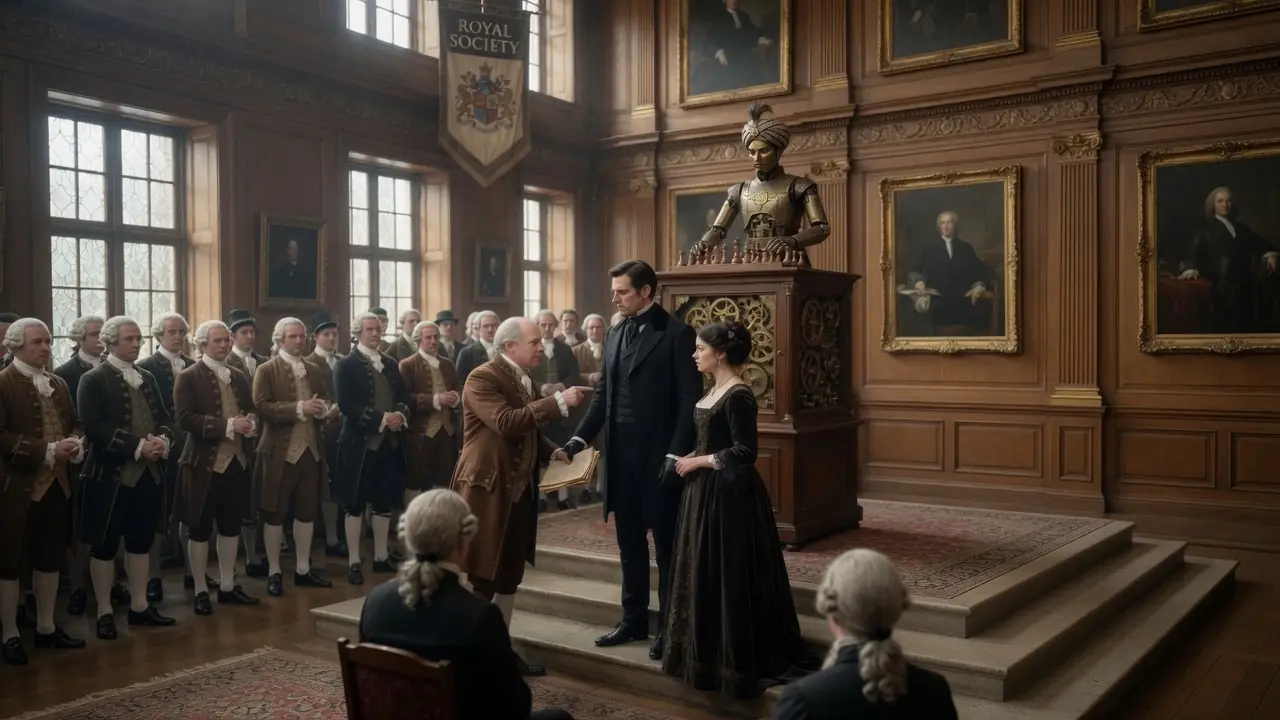
Elara nodded, her chest aching with a longing she couldn’t name. They were building a masterpiece of logic. But as she watched Julian turn back to the gears, she realized they were playing a game where neither of them knew the true stakes. The great hall of the Royal Society was a temple of cold marble and high-domed ambition, its acoustics designed to carry the voices of men and swallow the sighs of women.
As Elara stood beside Julian, the Iron Strategist positioned on a dais, she felt the weight of a hundred monocles turned in her direction. Her gown, a shimmering silk the color of a winter sea, was a masterpiece of deception. It made her look like a debutante, while beneath the stays, her heart beat with the rhythmic, relentless fury of a steam engine. “Steady, Elara,” Julian murmured, his hand coming to rest at the small of her back.
The heat of his palm through the silk was the only thing anchoring her to the floor. “They are not here to judge you. They are here to be dazzled. Let the machine do what it was born to do.” “And if they see only a trick,” she whispered, her gaze fixed on Sir Clive, who stood near the front row, his arms crossed and a smirk of pure hemlock on his face. “Then we shall show them the gears,” Julian replied, his voice a low, private velvet.
The demonstration was nothing short of a triumph. As the silver key turned and the Strategist began its silent, predatory movements against a renowned grandmaster, the hall fell into a silence so profound one could hear the flutter of the gas lamps. When the machine finally tapped a mahogany finger against the board, signaling a checkmate in three moves, the room erupted. It was a cacophony of startled cheers and the frantic scratching of pens on notebooks.
Julian looked at her then, his eyes burning with a pride so naked it made her breath hitch. In that moment the fake betrothal felt like the only truth in the room. He took her hand, lifting it to his lips in a gesture that was ostensibly for the crowd, but his gaze remained locked on hers, intense and searching. “A miracle indeed,” a voice boomed, cutting through the applause like a blade.
Sir Clive stepped forward, his face flushed a sickly triumphant red. He held a sheaf of papers aloft, his eyes darting to the assembled gentlemen. “A miracle of theft, perhaps,” Clive shouted. “I recognize these escapements. I recognize the very logic of the lateral drive. This is not the work of a young lady who spends her days at the pianoforte. These are the stolen designs of the late Arthur Vance. Designs he and I collaborated on for years. Lord Halifax has used his title to shield a fraud, hoping to pass off my intellectual property as his fiancée’s dowry.”
A collective gasp rippled through the room. The word “fraud” hung in the air like a poisonous fog. “That is a lie,” Elara said, her voice small but piercing. “Is it?” Clive sneered, stepping closer to the dais. “Show us the schematics, then. Show us the notes that weren’t penned by your father. You are a thief, Miss Vance, and Halifax is your accomplice.”
The ride back to Halifax House was a storm of a different kind. Inside the confines of the brougham, the silence was a living, breathing thing. Elara stared at the passing street lamps, her hands trembling so violently she had to hide them in the folds of her skirts. “You should have let me speak,” Julian said, his voice tight with a suppressed rage that made the very air in the carriage vibrate.
“Speak and say what, Julian?” Elara turned on him, her eyes bright with unshed tears and old, jagged pain. “That you are my protector? That I am a fragile thing that needs your title to stand upright? He called me a thief. He tried to erase every hour I spent bleeding over those brass plates.” “I was trying to save your reputation,” Julian roared, the sound startling in the small space.
He leaned forward, his face inches from hers, his expression a mask of tortured frustration. “Do you not understand? In their eyes, you are already ruined the moment you stepped into my laboratory. I am trying to keep the world from tearing you apart.” “I don’t want you to save me,” she cried, her voice breaking. “I want you to stand with me, not in front of me, Julian. I am not a piece on your chessboard.”
“You think this is a game to me?” He grabbed her shoulders, his grip firm but not bruising, his breathing ragged. “You think I spent the last fortnight worrying over gear ratios and patent laws because of a game? I have spent every night pacing my floor, terrified that I will lose the only person in this wretched city who actually sees the world the way I do.”
“Then why do you treat me like a secret?” she challenged, her chest heaving against the constraints of her corset. “Why is our engagement a shield instead of a truth?” “Because I am a fool,” Julian spat the words out. “Because I thought I could keep my heart behind a clockwork wall. Because I am terrified of how much I want you, Elara. Not for your mind, though God knows it’s the most beautiful thing I’ve ever encountered, but for you.”
The air between them snapped. The argument died in a sudden, searing heat as Julian’s gaze dropped to her lips. The anger was still there, but it had transformed into a desperate, starving hunger. He didn’t ask. He didn’t wait. He pulled her forward, and his mouth crashed against hers with a ferocity that tasted of rain, brandy, and a lifetime of loneliness. It wasn’t a gentleman’s kiss. It was a collision.
Elara’s hands flew to his neck, her fingers tangling in the hair at his nape as she pulled him closer, meeting his desperation with her own. The world outside—the scandal, the accusations, the cold marble of the Society—ceased to exist. There was only the friction of his wool coat against her silk, the low groan he made against her throat, and the terrifying, glorious realization that the machine was finally broken, and the heart was all that remained.
He pulled back just an inch, his forehead resting against hers, his eyes dark with a devastating vulnerability. “Tomorrow,” he whispered, his voice a scorched rasp, “we prove them wrong. Not as protector and ward. As partners.” The morning arrived, not with the gentle bloom of a rose, but with the cold, sharp clarity of a guillotine’s blade.
Elara stood before the tall looking glass in her chambers at Halifax House, her fingers tracing the faint yellowish bruise at her temple, a souvenir from the shadows of her workshop. She had traded her sea-foam silk for a gown of charcoal velvet, high-necked and severe, the color of a thunderstorm. She looked less like a debutante and more like a widow of her own reputation.
“You look as though you are preparing for an execution,” Julian’s voice came from the doorway. He was reflected in the glass behind her, dressed in a black frock coat that emphasized the broadness of his shoulders and the grim set of his jaw. “Is that not what today is?” Elara asked, her voice steady despite the tremor in her heart. “A public hanging of my character.”
Julian crossed the room, the floorboards groaning beneath his weight. He stopped just behind her, not touching, yet she could feel the heat radiating from him, the memory of last night’s kiss a visceral, humming current between them. “No,” he said, his gaze meeting hers in the mirror. “It is an unveiling. Today, the world learns that they cannot cage a lightning bolt in a birdcage.”
The Royal Society was even more crowded than the previous night. The scent of damp wool and skepticism was stifling. Sir Clive Sterling stood center stage, his chest puffed out, surrounded by a gaggle of elderly scholars who looked upon Elara with the pity one might reserve for a fallen woman or a broken clock. “The evidence is clear,” Clive’s voice carried to the rafters. “The Vance papers, which I have in my possession, detailed this very escapement. To allow this… this theatrical display to continue is an insult to science.”
“Then prove it,” Elara’s voice rang out clear and cold as a winter bell. She stepped forward, the heavy velvet of her skirt snapping like a whip. “If this machine is the product of my father’s notes, notes you claim to have mastered, then surely you can predict its every move. You claim the mind is yours, Sir Clive. Come, sit. Play against your own creation.”
A murmur of shock rippled through the room. Clive faltered, his face paling. “I… I have no need to prove what is already documented.” “Are you afraid of a girl’s toy, Sir Clive?” Julian stepped into the light, his presence like a dark shadow falling over the room. “Or are you afraid that the mind you claim to own has evolved beyond your meager understanding?”
Trapped by the eyes of his peers, Clive had no choice. He sat, his movements jerky, his forehead glistening with a fine sheen of sweat. Elara approached the Strategist. She didn’t look at the crowd. She looked at the brass figure, then at Julian. He gave her a singular, sharp nod. With a flourish, she turned the silver key. But she didn’t just wind it. She adjusted a small, hidden lever at the base of the neck—the balance she and Julian had perfected in the quiet hours of the night.
The match was a slaughter. Clive played with a frantic, aggressive style, relying on the predictable patterns he had found in her father’s early, flawed sketches. But the Strategist moved with a fluid, terrifying intuition. It didn’t just respond. It baited. It sacrificed its own pieces with a chilling lack of sentiment, drawing Clive into a trap of his own making.
The silence in the hall became absolute. The only sound was the click-clack of the brass hand and the increasingly ragged breathing of Sir Clive. When the machine finally slid its queen across the board, pinning Clive’s king against the edge of the ebony world, the room held its breath. “Checkmate,” Elara whispered.
Clive stared at the board, his jaw working. “It’s… It’s a trick. It’s not following the logic. You’ve hidden someone inside.” He lunged forward, grabbing the mahogany torso of the machine, trying to wrench it open. Julian was there in a heartbeat, his hand catching Clive’s wrist in a grip that made the man gasp.
“Look at the gears, Sterling,” Julian growled, his voice vibrating with a terrifying, restrained power. He pointed to the exposed clockwork. “Those are not Arthur Vance’s escapements. Those are the Vance-Ashwood modifications, a system of variable tension that mimics human hesitation and foresight. You didn’t recognize them because you couldn’t have. This mind was born in a Bloomsbury workshop and perfected in my laboratory. It belongs to Miss Vance, and any man who calls her a thief calls me a liar.”
The defeat was total. Clive was led away, his reputation in tatters, leaving the hall in a state of stunned reverence. Later, in the quiet sanctuary of the Halifax library, the fire had burned down to a soft, glowing ember. The Iron Strategist sat in the corner, its work done, its brass skin reflecting the orange light. Elara stood by the window, watching the London fog roll in. She felt lighter than she had in years. Yet there was a new, heavy weight in the air. The weight of what came next.
The fake engagement was no longer necessary. The patent was hers. The world was open. Julian approached her, his footsteps silent on the Persian rug. He didn’t stop until he was inches away. He reached into his waistcoat pocket and pulled out not a ring of diamonds, but a small, perfectly formed brass gear, one of the prototypes from their late-night sessions.
“The merger is complete,” he said, his voice low and roughened by emotion. “You have your name. You have your freedom.” “Is that what you want, Julian?” Elara turned to him, her eyes searching his. “For me to take my freedom and go?” Julian looked down at the gear in his palm, his thumb tracing its teeth. “I told you once that I wanted peace of mind. I was wrong. I want this. I want the friction. I want the heat of a mind that challenges mine and a heart that beats in syncopated rhythm with my own. I don’t want a ward, Elara. I don’t even want a wife who sits at the end of a long table.” He paused. He took her hand, placing the gear in her palm and closing his fingers over hers. “I want a partner. In the lab, in the world, and in this life. I am proposing a real union. No more scripts. No more shields. Just us.”
Elara looked at the man who had seen her soul through a collection of springs and wire. She didn’t think of duty or propriety or the safety of a title. She thought of the way his hands felt covered in grease and the way he looked at her when she solved a problem he couldn’t. “I think,” she whispered, stepping into his arms, “that is the most logical conclusion we’ve reached yet.”
As his mouth found hers, she realized that the greatest machines ever built were nothing compared to the magnificent, terrifying, and utterly unmechanical complexity of a heart that has finally found its home. In the end, it was never about the clockwork. It was about the realization that even the most brilliant mind is merely a collection of silent gears until it finds the one person whose touch provides the spark, turning cold brass into a living, breathing fire that refuses to be extinguished.