The first thing the gentlemen noticed was the color of her gown. Pale lilac was an unfortunate choice for a challenge, they would say afterward, because it made Miss Helena Vale appear gentle enough to be blown away by a summer breeze.
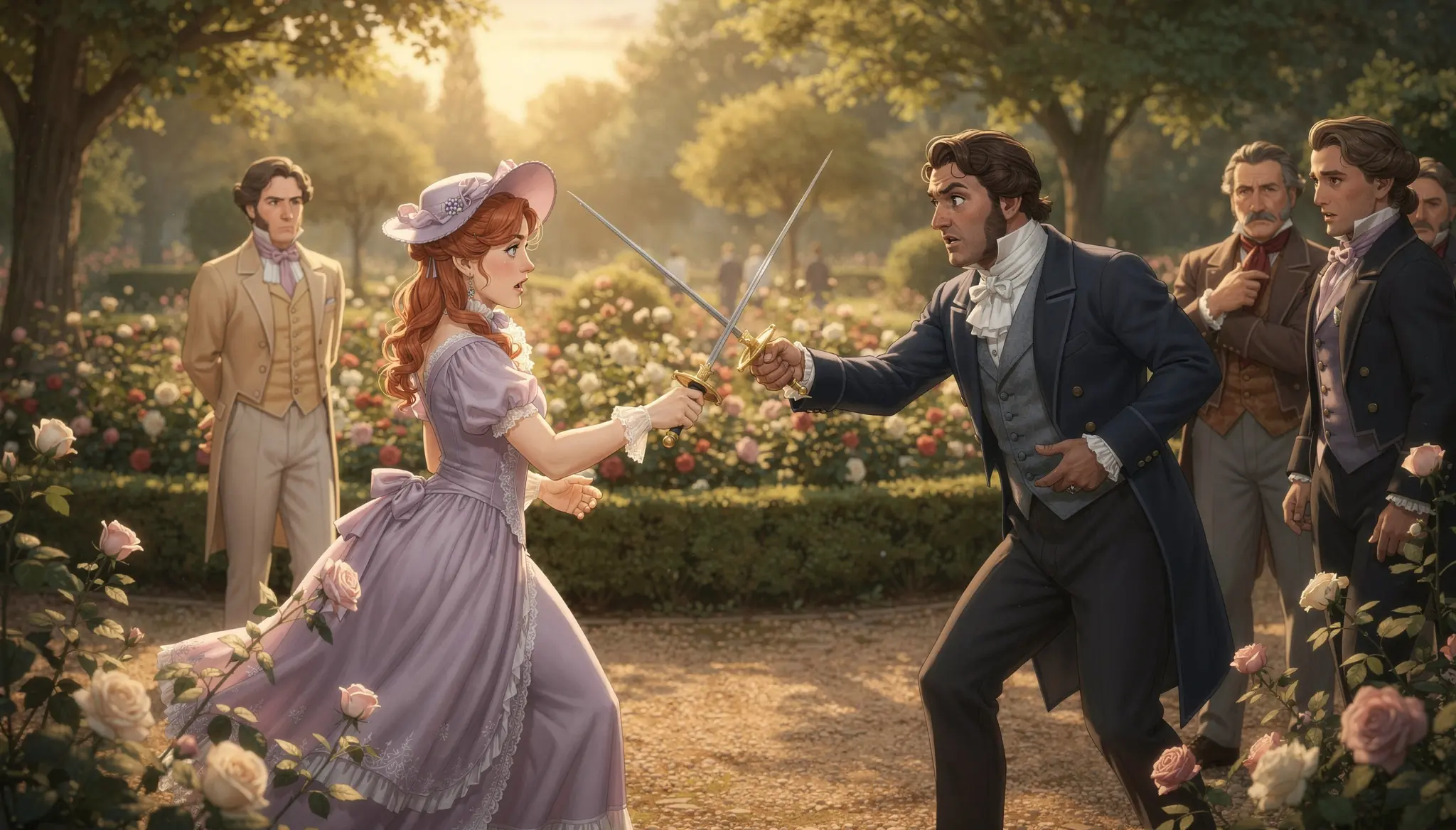
The second thing they noticed was that she had taken off neither her straw bonnet nor her cream-colored gloves. She stood in the sunlight on the stone terrace of Larchmere House, red hair tied beneath a dark ribbon, with a fencing foil balanced loosely in her right hand. At the far end of the terrace, Sir Edmund Wycliffe smiled as though someone had brought him an amusing pet. Behind him, several young men gathered to watch. Lord Nathaniel Harrow, the Earl of Larchmere, did not smile at all.
"Put the weapon down, Miss Vale," Sir Edmund said. "This is an exhibition for gentlemen. There is no need to make another spectacle of your family."
Helena looked down at the narrow steel blade and then at the man whose testimony had destroyed her father's name eight years earlier. "I believe," she answered, "that making a spectacle of my family is a skill you have already perfected."
A sharp intake of breath traveled through the spectators. Mr. Lucian Bell, dressed in a dark coat and an elaborately embroidered waistcoat, began to laugh, then stopped when he saw the expression on the earl's face. Lord Larchmere took one deliberate step forward. His dark cravat lay perfectly straight against his throat, and the morning sun touched the fair hair above his brow. "If you intend to challenge a gentleman," he said, "you ought to be offered a proper opponent."
"I do not require an opponent," Helena replied. "I require a witness."
No one on that terrace understood what she meant. Not yet. They saw only a young woman who had arrived without fortune, protection, or invitation to the inner circle and who now seemed determined to disgrace herself before the county's most powerful families. What they could not see was the folded notice in her reticule, giving her mother thirty days to leave the cottage in which Helena had grown up. They did not know about the battered notebook hidden inside her sleeve. Above all, they did not know that Helena had spent eight years imagining the exact moment when she could stand before Sir Edmund Wycliffe and ask a question he would be unable to laugh away.
Six weeks earlier, she had been kneeling beside a cracked window at Rosebank Cottage, trying to stop the wind from coming through. Her younger brother Thomas was at the table pretending to study Latin while quietly calculating how many potatoes remained in the cellar. Their