The first man to call Maggie Turner’s trout farm a museum was not Walter Briggs.
It was her own banker.
He had not meant it cruelly.
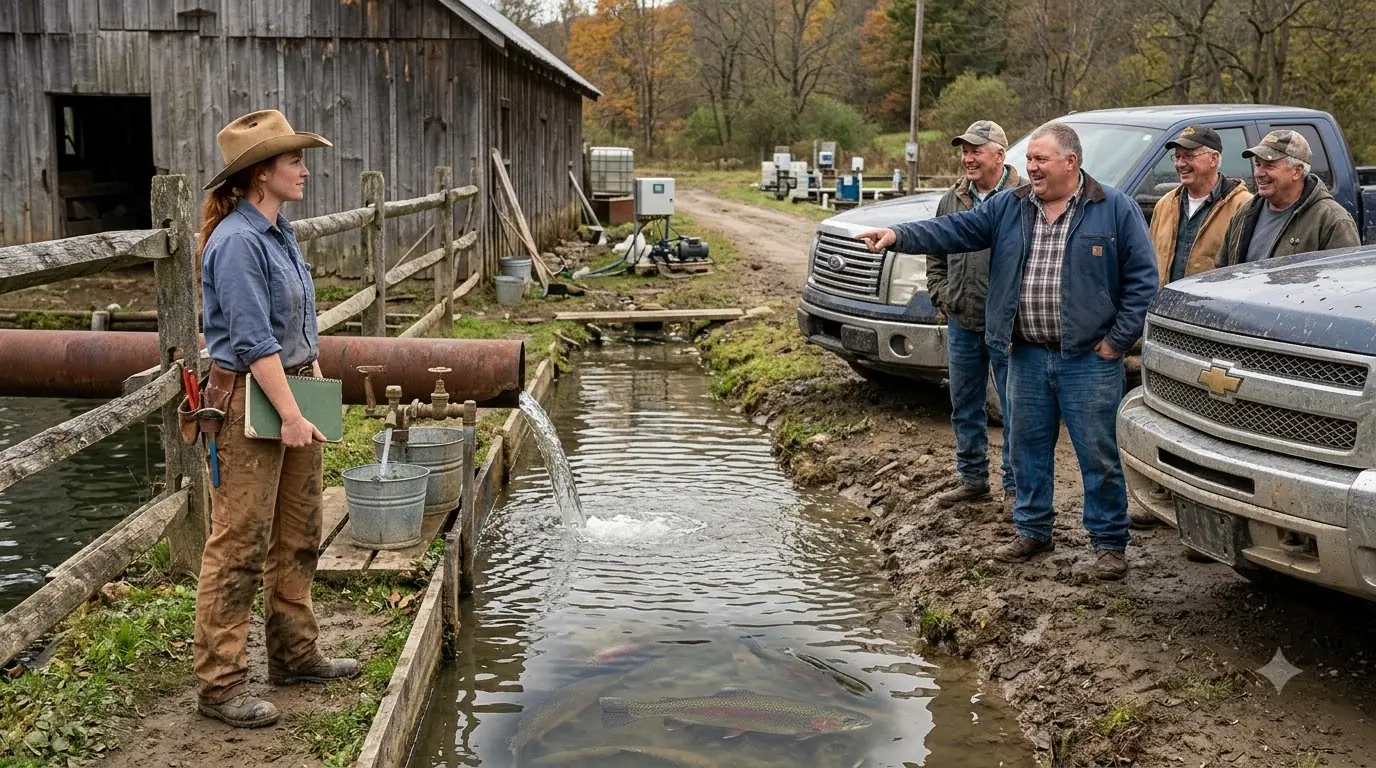
At least Maggie did not think so.
Daniel Webb had driven out to Turner Springs Trout Farm one wet March morning to discuss the operating line she needed for feed, diesel, veterinary supplies, and spring maintenance. He stood beside her oldest raceway with his dress shoes sinking slowly into mud and stared at a hand-operated brass valve that had probably been installed before he was born.
“You ever think about modernizing?”
Maggie rested both hands on the wooden fence.
“Every day.”
Daniel smiled.
“That was easier than expected.”
“I think about it.”
He waited.
Maggie continued.
“Then I calculate the cost.”
Daniel’s smile faded.
The modernization package proposed by Mountain Valley Aquaculture Systems would cost approximately $184,000.
That included electric circulation pumps, automated oxygen monitoring, programmable aerators, computerized feeding controls, backup sensors, remote alarms, and a central filtration system advertised as capable of increasing production by nearly thirty percent.
It sounded impressive.
It also required money Maggie did not have.
Turner Springs sat in a narrow valley outside Marlinton, West Virginia, where two cold underground springs emerged from limestone beneath a wooded hillside. Maggie’s grandfather had purchased the property in 1961.
He did not buy it because of the house.
The house leaned slightly even then.
He bought it because of the water.
Cold.
Clear.
Constant.
The springs flowed throughout summer.
They flowed in winter.
They flowed during drought years when neighboring streams narrowed to stones.
Maggie’s grandfather dug the first raceways by hand and rented a small excavator for the rest.
He used elevation instead of pumps.
Water entered at the highest point of the property through a screened stone intake, flowed into a concrete settling box, then traveled downhill through a network of steel pipes and open channels.
Each trout pond sat slightly lower than the one before it.
Water moved because gravity insisted.
No electric motor was required to convince it.
By the time Maggie’s father, Jack Turner, took over in the late 1980s, most commercial trout operations had begun adopting pumps, aeration systems, modern tanks, oxygen injection, and automated controls.
Jack adopted some improvements.
But never all.
He installed better screens.
Upgraded several valves.
Replaced rotten wooden channels with concrete.
Added mechanical backup gates.
He purchased two portable aerators for emergencies.
But he refused to redesign the entire farm around electricity.
“Water already knows where downhill is,” he used to tell Maggie.
“Seems expensive to pay a motor to remind it.”
Maggie thought that joke was ridiculous when she was fifteen.
At thirty-one, she had repeated it enough times that it sounded like wisdom.
Daniel Webb looked over the property.
Rusted pipes.
Old barn.
Concrete raceways.
Wooden walkways.
Galvanized buckets.
Mechanical gauges.
A maintenance notebook hanging from a nail inside a waterproof box.
“You know what this place reminds me of?”
Maggie looked at him.
“A museum.”
She laughed.
Daniel immediately raised both hands.
“I’m not criticizing.”
“You’re definitely criticizing.”
“I’m saying it has character.”
“That’s banker language for obsolete.”
Daniel smiled.
“Maybe a little.”
Maggie looked toward the spring outlet.
Water poured steadily into Raceway One.
Hundreds of rainbow trout moved beneath the surface.
“What would you do?”
Daniel hesitated.
“If I were running it?”
“Yes.”
“I’d probably finance the upgrade.”
“Of course you would.”
“I’m a banker.”
“Exactly.”
They laughed.
Then Maggie became serious.
“What if the power goes out?”
Daniel shrugged.
“Backup generator.”
“What if the generator fails?”
“Second generator.”
“What if fuel delivery stops?”
“Maggie.”
“What?”
“You can invent problems forever.”
“I don’t have to invent them.”
She pointed toward the hills.
“2009 ice storm. Four days without power.”
Daniel nodded.
“2012 derecho. Nearly three.”
Another finger.
“2016 flood. Substation went underwater.”
“Maggie.”
“2021 winter storm. Two days.”
Daniel sighed.
“You’re saying the old system is safer.”
“No.”
She looked toward the raceways.
“I’m saying it fails differently.”
That distinction mattered to Maggie.
No system was safe.
Anyone who believed otherwise had not worked around animals, water, weather, machinery, or money long enough.
The old farm could fail.
A spring intake could clog.
A pipe could crack.
A valve could seize.
A tree could fall across a channel.
A flood could overwhelm the settling basin.
A drought could reduce spring output.
But those failures were usually visible.
Physical.
Understandable.
A person with boots, tools, and enough patience could often correct them.
Maggie trusted systems she could touch.
Walter Briggs trusted systems that came with service contracts.
Walter owned Blue Ridge Aquatics, the largest trout farm in the county.
His operation sat eight miles downstream near a wider valley.
Where Maggie raised approximately 90,000 trout annually, Walter raised nearly 400,000.
His farm was modern.
Stainless steel tanks.
High-capacity pumps.
Automated feeders.
Oxygen sensors.
Remote monitoring.
Emergency generators.
Three-phase power.
A control room with screens showing water temperature, dissolved oxygen, feed rates, pump pressure, and alarm status.
County officials loved touring Blue Ridge Aquatics.
Students visited.
Agricultural publications photographed it.
Walter had been chairman of the Greenbrier Aquaculture Cooperative for seven years.
He enjoyed explaining the future.
Maggie enjoyed avoiding him.
Unfortunately, farms rarely allowed perfect avoidance.
The co-op purchased feed in bulk.
Negotiated transport contracts.
Coordinated fish processing.
Shared veterinary services.
Maintained cold-storage agreements.
Maggie needed the cooperative.
That meant she occasionally needed Walter.
The conflict truly began during an April inspection.
A county agricultural delegation visited several trout farms as part of a proposed infrastructure-resilience grant.
Maggie did not apply.
Walter found that suspicious.
“You’re turning down forty percent cost sharing.”
They stood beside Raceway Three while rain softened the soil beneath their boots.
Maggie wore a faded blue work shirt, muddy brown pants, her tan cowboy hat, and the leather tool belt her father had used until the stitching failed.
“I’m not turning it down.”
“You didn’t apply.”
“That is generally how turning something down works,” Walter said.
Maggie looked at him.
“I don’t want the system they’re funding.”
Walter laughed.
Two county representatives standing nearby looked uncomfortable.
“What system?”
“Centralized electric pumping.”
Walter pointed toward her old pipes.
“You need it.”
“My springs already provide enough flow.”
“For now.”
Maggie nodded.
“For now.”
“Your production could double.”
“I don’t want to double.”
Walter stared at her as though she had announced she did not enjoy money.
“What farmer doesn’t want more production?”
“One who wants enough margin to sleep.”
Walter shook his head.
“You sound like Jack.”
Maggie’s expression changed.
Not much.
But Walter noticed.
Jack Turner had died four years earlier after a sudden heart attack beside the feed shed.
Maggie found him.
Walter knew that.
He also knew mentioning Jack could stop a conversation faster than any argument.
But he continued anyway.
“Your father was a good farmer.”
Maggie waited.
Walter added, “Thirty years ago.”
One county representative looked away.
Maggie slowly folded her arms.
Walter gestured toward the farm.
“Look around. Manual valves. Gravity channels. Mechanical gauges. Steel pipe older than half the people in the cooperative.”
Water poured from the rusted outlet behind Maggie.
Walter smiled.
“This place is a museum.”
The county representatives tried not to react.
Maggie looked toward the pipe.
Then back at Walter.
“What does your system do when the power stops?”
Walter almost laughed.
“We have generators.”
“Two?”
“Three.”
“Automatic transfer?”
“Yes.”
“Fuel?”
“Seven days.”
“Pump redundancy?”
“Full.”
“Oxygen backup?”
“Liquid oxygen manifold.”
Maggie nodded.
“Sounds expensive.”
“It’s called running a professional operation.”
That irritated her.
Not enough to show.
Maggie crouched beside the pipe and put one hand beneath the steady stream.
Cold spring water struck her fingers.
Walter watched.
“Still proud of that?”
She stood.
“Very.”
He shook his head.
“One day this antique system will fail, and you’ll be calling the rest of us.”
Maggie wiped water across her work pants.
“Maybe.”
Walter pointed toward her maintenance notebook.
“When it happens, don’t expect sympathy because you refused to modernize.”
Maggie glanced toward the utility lines crossing the ridge.
Then gave him a small smile.
“Funny thing about my antique, Walter.”
“What?”
“It doesn’t notice when somebody pulls the plug.”
The inspectors laughed.
Walter did not.
By evening, three different farmers had heard about the exchange.
By the next co-op meeting, everybody had.
Maggie became the punchline.
Not viciously at first.
Farm communities had always used teasing as social currency.