The first piece Marcus Reed picked up was one of the little green wheels.
It lay upside down in the middle of his driveway, still spinning faintly on a bent plastic axle.
He stared at it for half a second.
Then he put it in his palm.
Behind him, his nine-year-old son was trying very hard not to cry.
Leo had inherited that from Marcus.
Not the crying.
The trying not to.
Marcus hated seeing it.
The boy stood on the bottom porch step wearing a faded red T-shirt, denim shorts, and one untied sneaker. His small shoulders were pulled inward. His hands were pressed together in front of his stomach.
Five feet from him lay the remains of the toy.
A green plastic military jeep.
Cheap by adult standards.
Priceless by Leo’s.
It had been a birthday present from Marcus’s older brother three years earlier, and Leo had played with it so often that the original stickers had nearly disappeared.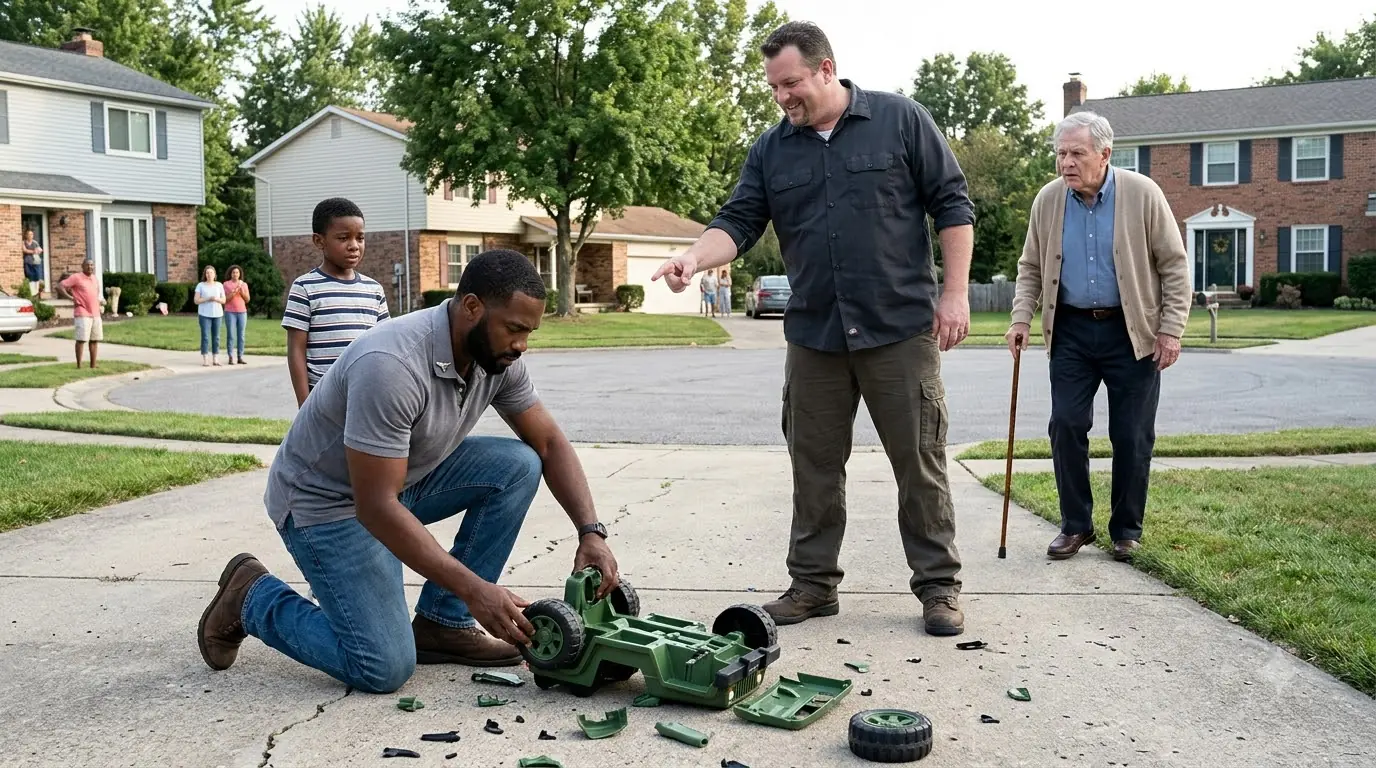
He had driven it across carpets.
Through dirt.
Over couch cushions.
Along the wooden railing of the porch.
He had built cardboard garages for it.
Drawn maps for imaginary missions.
Repaired one wheel twice with tape.
That afternoon, he had been pushing it along the edge of the driveway when Greg Lawson walked over.
Greg had told him to keep his “junk” off the property line.
Leo had apologized.
The jeep had not even crossed the line.
Greg kicked it anyway.
The toy flew from Leo’s hands and skittered across the concrete.
Then Greg stepped on it.
Deliberately.
The roof collapsed with a sharp crack.
Leo froze.
So did the neighborhood.
And now Marcus was kneeling on warm concrete picking up the pieces.
Greg stood over him.
Forty-four years old.
Six-foot-two.
Heavy through the shoulders.
Dark work shirt.
Tan cargo pants.
Heavy brown boots.
A permanent expression suggesting every room contained at least one person he considered beneath him.
He crossed his arms.
“Pathetic.”
Marcus found the second wheel.
He placed it beside the first.
Greg looked toward the surrounding houses.
By then at least eight neighbors had come outside.
Two stood beside mailboxes.
A woman watched from her porch.
Another man had paused halfway through washing his truck.
Nobody intervened.
Greg enjoyed that.
Marcus could tell.
It turned an ugly act into a performance.
Greg took another step.
“Look at you.”
Marcus picked up a section of the broken windshield.
“What exactly are you going to do about it?”
Marcus said nothing.
Greg laughed.
“I asked you a question.”
Marcus reached beneath the bumper of his truck and found the jeep’s tiny plastic steering wheel.
Leo whispered:
“Dad.”
Marcus looked toward him.
“I’m okay.”
The boy's lower lip trembled.
Marcus stood.
Not quickly.
No clenched fists.
No threat.
He walked toward Leo and handed him the least damaged wheel.
“Hold this for me?”
Leo nodded.
That small task seemed to help.
Marcus returned to the driveway.
Greg shook his head.
“You let your kid leave garbage everywhere and then act offended when somebody teaches him manners.”
That made Marcus stop.
He looked up.
The cul-de-sac became very quiet.
Greg smiled.
There it was.
The reaction he wanted.
Marcus stood fully.
He was thirty-eight.
A little under six feet.
Broad-shouldered without looking like he lived in a gym.
Short black hair.
Trimmed beard.
Faded gray polo shirt.
Old jeans marked with grease from the lawn mower he had been repairing in the garage.
Brown work boots.
Nothing about him looked impressive by Greg’s preferred standards.
No expensive watch.
No luxury truck.
No pressed shirt.
No loud confidence.
Just a father interrupted halfway through repairing machinery.
Marcus wiped his hands with the rag still tucked into his back pocket.
Then he spoke.
“Do not talk about my son like that.”
His voice was quiet.
Greg’s smile widened.
“There he is.”
Marcus stared.
“I said don't.”
“What?”
“You gonna do something?”
Marcus looked at Leo.
Then back.
“Not in front of my son.”
Greg laughed.
“Right.”
He turned toward the neighbors.
“Hear that? Big man has rules now.”
Nobody laughed with him.
Greg seemed annoyed.
He looked back at Marcus.
“You've been hiding behind that calm act since you moved here.”
Marcus almost smiled.
He had lived there fourteen months.
Greg had been a problem for eleven.
Not constantly.
That would have been easier.
Constant harassment creates obvious patterns.
Greg preferred small incidents.
A trash bin left three inches too close to the line.
A complaint about basketball noise at 6:40 p.m.
A photograph of Marcus’s recycling container posted in the neighborhood group because the lid had not fully closed.
A handwritten note demanding Leo stop riding his bicycle near Greg’s driveway.
A claim that Rachel Reed's guests were using “his side” of the public curb.
Nothing large enough by itself to justify war.
Everything irritating enough to create one.
Marcus mostly ignored him.
Rachel hated that strategy.
“People like Greg treat silence as permission,” she had said.
Marcus answered:
“People like Greg treat reaction as fuel.”
Both statements were probably true.
Until that afternoon, Greg’s behavior had targeted adults.
The moment he crushed Leo’s toy, something changed.
Marcus felt it.
Not rage exactly.
Rage would have been easier.
This was colder.
A boundary.
Greg pointed toward Marcus's shirt.
“What is that, anyway?”
Marcus instinctively glanced toward his collar.
A small tarnished silver pin was clipped near the top button.
He had forgotten he was wearing it.
Leo had found the insignia that morning inside an old wooden box in the garage.
“Dad, can you wear it?”
Marcus had said no.
Leo asked why.
Marcus said it did not belong on a polo shirt.
Leo answered:
“You wear my school pins.”
Marcus had laughed.
So he clipped it on.
Just for the day.
He had intended to remove it before mowing.
Forgotten.
Greg leaned closer.
“Some fake medal?”
Marcus’s expression changed.
“Leave it.”
Greg smiled.
“Touchy.”
Across the street, a cane tapped against concrete.
Once.
Then again.
Marcus looked past Greg.
Harold Hayes was approaching.
Mr. Hayes was seventy-two and lived in the oldest house on the cul-de-sac.
White hair.
Thin face.
Beige cardigan despite the summer heat.
Dark trousers.
Brown walking shoes.
Wooden cane.
He had lived in Maple Hollow for thirty years, long before developers replaced the woods behind the neighborhood with new houses.
Harold rarely participated in neighborhood disputes.
He had skipped every HOA argument Marcus knew of.
When two residents fought over a tree branch, Harold went fishing.
When someone tried organizing a petition over mailbox colors, Harold said:
“I survived the seventies. I’ll survive a blue mailbox.”
Marcus liked him.
Mostly because Harold understood the value of minding his own business.
But now the old man was not looking at Greg.
Or Leo.
Or the toy.
His eyes were fixed on Marcus’s collar.
He stopped three feet away.
His face changed.
Marcus noticed immediately.
Harold lifted his chin.
“Marcus.”
“Yes, sir?”
“May I see that pin?”
Greg laughed.
“Seriously?”
Harold ignored him.
Marcus looked toward the insignia.
Then unclipped it.
Placed it in Harold’s palm.
The old man stared.
His fingers trembled.
He turned it over.
Looked at the back.
Then at Marcus.
“Where did you get this?”
Marcus's face became guarded.
“It was mine.”
Harold's lips parted.
Greg rolled his eyes.
“Great. Antique jewelry hour.”
Harold still ignored him.
“Your name.”
Marcus frowned.
“You know my name.”
“Full name.”
Marcus became even more confused.
“Marcus Daniel Reed.”
Harold went pale.
Not metaphorically.
Color visibly drained from his face.
He stared at Marcus for several seconds.
Then whispered:
“No.”
Marcus understood before Harold finished.
He hated that he understood.
Harold looked toward the pin again.
“Lieutenant Colonel Reed?”
Greg laughed.
“Lieutenant what?”
Marcus reached for the insignia.
“Mr. Hayes.”
Harold did not give it back.