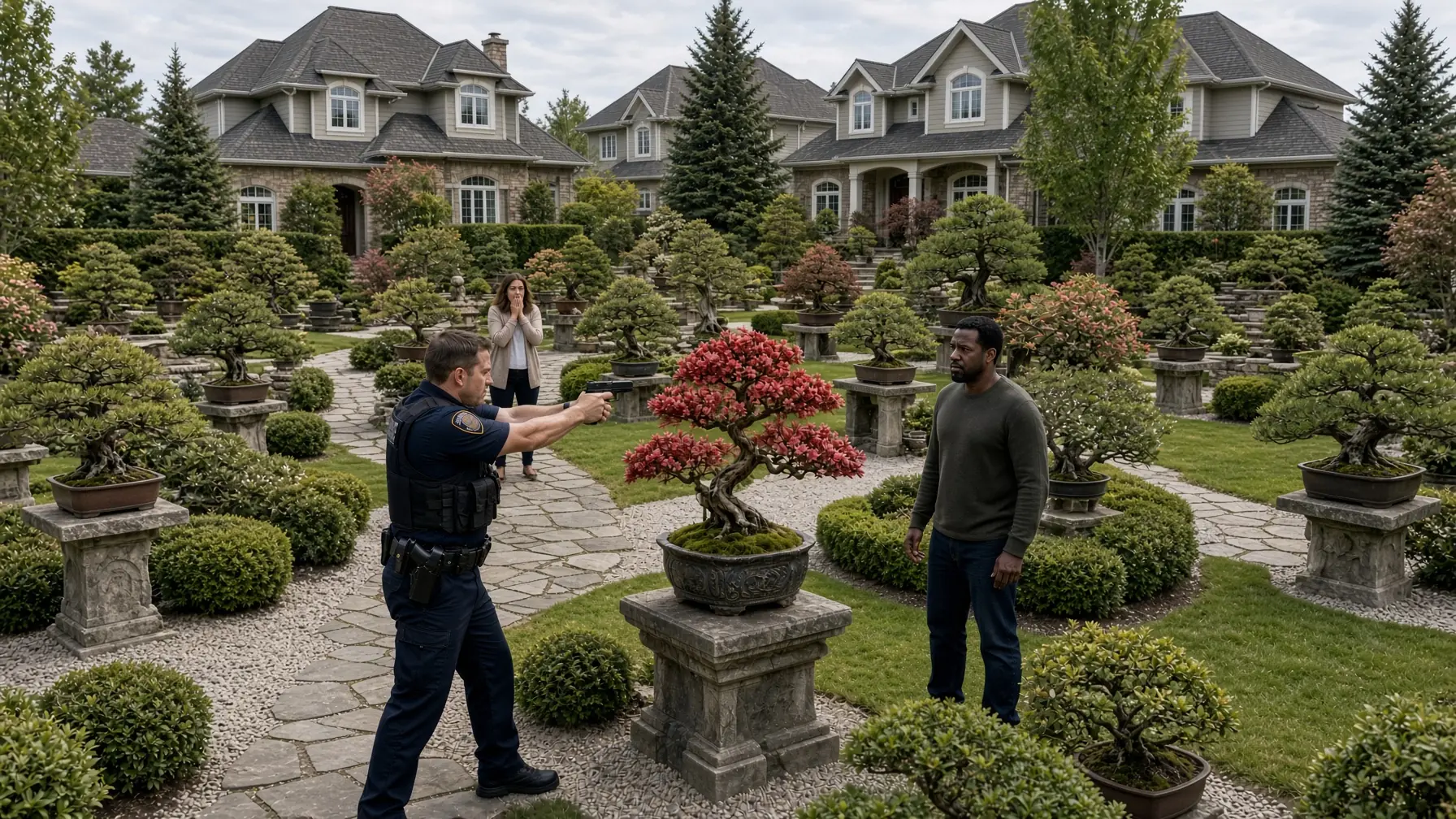
The first chainsaw started at 8:17 on a Tuesday morning.
Calvin Reed was standing barefoot on a flat piece of slate in the middle of his garden when the engine screamed to life behind him. He slowly lowered the copper watering wand in his hand and turned toward the sound. Beyond the low stone wall, three men in gray work shirts were unloading saws, pry bars, plastic tubs, and a wood chipper from a white landscaping truck.
Behind them stood Gavin Rusk, the municipal code enforcement officer who had been coming to Calvin's house twice a week for nearly a month.
Rusk held a clipboard against his stomach and looked almost cheerful.
"Morning, Mr. Reed."
Calvin glanced from the clipboard to the chainsaw.
"You planning to trim something?"
Rusk smiled.
"We're past trimming."
For a few seconds, neither man said anything.
Then Calvin looked over the garden surrounding them.
Forty-two bonsai trees rested on individually built cedar stands between carefully placed stones, patches of moss, and narrow gravel paths. Some were no taller than a coffee mug. Others spread nearly five feet from branch to branch, their trunks twisted by decades of wind, wire, patience, and human hands.
It was not a yard decorated with little trees.
It was a collection.
More accurately, it was the last twenty-eight years of Calvin's marriage arranged beneath the Virginia sky.
His late wife, Miriam, had bought their first bonsai at a roadside nursery outside Richmond when they were thirty-two. It had been an ugly little juniper in a blue plastic pot, and Calvin had laughed when she spent forty dollars on it. Miriam had looked at him and said, "You don't buy what it is. You buy what it might become if somebody stays patient."
That tree now stood near the center of the garden.
It was almost thirty years older.
So was Calvin.
Miriam wasn't.
Cancer had taken her fourteen months earlier.
After she died, Calvin sold the large house they had shared outside Alexandria and moved to Briarwood Heights, a quiet development twenty miles west of Richmond. He wanted less traffic, fewer rooms, and enough land to build the garden Miriam had sketched during the final winter of her life.
She had never seen it finished.
Calvin had finished it anyway.
The garden occupied nearly half an acre behind and beside the house, protected by a low stone wall and an iron gate. Every tree sat where Miriam had marked it on graph paper from her hospital bed. The Japanese black pines faced east. The maples received afternoon shade.
At the far end stood a row of American species Miriam had insisted belonged beside the imported varieties.
Bald cypress.
Virginia pine.
American hornbeam.
A tiny live oak with a trunk that looked a hundred years older than the suburban rooflines beyond it.
The most valuable tree in the collection was a Japanese white pine estimated to be more than 110 years old. Calvin had acquired it legally from an established California collection eight years earlier. Its insurance appraisal alone was higher than the price of some houses in Briarwood Heights.
But that wasn't the tree Calvin would have saved first.
That would have been Miriam's ugly little juniper.
Rusk pointed toward the garden.
"By order of the Briarwood Municipal Code Office, this nonconforming landscaping is being removed."
Calvin stared at him.
"You know that's false."
"That's your opinion."
"No. That's paperwork."
Calvin walked toward a small weatherproof cabinet mounted beneath the covered patio. He opened it and removed a clear folder. Inside were the same documents he had shown Rusk eleven days earlier.
Site approval.
Drainage approval.
HOA architectural approval.
Municipal horticultural exemption.
Every page stamped and dated before Calvin had moved the first tree onto the property.
He handed the folder over the wall.
Rusk didn't take it.
"I've already seen your documents."
"Then you know this garden is approved."
"Approval can be reconsidered."
"Not by you standing in my driveway with a landscaping crew."
Rusk looked toward the workers.
"Start on the west row."
Calvin's expression changed.
"Don't touch those trees."
One of the workers hesitated.
He was young, maybe twenty-five, with safety glasses pushed onto his forehead.
Rusk pointed sharply.
"You heard the order."
The young man looked uncomfortable.
"Sir, are these actually bonsai?"
Rusk laughed.
"They're trees in pots."
The worker looked at the garden again.
Even he could tell that wasn't true.
Calvin stepped closer to the wall but did not cross it.
"Gavin, I'm going to say this once. You have no legal authority to enter this property or remove anything from it. Every tree is documented, insured, photographed, and covered by written approval from both the town and the homeowners association."
Rusk's smile disappeared.
"You people always think a folder full of paper makes you untouchable."
The words settled between them.
Calvin looked directly at him.
"You people?"
Rusk glanced away for half a second.
He had already said more than he intended.
Briarwood Heights was the kind of neighborhood that never described itself as exclusive. It didn't need to. The brick mailboxes matched, the lawns stayed trimmed, and most homeowners belonged to the same golf club three miles away.
Calvin was one of only three Black homeowners on his street.
He had noticed the looks when the moving truck arrived.
He had noticed them again when the bonsai garden took shape.
But Calvin had spent sixty-three years learning the difference between discomfort and evidence.
He didn't accuse people because of a look.
He waited for facts.
Rusk had just given him one.
Across the street, a garage door stopped halfway open.
Calvin's neighbor, Susan Bell, stood behind it with her golden retriever beside her.
She was watching.
So were two men farther down the block.
Rusk noticed them too.
His shoulders stiffened.
"This isn't about you," he said.
"I didn't say it was."
"It's about maintaining the visual character of the community."
"The garden is behind an approved wall."
"Parts of it are visible from the street."
"So is your truck."
Rusk's jaw tightened.
Calvin had learned over the previous month that Rusk disliked two things more than anything else.
Being corrected.
And being corrected calmly.
He opened his clipboard.
"You received final notice Friday."
"No, I didn't."
"It was delivered personally."
"By whom?"
"Municipal officer."
"Which one?"
Rusk looked at him.
"It's in the file."
Calvin nodded.
"Good."
Something about the answer irritated Rusk.
"You think this is funny?"
"No."
Calvin took his phone from his pocket.
"I think it's being recorded."
Rusk looked toward the phone.
Then he smiled again.
"Record whatever you want."
He turned to the landscaping crew.
"Go."
The young worker still hesitated.
The older man beside him did not.
He opened the iron gate.
Calvin stepped in front of him.
"You're entering private property without permission."
The man stopped immediately.
"Mr. Rusk?"
Rusk sighed dramatically.
Then a police cruiser turned onto the street.
Calvin watched it approach.
That was when he understood this had never been an ordinary code visit.
The cruiser stopped behind the landscaping truck.
Officer Brent Fallon climbed out.
He was broad through the shoulders, middle-aged, and already wearing the expression of a man who had been told which side he was on before arriving.
Rusk pointed toward Calvin.
"He's obstructing a lawful abatement."
Fallon didn't ask for Calvin's paperwork.
He didn't inspect the garden.
He didn't ask what ordinance had been violated.
He walked straight toward Calvin.
"Sir, step away from the workers."
"They're trespassing."
"Step away."
Calvin looked at him.
"Officer, I have written approval for this entire property."
"You can argue that later."
"After they destroy it?"
Fallon's face hardened.
"I'm not going to tell you again."
Calvin looked at the workers.
Then at his trees.
Then he stepped backward.
"Fine."