At 2:17 on a January morning, the power disappeared from nearly all of Grayson County.
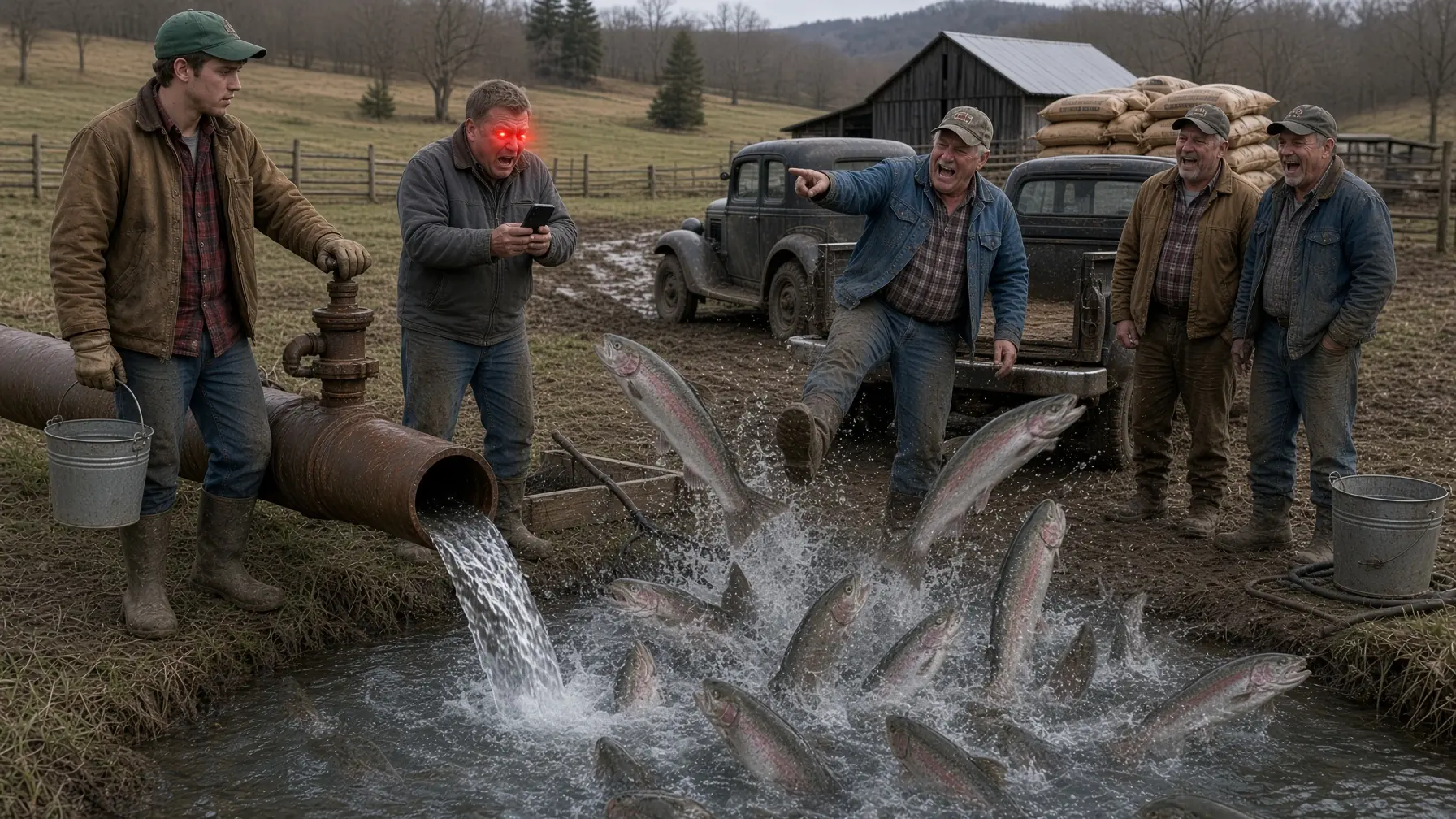
The first thing twenty-seven-year-old Owen Hale noticed was not darkness.
It was silence.
The old refrigerator in the packing shed stopped humming. The little electric heater in the office clicked off. Somewhere behind him, the fluorescent light above the processing table blinked once and vanished. Across the valley, porch lights disappeared one by one until the mountains became a wall of black beneath a sky heavy with sleet.
Owen stood still for three seconds.
Then he heard the sound that mattered.
Water.
Thousands of gallons of cold limestone spring water continued pouring through the six-inch cast-iron main beneath his feet, crossing the road, splitting through old valves, tumbling through concrete raceways, and spilling into seven earthen ponds exactly as it had ten seconds earlier.
No motor started it.
No electric pump kept it moving.
Gravity did.
Owen turned on his headlamp and stepped outside.
Sleet clicked against the roof.
The main pond was barely visible beyond the packing shed, but he could hear the constant rush of water entering through the head box. He walked to the first raceway and aimed his light downward. Hundreds of rainbow trout held themselves calmly in the current, silver sides appearing and disappearing beneath the surface.
He checked the inlet.
Clear.
Then the outlet.
Clear.
Then he lowered a dissolved-oxygen meter into the water.
Seven point nine.
Good.
He exhaled.
Not because the farm was safe.
It wasn't.
His freezers were without power. The processing room could not operate. His well pump for domestic use had stopped. A small recirculation pump serving one nursery tank was down. If electricity remained off long enough, Monday shipping would become a problem.
But the fish were still breathing.
That was more than could be said for everybody else in the valley.
At 2:41, Owen’s phone rang.
The screen showed Nathan Cole.
Owen stared at it.
Nathan owned Blue Ridge Aquatics eighteen miles east, a modern indoor trout operation with stainless raceways, automated feeders, oxygen injection, alarms, pumps, backup pumps, sensors, computerized controls, and more technology than Owen’s entire farm possessed.
Nathan had once referred to Owen’s operation as “a trout museum with a business license.”
Owen answered.
“You still have water?” Nathan asked.
No greeting.
“Yeah.”
“Full flow?”
“Close enough.”
Silence.
Then Nathan said, “Our generator isn't taking the transfer.”
Owen straightened.
“What happened?”
“Don't know. Electrician's coming. I've got backup oxygen cylinders running, but if the main pumps stay down—”
He stopped.
Owen understood.
High-density fish systems depended on continuous movement and oxygen.
Minutes mattered.
“How many tanks?”
“Four critical.”
“You got portable generators?”
“Two. Not enough for everything.”
“Can you split load?”
“Trying.”
Owen looked toward his ponds.
Nathan said quietly, “I used to make fun of that spring of yours.”
“You made fun of everything here.”
“I know.”
Another pause.
“Not tonight.”
Owen grabbed his coat.
“What do you need?”
For the next fourteen hours, nobody in Grayson County cared whether a trout farm looked old-fashioned.
They cared whether fish stayed alive.
And by sunrise, three trucks were parked outside Owen Hale’s gate.
By noon there were six.
Some belonged to farmers who had spent five years laughing at him.
But to understand why they were standing there in the freezing rain staring at a stream of water that did not know the electrical grid had failed, you had to go back six years—to the first afternoon Owen stepped onto four abandoned acres outside Newcastle, Virginia, and asked a question that made almost everyone around him think he was making the worst financial decision of his life.
The property did not look like a farm.
It looked like the remains of one.
Knee-high grass covered most of the ground. Blackberry vines climbed through broken fencing. One concrete raceway had filled with leaves so deeply a small maple tree was growing from it. Rusted pipes emerged from the earth and disappeared again without explanation. The hatchery building leaned slightly toward the creek, its windows cloudy and one corner of the roof patched with sheet metal.
Seven earthen ponds stretched behind it.
Or they had once been ponds.
Two were dry.
One had become cattails.
Another contained shallow brown water and enough weeds to hide a deer.
Owen stood beside his wife, Claire, and stared.
Claire folded her arms.
“This is the place?”
“Yes.”
“Where are the fish?”
“There aren't any.”
“Where's the water?”
Owen looked around.
“That is currently an excellent question.”
The real-estate agent pretended not to hear.
Owen had not gone looking for a trout farm.
At twenty-one, he had been working on his grandparents’ cattle property, raising a few pigs, helping with pasture, repairing fences, and making just enough money from several side jobs to convince himself he was self-employed.
A friend called one afternoon.
“There’s an old trout hatchery near Newcastle.”
“I don't know anything about trout.”
“Neither does the guy selling it.”
“That is not encouraging.”
“Come look anyway.”
Owen did.
The hatchery had originally been built in the 1930s as a small research and propagation facility. Decades later it passed through private hands, then slowly stopped operating. What made the property unusual was not the concrete or the ponds.
It was the spring.
Jerry Collins showed Owen where.
Jerry was seventy-four, wore suspenders beneath a faded work jacket, and had maintained the hatchery in one form or another for nearly thirty years.
He walked Owen uphill through brush until they reached an old stone spring house.
“Water's underneath.”
“How much?”
Jerry shrugged.
“Enough.”
“That sounds scientific.”
“It isn't.”
They cleared debris from one valve.
Jerry used a wrench older than Owen.
Nothing happened.
Then he struck the side of the valve body twice with the wrench.
Claire raised an eyebrow.
“That part in the manual?”
Jerry ignored her.
The valve moved.
A deep vibration traveled through the buried pipe.
Thirty seconds later, water appeared in the upper raceway.
Not a trickle.
A surge.
Cold, clear water spilled through a channel that had been dry for years, crossed beneath the road, and entered the abandoned concrete system.
Owen stared.
“Where's the pump?”
Jerry looked at him.
“What pump?”
“To move all that.”
Jerry pointed uphill.
“Mountain.”
Owen waited.
Jerry smiled.
“Gravity's cheap.”
That sentence changed Owen’s life.
The spring emerged at a higher elevation than the farm. The old hatchery had been designed around that fact. Water collected behind a simple structure, dropped through the buried main, and used elevation difference to distribute flow through the farm.
No giant electric pumping station.
No continuous energy bill for moving the primary water supply.
The system was ancient.
It was also elegant.
Owen crouched beside the raceway and put his hand into the water.
Cold.
“What temperature?”
“About fifty-two most of the year,” Jerry said.
Owen looked up.
“For trout?”
Jerry smiled.
“Now you're asking the right question.”
Owen went home and read until two in the morning.
Rainbow trout preferred cold, oxygen-rich water.
The spring temperature appeared remarkably stable.
The property already had raceways.
Ponds.
Flow infrastructure.
A small processing building that would eventually require major regulatory work.
Owen saw opportunity.
Claire saw the bank account.
“How much money do we have?”
“Sixty-two thousand if we liquidate nearly everything.”
“How much experience?”
“Very little.”
“No, Owen.”
“Some.”
“How many trout have you raised?”
He stopped.
Claire waited.
“Personally?”
“Oh, good. There are several categories of trout experience?”
Owen laughed.
She did not.
“Zero.”
“That is the number I was looking for.”
They bought it anyway.
Not recklessly.
Not because Owen had discovered a magical business.
The purchase price was low enough relative to the infrastructure and land that failure would hurt without destroying three generations of family property. Owen kept part of his savings untouched. Claire continued working part-time. They made no assumption that income would arrive quickly.
That turned out to be the most accurate assumption they made.
Year one produced no trout sales.
Mostly it produced garbage.
Owen removed broken fencing, old pipe, rusted sheet metal, dead pumps that were no longer connected to anything, rotten boards, accumulated leaves, and enough discarded plastic to fill multiple trailers.
He learned the valve system by opening the wrong valves.
He learned water volume by getting knocked backward into a raceway.
He learned earthen ponds by discovering that a small leak could disappear underground twenty feet before appearing somewhere completely inconvenient.
Jerry visited twice a week at first.
“Why does Pond Four lose water?”
“Muskrat.”
“You sure?”
“No.”
“What do I do?”
“Figure out whether I'm right.”
Owen hated answers like that.
He eventually found the burrow.
Jerry was right.
Year two was worse because Owen finally bought fish.
Fifty thousand trout eggs sounded impressive until he learned how fragile tiny fish could be.
Temperature change mattered.
Oxygen mattered.
Feed size mattered.
Flow mattered.
Density mattered.
Disease mattered.
Cleanliness mattered.
And fish had the irritating habit of expressing husbandry mistakes by dying.
One morning Owen opened the hatchery and found hundreds of fry floating.
He stood over the trough for almost five minutes.
Jerry arrived later.
“What happened?”
“I don't know.”
“Then don't clean anything yet.”
Owen looked at him.
“They're dead.”
“I can see that.”
“Why leave them?”
“Because if you erase the scene before you understand the failure, tomorrow you get to kill another batch.”
They checked everything.
Flow had dropped overnight after debris partially blocked an inlet screen.
Dissolved oxygen fell.
The smallest fish went first.
Owen wrote the lesson on the hatchery wall:
WATER FIRST. FISH SECOND.
It remained there for years.
He lost more fish that season.