Maya Ellis learned to skate in a rink that smelled like old rubber mats, cold metal, stale popcorn, and dreams nobody rich had bothered to claim.
The Eastbrook Community Ice Center sat behind a strip mall on the rough side of town, squeezed between a laundromat and an auto parts store that kept getting robbed every winter. Its sign flickered whenever the wind came hard off the river, and the parking lot lights worked only when they felt like it. Most parents who wanted champions drove their children across the county to private rinks with heated viewing lounges and coaches whose hourly rates could feed a family for a week.
Maya had Eastbrook after midnight.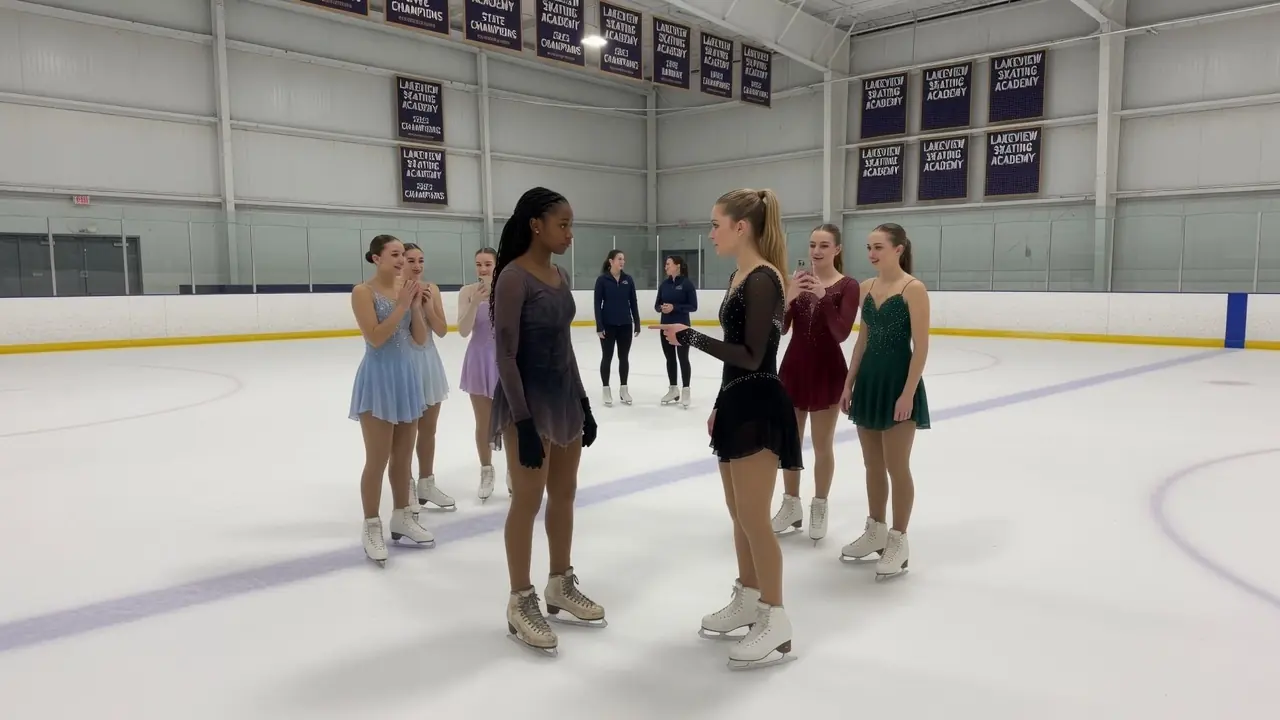
Her grandmother, Viola Ellis, cleaned the rink five nights a week. She emptied trash cans, wiped down locker rooms, scrubbed coffee spills from the lobby, and polished fingerprints off the glass that separated spectators from the ice. When the last public skaters left and the front doors locked, Viola would look at Maya, nod toward the rink, and say the same thing every night.
“Lace up, baby. The ice doesn’t care where you came from.”
Viola had once been the best young figure skater in three states, back when newspapers still called Black girls “surprising” when they were graceful. She had photographs hidden in an old shoebox beneath her bed, black-and-white pictures of her mid-spin, one leg lifted clean behind her, arms open like she was hearing music nobody else could hear. In every photo, she looked weightless.
But figure skating had never been kind to girls like Viola.
Judges praised her speed but marked her down for “line.” Coaches told her she was powerful but not “delicate enough.” One man told her straight to her face that audiences were not ready for “that kind of skater” at the top. Viola kept skating anyway until a bad landing on a double axel shattered her right ankle and ended the career she had built one frozen morning at a time.
After that, the ice became her workplace instead of her stage.
She never complained about it. She just carried the mop bucket past the boards, watched other girls train under clean lights, and swallowed every memory that tried to rise in her throat. Then Maya was born with long limbs, sharp balance, stubborn eyes, and a laugh that could warm the coldest corner of the rink.
By five, Maya could glide without holding the wall.
By seven, she could hold a spiral longer than girls with private coaches and custom boots. By ten, she was drilling three-turns, mohawks, crossovers, and scratch spins while Viola leaned on a push broom near center ice, counting under her breath like a metronome with a heartbeat. The rink’s old speakers crackled, the Zamboni left uneven lines, and Maya learned to feel every bump through her blades.
Other children learned figure skating in sequins and private lessons.
Maya learned it in thrift-store leggings, a hoodie with a broken zipper, and skates Viola had bought from a retired coach for forty dollars. The boots were scuffed white leather, the blades sharpened so many times they were thinner than they should have been, but Maya loved them like they had been made for her. Every mark on them felt like proof that something could be worn down and still carry a person forward.
Viola taught her edges first.
“Edges tell the truth,” she would say, tapping the ice with the end of her broom. “Anybody can look pretty for three seconds. But if your edges are weak, the ice will expose you.”
So Maya learned outside edges, inside edges, deep curves, shallow curves, how to ride pressure through her knees and let speed come from control instead of panic. She learned to spin until the rink lights blurred into white circles. She learned to fall without fear, get up without drama, and never waste a bruise.
But Maya taught herself something Viola had never known.
After school, she watched street dancers on her cracked phone screen while sitting behind the snack counter waiting for Viola’s shift to end. Hip-hop crews, krump battles, Chicago footwork, house dancers moving so fast their feet seemed to argue with gravity. Maya saw rhythm there that felt like home.
One night, alone on the ice with the old speakers buzzing, she tried mixing it into her skating.
At first, it was messy.
A clean bracket turn broke into a shoulder hit. A spiral dropped into a sharp body roll. A footwork sequence snapped into street rhythm, toe picks tapping the ice like drums. It should not have worked, but sometimes the body understands a thing before the world has a name for it.
Maya never told Viola.
Not because she was ashamed, but because she wanted to show her grandmother something finished someday. Viola had given her the language of skating, the discipline, the blade work, the history, the respect for the ice. Maya wanted to bring back a new dialect, one born from late buses, cracked sidewalks, block parties, and the beat that kept people moving when life gave them no smooth surface to stand on.
The poster appeared in February, taped crookedly to the glass outside the rink office.
Northern Regional Figure Skating Classic.
Open division.
A full scholarship to the Lakeview Elite Skating Residency.
National judges.
Live broadcast.
Maya stood in front of the poster so long that the rink manager finally leaned out of his office and asked if she was frozen there. She did not laugh. She read the words again and again until they stopped looking like ink and started looking like a door.
That night, she showed Viola.
Her grandmother sat on the locker room bench, rubbing ointment into the ankle that still swelled whenever snow came. She read the poster once, then twice. Her face did not change at first, but Maya saw her fingers tighten around the paper.
“You want it?” Viola asked.
Maya swallowed. “More than I’m supposed to.”
Viola looked up then. Her eyes were old, tired, and bright enough to cut through the dim locker room light. “Then go take the ice they never thought belonged to you.”
Maya registered the next morning.
The Lakeview Skating Academy sat on the north side of the city behind iron gates and trimmed hedges dusted with perfect snow. The building was all glass and silver steel, with banners hanging from the ceiling and photographs of champions lining the entrance hall. Olympic hopefuls smiled from framed posters. Sponsors’ logos gleamed on the walls.
Everything about it whispered money before anyone spoke.
Maya walked in wearing clean jeans, her heavy winter coat, and a backpack carrying her skates, a granola bar, and the folded entry fee Viola had pulled from a cookie tin in the kitchen. The receptionist looked up, then looked down at Maya’s boots, then at her backpack. Her smile arrived late.
“Can I help you?”
“I’m here to register for the Northern Regional Classic.”
The woman blinked.
“The skating competition?”
“Yes, ma’am.”
There was a pause long enough to chill more than the air. “Registration is down the hall, second door on the left.”
Through the glass walls, she saw private sessions in progress. Girls in fitted training jackets moved through triple jumps, layback spins, and step sequences while coaches followed them with tablets. Their skates were clean, their gloves matched their outfits, and their ponytails swung like everything in their lives had been conditioned to stay in place.
Maya found the registration room, paid the fee, signed the forms, and tried not to think about how many groceries that money could have bought.
On her way out, she passed Rink A.
The door was open.
A girl with honey-blonde hair was practicing a program under bright white lights. She wore a midnight-blue training dress, skin-tone tights, and skates so new they barely looked real. Every movement was polished, expensive, and exact. She landed a double lutz cleanly, glided backward, and stopped just hard enough to spray ice against the boards.
The girl saw Maya watching through the glass.
She skated toward the door slowly, not out of curiosity, but possession.
“Can I help you?” she asked.
The same words again.
Different blade.
“I was just leaving,” Maya said.
The girl’s eyes moved to Maya’s backpack. “Public skate is across town.”
Maya did not answer.
The girl smiled, soft and cruel. “Unless you’re here to clean the rental skates.”
Two girls behind her laughed.
Maya tightened the strap on her backpack and walked away. Her face stayed calm until she reached the parking lot. Only then did she breathe out, long and slow, into air cold enough to turn hurt visible.
That was the first time Brooke Langley made Maya Ellis feel small.
It would not be the last.
But it would be the last time Maya let her see it.
The open practice took place ten days before the championship.
All twenty-four finalists were given two hours on the main ice at Lakeview to learn the surface, test their speed, and adjust to competition lighting. The arena was three times wider than Eastbrook, with fresh boards, bright lights, clean glass, and ice so smooth it felt unreal beneath Maya’s blades. For the first five minutes, she almost did not trust it.
She arrived early and chose a corner near the penalty box.
Her skates were old, but Viola had polished them until they shone as much as they could. Maya laced them slowly, pulling each hook tight, pressing her thumb against the creases in the leather. Across the rink, academy girls claimed the center ice the way rich people claim space without noticing they are doing it.
Brooke Langley arrived last.
She did not enter a rink so much as make the rink rearrange itself around her. Her father owned Lakeview Academy. Her mother chaired the foundation that funded the competition. Brooke had won the last two regional titles, and her face was on a banner hanging above the lobby stairs.
She wore a black practice dress with sheer sleeves and tiny stones along the neckline, even though it was only rehearsal.
Her friends followed behind her like a formation. Tessa, Claire, and Maribel, all academy girls, all polished enough to look printed from the same expensive catalog. They took center ice without asking.
No one challenged them.
For twenty minutes, practice stayed controlled.
Jumps landed, coaches whispered, blades hissed over the surface. Maya kept to her corner, testing edge depth, speed, and the strange clean glide of ice that had never been patched with hot water and hope. She ran a footwork sequence twice, then eased into a camel spin, her body lowering, her free leg lifting, her blade carving a tight circle under her.
Brooke noticed.
At first, it was just a glance.
Then she stopped near the blue line, one hand on her hip, watching Maya the way a queen might watch someone sit in the wrong chair. The music from another skater faded out. Brooke smiled.
“Everybody,” she called, not loudly, because she had never needed volume to be heard. “Hold on. You have to see this.”
The rink went quiet in pieces.
Maya slowed out of her spin, one foot still balanced, one hand extended. She could feel eyes turning toward her like cold needles.
“No, keep going,” Brooke said sweetly. “Please. I want everyone to appreciate what we’re competing against.”
A few skaters laughed.
Maya lowered her arm. “I’m practicing.”
Brooke glided closer. “That’s what you call it?”
Tessa pulled out her phone.
Maya saw the camera rise and felt something in her stomach tighten. Not fear exactly. Recognition. The old kind.
Brooke looked down at Maya’s skates. “Are those older than you?”
“They hold an edge,” Maya said.
Brooke’s smile widened. “Barely. You skate like somebody broke into a rink after hours and taught herself from YouTube.”
The words should not have hit as hard as they did, because they were close enough to true to draw blood.
Maya said nothing.
Brooke circled her slowly. “Honestly, it’s brave. Showing up here from some public rink with thrift-store boots and thinking this is a movie.”
Claire giggled. “Maybe she’s here for the Zamboni job.”
Maya’s jaw tightened.
“Careful,” Brooke said, looking at the others. “She might hit us with one of those rental-skate jumps.”
Maya turned toward the far end of the rink. “I need space.”
Brooke moved into her path. “No. What you need is honesty.”
The arena had gone still now.
Even the coaches were pretending not to watch while watching everything.
Brooke leaned in close enough that Maya could smell mint gum and expensive perfume. “You don’t belong on this ice. You never did. And when the lights come on, everyone will know it.”
Maya held her gaze.
“Are you done?”
Brooke blinked. “Excuse me?”
“I asked if you’re done.”
The silence after that was sharper than a skate blade.
Brooke’s face hardened. “Fine. Go ahead. Show us something.”
Maya pushed away, trying to hold the anger down where it could not disturb her balance. She set up for a double salchow, an easy jump for her when the world was not staring. But the ice was faster than Eastbrook’s, her timing was tight, and her mind was full of Brooke’s voice.
She caught the landing edge wrong.
Not a fall, but an ugly skid.
Her arms flew out, her blade scraped, and she barely saved herself from hitting the ice. Laughter cracked across the rink. Tessa’s phone stayed locked on her.
Someone whispered, “Bambi.”
By nightfall, the video was everywhere.
Tessa had trimmed it perfectly. The clip showed Brooke asking Maya to “show us something,” then Maya stumbling on the landing. The caption read: When the midnight rental-skate girl thinks she’s Olympic.
The hashtag was #BambiOnBlades.
By morning, it had a million views.
The comments were worse than the stumble.
She should stick to open skate.
Somebody get her a helmet.
This is why not everybody needs a dream.
Maya sat on the edge of her bed with her phone in her hand and watched strangers turn her into a joke. They did not know Eastbrook. They did not know Viola. They did not know the midnight hours, the bruised knees, the stitched gloves, the mornings she went to school with cold still living in her bones.
They only knew twenty seconds.
Sometimes that is all the world needs to decide who you are.
Maya turned the phone off and went to the rink.
Viola was already there, sitting in the empty stands with her cane across her lap. She had seen the clip. Of course she had. Half the neighborhood had sent it to her, angry and sorry and helpless all at once.
Maya stepped onto the rubber mat near the boards.
“Maybe they’re right,” she said.
Viola did not answer quickly.
She pushed herself up from the bench, slow and stiff, then walked toward the back office. Maya followed her through the narrow hallway past the lost-and-found bin, the broken vending machine, and the storage closet where old hockey nets leaned like tired men. Viola unlocked a dented metal cabinet and pulled out a blue skate bag faded almost gray.
She carried it like it had weight beyond leather and steel.
Inside was a pair of old white figure skates.
The boots were yellowed with age, the blades wrapped in soft cloth, the laces carefully wound and tucked under the tongues. Maya knew what they were before Viola said a word.
“These were mine,” Viola said. “Last pair I ever competed in.”
Maya touched one boot with two fingers. “Grandma…”
“Open the right one.”
Maya lifted the tongue. Inside, written in faded blue marker on the lining, were nine words.
Skate like the ice was waiting for you.
Viola’s voice softened. “I wrote that before the program that was supposed to change my life.”
Maya looked up.
“I never got to skate it,” Viola said. “My ankle went on the first jump in final practice. After that, people stopped talking about my future and started talking about what a shame it was.”
The rink hummed around them.
Compressors. Pipes. Cold air.
Viola closed Maya’s hands around the skates. “They took my moment, baby. Don’t you hand them yours.”
Maya did not cry.
She carried the skates to the bench, sat down, and unlaced her old pair.
By the time she stepped onto the ice wearing Viola’s boots, the sun was coming through the high windows. The blades felt different. Older. Lower. Honest. They did not forgive sloppy pressure, but when Maya found the edge, they held like memory.
“Again,” Viola said.
Maya pushed forward.
From that morning on, she trained like a girl who had already survived humiliation and decided shame was too heavy to carry.
At five before school, she skated. After homework, she skated. After Viola finished cleaning the locker rooms, she skated until midnight. Viola sat at the boards in her winter coat, cane resting beside her, calling corrections over the empty rink.
“Knees deeper.”
“Don’t rush the edge.”
“Check the shoulder before the turn.”
“Again.”
That word became the whole world.
Again after a bad landing.
Again after a spin traveled too far.
Again when Maya’s ankles screamed and the cold bit through her gloves.
Again when her mind replayed Brooke’s voice and strangers laughing from behind their screens.
Maya rebuilt her program from the blades up.
The first minute stayed pure figure skating. Deep edges. Clean turns. A spiral held long enough to prove control, then a layback spin that opened into a faster upright position. It was Viola’s world: grace, discipline, clarity.
Then the beat came in.
That was Maya’s world.
She kept the blades clean but broke the upper body loose. A step sequence snapped into hip-hop isolations, shoulders hitting hard while her feet carved precise brackets and counters. A twizzle sequence fractured into toe-pick rhythms like street footwork translated onto ice. A double toe loop landed into a low slide, then rose into a body roll that made the whole phrase feel like breath turning into thunder.
It was dangerous.
Not because the jumps were impossible, but because judges did not always know what to do with something that refused to ask permission.
Viola watched it for three nights without speaking.
On the fourth, Maya finished the fusion section and looked toward the boards, chest heaving.
“Well?” she asked.
Viola tapped her cane twice against the rubber floor.
Tap. Tap.
Maya smiled for the first time in days.
“That right there,” Viola said. “That’s the part they’ll pretend they don’t understand until the audience makes them understand it.”
Two nights later, someone else saw it.
Nora Pierce stood outside the dark rink doors with her backpack over one shoulder and guilt written all over her face. She was one of Brooke’s friends, not the loudest one, but one of the girls who had laughed when the video was filmed. Maya noticed her through the glass after finishing a spin and skated slowly toward the boards.
Viola turned from her chair. “You lost?”
Nora swallowed. “No, ma’am. I came to apologize.”
Maya stepped off the ice, guards clicking against the rubber. “For what?”
“For laughing,” Nora said. “For not stopping Tessa. For acting like Brooke’s approval was worth more than being decent.”
Maya studied her.
There was no smirk, no hidden phone, no performance. Just a girl standing in the cold with her pride in pieces.
“Why now?” Maya asked.
Nora looked through the glass toward the ice. “Because I watched you for six minutes, and I realized Brooke lied to all of us. You’re not a joke. You’re better than anybody in that academy.”
Viola made a small sound, almost a laugh.
Maya did not forgive her right there.
Real forgiveness does not happen because someone says one honest sentence after doing harm. But she let Nora sit in the stands and watch the rest of practice. She told her if a phone came out, she would never be welcome in Eastbrook again.
Nora kept both hands in her pockets for two hours.
By the next morning, rumors started at Lakeview.
Maya Ellis was stealing choreography.
Nora was feeding her insider information.
Maya’s grandmother had no coaching license.
The Eastbrook rink was unsafe.
Brooke never spread a lie with both hands. She placed it carefully, like a coin dropped in the right machine. By lunch, the whole academy was buzzing.
Then Brooke’s father got involved.
Daniel Langley was the founder of Lakeview Skating Academy, a man whose suits fit too well and whose smile never reached his eyes. He had built the academy from family money and called it a legacy. His daughter was supposed to win the regional title again, then move cleanly into national sponsorship, then into a future already arranged for her by people who believed money should never be surprised.
Maya Ellis was not part of that arrangement.
The letter arrived three days later.
A courier brought it to Eastbrook while Maya was helping Viola wipe down the lobby tables. The envelope was thick, cream-colored, and too formal for any news that wanted to be kind. Maya opened it under the flickering vending machine light.
Dear Miss Ellis,
After review of competition rules, the organizing committee has determined that your participation violates Section 8.7, which prohibits unauthorized public media featuring registered competitors during the preparation period. Your registration for the Northern Regional Figure Skating Classic has been revoked, effective immediately.
We wish you success in future athletic endeavors.
Maya read it twice.
Then she handed it to Viola.
Her grandmother’s face changed slowly.
Not with shock.
With recognition.
People who had been blocked from doors their whole lives knew the sound of a lock turning.
“They kicked me out,” Maya said.
Viola folded the letter carefully. “No. They tried.”
Nora called fifteen minutes later.
“Don’t accept it,” she said before Maya could speak. “That rule has never been enforced. Brooke posted six practice clips this month. Tessa posted the video of you. Half the finalists have videos online.”
Maya closed her eyes. “Then why me?”
“Because Daniel Langley told the committee to make you disappear.”
Silence stretched between them.
“I heard him,” Nora said. “His office shares a wall with the stretching room. He said to use Section 8.7 because it sounded clean.”
Viola, sitting nearby, lifted her head.
“Nora,” Maya said carefully, “would you say that publicly?”
There was a pause.
Then Nora exhaled. “Yes.”
The next person to move was Jalen Reed.
Jalen had grown up three streets from Maya, danced with a footwork crew downtown, and worked part-time sharpening skates at Eastbrook even though he hated the cold. He had been filming Maya’s training for weeks, not to embarrass her, but because he kept saying people needed to see what she was building.
When Maya told him about the letter, his face went quiet.
That was always when he was most dangerous.
He stayed up all night cutting together a three-minute video. It showed Maya at Eastbrook, alone under dim lights, falling, getting up, drilling jumps, gliding backward through footwork, landing a clean double salchow, then breaking into the fusion section that made skating look like it had learned a new heartbeat.
At the end, he added a shot of Viola’s old skates.
Then the letter.
Then one line of text.
They laughed when she stumbled. Now they’re afraid you’ll see her fly.
He posted it at 1:12 a.m.
By breakfast, it had 200,000 views.
By noon, it had crossed a million.
The hashtag #LetMayaSkate started in Eastbrook, then moved across the city, then spread beyond anything Maya understood. Former skaters commented. Coaches commented. Mothers whose daughters had been priced out of elite rinks commented with stories that sounded too familiar. A retired Olympian reposted the video and wrote, This is skating. Let her compete.
Lakeview Academy turned off comments by dinner.
That only made people louder.
The board called an emergency meeting.
The woman who took control of the room was Helena Cross, head judge of the regional championship and one of the most respected skating officials in the country. She had gray hair cut short, a voice like polished stone, and a reputation for making rich parents nervous. She had judged Olympic trials and refused bribes so politely that people thanked her while losing power.
Helena reviewed everything.
Maya’s registration.
Section 8.7.
Brooke’s public practice clips.
Tessa’s edited humiliation video.
Nora’s statement.
Screenshots of messages between Daniel Langley and the committee chair, including one that read: Handle the Eastbrook girl before she becomes a problem.
Helena placed the papers on the conference table and looked at Daniel Langley.
“If we enforce Section 8.7,” she said, “we must enforce it for every competitor.”
Daniel adjusted his cuff. “That is not necessary.”
“It is necessary if this is truly about rules.”
No one spoke.
Helena turned to the committee chair. “Brooke Langley has six posted practice clips. Tessa Varrick posted unauthorized media of Maya Ellis. Fourteen other competitors have publicly shared preparation footage. Shall I remove them all?”
Daniel’s face tightened.
Helena nodded. “I thought not.”
By unanimous vote, Maya was reinstated.
By the end of the meeting, the committee chair had resigned.
The news reached Eastbrook just after closing.
Maya was sitting on the bottom row of the bleachers with Viola’s skates in her lap when her phone buzzed. Jalen had texted two words.
You’re back.
Maya did not scream.
She did not jump.
She tied the skates, stepped onto the ice, and ran the entire program twice.
At the end of the second run-through, Viola clapped once from the boards. Not because it was perfect. Because it was ready.
Then, the night before the championship, Viola fell.
It happened in the locker room after practice. She turned too quickly near the bench, her bad ankle gave out, and her cane slid away from her hand. Maya heard the crash from the ice and reached her before the echo faded.
Viola lay on the rubber mat, her face pale with pain, one hand gripping her ankle.
“I’m fine,” she said immediately.
“You are not fine.”
“I said I’m fine.”
“Grandma.”
The ambulance came because Maya refused to argue with pride while fear was eating her alive.
At the hospital, the doctor called it a severe sprain on top of old damage. No fracture, but no walking for a while either. Viola sat propped against white pillows, her ankle wrapped and elevated, looking furious at her own body.
Maya stood beside the bed with her hands stuffed in her coat pockets.
“I’m not going,” she said.
Viola turned her head slowly. “Say that again so I can hear how foolish it sounds.”
“I can’t leave you here.”
“You can, and you will.”
Maya shook her head. “You’re the reason I’m skating.”
“No,” Viola said. “I am the reason you started. You are the reason you kept going.”
Maya looked away.
Viola reached for her hand and held it with surprising strength. “Listen to me, baby. I spent half my life cleaning the edge of a rink I should have been skating in. I made peace with some things and lied to myself about the rest. But tomorrow, you step onto that ice, and you don’t skate like you’re asking them to accept you.”
Her eyes sharpened.
“You skate like the ice was waiting for you.”
Maya’s throat closed.
She pressed her forehead to Viola’s hand and stayed like that until the nurse came in to check the monitor.
That night, Maya returned to Eastbrook alone.
The rink was dark except for one row of lights above center ice. The boards were scuffed. The bleachers were empty. Viola’s chair sat near the glass, cane missing from its usual place beside it.
Maya set her phone on the ledge, pressed play, and skated the full program once.
No applause.
No corrections.
No cane tapping.
Just the hiss of blades and the memory of a woman who had taught her that falling was only failure if you stayed down to make other people comfortable.
When the music ended, Maya stood at center ice, breath rising white in front of her face.
“Ready,” she whispered.
The Northern Regional Figure Skating Classic filled every seat in the Rivergate Arena.
The rink looked nothing like Eastbrook. Its boards were bright, the glass spotless, the ice freshly resurfaced until it reflected the lights like a frozen mirror. Cameras lined the corners. Judges sat at a long table with tablets and headsets. A live broadcast streamed to thousands of people who had heard the story before they had ever seen Maya skate.
Brooke Langley drew the tenth slot.
Maya drew the twelfth and final slot.
The first nine skaters were strong. Clean jumps, polished spins, expensive costumes, routines built to please judges without disturbing anyone. The audience clapped politely. Scores rose and fell. Coaches whispered at the boards.
Then Brooke took the ice.
She was beautiful.
There was no point pretending otherwise. Her program was elegant, controlled, and built around every advantage she had been given. She landed two clean double axels, a strong triple toe, and a combination spin that drew real applause. Her dress shimmered pale blue under the lights, and when she finished with one arm lifted, she looked exactly like the champion her father had paid the world to expect.
Her score came up.
9.41.
The highest of the night.
Brooke smiled like the story had returned to its proper owner.
Two more skaters performed after her, both nervous, both swallowed by the size of the moment. Then the lights shifted, and the announcer’s voice moved through the arena.
“Final competitor, representing Eastbrook Community Ice Center, Maya Ellis.”
Phones rose in the stands.
Maya stepped onto the ice wearing a simple black skating dress with long sleeves and no stones. Her hair was braided close and tight, her gloves plain, her makeup minimal. On her feet were Viola’s old white skates, polished but still visibly aged, their creased leather catching the light like history refusing to hide.
Someone near the front whispered, “That’s her.”
Maya glided to center ice.
She took her starting position.
Head down.
Arms at her sides.
Stillness.
For three seconds, the whole arena waited.
The music began with a single violin.
Soft. Lonely. Almost too fragile for a room that large.
Maya moved on a deep outside edge, her body unfolding slowly, not like a skater trying to impress, but like someone opening a door that had been locked for generations. Her first spiral stretched across the ice with clean control, the blade carving a line so smooth that even the judges looked up from their screens. She changed edge without losing speed, rose into a twizzle, then settled into a layback spin that tightened until her dress blurred into black shadow.
The audience went quiet.
Not bored quiet.
Held quiet.
She landed her first double salchow clean, then her double toe combination with a check so sharp it looked effortless. But the jumps were not the point. They were proof. Proof that whatever came next was not hiding weakness behind style.
Then the beat dropped.
Low.
Heavy.
Alive.
Maya’s body changed.
Her blades stayed precise, but her shoulders hit the rhythm. A step sequence snapped across the ice, brackets and rockers woven with street-style isolations. Her toe picks tapped in syncopated patterns, quick as rain on pavement. She dropped low into a slide, one hand grazing the ice, then rose into a body wave that rolled through her spine and opened into a clean outside spread eagle.
The arena gasped.
Maya did not slow down.
She built speed into the far corner, launched into a double loop, landed tight, and let the landing flow straight into hip-hop footwork on ice. No pause. No apology. Her arms cut sharp angles while her feet wrote curves beneath her, tradition and street rhythm locked together in a language nobody in that arena had heard before.
At the boards, Brooke’s smile disappeared.
The violin returned over the beat.
Now Viola’s world and Maya’s world were moving together.
Maya entered a flying camel spin, snapped into sit position, then rose through a variation that ended with her arms thrown open, chest lifted toward the lights. The crowd made a sound before it could stop itself. A wave of breath, surprise, and recognition.
They were no longer watching a girl survive humiliation.
They were watching an artist take ownership of the ice.
The final section came fast.
Maya pushed into crossovers, gaining speed, every stroke stronger than the last. She set her edge for the double axel, the jump that had ended Viola’s career decades earlier. For one second, the whole story seemed to balance on the blade beneath her.
She took off.
Rotated.
Landed.
Clean.
The arena erupted before the music ended.
But Maya was not finished.
She rode the landing into a final step sequence, sharper now, freer now, every movement carrying Eastbrook, Viola, late nights, broken skates, laughter, viral cruelty, and the stubborn faith of a grandmother who cleaned rinks so her granddaughter could own one. She spun once, twice, then stopped dead center with both arms open.
The last note faded.
For one heartbeat, there was silence.
Then Rivergate Arena stood up.
Not slowly.
All at once.
The sound hit the ice like weather. People clapped, shouted, cried, stomped their feet against the concrete stands. Judges looked at one another as if trying to remain professional while knowing professionalism had just been dragged into something bigger than scoring.
In a hospital room across town, Viola watched on a tablet propped against a water pitcher.
Her ankle was wrapped.
Her eyes were full.
When Maya landed the double axel, Viola covered her mouth with both hands. When the crowd stood, she let the tears come. She had spent decades holding back grief because there was always work to do, always floors to mop, always bills to pay, always pride to keep straight.
This time, she did not hold anything back.
The scores took longer than usual.
The judges reviewed technical elements.
They reviewed transitions.
They reviewed program components.
The arena buzzed, restless and alive.
Then the numbers flashed.
9.84.
For a moment, Maya did not understand what she was seeing.
Then Jalen jumped so high near the boards that a volunteer had to tell him to step back. Nora burst into tears. The Eastbrook kids watching from a crowded living room three blocks from the rink screamed loud enough for neighbors to knock on the wall.
Brooke stared at the scoreboard.
Her face did not twist with rage.
It emptied.
Sometimes losing hurts less than discovering the world is bigger than the version you were trained to control.
Helena Cross stood from the judges’ table and took the microphone.
The arena quieted in waves.
“In all my years judging this sport,” Helena said, “I have seen great technique, great athleticism, and great ambition. Tonight, I saw something rarer. I saw a skater bring her whole life to the ice without asking any part of it to shrink.”
Maya stood near center ice, still breathing hard.
Helena turned toward her. “Maya Ellis, what you performed tonight was not a gimmick. It was not rebellion for rebellion’s sake. It was figure skating with a new pulse, rooted in discipline and carried by truth.”
The applause rose again.
Helena waited.
“On behalf of the Lakeview Elite Skating Residency, and with the unanimous approval of the scholarship committee, I am honored to award you the full training scholarship.”
Maya bent forward, hands on her knees.
For the first time all night, she cried.
Not dramatically.
Not for cameras.
Just enough for the little girl who had once skated after midnight while rich girls trained in daylight.
Daniel Langley left before the medal ceremony.
By morning, his messages had leaked. By the end of the week, Lakeview Academy announced his resignation from the competition board. Brooke’s name stayed in the standings because she had earned her score, but her father’s shadow no longer stretched over the whole rink.
Brooke found Maya in the hallway after the ceremony.
Her hair was loose now, her makeup smudged, her skating bag hanging from one shoulder. Without the lights and the costume, she looked younger. Smaller. Almost ordinary.
“I was wrong,” Brooke said.
Maya held the medal in one hand and Viola’s skate guards in the other. “You were cruel.”
Brooke swallowed. “I know.”
“You laughed when they made me a joke.”
“I know.”
“You tried to keep me off the ice.”
“My father did that.”
Maya looked at her.
Brooke lowered her eyes. “And I let him.”
That was the first true thing she had said.
Maya did not hug her.
She did not offer a clean forgiveness that would make the room feel better.
“I hope one day you skate because you love it,” Maya said, “not because you’re scared of who you are without winning.”
Brooke nodded.
Then she walked away down the same hallway where she had once told Maya public skate was across town.
Viola came home from the hospital three days later.
Maya had cleaned the apartment, stocked the fridge, and placed the medal on the kitchen table beside the old blue skate bag. Jalen and Nora helped carry flowers from neighbors, church ladies, rink kids, and people Maya had never met who had somehow decided she belonged to them now.
Viola entered on crutches, looked at the medal, then looked at Maya’s feet.
“You still wearing my skates?”
Maya smiled. “Only until you make me take them off.”
Viola laughed so hard she had to sit down.
Then she reached for Maya and pulled her close. The hug lasted a long time. It held everything they had no language for: the lost career, the midnight lessons, the years of cleaning ice that should have been hers, the girl who had taken an old pair of skates and made them heard again.
That summer, Maya used part of her scholarship stipend and donations from people who had followed the story to rebuild Eastbrook’s youth program.
She called it the Viola Ellis Ice Project.
Free lessons every Saturday morning.
No tryouts.
No expensive costumes.
No one turned away for wearing rental skates.
The first week, twelve kids came. The second week, twenty-seven. By August, there were so many families packed into the lobby that the rink manager had to open the side entrance and bring in extra benches.
Some kids came from neighborhoods where ice sports had always looked like someone else’s language.
Some arrived shy, holding their parents’ hands.
Some stepped onto the ice and fell immediately.
Maya taught them how to get up first.
Then she taught them edges.
Viola sat near the boards with a blanket over her knees and her cane across her lap. She corrected posture, counted rhythm, and tapped twice whenever someone found the right feeling. Tap. Tap. The whole rink learned what it meant.
On the wall beside the entrance, Maya hung a glass case.
Inside were Viola’s old white skates.
The leather was creased. The blades were worn. The laces were yellowed with age. Inside the right boot, written in faded blue marker, were the words that had carried two generations across the ice.
Skate like the ice was waiting for you.
Underneath, a small brass plate read:
Viola Ellis, unfinished program, 1981.
Maya Ellis, regional champion, 2026.
Every Saturday, a child would stop beneath the case and ask the same question.
“Whose skates are those?”
Maya always gave the same answer.
“They belong to every girl who was told the ice wasn’t hers.”
Then she would step onto the rink, hold out her hand, and help another child find balance.
Because Maya Ellis had learned the truth the hard way.
The ice does not care who laughs first.
It only remembers who keeps standing.