What would you do if you won a human life in a poker game? In the lawless American frontier of 1882, a silent rancher named Caleb Ridge faced exactly that choice. One desperate hand, one impossible wager, one young woman’s fate hanging in the smoke-filled air of a brutal saloon. They called her worthless, a piece of property to be traded like cattle.
But when Caleb looked into her terrified eyes across that bloodstained poker table, he saw something the others had missed. A soul worth saving. The Dusty Rose Saloon stank of desperation. It was the kind of place where dreams went to die, where men gambled away their last dollars and sometimes their last shreds of dignity.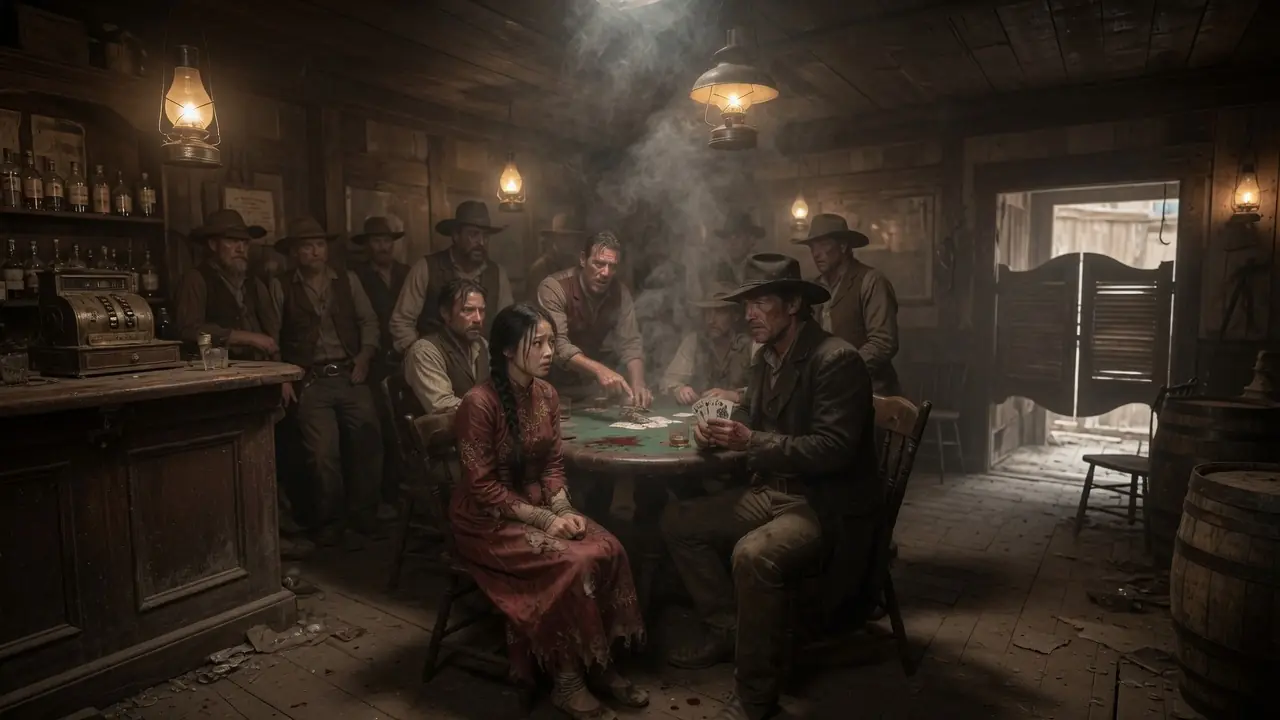
The whiskey was watered down. The cards were marked by those who knew where to look, and the bartender kept a loaded shotgun within easy reach. On this particular November night in 1882, the air hung thick with tobacco smoke, and the sour smell of unwashed bodies pressed too close together. Caleb Ridge sat in the back corner, exactly where he always sat when business brought him to town.
His back was to the wall, a habit formed during years when turning your back on a room could get you killed. His hat was pulled low, casting shadows across a face that hadn’t smiled in three years. Not since he’d buried his wife and infant daughter in the rocky soil of his ranch. The cards in his callous hands meant nothing to him.
Caleb didn’t gamble for money or excitement. He came to town once a month for supplies, sat in on a few hands to be sociable, lost a little, won a little, and rode back to his ranch before dawn. That was the routine. That was the life he’d carved out in his grief.
Simple, solitary, safe from the pain of caring about anything or anyone ever again. But tonight, routine was about to shatter. I’ll see your 20 and raise you 50, the man across the table said, his voice cracking with something that might have been desperation or might have been madness. Caleb’s eyes flicked up briefly.
The man was a stranger to these parts, a gambler by the look of him, with a fancy vest gone threadbare at the elbows and a diamond stick pin that was probably paste. His hand shook as he pushed chips into the center of the table. sweat beaded on his forehead despite the November chill that seeped through the saloon’s walls. That’s a bold play on a pair of sixes, friend, old Tom Weatherby said from his seat to Caleb’s right.
Tom was a fixture in these parts, a former prospector who’d found just enough gold to drink himself into an early grave. You sure you got the hand to back it up? The stranger’s laugh was brittle as breaking glass. I got something better than a hand, old man.
I got collateral. That’s when Caleb noticed her. She’d been sitting so still in the corner behind the stranger that she’d seemed like part of the shadows. Now, as every eye in the saloon turned her direction, she became terrifyingly real.
A young Chinese woman, maybe 20 years old, dressed in the tattered remnants of what had once been silk. Her black hair hung in a long braid down her back, and her eyes, dark and fathomless, stared at nothing, seeing everything. That’s right, gentlemen. the stranger said, his voice rising with a showman’s flare.
Mei Lin here is part of my stake. Won her off a railroad foreman up in Sacramento who didn’t need her no more. Been hauling her from town to town, but she’s more trouble than she’s worth. Doesn’t speak English, can’t cook worth a damn, and she’s got a stubborn streak a mile wide.
A murmur rippled through the saloon. Some men laughed. Others leaned forward with interest gleaming in their eyes, an interest that made Caleb’s stomach turn. You can’t wager a person, Silas, the bartender called out, though his protest sounded half-hearted at best.
That ain’t legal. Legal? The stranger, Silas, spat on the sawdust-covered floor. We’re 200 miles from the nearest marshal, and you’re talking to me about legal?
She ain’t a citizen. She ain’t got papers. And she sure as hell ain’t got rights. Out here, she’s whatever I say she is.
And right now, I say she’s worth 50 dollars in this pot. Caleb looked at the woman again. Mei Lin. She hadn’t moved, hadn’t reacted to being discussed like livestock. But Caleb saw the white-knuckled grip of her hands clasped in her lap.
Saw the barely perceptible tremor running through her thin frame. She was terrified, he realized. Terrified, but trained not to show it. Something twisted in Caleb’s chest.
Something he thought had died with his wife and daughter. I’m out, Old Tom said, tossing his cards onto the table. This is getting too dark for my taste. The other two players, a ranch hand named Pete and a drifter nobody knew, quickly followed suit.
That left just Caleb and Silas. What about you, friend? Silas asked, his eyes glittering with something feverish. You in or out?
Or are you too yellow to take a real gamble? Caleb studied his cards without really seeing them. He had three queens, a strong hand by any measure. But that wasn’t what made him keep his cards.
It was the look in Min’s eyes when she’d briefly glanced his direction. It was the memory of his own daughter’s face, frozen in death at six months old. It was the knowledge that if he folded, if he walked away, this woman would fall into the hands of whoever won the next hand. And based on the men still lingering around the table, those hands would show no mercy.
I’m in, Caleb said quietly. And I’ll see your 50 and raise you another hundred. A hush fell over the saloon. You got that kind of money?
Silas asked, suspicion mixing with greed in his expression. Caleb reached into his coat and pulled out a leather pouch, dropping it on the table. Gold coins clinked together. six months of careful saving.
He’d been planning to expand his barn come spring, maybe hire a hand to help with the cattle. That plan seemed distant and unimportant now. Silas’s eyes widened. His tongue darted out to wet his lips.
That’s that’s a lot of money. It’s a lot of woman according to you, Caleb replied, his voice level and cold. You backing out? Pride and greed warred on Silas’s face.
Pride won as Caleb had known it would. Men like Silas always let pride win. Call, said Silas said, shoving the rest of his meager chips into the pot. I call your raise.
Caleb laid down his cards. Three queens, a nine, and a seven. A solid hand. Silas stared at the cards for a long moment.
Then his face crumpled. Two pair, he said weakly, turning over his cards. Sixes and fours. The saloon erupted.
Men shouted, some congratulating Caleb, others cursing Silas for being a fool. Money changed hands as side bets were settled. The bartender banged his shotgun on the bar to restore some semblance of order. Through it all, Caleb sat perfectly still, his eyes not on the pot he’d won, but on the woman whose life had just changed hands like a playing card.
She’s all yours, Silas said, standing so quickly his chair fell backwards. There was relief in his voice now, relief at being free of a burden. Good riddance. You’ll regret it within a week. Mark my words.
She’s nothing but trouble. He didn’t wait for a response. Just grabbed his coat and stumbled toward the door, heading out into the cold November night. Caleb slowly raked the coins and chips toward him, separating out what was his from what Silas had wagered.
He left the coins that were supposed to represent Mei Lin’s worth scattered on the table. Then he stood, his 6’2 frame unfolding with deliberate slowness. The saloon had grown quiet again. Everyone was watching, watching him, watching her, waiting to see what would happen next.
Caleb walked over to where Mei Lin sat. Up close, he could see the marks of her ordeal more clearly. Her dress was torn at the hem. There were bruises on her wrists, partially hidden by her sleeves.
Her feet were wrapped in cloth rather than proper shoes. But it was her eyes that struck him most. Eyes that had seen too much, endured too much, and expected nothing but more of the same. Ma’am, Caleb said quietly, removing his hat.
My name is Caleb Ridge. I’ve got a ranch about ten miles from here. I can offer you a roof, food, and safety if you’ll come with me. She stared at him without comprehension.
He’d suspected she didn’t speak English, but the confirmation still presented a problem. How could he explain his intentions? How could he make her understand that he meant her no harm? He held out his hand, palm up, waiting.
For a long moment, Mei Lin didn’t move. Her eyes searched his face, looking for something. Cruelty, lust, deception. Whatever she was looking for, she apparently didn’t find it.
Slowly, moving like someone in a dream or a nightmare, she placed her small hand in his. Her skin was ice cold. Caleb carefully helped her to her feet. She swayed slightly, and he realized she was weak from hunger or exhaustion, or both.
Without thinking, he shrugged off his heavy wool coat and draped it around her shoulders. It swallowed her small frame, making her look even more fragile. Let’s go, he said, though he knew she couldn’t understand the words. He hoped his tone would convey safety.
They walked through the saloon together, Caleb moving slowly to match her unsteady pace. The crowd parted before them like water around a stone. Some men nodded respectfully at Caleb. Others watched Mei Lin with expressions that made Caleb’s hand drift toward the Colt revolver at his hip.
He met each gaze steadily until they looked away. The cold November air hit them like a physical blow as they stepped outside. The Dusty Rose Saloon sat on the outskirts of what barely qualified as a town. A collection of rough buildings huddled against the vast emptiness of the frontier.
Above them, stars blazed in a sky so clear it seemed impossible that anything ugly could happen beneath such beauty. Caleb’s horse, a sturdy rangy gelding named Buck, was tied at the hitching post. Next to Buck, looking half starved and mistreated, stood a swaybacked mare. That must have been how Silas and Mei Lin had traveled.
That your horse? Caleb asked, pointing to the mare. Mei Lin looked at the animal and gave a slight nod. All right, Caleb said.
We’ll bring her along. She needs better care than she’s been getting. He helped Mei Lin onto Buck first, then untied both horses. Leading them by the reins, he started down the dark road that led away from town, away from civilization toward his ranch, and whatever future awaited them there.
They walked in silence for nearly half an hour. The only sounds were the horses hooves on the hardpacked dirt, the whisper of wind through scrub grass, and the distant howl of a coyote. Caleb kept glancing up at Mei Lin, checking to make sure she hadn’t fallen asleep and tumbled from the saddle. Each time he looked, he found her wide-eyed and alert, watching the landscape pass with the careful attention of someone who needed to remember the way back.
She thinks I’m taking her somewhere to hurt her. Caleb realized she’s memorizing the route so she can escape. The thought made him sick to his stomach. What kind of life had she endured that made her expect that?
What had been done to her? When they were well away from town, Caleb stopped. He stood in the middle of the road, the reins loose in his hands, and looked up at the woman on his horse. I need you to understand something, he said, knowing she couldn’t understand his words, but hoping his tone would carry meaning.
I didn’t win you because I wanted to own you. I won you because if I didn’t, somebody else would have. Somebody worse. Mei Lin stared down at him, her face unreadable in the starlight. When we get to my ranch, Caleb continued.
I’m going to give you your own space. You’ll have a cabin. It’s small, but it’s warm, and it’s got a good lock on the inside of the door. Inside means you control it, not me.
You’ll have food and water. I won’t hurt you. I won’t force you to do anything. And when you’re ready, if you want to leave, I won’t stop you.
He paused, searching for the right words, even though he knew she couldn’t understand them. I lost my wife and baby daughter three years ago, he said quietly. Fever took them both in the same week. I couldn’t save them.
I couldn’t protect them when it mattered. Maybe I can’t make up for that. Maybe nothing can. But I’ll be damned if I stand by and let another innocent person suffer when I have the power to stop it.
Mei Lin tilted her head slightly, though she didn’t understand his words. Something in his tone or his expression seemed to reach her. The rigid terror in her posture eased just fractionally. Caleb tugged gently on Buck’s reins, and they resumed their journey into the darkness.
The Ridge Ranch appeared in the predawn gloom like a promise kept. It wasn’t much, a modest house, a barn, a few outbuildings, and a corral that held 30 head of cattle, but it was well-maintained and built with care. Caleb had put every ounce of his grief into this land, working himself to exhaustion every day so he wouldn’t have to think, wouldn’t have to feel. He led the horses to the barn first, helping Mei Lin down from Buck’s back.
He unsaddled both horses, rubbing them down and making sure they had feed and water. The swaybacked mare ate hungrily, and Caleb made a mental note to give her extra portions and check her for injuries in the daylight. While he worked, he was conscious of Mei Lin watching his every move from where she stood just inside the barn door, his coat still wrapped around her shoulders. When the horses were settled, Caleb grabbed a lantern and lit it.
He beckoned for Mei Lin to follow him. She did, maintaining a careful distance of about six feet between them. The cabin Caleb led her to had been built as a guest house back when he’d still imagined having guests, having family, having a life that included other people. It sat about 50 yards from the main house, far enough for privacy, but close enough to reach quickly if needed.
It was one room, maybe 15 feet square, but it had a woodstove, a bed with a real mattress, a table and chair, and shelves stocked with basic supplies. Caleb pushed open the door and held the lantern high so Mei Lin could see inside. Her eyes widened as she took in the space. He watched her mentally cataloging everything, the cleanliness, the supplies, the door that did indeed have a lock on the inside.
This is yours, Caleb said, setting the lantern on the table. He moved to the woodstove and began building a fire, working quickly with the ease of long practice. Within minutes, flames were crackling and warmth began to spread through the small room. He pointed to the shelves where he’d stored dried beef, beans, flour, coffee, and other staples.
He pantomimed eating, then pointed to her, then to the food. She needed to understand it was hers to use. Mei Lin nodded slowly. Caleb pulled the door key from where it hung on a nail by the door frame.
He held it out to her. When she hesitated, he took her hand as gently as he might handle a frightened bird and placed the key in her palm. Then he pointed to the lock on the door, made a locking motion, and nodded. Inside lock, he said clearly, knowing she wouldn’t understand, but needing to say it anyway.
You control it, not me. You. He saw the moment comprehension dawned. her fingers closed around the key and something flickered across her face. Surprise maybe or disbelief, as if the concept of having Control over anything was foreign to her.
Caleb backed toward the door, giving her space. He paused in the doorway and pointed to the main house, visible through the darkness. I’ll be there if you need anything. Main house. That way. She watched him with those fathomless dark eyes, still waiting for the trap to spring, for his true intentions to reveal themselves.
But Caleb just tipped his hat to her, stepped outside, and pulled the door closed behind him. He stood in the darkness for a moment, listening. After a few seconds, he heard the metallic slide of the lock being engaged from the inside. The sound satisfied something deep in his chest.
She was safe, at least for tonight. She was warm and had food and privacy. Tomorrow would bring its own challenges. Tonight, this was enough.
Caleb walked back to the main house as the first fingers of dawn began to paint the eastern sky. He didn’t go to bed. Instead, he sat in a chair on his porch, his rifle across his knees, and kept watch over the cabin until full daylight came. He’d won her life in a card game, but he’d be damned if he’d treat it as something owned.
Mean wasn’t his property. She was a person, a person who’d been through hell and deserved a chance at something better. Whether she’d trust him enough to take that chance remained to be seen. Inside the cabin, Mei Lin stood with her back pressed against the door, her heart hammering so hard she thought it might burst from her chest.
Her fingers gripped the key like a lifeline. She didn’t believe it. Couldn’t believe it. Men didn’t win women in card games and then give them privacy and locks and kindness.
There had to be a trick. There had to be a price. She’d been sold twice already in her young life. First by her desperate family to pay debts, then by her first owner to the railroad foreman, then by the foreman to Silas.
Each time she’d learned that survival meant submission, that resistance brought only pain, that hope was a luxury she couldn’t afford. And yet this strange silent man with the sad eyes had covered her with his coat, had given her a horse for the journey, had built her a fire and shown her food and handed her the key to her own door, had spoken to her with something that sounded almost like respect. It didn’t make sense. In Min’s experience, nothing good came without a price.
But as the cabin warmed and exhaustion finally overcame her fear, she allowed herself to move away from the door. She approached the bed cautiously, half expecting it to disappear like a mirage. When it remained solid beneath her tentative touch, she sat down. The mattress was firm and clean.
After months of sleeping on floors and in corners, and once in a horse stall, it felt like impossible luxury. Mei Lin unlaced the cloth wrappings around her feet. Her toes were bruised and blistered from walking too far and inadequate protection. She would need to find proper shoes somehow, though she had no idea how to ask for them.
Through the small window, she could see the main house. A single light burned in one window. Was the man Caleb? He’d said his name was Caleb.
Was he waiting there to come for her? Was this all just a game, a way to make her relax before he took what he wanted? But hours passed and he didn’t come. The sun rose higher, painting the unfamiliar landscape in shades of gold and brown.
Mei Lin watched, waiting, her muscles tense and ready to run, even though she had nowhere to run to. Still, Caleb didn’t come. Eventually, driven by hunger that n gnawed at her belly, Mei Lin approached the shelves where he’d indicated the food was stored. Her hands trembled as she reached for the dried beef, half expecting something to stop her, but nothing did.
She tore off a small piece and ate it slowly, the salt and smoke flavor exploding on her tongue. It was the first real meal she’d had in three days. She ate sparingly, knowing from hard experience not to overeat after going hungry. As she chewed, she continued to watch the main house.
The man emerged midmorning. He walked to the barn, did some work there, then headed to the corral where cattle moved slowly in the weak November sun. He never once looked toward her cabin, never checked on her, never demanded anything. It was the strangest form of captivity Mei Lin had ever experienced.
As the day wore on and Caleb continued to maintain his distance, something small and fragile began to unfurl in Mei Lin’s chest. It wasn’t trust. Trust would take far more than one day of kindness to earn. It wasn’t even hope.
Not really, but it was possibility, the faintest glimmer of possibility that maybe, just maybe, this time would be different. She didn’t believe it yet, but she hadn’t stopped watching. And in a life where watching carefully had meant the difference between survival and destruction, that was as close to hope as Mei Lin dared to get. Outside, Caleb worked his land and kept his distance, and wondered how long it would take for the haunted look to fade from the eyes of the woman he’d won in a card game.
Neither of them knew that this fragile beginning was the first step on a journey that would transform them both. That would take two broken souls and forge them into something stronger than either could have been alone. But that knowledge would come later. For now, there was just the silence, the space, and the tiny seed of possibility planted in the cold November earth.
The first week passed in a silence so complete it felt like a physical presence between them. Caleb maintained his routine with the discipline of a soldier. He woke before dawn, tended to his cattle, repaired fences, chopped wood, and handled the countless tasks that came with running a ranch alone. Every morning he left a basket outside Mei Lin’s cabin door, fresh eggs when the chickens provided them, bread he’d baked himself, vegetables from his root cellar, sometimes a piece of salt pork or dried venison.
He never knocked, never waited to see if she’d open the door. He simply left the basket and walked away. Every evening, the basket would be empty, sitting precisely where he’d left it. It was the only communication they had.
From his porch, Caleb could see smoke rising from her cabin’s chimney, so he knew she was keeping the fire going. Sometimes, in the late afternoon, he’d catch a glimpse of her shadow moving past the window. Once he saw her standing in the doorway, wrapped in a blanket, watching the sunset paint the sky in shades of orange and purple. When she noticed him on his porch, she’d retreated inside so quickly she might have been a ghost.
He didn’t approach, didn’t try to force conversation or connection. He’d learned patience in his years alone. Had learned that some wounds needed time more than they needed anything else. On the eighth day, he found the basket moved.
Not much, just a few inches to the left, placed more carefully than usual. It was such a small thing that most men wouldn’t have noticed. But Caleb had spent three years with only cattle for company, and he’d learned to read the small signs, the tiny shifts that indicated change. She was acknowledging him in her own way, in her own time.
She was letting him know she saw his effort. That night, Caleb added an extra blanket to the morning basket. Winter was coming on hard, and the nights were getting colder. He also included a pair of his late wife’s boots.
Sarah had been a small woman, and he thought they might fit Mei Lin’s feet better than the cloth wrapping she’d been wearing. The next morning, the blanket was gone from the basket. The boots remained. Too big, Caleb thought.
Or maybe too much too soon. He took the boots back without comment and left the basket empty except for food. two days later, he tried again, this time with a pair of thick wool socks and some leather strips that could be wrapped around them for warmthth. These disappeared from the basket.
It became a strange dance, this wordless negotiation of care and acceptance. Caleb would leave things. Mei Lin would take what she could accept and leave what she couldn’t. He learned to read her boundaries through these small rejections and acceptances.
Learned that practical items were acceptable, but anything that felt too personal was not. The second week brought the first real cold snap. Caleb woke to find frost covering everything, turning his ranch into a crystalline landscape that sparkled in the early morning light. His breath misted in the air as he did his morning rounds, and he worried about whether Mei Lin had enough wood for her stove.
When he approached her cabin to leave the morning basket, he found her outside. She was gathering wood from the small pile he’d stacked near her door, her arms full of logs that were clearly too heavy for her slight frame. She wore the wool socks he’d given her, wrapped with the leather strips, and she’d fashioned his coat into a makeshift cloak that covered most of her body. Her breath came in short white puffs, and her hands were red with cold.
She froze when she saw him like a deer sensing a hunter. Caleb stopped walking, giving her space. He set down the basket slowly, deliberately, then pointed to the wood pile. Let me, he said, knowing she wouldn’t understand the words, but hoping his gesture would be clear.
Min’s eyes darted from him to the wood to the cabin door. He could see her calculating distances, weighing risks. After a long moment, she took one step backward, then another, creating space between them while keeping her eyes locked on his face. Caleb moved slowly, telegraphing each motion.
He walked to the wood pile, gathered a large arm load, twice what she’d been carrying, and carried it to her cabin door. He set it down carefully, then backed away. Then he returned to the wood pile and brought another load and another. He worked steadily for 20 minutes, stacking enough wood by her door to last her several days.
Through it all, Mei Lin watched from a safe distance, her expression unreadable. When Caleb finished, he dusted off his hands and nodded to her. Should be enough for a while, he said. Then he picked up the empty basket from the previous evening, left the new one, and walked away without looking back.
He was halfway to his barn when he heard it. A sound so soft he almost missed it over the crunch of frost beneath his boots. Chia. Caleb turned. Mei Lin stood by her cabin door, one hand gripping the door frame as if she might need to dart inside at any moment. She was looking at him, really looking at him for the first time since that night in the saloon.
He didn’t know what the words meant, but he understood the tone. Thank you. She was thanking him. Caleb touched the brim of his hat in acknowledgement, keeping his expression neutral, careful not to make too much of the moment. You’re welcome, ma’am, he said quietly.
She slipped back inside her cabin, but this time she didn’t slam the door. She closed it gently, deliberately, and through the window he saw her shadow pause there, as if she too was trying to understand what had just passed between them. That night, Caleb sat at his kitchen table with a cup of coffee and his late wife’s old dictionary. Sarah had been educated, the daughter of a schoolteacher, and she’d loved books.
Her small library still sat on the shelf in the bedroom Caleb couldn’t bring himself to enter, but she’d kept a working dictionary in the kitchen where she’d sometimes write letters or read while Caleb did his evening chores. He flipped through it now, looking for anything that might help him communicate with Mei Lin. But the dictionary was English words defined by other English words. It was useless for his purpose.
He needed a different approach. The question was, what? The answer came to him three days later when he was in town for supplies. The general store had a new shipment of goods, and among them was a child’s picture book.
Simple drawings with single words beneath them. Apple, horse, house, sun, moon. That’s for teaching reading, the shopkeeper said when he saw Caleb studying it. You got a young one I don’t know about, Ridge?
Something like that, Caleb replied, adding it to his purchases. He also bought a small slate and some chalk, the kind school children used. If he couldn’t speak to Mei Lin, maybe he could draw. Maybe they could build a bridge of images and simple words, one careful step at a time.
That evening, he left the picture book, slate, and chalk in the morning basket along with the usual food. He weighted the book down with a small stone so the wind wouldn’t scatter the pages. For two days, nothing happened. The book remained in the basket, untouched.
Caleb began to think he’d overstepped again, pushed too hard, too fast. But on the third morning, when he went to collect the empty basket, he found the slate inside. On it, drawn in careful chalk lines, was a simple flower, five petals, a stem, two leaves. Beneath it, she’d copied the word from the picture book, flower.
Caleb stood there in the cold dawn light, staring at that drawing and felt something crack open in his chest. It was the first time she’d offered something back, the first time she’d reached across the silence that separated them. He carried the slate back to his house with hands that trembled slightly. That night, he sat at his table and drew his own picture, a simple rendering of the sun rising over mountains.
Beneath it, he wrote, sun. Then after a moment’s thought, he added another word, hope. The next morning, he left the slate in the basket. From then on, the slate became their conversation.
Each day, one of them would draw something and write the English word beneath it. Mei Lin was learning his language letter by letter, word by word. And Caleb was learning something, too. Learning that healing wasn’t loud or dramatic.
It was quiet and slow, built from tiny acts of trust. accumulated over time like snow building into drifts. By the end of the third week, their pictures had become more complex. Mei Lin drew the barn, the cattle, the chickens that pecked around the yard.
Caleb drew the seasons. Winter’s bare trees, spring’s first flowers, summer’s full fields, autumn’s falling leaves. Under each image, he wrote the English words, and she copied them in her own careful hand. One morning, he found a new drawing on the slate.
It showed two stick figures, one tall, one small, standing on opposite sides of a simple house. Between them, Mei Lin had drawn a line like a wall or a border. Beneath the tall figure, she’d written Caleb. Beneath the small figure, Mei Lin.
Caleb studied the drawing for a long time, understanding what she was telling him. She saw the distance between them. She understood that he was maintaining space deliberately. She was asking or maybe just observing why they stood apart.
That night, Caleb drew his response. He copied her picture exactly, but he erased the line between the figures. In its place, he drew a door, open, inviting, but not forcing. Beneath his drawing, he wrote, When ready.
He wasn’t sure she’d understand. The concept was too complex for their simple picture language. But when he collected the slate the next morning, she’d added one more element to his drawing. She’d drawn a small clock next to the door with a question mark beside it.
She was asking how long, how long until that open door became real instead of theoretical. Caleb erased everything and drew something new. Just a simple image of a man waiting. Beneath it, he wrote, As long as it takes.
The slate came back empty the next day, wiped clean. For a moment, Caleb worried he’d said the wrong thing. But that afternoon, when he returned from checking his fence line, he found something new waiting on his porch. It was a small carving, no bigger than his thumb, made from a piece of scrap wood she must have found near her cabin.
She’d shaped it into a crude but recognizable horse, Buck, he realized his rangy gelding. The details were rough, carved with what must have been a sharp stone or a piece of metal, but the care in it was evident. Caleb picked it up with hands that had forgotten how to be gentle with delicate things. The wood was smooth where she’d worked it, still showing the marks of her effort.
It must have taken her days to make. He looked toward her cabin and saw her watching from the window. When their eyes met, she didn’t retreat this time. She just stood there, letting him see her, letting him hold this piece of herself she’d offered.
Caleb held up the carving, nodding his thanks. Then he placed it carefully on the windowsill of his front window where she could see it from her cabin where it could remind both of them that something was growing between them. Fragile as new grass but growing nonetheless. That night, the temperature dropped below freezing.
Caleb woke to the sound of wind howling around his house, rattling the shutters and driving ice-cold air through every crack. He pulled on his coat and boots and went to check on the cattle, making sure they had access to the sheltered areas of the barn. As he worked, his mind kept drifting to the small cabin and the woman inside it. The structure was solid enough, but the stove was small.
Would she have enough wood? Would she know to bank the fire properly to keep warm through the long night? He told himself to stop worrying. She’d survived this long without him.
She had enough supplies. She could manage one cold night, but memory rose unbidden. Sarah’s voice on a night much like this one, reading aloud from one of her books while their baby daughter slept in the cradle Caleb had built. The warmth of family, of not being alone against the darkness and cold.
He’d lost that warmth, and the loss had nearly destroyed him. Caleb finished with the cattle and stood in the barn doorway, looking out at Min’s cabin. Smoke rose from the chimney, a thin gray line against the black sky. She was awake, tending her fire.
He should go back to his house, should respect the boundaries they’d established, should trust that she’d ask if she needed help. But something pulled at him. Instinct or worry or the memory of loss. Against his better judgment, Caleb walked through the freezing night to her cabin.
He knocked three gentle raps that wouldn’t startle. Silence answered him. Mei Lin, he called softly. It’s Caleb. I just want to make sure you’re all right in this cold. More silence.
He tried again, knowing she probably didn’t understand enough English yet to grasp his meaning. Then her voice came from inside, thin and uncertain. Cold? Very cold. Three words. English words. She’d been practicing.
Can I bring you more wood? Caleb asked. Wood for fire for warmth. A pause. Then yes, thank you. Caleb hurried back to his own wood pile, loading his arms with the driest, best burning logs he had.
He returned and knocked again. This time he heard the scrape of the lock, and the door opened a crack. Mei Lin stood there, wrapped in every blanket she owned, shivering despite the layers. The cabin behind her was dim, lit only by the struggling fire in the stove.
The wind, she said, gesturing to the walls. Air comes. Fire is small. She was trying so hard to communicate, using the handful of English words she’d learned. Caleb felt a surge of admiration for her effort.
I understand, he said. He gestured to the wood in his arms, then to the stove. May I help? Mei Lin hesitated.
Then, in a decision that must have cost her greatly, she stepped back and opened the door wider. Caleb entered slowly, keeping his movements predictable and calm. The cabin was indeed much colder than it should be. He could see his breath, and he noticed now that several of the wall boards had gaps where the wind was whistling through.
He’d need to fix that before the next cold snap. But first, the fire. He knelt by the stove and opened it, studying the weak flames struggling against the draft. Your wood is good, he said, speaking slowly and clearly.
But the air flow is wrong. I can fix it. He adjusted the damper, repositioning the logs to allow better air flow. Within minutes, the fire was burning stronger, radiating more heat into the small space.
Then he stood and examined the walls, finding the worst gaps. I have materials, he said, pointing to the gaps and then toward his barn. Tomorrow, I fix these. Make warm. Okay. Okay, Mei Lin repeated, though she hugged her blankets tighter around herself.
Caleb turned to leave, but as he reached the door, he noticed she was still shivering despite the improved fire. The cold had gotten too deep into the room, and it would take time for the space to warm properly. He paused, weighing his next words carefully. Mei Lin, it’s very cold tonight.
Your cabin will warm up, but it will take time. My house is bigger with a better stove. You could, he trailed off, seeing alarm flash across her face. No, she said quickly.
I stay here. I understand, Caleb said, backing off immediately. You’re safe here. I just wanted to offer.
But even as he said it, he could see she was shaking badly now, and he realized with a start that it wasn’t just from cold. She was afraid. Afraid that his offer was a trick, a way to get her into his space where she’d be vulnerable. The realization hit him like a physical blow.
Of course, she was afraid. Every kindness she’d ever been shown had probably come with a price. Why would she believe his was any different? Listen, Caleb said, squatting down so he was at her eye level rather than looming over her.
I’m going to leave now, but I’m going to put more wood right outside your door, enough to last all night. And I’m going to leave my door unlocked. If you need anything, anything at all, you can come to my house. There’s a spare room with its own door and lock.
If you get too cold, if you need help, that room is yours. No questions asked. He could see her processing this, trying to decide if it was truth or trap. I lost my family, Caleb continued, his voice rough with old grief.
My wife and baby daughter, I couldn’t protect them when it mattered. But I can protect you now if you’ll let me. Not because I own you. I don’t. Nobody owns you, but because it’s the right thing to do.
Because you deserve to be warm and safe. And he stopped, realizing he was saying too much, overwhelming her with English she probably couldn’t follow. I’m sorry, he said simply. I’ll leave more wood outside.
You stay here if that’s what you want. You’re safe. He stood and moved to the door. As he opened it, letting in a blast of frigid air, Mei Lin spoke behind him. Caleb. He turned. She was watching him with an expression he couldn’t quite read.
Thank you, she said carefully. For fire, for wood, for she gestured around the cabin, seeming to encompass everything, the supplies, the privacy, the careful distance he’d maintained. For this. You’re welcome, Caleb said softly. Then he stepped out into the cold and closed the door behind him.
True to his word, he stacked enough wood outside her cabin to last through several nights. Then he returned to his house where he deliberately left his front door unlocked, something he hadn’t done since Sarah died. He didn’t expect Mei Lin to come, but the offer needed to be real, needed to be genuine, or it meant nothing. Caleb lay in his bed, listening to the wind howl in the house creak, and found himself unable to sleep.
He kept thinking about the small cabin, about Mei Lin wrapped in blankets, about how fragile this trust between them was, and how easily it could shatter. Somewhere past midnight, exhaustion finally claimed him. He woke to pale dawn light and the smell of wood smoke. For a moment, in that confused space between sleep and waking, he thought he was back in time, that Sarah was up early making breakfast, that his daughter would wake soon and need feeding.
Then reality crashed back as it always did. Caleb rose and dressed, steeling himself for another day of careful distance and wordless negotiation. He opened his bedroom door and stepped into the main room of his house. Then he froze.
Mei Lin sat at his kitchen table wrapped in one of his blankets, her hands cupped around a mug of something hot. She looked up when she heard him, and for a long moment they just stared at each other. The cold, she finally said, her English halting but determined. was too much. I came.
You said come if need, so I came. Caleb’s throat felt tight. She’d done it. She’d taken the risk, crossed the distance, accepted his offer of shelter.
It was a leap of faith, bigger than any he’d asked of her before. You did right, he managed to say. I’m glad you came. He could see now that she’d made herself tea from his supplies and had been sitting here waiting for him to wake.
The spare room door stood open, showing an undisturbed bed. She hadn’t slept. Too afraid perhaps, or too vigilant to let her guard down that much. Are you warm enough now? Caleb asked.
Mei Lin nodded. Yes, your fire is big, strong. An awkward silence fell between them. This was new territory.
She was in his space now, not separated by yards and walls. The rules of their careful dance didn’t quite apply here. Are you hungry? Caleb asked, moving slowly toward the kitchen area.
I can make breakfast. I can help, Me offered uncertainly. If you want to, Caleb replied. But you don’t have to.
You’re a guest, not a servant. He could see her struggling with that concept. In her experience, there were owners and owned, masters and servants. The idea of being simply a guest with no debt owed seemed to confuse her.
They worked together in careful silence, Caleb showing her where things were, Mei Lin following his lead. He made eggs and fried bread, while she set the table with an attention to detail that spoke of long practice. When they sat down to eat, they took seats across from each other, maintaining distance even while sharing a meal. Halfway through breakfast, Mei Lin spoke.
Why? she asked, the single word loaded with a thousand questions. Caleb knew what she was asking. Why had he won her in that card game?
Why had he given her a cabin instead of chains? Why did he feed her and protect her and ask nothing in return? He set down his fork and looked at her directly. Because you’re a person, he said simply, not property, not a thing to be owned, a person, and people deserve dignity.
Mei Lin absorbed this, her dark eyes searching his face for deception and finding none. In my country, she said slowly, clearly working hard to find the right English words. I was sold two times. First time for money.
Family had no food. They sell me. Second time, railroad man bought me. He was bad.
She touched her wrist unconsciously where Caleb had seen bruises that first night. Then Silas, she continued, he won me in game like you, but he was angry always hit me. No food for many days. Said I was nothing, worth nothing.
Her voice was flat, reciting facts without emotion. But Caleb could see the pain beneath her control. When you won me, Mei Lin said, I thought, Same. Same like others, but you.
She gestured around the house, struggling to express something too complex for her limited English. You are different. I don’t understand why. Because treating people right shouldn’t be rare, Caleb said.
It should be normal. The fact that kindness surprises you tells me how badly you’ve been treated, and that’s not okay. Mei Lin tilted her head, processing this. You lost family, she said.
It wasn’t a question. Wife and baby, you said. Yes, Caleb confirmed, surprised she’d understood and remembered from his rambling the night before. So, you are alone, Mei Lin continued. Like me.
We are both alone. I suppose we are, Caleb agreed. They finished breakfast in a more companionable silence. When the meal was done, Mei Lin helped him wash the dishes without being asked.
Then she gathered her blanket around her shoulders. I go back, she said, gesturing toward her cabin. To my house. Wait, Caleb said.
Let me fix those gaps in the walls first, otherwise tonight will be just as cold. Mei Lin hesitated, then nodded. Okay. They walked together through the morning cold to her cabin. Caleb gathered his tools while Mei Lin watched from the doorway.
He worked efficiently, stuffing the gaps with insulation he’d made from old cloth and sealing them with thin strips of wood. While he worked, he was conscious of her eyes on him, always watching, always evaluating. You have people? Mei Lin asked suddenly.
In town, friends? Not really, Caleb admitted. I keep to myself mostly. After Sarah and the baby died, it was easier to be alone.
Easier? Mei Lin repeated thoughtfully. But not better. The question caught him off guard.
He paused in his work, considering it. No, he finally said, not better, just easier. Same for me, Mei Lin said softly. Is easier to trust no one, but not better.
Caleb looked at her then, really looked at her, and saw something he’d missed before. She wasn’t just a victim surviving trauma. She was a person making choices, evaluating her circumstances, deciding each day whether to risk trusting him a little more. Maybe we can both try something better than easier, Caleb suggested quietly.
Mei Lin didn’t respond, but she didn’t retreat inside either. She stayed in the doorway, watching him work, and when he finished and stood back to survey his repairs, she spoke again. Thank you for this, for everything. You already thanked me.
Caleb pointed out. I know, but I say again because I mean it. Caleb nodded, picking up his tools. You’re welcome again.
As he walked back to his house, he felt something shift inside him. A loosening of the tight knot of grief and isolation he’d carried for three years. He’d helped someone today. He’d made a difference, however small, in one person’s life.
It wasn’t redemption for failing to save his family. Nothing could be that. But it was something, a start, a step back toward being human again. Behind him, Mei Lin closed her newly weatherproofed cabin door.
But this time, Caleb noticed she didn’t lock it right away. She stood there for a moment, watching him walk away, and only then did he hear the quiet click of the lock engaging. Progress, he thought. Slow, careful progress.
It would have to be enough. The weeks that followed brought a rhythm to their days that felt almost like normalcy, almost, but not quite. Because beneath the surface of shared meals and careful conversations, both Caleb and Mei Lin carried the weight of their separate wounds, and healing was never a straight path. December arrived with a vengeance, bringing snow that transformed the ranch into a white wilderness.
Mei Lin had never seen snow before, and the morning she woke to find the world buried under a blanket of white, she stood in her doorway with an expression that was equal parts wonder and fear. Caleb was already up, clearing a path from his house to the barn when he noticed her. He stopped his work and waited, letting her take in the transformed landscape at her own pace. After a long moment, she stepped out tentatively, her feet sinking into snow that came up to her ankles.
She bent down, scooped up a handful, and watched it melt against her palm with the fascination of a child discovering magic. It’s called snow, Caleb called out, keeping his distance, but wanting to share her moment. It falls when it gets cold enough. Usually melts by spring.
Snow, me repeated, tasting the word. She looked up at the gray sky where more flakes were drifting down like ash from a gentle fire. Is beautiful, but also cold. That’s the truth of it, Caleb agreed.
Beautiful and dangerous at the same time. He returned to his shoveling, but he was aware of Mei Lin experimenting with the snow, packing it between her hands, watching how it compressed and held shape. When he next looked up, she’d built a small mound near her cabin door, crude and lopsided, but unmistakably intentional. That’s good, Caleb said, gesturing to her creation. Very good.
It’s called a snowman, though usually they’re taller. Mei Lin smiled then, a real smile. Small and fleeting, but genuine. It was the first time Caleb had seen her smile, and it transformed her face from merely pretty to something luminous.
He found himself smiling back before he could stop himself. But the smile faded from both their faces when they heard the sound of horses approaching on the road. Caleb straightened, his hand instinctively moving to where his rifle leaned against the fence. Visitors were rare this far out, and unexpected visitors were rarely good news.
Mei Lin had gone completely still, her body tense as a bowstring, her eyes tracking the sound. Three riders came into view, moving slowly through the deep snow. As they drew closer, Caleb recognized the lead horse and relaxed slightly. It was Doc Hendricks from town, along with two men Caleb didn’t know.
Caleb Ridge, Doc Hendricks called out as they approached. He was a weathered man in his 60s with kind eyes and steady hands that had delivered half the babies in the territory and closed the eyes of half the dead. Hope we’re not intruding. Doc, Caleb replied, keeping his tone neutral.
What brings you out in this weather? The doctor dismounted with a grunt, his joints stiff from the cold ride. Heard you might have someone here who needs medical attention. Thought I’d check in, seeing as how the snow is going to make travel harder for a while.
Caleb’s eyes narrowed. Who told you that? Does it matter? Doc Hendricks gestured to his companions who remained mounted.
These are my assistants. We’re making rounds to the outlying ranches, making sure everyone’s prepared for winter. It was a reasonable explanation, but something felt off. Caleb glanced at Mei Lin and saw that she’d backed up to her cabin door, ready to bolt inside at the first sign of danger.
Her instincts were good. These men might be exactly what they claimed. Or they might be something else entirely. We’re doing fine here, Doc, Caleb said carefully.
Appreciate the concern, but we don’t need any help. We Doc Hendricks raised an eyebrow. So, it’s true then. You’ve got that Chinese girl out here, the one you won from Silas Webb.
The way he said it made Caleb’s jaw clench. Her name is Mei Lin and she’s a free person living on my land. Same as any tenant farmer or ranch hand. Now, Caleb, nobody’s suggesting otherwise, Doc said, holding up his hands in a placating gesture.
But you got to understand how it looks. A man living alone for three years suddenly has a young woman on his property. People talk. Let them talk, Caleb replied flatly. As long as Mei Lin is safe and treated with respect, I don’t care what people say.
One of the mounted men spoke up, his voice carrying an edge that made Caleb’s hackles rise. That’s real noble of you, Ridge, but some folks in town are wondering whether this girl wants to be here, or if maybe she’s being kept against her will. That’s ridiculous, Caleb said, his voice hardening. She has her own cabin.
She locks it from the inside. She’s free to leave anytime she wants. Then maybe we should ask her, the man pressed. Let her speak for herself.
Caleb’s hand moved closer to his rifle. You’re not interrogating anyone on my land. If Mei Lin wants to talk to you, that’s her choice. But I’m not going to let you intimidate her.
Nobody’s intimidating anyone, Doc Hendricks interjected quickly, shooting a warning glance at his companion. We’re just concerned citizens, Caleb. You got to admit the circumstances are unusual. Unusual doesn’t mean wrong, Caleb said.
During this exchange, Mei Lin had been watching and listening with intense concentration. Her English had improved considerably, but rapid conversation between multiple speakers was still challenging for her. What she understood clearly, though, was that these men represented a threat. Not the immediate physical threat she’d learned to recognize and fear, but something more complex and potentially more dangerous.
She stepped forward, moving away from the safety of her cabin. Caleb shot her a concerned look, but she kept walking until she stood a few feet from him. Close enough to show unity, but not so close as to suggest dependency. I am Mei Lin, she said, her voice clear despite the tremor Caleb could hear beneath it.
I live here. I choose to live here. Caleb Ridge is good man. He give me house, give me food, give me safety.
I am not prisoner. I am. She searched for the word guest and maybe friend. The last word came out softer, more tentative, as if she was testing it for the first time. Doc Hendricks studied her for a long moment.
Then he nodded slowly. All right, miss. If you say you’re here by choice, then that’s good enough for me. He glanced at his companions.
We should be moving on. Other ranches to check before the next storm hits. But the man who’d spoken before wasn’t ready to let it go. How do we know she’s not just saying what he told her to say?
She’s probably scared of what he’ll do if she speaks the truth. Min’s eyes flashed with something Caleb had never seen in her before. Anger. You think I’m weak? Think I cannot speak truth?
She drew herself up to her full height, which wasn’t much, but her presence seemed to fill more space than her small frame should have occupied. I was sold by my family. I was owned by bad men. I know what is prison.
This, she gestured around the ranch, is not prison. This is first place I am treated like person. First place I am safe. You want to help me?
Then leave me alone. Let me heal. The silence that followed her words was profound. Even the horses seemed to sense the weight of what she’d said, standing perfectly still in the falling snow.
Doc Hendricks cleared his throat. Well then, I apologize for the intrusion, Miss Mei Lin. Caleb, he nodded to both of them. We’ll be on our way.
He remounted with some difficulty, and the three riders turned their horses back toward town. But before they disappeared into the swirling snow, the man who’d been so hostile called back over his shoulder. Silas Webb is back in town. Ridge thought you should know.
He’s been drinking heavily and talking about how he got cheated in that poker game. You might want to watch your back. Then they were gone, swallowed by the white landscape. Caleb stood motionless, processing this information.
Silas was back. That complicated things considerably. Who is Silas? Mei Lin asked.
Though Caleb suspected she knew exactly who he was. The man who lost you in the card game, Caleb said. The man you were with before you came here. Mei Lin nodded slowly.
He was very angry all the difference. time. Angry. He will come here. I don’t know, Caleb admitted. But if he does, I won’t let him hurt you.
I promise you that. Mei Lin looked at him for a long moment. Something unreadable in her expression. You make many promises to me.
Why? It was a fair question. Caleb thought about his answer carefully before speaking. When my wife Sarah died, he said, I made her a promise.
I promised I’d try to do right by people, try to make the world a little better than I found it. I broke a lot of promises to her when she was alive, was gone too much, worked too hard, didn’t tell her I loved her enough. But that last promise, the one I made when I buried her. That one I can keep.
So I am promise to dead wife? Mei Lin asked, and there was hurt in her voice. No, Caleb said quickly. No, that’s not what I meant.
You’re not a promise or an obligation or a debt to be paid. You’re a person who deserves better than what life has given you. Helping you isn’t about Sarah. It’s about you.
Mei Lin absorbed this, the hurt in her expression easing slightly. Thank you, she said, for explaining. My English is better, but sometimes I misunderstand. Your English is remarkable, Caleb said honestly.
You’ve learned more in a few weeks than most people learn in months. A faint flush colored Min’s cheeks at the compliment. I practice every day. The picture book helps.
And listening to you. They stood there in the falling snow. The space between them somehow less than it had been before. The confrontation with Doc Hendricks and his companions had shifted.
Something had forced them to declare their alliance publicly. There was no going back from that. We should get inside, Caleb said, breaking the moment. Storm’s getting worse.
But as they turned toward their respective shelters, Mei Lin spoke again. Caleb, tonight, can I can I come to your house for dinner? I want to learn more English, and I want to She struggled with the words, not be alone when storm comes. It was the first time she’d asked for something beyond basic necessities, the first time she’d admitted to wanting companionship rather than just safety.
Of course, Caleb said, trying to keep the surprise and pleasure out of his voice. I’d like that. That evening, as wind howled around the buildings and snow piled higher against the walls, Caleb and Mei Lin sat at his kitchen table with the picture book between them. He taught her new words: table, chair, window, storm, safe, and she repeated them carefully, her pronunciation improving with each attempt.
When they’d worked through several pages, Mei Lin closed the book and looked at Caleb directly. Can you teach me to write letter? She asked. Not just word, whole letter. So if I need help, I can write for it.
You mean if something happens to me? Caleb asked, understanding the practical fear beneath the request? Yes. Or if Silas comes or if anything happens. I want to be able to ask for help in English.
That’s smart thinking, Caleb said. He found some paper and a pencil and began teaching her the basics of letter writing. They worked until late into the night. Mei Lin practicing each phrase until she could write it clearly.
Dear sir or madam, I am writing to request assistance. My name is Mei Lin. I am at Ridge Ranch, ten miles west of town. Please send help.
It was a grim exercise planning for disaster, but Caleb understood why she needed it. Control over her own fate, even in small ways, was essential to her healing. When they finished, Mei Lin carefully folded the practice letter and tucked it into her pocket. Thank you, she said.
Now I am less afraid. Fear is good sometimes, Caleb said. Keeps you alert. But you shouldn’t have to live in constant fear. Nobody should.
In my country, Mei Lin said slowly, there is saying, The bird in cage forgets how to sing but never forgets it has wings. I forgot my wings. You help me remember. Caleb felt his throat tighten at her words.
You always had wings, Mei Lin. You just needed a safe place to remember how to use them. The storm raged for three days. During that time, Mei Lin spent most of her hours in Caleb’s house rather than her cabin.
It was simply more practical, warmer with better supplies and more space. They fell into an easy routine of shared meals and English lessons punctuated by long stretches of comfortable silence while Caleb mended tack and Mei Lin practiced her writing. On the second night of the storm, when the wind was screaming like a living thing and the windows rattled in their frames, Mei Lin fell asleep at the kitchen table, her head pillowed on her arms, her hand still holding the pencil she’d been using to practice letters. Caleb stood over her, torn between waking her to send her to the spare room and letting her sleep where she’d fallen.
She looked so young in sleep, so vulnerable that something protective and fierce rose in his chest. Whatever happened, whatever came next, he would keep her safe. He’d failed to protect his own family, but he would not fail her. Gently, he lifted her in his arms.
She weighed almost nothing and carried her to the spare room. She stirred slightly, but didn’t wake as he laid her on the bed and covered her with quilts. He left the door open and the lamp burning low in the hallway, so she wouldn’t be frightened if she woke in an unfamiliar place. Then he returned to the kitchen and sat in the chair she’d vacated, staring at the words she’d been practicing.
Her handwriting was careful and deliberate, each letter formed with painstaking precision. I am Mei Lin. I am a person. I have value.
I am free. She’d written it 50 times, filling the entire page with this simple declaration of her own worth. Caleb felt something break and reform inside him as he read those words over and over. The storm broke on the morning of the fourth day, leaving the world buried under three feet of snow and glistening in weak winter sunlight.
Caleb woke to find Mei Lin already up standing at the kitchen window and watching the transformed landscape. It’s beautiful when it’s still, she said without turning around. when it stops being angry. Like people, Caleb observed, coming to stand beside her.
Yes, like people, she glanced at him. You are not angry anymore. Not like when I first came. Caleb was surprised by her observation.
I didn’t realize I was angry then. Very angry, Mei Lin said. But hiding it, pushing it down deep. Now it’s less.
you are more um peaceful. Maybe you’re right, Caleb admitted. Having someone to care for again, someone to be responsible for, it gives me purpose beyond just surviving. I am glad, Mei Lin said that I can give you something.
You give me so much. I want to give something back. Before Caleb could respond, they heard it. The sound of a horse approaching through the deep snow.
Just one rider this time, moving slowly but deliberately toward the house. Caleb’s hand went to his rifle automatically. Mei Lin tensed beside him, her breathing quickening with fear. The writer came into view, and Caleb felt ice form in his stomach.
It was Silas Webb. He looked worse than he had that night in the saloon, thinner, meaner, with the desperate edge of a man who’d lost everything and had nothing left to lose. He pulled his horse to a stop in front of the house and sat there staring at the building with red-rimmed eyes. Stay inside, Caleb told Mei Lin quietly.
Lock yourself in the spare room if things go wrong. No, Mei Lin said, surprising him. I stay with you. We face him together.
Mei Lin, together, she repeated firmly. I am not hiding anymore. Caleb wanted to argue, wanted to protect her from this confrontation, but he recognized the steel in her voice. This was important to her, facing her path, standing her ground.
He couldn’t deny her that. Stay behind me, he compromised. And if I tell you to run, you run. Understood? She nodded.
Caleb picked up his rifle, checked that it was loaded, and walked to the door. He opened it and stepped out onto the porch. Mei Lin following close behind him. Webb, Caleb called out, his voice carrying across the snow.
You’re not welcome here. Turn around and ride back to town. Silas laughed, a sound like breaking glass. Not welcome?
That’s rich coming from the man who stole my property. She’s not property, Caleb said flatly. She’s a person, and she was never yours. You lost her in a fair game.
Fair? Silas spat the word. You cheated. Had to have. Nobody’s luck is that good.
My hand was better than yours. That’s not luck. That’s just cards. Silas swayed in his saddle and Caleb realized the man was drunk.
That made him more dangerous, more unpredictable. I want her back, Silas said, his words slurring slightly. I paid good money for her. She owes me work, and I aim to collect.
The only thing she owed you was left on that poker table, Caleb replied. You’ve got no claim here. Now leave before this gets ugly. Gets ugly. Silas reached for something at his belt and Caleb raised his rifle in one smooth motion, aiming at the man’s chest.
Don’t, Caleb said, his voice dropping to a deadly quiet. Whatever you’re reaching for, leave it where it is. Silas froze, his hand hovering near what looked like a knife sheath, his eyes, bloodshot and wild, fixed on Mei Lin, standing behind Caleb. You ungrateful witch, he snarled at her.
I fed you, gave you a place to sleep, and this is how you repay me? Running off with the first man who shows you a kind word. Mei Lin stepped forward, moving out from behind Caleb’s protective bulk. Caleb tried to push her back, but she resisted, her small frame rigid with determination.
You did not feed me, she said, her English clear and cutting. You gave me scraps like a dog. You did not give me place to sleep. You give me floor with no blanket.
You hit me when you are angry. You tell me I am nothing. You are liar and cruel man. Her voice rose with each accusation.
Years of suppressed anger finally finding voice. I am not running away, she continued. I am choosing better life. I am choosing dignity.
I am choosing freedom. You cannot have those things because you do not deserve them. But I do. I deserve better than you.
The silence that followed her words seemed to stretch forever. Silas sat on his horse, his face cycling through shock, rage, and something that might have been shame. Caleb kept his rifle trained on him, ready to fire if the man made any threatening move. Finally, Silas spoke and his voice was broken.
I’ve got nothing left, he said. Lost everything gambling. You were supposed to be my stake, my way to win it all back. Now I’ve got nothing.
That’s not her problem, Caleb said. You made your own choices. Now live with them. Easy for you to say, Silas muttered.
You got land, got money, got—his eyes drifted to Mei Lin. Got her? I don’t got her. Caleb corrected. She’s not a possession.
She’s a person who chose to stay here because it’s safe. That’s the difference between you and me, Webb. I see her as human. You see her as property.
Silas seemed to deflate then, all the difference. fight draining out of him. What am I supposed to do? He asked, and he sounded almost pitiful.
Where am I supposed to go? That’s for you to figure out, Caleb said, though his voice had lost some of its hard edge. But it can’t be here. This is Min’s home now, and you’re not welcome.
For a moment, Caleb thought Silas might argue further, but then the man’s shoulder slumped, and he turned his horse away. You’ll regret this ridge, he called back over his shoulder. Mark my words. She’ll cause you nothing but trouble.
She’s worth whatever trouble comes, Caleb replied. They watched as Silas rode away, his figure growing smaller against the white landscape until he disappeared entirely. Only then did Caleb lower his rifle, releasing a breath he hadn’t realized he’d been holding. Is he gone?
Mei Lin asked, her voice small now that the confrontation was over. For now, Caleb said. But men like that don’t give up easy. We’ll need to stay alert.
Mei Lin nodded. Then suddenly, her legs seemed to give out beneath her. Caleb caught her before she fell, supporting her weight as the adrenaline that had kept her upright drained away. I stood up to him, she whispered, and there was wonder in her voice.
I told him truth. I was so afraid, but I did it. You were incredibly brave, Caleb said, helping her back into the house. I’m proud of you.
Inside, he settled her into a chair by the fire and wrapped a blanket around her shaking shoulders. She was trembling now, the delayed reaction to fear setting in. What if he comes back? she asked. What if he brings others?
Then we’ll deal with it, Caleb said firmly. Together, just like we did today. Mei Lin looked up at him, and in her eyes, he saw something new. Not just gratitude or trust, but something deeper.
Partnership, maybe, the recognition that they were no longer two separate people sharing space, but two people facing the world side by side. Caleb, she said softly, When I first came here, I thought you saved me from Silas, but now I think maybe we save each other. You give me freedom. I give you purpose, reason to care again.
Caleb sank into the chair across from her, humbled by her insight. Yes, he admitted. Before you came, I was just going through motions, working to exhaustion so I wouldn’t have to feel anything. You’ve reminded me what it means to care about someone again, what it means to have something worth protecting.
So, we are both healing, Mei Lin said. You from grief, me from everything. Yeah, Caleb agreed. I guess we are.
They sat together in the warm room, while outside the sun climbed higher, melting the snow in slow rivullets and bringing the promise of clearer days ahead. The threat of Silas still loomed, but they’d faced him together and emerged stronger for it. Freedom, Caleb reflected, wasn’t just about being physically free from chains or ownership. It was about choosing your own path, speaking your own truth, standing your ground even when fear told you to run.
Mei Lin had been freed from Silas’s ownership. But today she’d freed herself from something deeper. The belief that she was powerless, voiceless, worthless. And in helping her find that freedom, Caleb had begun to free himself from the prison of his own grief.
The road ahead would not be easy. But at least now they wouldn’t walk it alone. The days following Silas’s confrontation brought an unexpected peace to the ranch. The kind of calm that settles after a storm has passed, but leaves everyone wondering if another might be building on the horizon.
Mei Lin moved through this peace with growing confidence, her steps lighter, her voice stronger, as if standing up to Silas had unlocked something inside her that had been caged for too long. She no longer retreated to her cabin every evening. Instead, she’d taken to staying in Caleb’s house well past dark, helping with supper, practicing her English, and sometimes just sitting by the fire while Caleb read aloud from Sarah’s books. He’d started with simple stories, children’s tales that use clear language.
But Mei Lin had insisted on more challenging material. She wanted to learn faster, to understand more, to claim this new language as her own. One evening, nearly two weeks after Silas’s visit, Caleb looked up from the book he was reading to find Mei Lin staring into the fire with an expression he’d come to recognize. She was working up the courage to say something difficult.
What’s on your mind? he asked, setting the book aside. Mei Lin was quiet for another moment, then spoke without looking at him. I want to learn to shoot.
Caleb blinked, surprised. Shoot? You mean a gun? Yes. Rifle like yours or pistol.
She turned to face him, her expression serious. If Silas comes back or if someone else comes when you are not here, I want to be able to protect myself, not just run and hide. protect. It was a reasonable request, but Caleb felt a strange reluctance rise in him. Teaching Mei Lin to shoot meant acknowledging that she might face danger again, that his protection might not always be enough.
It meant accepting that the world was harsh and unpredictable, and she needed to be prepared for its cruelties. But he’d promised her freedom, and freedom meant having the tools to defend it. All right, he said. Tomorrow, if the weather holds, I’ll teach you.
Mei Lin’s face lit up with relief and determination. Thank you. I will be good student. I don’t doubt that, Caleb said, and he meant it. Everything Mei Lin set her mind to, she pursued with fierce dedication.
The next morning dawned clear and cold, the kind of winter day where the air itself seemed to sparkle. After morning chores, Caleb gathered his rifle and pistol along with ammunition and some empty tin cans for targets. Mei Lin him in the yard, dressed in layers against the cold, her eyes bright with anticipation and nervousness. They walked to a clearing about a 100 yards from the house, where Caleb had set up the tin cans on fence posts.
The snow had melted enough to reveal patches of brown grass, and the footing was solid enough for shooting practice. We’ll start with the rifle, Caleb said, checking to make sure it was unloaded. It’s easier to learn on because it’s steadier. pistol comes later after you understand the basics.
He spent the next hour teaching her the fundamentals. How to hold the weapon, how to sight down the barrel, how to breathe and squeeze the trigger rather than pull it. Mei Lin listened intently to every word, asking questions when she didn’t understand, repeating his instructions back to him to make sure she had them right. When he finally loaded the rifle and handed it to her, she took it with hands that trembled only slightly.
Remember, Caleb said, standing close behind her to guide her stance. The rifle will kick back against your shoulder when you fire. Keep it tight against you or it’ll bruise you good. Mei Lin nodded, settling the rifle butt firmly against her shoulder.
She aimed at the nearest tin can, her breathing measured and controlled. For a long moment, she just stood there getting a feel for the weapon, for the weight of this new skill she was learning. Then she fired. The crack of the rifle split the cold air.
The bullet went wide, kicking up dirt several feet to the left of the target, but Mei Lin didn’t flinch from the recoil. She worked the bolt action like Caleb had shown her, chambering another round and aimed again. A little to the right, Caleb coached. And breathe out as you squeeze.
She fired again. This time, the bullet pinged off the fence post inches from the can. Better, Caleb said, impressed. Much better. Try once more.
The third shot knocked the can clean off its perch. Mei Lin lowered the rifle slowly, a smile spreading across her face that was part triumph, part disbelief. I did it, she said, turning to Caleb. I hit it.
You did, Caleb confirmed, feeling an unexpected surge of pride. Natural talent, seems like. They spent another hour practicing until Mei Lin could hit the targets with reasonable consistency. Her shoulder would be sore tomorrow.
The rifle’s recoil was significant for someone her size, but she never complained, never asked to stop. She pushed through until she’d emptied two boxes of ammunition and could hit four out of five shots. When they finally returned to the house, Mei Lin’s cheeks were flushed from cold and exertion, and there was a light in her eyes that Caleb hadn’t seen before. It was the look of someone discovering their own strength, their own capability.
Thank you, she said as they cleaned the rifle together at the kitchen table. This is important not just for safety, for feeling like I have power, like I am not helpless. You were never helpless, Caleb said. But I understand wanting to feel it yourself.
Mei Lin carefully ran the cleaning cloth down the rifle barrel, her movements already growing familiar with the weapon. In China, women are taught to be soft, to bend, to serve. I tried to be that, but soft things break too easily. I want to be strong now.
You can be both, Caleb said. Strong and soft. One doesn’t cancel out the other. She considered this, tilting her head in that way she had when processing new ideas.
Like you, she said finally. You are strong. I see this. But also gentle, kind, both things together.
Caleb felt heat rise to his face at her assessment. I try, he said simply. They worked in companionable silence for a while, the familiar rhythm of maintenance tasks creating a peaceful atmosphere, but that peace shattered when they heard the sound of multiple horses approaching fast. Caleb was on his feet instantly, moving to the window.
What he saw made his blood run cold. Five riders were coming up the road at a gallop, and leading them was a man wearing a deputy’s badge that caught the weak winter sunlight. Behind the deputy rode Silas Webb. Get the rifle, Caleb said urgently.
Load it and keep it ready, but don’t show yourself unless I tell you to. Mei Lin moved quickly, her earlier training clicking into place. She loaded the rifle with steady hands and positioned herself near the window where she could see, but wouldn’t be immediately visible from outside. Caleb grabbed his own pistol and stepped out onto the porch, closing the door behind him.
He wanted Mei Lin protected by walls and distance if this turned violent. The riders pulled up in his yard, their horses breathing hard from the fast ride. The deputy was a man Caleb recognized but didn’t know well. Frank Morrison, relatively new to the position and known more for ambition than good judgment.
Caleb Ridge, Morrison called out, his hand resting on his own pistol. We need to talk. Then talk, Caleb replied, keeping his voice level. But I’ll ask you to state your business and keep your hands where I can see them.
Morrison’s eyes narrowed. I’m here on official business. Got a complaint filed by Mr. Webb here saying you’re holding a Chinese woman against her will. Says she’s his legal property and you stole her in a rigged poker game.
That’s a lie, Caleb said flatly. The game was fair, witnessed by a dozen men, and she’s not property. She’s a person. She stays here by choice.
That’s for the courts to decide, Morrison said. We’re here to take the girl into custody until this gets sorted out proper. Over my dead body, Caleb said, his voice dropping to a dangerous quiet. One of the other riders, a rough-looking man Caleb didn’t recognize, laughed.
That can be arranged, Ridge. Don’t make this harder than it needs to be. Let me see your warrant, Caleb demanded, addressing Morrison. If you’re here on official business, you’ve got paperwork.
Let me see it. Morrison shifted uncomfortably in his saddle. Don’t need a warrant for property dispute. She’s not property, Caleb repeated.
And you damn well do need a warrant to enter my land and take someone from my house. You know it. I know it. And if you had an honest judge behind you, you’d have one.
Since you don’t, I’m guessing this is more about whatever Silas is paying you than actual law. Morrison’s face flushed red. You calling me corrupt? I’m saying you’re overstepping your authority, Caleb replied.
And I’m saying you need to leave my land now. Can’t do that. Morrison said, We’re taking the girl one way or another. The men behind Morrison began to spread out, clearly preparing for trouble.
Caleb calculated quickly. Five against one weren’t good odds, even if he was the better shot. But he wouldn’t back down, wouldn’t let them take me without a fight. What happened next took everyone by surprise.
The door behind Caleb opened and Mei Lin stepped out onto the porch. She held the rifle with competent ease, not pointing it at anyone yet, but making it clear she knew how to use it. I am Mei Lin, she said, her voice carrying across the yard with remarkable strength. I am not property.
I am free person. I choose to be here. Nobody takes me anywhere. Morrison looked between her and Caleb, clearly not having expected armed resistance from the woman herself.
Now, miss, put that rifle down before someone gets hurt. You want to take me? Mei Lin continued, ignoring his command. Then you take me dead because I not go back to being owned.
I not go back to being hit and scared and treated like animal. I die first. The absolute conviction in her voice made even the rough men behind Morrison pause. This wasn’t empty bravado.
She meant every word. Mei Lin Silas called out, his voice taking on a weedling tone. Be reasonable. I’m not a bad man. I’ll treat you better this time. I promise.
Just come back with me peacefully. You are a liar, Mei Lin said, finally turning the rifle toward him. Her hands didn’t shake. You hit me.
You starve me. You sell me to men for money. You are very bad man and I never go with you again. You ungrateful, Silas started, but Morrison cut him off.
Let me handle this. The deputy turned back to Caleb and Mei Lin. Look, nobody wants violence here, but Mr. Webb has filed an official complaint. Until a judge sorts this out, the girl needs to come to town.
That’s just how the law works. The law says people can’t be owned, Caleb countered. The law says you need proper cause and proper paperwork to take someone into custody. You’ve got neither.
What you’ve got is a drunk gambler who lost fair and square and can’t accept it, and you’re backing his play for reasons I can only guess at. That’s quite an accusation, Morrison said dangerously. It’s the truth, Caleb said. And here’s another truth.
You try to take Mei Lin off this ranch and you’ll have to go through both of us. Are you prepared for that? Are your men? Because I promise you, some of you won’t ride away from here.
The tension stretched tight as a wire. Caleb could see Morrison calculating, weighing his options. The deputy wasn’t stupid. He had to know this could go very bad very quickly.
Then a new voice cut through the standoff. What in blazes is going on here? Everyone turned to see another rider approaching, an older man on a grey mare, moving at a steady pace despite the charged atmosphere. As he drew closer, Caleb recognized Judge Harold Winters, the circuit judge who’d presided over this territory for 20 years.
Judge Winters, Morrison said, surprise and something like dismay in his voice. We’re just handling a property dispute. Property dispute? The judge dismounted with the stiffness of age and arthritis, but his eyes were sharp as he surveyed the scene.
I see a standoff between an honest rancher and his guest on one side and what looks like an unofficial posse on the other. Deputy Morrison, did you file the proper paperwork for this action? Mr. Webb came to me with a complaint, sir. Morrison started. That’s not what I asked.
Judge Winters cut him off. Did you file paperwork? Did you consult with me before riding out here with armed men? Did you follow procedure?
Morrison’s silence was answer enough. Judge Winters turned to Caleb. Mr. Ridge, may I approach? I’d like to speak with you and miss.
He paused, looking at Mei Lin. Mei Lin, she supplied, still holding the rifle, but lowering it slightly now that someone with actual authority had arrived. Miss Mei Lin, the judge continued. May I have a word with you both? Caleb nodded.
Of course, judge. Mei Lin, it’s all right. Lower the rifle. She did so slowly, keeping wary eyes on Morrison and his men as the judge climbed the porch steps.
Up close, Winters looked tired and concerned, not the expression of someone bent on injustice. I heard about that poker game, the judge said quietly, for only Caleb and Mei Lin to hear. Half the town heard about it. And I heard how you gave this young lady her own cabin, treated her with respect.
That true? Yes, sir, Caleb confirmed. And Miss Mei Lin, the judge turned to her. Are you here of your own free will?
Has Mr. Ridge harmed you or forced you to stay? No, Mei Lin said firmly. He is good man. He give me freedom.
I choose to stay. Silas was bad to me. Hit me. Starve me. I not go back to him ever. Judge Winters studied her face for a long moment, reading the truth there.
Then he nodded. That’s what I figured. Mr. Ridge, you got any objection to me declaring this young lady a free resident of this territory with all rights and protections thereof? None at all, your honor, Caleb said, relief flooding through him.
Then it’s done. Judge Winters turned to face Morrison and the others. Deputy Morrison. Miss Mei Lin is hereby declared a free resident under my authority as circuit judge. Any attempt to remove her against her will would constitute kidnapping.
Mr. Webb, your claim is denied. The poker game was legal, witnessed, and fair. Even if it weren’t, you can’t claim ownership of a human being in this territory. That’s the law, and it’s final.
But judge, Silas started to protest. It’s final. Judge Winters repeated steel in his voice. And Mr. Webb, I’m warning you right now. If you come back to this ranch, if you harass Mr. Ridge or Miss Mei Lin in any way, I’ll have you arrested for trespassing and disturbing the peace.
Am I clear? Silas’s face contorted with rage and frustration, but he nodded sullenly. Judge Winters turned to Morrison. Deputy, I’ll be having a word with you about proper procedure when we get back to town.
For now, you and your men turn around and ride out. This matter is settled. Morrison looked like he wanted to argue, but he was smart enough to know he’d lost. Yes, sir, he said through gritted teeth.
He wheeled his horse around and gestured for the others to follow. Silas lingered for a moment, staring at Mei Lin with an expression that mixed hatred and something that might have been genuine hurt. You could have been comfortable with me, he said. I would have taken care of you.
You would have owned me. Mei Lin corrected. That is not same as care. Caleb shows me difference.
Silas spat into the snow and rode away without another word. His shoulders hunched against more than just the cold. When the riders had disappeared and the sound of hoofbeats had faded, Judge Winters turned back to Caleb and Mei Lin. I apologize for the intrusion, he said.
Doc Hendricks told me about his visit here a few weeks back. And when I heard Morrison was riding out this way with Webb, I figured I’d better come along just in case. We’re grateful, judge, Caleb said. Things might have gone very badly without you.
They might have, the judge agreed. He looked at Mei Lin with kind eyes. Young lady, you’ve got courage. Not many people would stand up like you did.
You make sure you hold on to that. Thank you, Mei Lin said, for helping, for making me free in law, not just in heart. That’s how it should be. Judge Winters said.
Freedom in both. He turned to Caleb. You’re doing right by her ridge. I can see that.
But people are going to talk. Small-minded folks don’t like things that don’t fit their narrow view of how the world should work. You prepared for that? I don’t care much about talk, Caleb said.
As long as Mei Lin is safe and free, that’s all that matters. Good man, the judge said. He tipped his hat to them both and returned to his horse. You have any more trouble, you come see me in town.
I’ll make sure it gets handled proper. They watched him ride away at his steady, unhurried pace. When he was out of sight, Caleb and Mei Lin stood together on the porch, the adrenaline of the confrontation slowly draining away and leaving them shaky. Is it really over?
Mei Lin asked quietly. Silas cannot take me now. It’s really over. Caleb confirmed. You’re free, Mei Lin.
Legally officially free. Nobody can take that away from you now. Mei Lin set the rifle down carefully, then turned to Caleb. Without warning, she threw her arms around him in a fierce embrace.
Caleb stiffened in surprise. It was the first time she’d voluntarily touched him beyond a handshake. But then he relaxed and carefully returned the hug, mindful of her smaller frame. Thank you, she whispered against his chest.
Thank you for standing with me, for not letting them take me, for believing I am worth protecting. You are, Caleb said, his voice rough with emotion. You’re worth protecting, worth caring about. Don’t ever let anyone tell you different.
They stood like that for a long moment. two people who’d been alone finding comfort in each other’s presence. When Mei Lin finally stepped back, there were tears on her cheeks, but she was smiling. I am really free, she said as if testing the words.
Free to choose. Free to stay or go. Free to be myself. You are, Caleb agreed.
So, what do you choose? Mei Lin looked around at the ranch, the house, the barn, the snow-covered fields stretching toward distant mountains. Then she looked back at Caleb and her smile widened. I choose to stay, she said.
This is home now. You are. She paused, searching for the right word. Family. We are family. Not by blood, but by choice. Yes.
Caleb felt something warm unfold in his chest. Something he hadn’t felt since Sarah and the baby died. Yes, he said. By choice. That’s the best kind of family there is.
That evening, they celebrated with a dinner that was more elaborate than their usual fare. Mei Lin insisted on cooking, using the techniques Caleb had taught her and adding some methods from her own culture that she’d remembered. The result was a fusion of east and west that was surprisingly delicious. As they ate, they talked about the future, about spring planting, about expanding the cattle herd, about maybe hiring a hand to help with the work.
They talked about Mei Lin continuing her English lessons and maybe someday teaching Caleb some Chinese. They talked about building a better life together, one based on mutual respect and freely given partnership. I want to learn everything, Mei Lin said, her eyes bright with enthusiasm. How to run ranch, how to do business, how to read and write better.
I want to be, she struggled for the word, independent so I am not burden. You’re not a burden, Caleb said. But I understand wanting to be self-sufficient. I’ll teach you everything I know.
And I teach you things, too, Mei Lin said. Chinese language, Chinese cooking, Chinese stories. We teach each other. We both grow stronger.
That sounds like a good plan, Caleb agreed. As the evening wore on and the fire burned low, Mei Lin grew contemplative. Caleb, she said slowly. Can I ask you something? Anything.
your wife Sarah and your baby, do you still miss them very much? It was a question no one else had dared to ask him in three years. Caleb considered it carefully before answering. Every day?
he said honestly. I think about them every day. But it’s different now than it was. Before you came, the missing was like a wound that never healed, just kept bleeding and bleeding.
Now it’s more like a scar. still there, still tender sometimes, but not destroying me anymore. I am glad, Mei Lin said. Not glad that you hurt, but glad that hurt is less.
They would want you to be happy again, I think. I think so, too. Caleb agreed. Sarah always said life was for living, not for hiding from. I forgot that for a while.
But you’ve reminded me. Then we both saved each other, Mei Lin said, echoing what she’d said weeks before. That is good. That is right.
When Mei Lin finally rose to return to her cabin, she paused at the door. Caleb, I do not think I will lock the door tonight. I think I do not need to anymore. Is that okay?
That’s more than okay, Caleb said, understanding the significance of what she was saying. She no longer felt the need to barricade herself against potential harm. She trusted that she was safe, truly safe, for the first time since she’d arrived. After she left, Caleb sat alone in the quiet house and thought about how much had changed in just a few months.
He’d won a woman’s life in a poker game with the intention of giving her freedom. What he hadn’t expected was that in freeing her, he’d begin to free himself from the chains of grief and isolation that had bound him. They’d stood together today against those who would have taken that freedom away. They’d stood as equals, as partners, as family.
And tomorrow, they’d wake up and continue building the life they’d both chosen. A life based not on ownership or obligation, but on respect, trust, and the simple human need to not face the world alone. Outside, the stars emerged one by one in the vast western sky, cold and bright and eternal. Somewhere in the darkness, threats might still lurk.
There would always be men like Silas. Always be challenges to face. But for now, in this moment, there was peace. And that was enough.
Winter gradually loosened its grip on the land, giving way to the tentative promises of early spring. The snow melted in uneven patches, revealing brown grass that would soon turn green. And the creek that ran through Caleb’s property swelled with runoff, its voice growing from a whisper to a song. The cattle grew restless in their winter quarters, sensing the change in seasons, and the chickens began laying with renewed enthusiasm.
Mei Lin watched these transformations with the wonder of someone experiencing spring for the first time. Though Caleb knew she must have seen many springs in China, but this was different. This was her first spring as a free woman, her first spring in a place she could call home without fear. Every morning she woke to bird song instead of orders, to possibility instead of dread.
The change in her was remarkable. She moved with a confidence she hadn’t possessed even a month ago. Her shoulders back, her head high. Her English had progressed to the point where they could have real conversations, complex discussions about philosophy and dreams and the nature of freedom.
She’d started keeping a journal, filling page after page with her thoughts in careful English script, practicing not just the language, but the art of claiming her own narrative. One morning in late March, Caleb woke to find Mei Lin already up and working in what would become the garden. She’d spent weeks planning it, drawing diagrams, and asking him questions about soil and sun and growing seasons. Now she was turning earth with a determination that made him smile.
You’re up early, he called out, walking over with two cups of coffee. Mei Lin straightened, pushing hair from her face and leaving a smudge of dirt on her cheek. I am too excited. Today we plant seeds.
Yes, you promised when ground is soft enough. I did promise, Caleb confirmed, handing her one of the cups. Ground looks about ready. We can start this afternoon if you want.
I want, Mei Lin said emphatically. She took a sip of coffee and looked out over the land. This garden will be mine. I choose what grows.
I do the work. I harvest what comes. It is mine. Caleb understood what she was really saying.
The garden wasn’t just about vegetables. It was about ownership in the best sense of the word, about putting down roots, about investing in a future she could count on. Tell me what you want to plant, he said. They spent the morning going through his collection of seeds.
Mei Lin asking questions about each variety, learning the differences between vegetables she’d never heard of. She wanted to plant some traditional Chinese vegetables, too. And Caleb made a note to see if he could find seeds when he went to town next. Caleb, Mei Lin said as they worked, her voice taking on that tone she used when she had something important to say.
I have been thinking about money. Caleb looked up surprised. What about it? You give me everything.
house, food, clothes, safety. I give nothing back. This is not balanced, not fair. Mei Lin, you don’t owe me.
I know, she interrupted gently. You tell me many times. But I want to contribute, not because I owe, but because this is my home, too. I should help with costs, with work, with everything.
We are partners. Yes, partners share burdens, too. Caleb sat back on his heels, considering her words. She was right in a way.
He’d been so focused on protecting her, on making sure she never felt obligated or owned that he hadn’t considered she might want to contribute as an equal. What did you have in mind? he asked. I can sew very well, Mei Lin said. In China, before I was sold, I learned from my grandmother.
I can make clothes, repair things, do fine embroidery. Maybe I can sell these things in town, earn money to pay my share. That’s a good idea, Caleb said slowly. But there’s something you should know.
Half this ranch is already yours. Mei Lin stared at him. What? I went to see Judge Winters two weeks ago, Caleb explained.
Had him draw up papers making you part owner of this property. 50/50 split. You live here. You work here. You deserve to own it, too.
I meant to tell you, but I wanted to wait until the papers were official. Min’s eyes filled with tears. You give me half of ranch just like that. Not give. Caleb corrected. You’ve earned it.
You work as hard as I do, maybe harder. You’ve made this place feel like a home again instead of just a house I’m existing in. That’s worth more than money can measure. But what if I leave?
Mei Lin asked. What if someday I decide to go somewhere else? Then you sell me your half or we sell the whole place and split the money. Caleb said simply, You’re free, Mei Lin.
That means free to stay and free to go. I’m not trying to trap you with ownership. I’m trying to give you security, a safety net, something that’s yours that nobody can take away. Mei Lin wiped her eyes with the back of her hand, smearing more dirt across her face.
I do not want to leave, she said fiercely. This is my home. You are my family. I just want to make sure you know you can trust me, that I will work hard, that I am worth this gift you give.
I know all that already, Caleb said. But if you want to start a sewing business, I think that’s a fine idea. We can set aside one of the spare rooms as your workshop. I’ll build you a proper table, and next time I’m in town, I’ll see about getting you good supplies.
Thank you, Mei Lin whispered. For everything, for seeing me as equal, not as someone to save or someone to protect. Equal. That’s what you are, Caleb said. my equal and my partner.
They returned to planting the garden, but something had shifted between them again. Another layer of understanding, another deepening of the bond that had formed from such unlikely beginnings. That afternoon, they planted seeds together. Caleb showing Mei Lin how to space them properly, how deep to plant each variety, how to mark the rows so they’d remember what they’d planted where.
Mei Lin worked with intense focus, treating each seed like a promise she was making to the earth and to herself. As they worked, Caleb found himself talking about Sarah and the baby more freely than he had in years. He told Mei Lin about how Sarah had loved gardening, too. How she’d had a gift for making things grow.
He talked about his daughter’s brief life, about the joy she’d brought in her few months and the devastation her loss had caused. Do you think they would approve? Caleb asked suddenly, surprising himself with the question. of you being here, of us being partners.
Do you think Sarah would be angry that I’ve moved on? Mei Lin considered this carefully before answering. I think, she said slowly, that people who love us want us to be happy. Your Sarah loved you.
Yes, she would want you to live, not just survive. She would want you to find peace and purpose again. And your daughter, she knew only love in her short life. She would want you to have love again too in whatever form it takes.
What about you? Caleb asked. Your family sold you, but did you love them? Are you angry at them? Both?
Mei Lin admitted. I was angry for a long time, but now I understand they had no choice. Starvation makes people do terrible things. They sold me so my younger brothers could eat.
Is it right? No. But I understand why. She patted dirt around a seed with gentle hands. I hope they survived.
I hope my brothers grew up strong and had better lives than I had. But I cannot go back there. That life is finished. This is my life now.
They worked in comfortable silence for a while, the afternoon sun warm on their backs, the smell of fresh earth filling the air. It was peaceful, this shared labor, this investment in future harvests. Caleb Mei Lin said eventually when we go to town next time I want to thank Judge Winters and I want to see Doc Hendricks, too. Apologize for being suspicious when he came here.
He was only trying to help. That’s thoughtful of you, Caleb said. We can do that. Maybe make a day of it.
Handle business, get your sewing supplies, have a proper meal at the hotel restaurant, show folks that you’re not hiding, that you’re a respectable member of this community. Will they accept me? Mei Lin asked quietly. Chinese woman living with white man, not married.
People talk, Judge Winters said. Will they talk badly? Probably some will, Caleb admitted. But the good folks, the ones worth knowing, they’ll see the truth.
They’ll see a hardworking woman building a life for herself. That’s what matters. Maybe someday I will not be Chinese woman to them, Mei Lin said. Maybe I will be just Mei Lin.
But this takes time. I think it does. Caleb agreed. But time is something we’ve got plenty of. They finished planting as the sun began its descent toward the western mountains.
Standing at the edge of their new garden, looking at the neat rows of freshly turned earth, Caleb felt something he hadn’t felt in a long time. Hope for the future, anticipation for what would grow from the seeds they’d planted, both literal and metaphorical. Two weeks later, they made the trip to town. Mei Lin had spent the intervening days preparing, practicing what she wanted to say to Judge Winters and Doc Hendricks, making herself as presentable as possible.
She wore a dress that Caleb had bought for her, altered to fit her small frame, and she’d braided her hair in a style that was practical but elegant. The ride to town was pleasant, the spring weather mild and welcoming. Mei Lin sat beside Caleb on the wagon seat, no longer huddled in fear, but looking around with open curiosity at the landscape she was coming to know. When they reached town, Caleb noticed people staring, some with curiosity, some with disapproval, a few with open hostility, but Mei Lin held her head high, ignoring the whispers and pointed looks.
Their first stop was Judge Winter’s office. The judge greeted them warmly, genuinely pleased to see Mei Lin looking so well. Your honor, Mei Lin said carefully. I want to thank you for what you did, for making me free in law.
You saved my life that day, and I never forget this kindness. Judge Winters smiled. Young lady, you saved your own life by having the courage to stand up for yourself. I just made sure the law recognized what was already true, that you’re a human being with rights.
How are you settling in? Very well, Mei Lin said. Caleb is good partner. We plant garden together.
We build life together. I am happy partner. The judge raised an eyebrow looking between them. Business partners, Caleb clarified, though he felt heat rise to his face.
I made her co-owner of the ranch. Seemed only fair given how hard she works. That’s quite generous, Judge Winters said approvingly, and quite wise. Gives her security and legal standing.
Well done, Ridge. They talked for a few more minutes, then took their leave to visit Doc Hendricks. The doctor’s office was busy, but he made time to see them between patients. Miss Mei Lin, he said warmly, you’re looking much healthier than the last time I saw you.
ranch life clearly agrees with you. Thank you, doctor. Mei Lin said, I come to say sorry for being unfriendly before. You were trying to help and I was too scared to see this. I apologize.
No apology necessary, Doc Hendricks assured her. You’d been through trauma. Suspicion was a natural response. I’m just glad to see you thriving now.
How’s that cough I heard when I was out at the ranch? Gone, Mei Lin said. Caleb made me stay warm and rest. He is good caretaker.
that he is, the doctor agreed, giving Caleb an approving nod. You folks need anything else, you know where to find me. Their next stop was the general store where Mei Lin needed supplies for her sewing business. The shopkeeper, a woman named Mrs. Peterson, was initially cool toward Mei Lin, but when Mei Lin explained what she needed and showed her some sample embroidery she’d brought along, Mrs. Peterson’s attitude shifted.
This is fine work, she said, examining the delicate stitching. Very fine indeed. You learned this in China? Yes, ma’am. Mei Lin confirmed.
From my grandmother. I can do western style, too, if people prefer. I learned fast. Mrs. Peterson looked thoughtful.
You know, I might have some work for you. I’ve got customers asking for custom embroidery on handkerchiefs, pillowcases, that sort of thing. Can’t keep up with demand myself. If your work is as good as this sample, I could send business your way for a fair commission, of course.
Mei Lin’s face lit up. Really? You would do this? Business is business, Mrs. Peterson said pragmatically.
I don’t care where you come from if you do good work and are reliable. What do you say? Yes, Mei Lin said eagerly. Yes, I say yes, thank you.
They spent the next hour selecting fabric, thread, needles, and other supplies. Caleb noticed how Mei Lin carefully calculated costs, making sure not to overspend, choosing quality materials, but not the most expensive options. She was thinking like a businesswoman already. As they left the store with their purchases, they nearly collided with a woman and young girl on the boardwalk.
The woman was Sarah’s younger sister, Emma, whom Caleb hadn’t seen since the funeral. She froze when she saw him, her eyes going wide. Caleb, she breathed. I I didn’t know you came to town, Emma, Caleb said, feeling awkward.
He’d avoided Sarah’s family, not out of anger, but because seeing them hurt too much. They reminded him of what he’d lost. How are you? And this must be little Annie. She’s grown.
Almost nine now, Emma said, her eyes drifting curiously to Mei Lin. And you are? This is Mei Lin, Caleb said. She lives at the ranch.
Mei Lin, this is Emma. She’s my late wife’s sister. I am very pleased to meet you, Mei Lin said politely, offering her hand. Emma shook it, though her expression was confused and maybe a little hurt.
You’re living at the ranch with Caleb. Yes, Mei Lin said simply. Caleb, give me home when I have nowhere to go. He is good man, like his wife must have been good woman to marry him.
Emma’s eyes filled with tears at the mention of her sister. Sarah was the best, she said softly. Then to Caleb, We’ve missed you. Mother asks about you all the difference. time.
Wonders why you never visit. Caleb felt guilt wash over him. He’d been so consumed by his own grief, so focused on just surviving that he’d cut off Sarah’s family completely. I’m sorry, he said.
I should have stayed in touch. I It was just hard. I understand, Emma said. But maybe maybe now that you’re doing better, you could visit.
Mother would love to see you. And Annie barely remembers you. Caleb looked down at the little girl, seeing Sarah in the shape of her eyes, the curve of her mouth. It hurt, but it was a different hurt than before.
Bittersweet rather than crushing. I’d like that, he said. Maybe we could come by next week. Mei Lin could come, too, if that’s all right.
Of course, Emma said, though she still looked uncertain about the whole situation. Sunday dinner around 2. We’ll be there, Caleb promised. As they walked back to the wagon, Mei Lin glanced at him with concern.
You did not tell me about wife’s family. This makes you sad. Used to, Caleb admitted, but today it wasn’t so bad. Maybe it’s time I reconnected with them.
They’re good people, and they love Sarah, too. We should be able to comfort each other instead of avoiding each other. And they will be okay with me, Mei Lin asked. Chinese woman with their dead sister’s husband.
They’ll have questions, Caleb said honestly. But once they understand the truth that we’re partners and friends, not, he trailed off, not quite sure how to finish that sentence. Not lovers, Mei Lin supplied calmly. I understand people see man and woman living together.
They assume romance, but we are different. We are family by choice, not by romance or blood. Exactly, Caleb said, relieved she understood. But as they loaded their purchases into the wagon and began the journey home, Caleb found himself thinking about Mei Lin’s words.
Family by choice. It was true. They’d built something solid and real between them. But lately, he’d caught himself noticing things he probably shouldn’t.
The way her eyes crinkled when she laughed, the grace of her movements when she worked, the sound of her voice singing Chinese songs while she cooked. He pushed these thoughts away firmly. Mei Lin trusted him, depended on him. The last thing she needed was him developing feelings that would complicate their carefully balanced relationship.
She’d been through enough trauma. She needed friendship and safety, not romantic pressure from the one person she’d learned to trust. The Sunday dinner with Emma’s family was both easier and harder than Caleb had anticipated. Sarah’s mother cried when she saw him, holding him tight and telling him she’d prayed for him every day.
Sarah’s father shook his hand with quiet dignity, his own grief visible in the lines time had carved deeper in his face. They were curious about Mei Lin, but not unkind. Over dinner, Mei Lin told them her story. Not all of it, not the worst parts, but enough for them to understand what she’d endured, and why Caleb had helped her.
She spoke about the ranch, about the garden they’d planted, about her sewing business just starting. Sarah would have liked you, Sarah’s mother said quietly, surprising everyone. She always rooted for the underdog, always wanted to help people who were struggling. She would have approved of what Caleb did, giving you a chance at a new life.
Thank you, Mei Lin said, tears in her eyes. I wish I could have known her. Caleb speaks of her with much love. She must have been special.
She was, Emma said. But she wouldn’t want Caleb to be alone forever. None of us do. We just want him to be happy.
The way she said it, looking meaningfully between Caleb and Mei Lin made Caleb’s face heat. It’s not like that, he said quickly. Mei Lin and I are partners, friends. Nothing inappropriate is happening.
I I didn’t say anything was inappropriate, Emma said mildly. But would it be so wrong if someday it became something more? You’re both adults, both free to make your own choices. Emma, her father said warningly.
I’m just saying, Emma continued, that Sarah loved Caleb. She’d want him to love again if the right person came along. That’s all. An awkward silence fell. Mei Lin rescued it by changing the subject, asking Annie about her schooling and managing to draw the shy girl into conversation.
The rest of the meal passed pleasantly enough, but Emma’s words lingered in Caleb’s mind as they rode home in the gathering dusk. Your wife’s family is kind, Mei Lin said as they neared the ranch. They loved her very much, and they care about you, too. They are good people, Caleb agreed.
I should have stayed in touch. Grief makes you selfish sometimes. Makes you forget other people are hurting too. You are less selfish now.
Mei Lin observed more open, less broken. So are you, Caleb pointed out. Yes, Mei Lin agreed. We heal each other.
This is gift we give. Spring deepened into summer, and the garden Mei Lin had planted flourished. She tended it with devoted care, and the vegetables grew thick and healthy. Her sewing business grew, too.
Mrs. Peterson sent a steady stream of customers her way, and soon Mei Lin was working late into the evenings, her fingers flying over fabric, creating beautiful embroidery that made people gasp with admiration. She saved every penny she earned, though Caleb told her repeatedly she didn’t need to. Is mine, she insisted. I earn it.
I keep it. Maybe someday I need it. Maybe someday I want to help someone else like you helped me. Money means choices means freedom.
Caleb couldn’t argue with that logic. In July, a letter arrived for Mei Lin, the first she’d ever received. It was from Mrs. Peterson asking if Mei Lin would consider teaching a class on Chinese embroidery techniques. Several ladies in town were interested in learning, and they were willing to pay for lessons.
Mei Lin stared at the letter with wonder. They want to learn from me? she asked. Me? Teach them?
Why not? Caleb said, You’re skilled. You’re patient. And you speak English well now. You’d be a good teacher.
But I’m Chinese. I’m immigrant. I’m She struggled for words. You’re a talented craftswoman, Caleb said firmly. That’s all that matters.
They want to learn from you. It means they respect your skill. That’s progress, Mei Lin. That’s acceptance. She taught her first class in early August, and it went so well that she was asked to do a regular weekly session.
Slowly but surely, Mei Lin was building not just a business, but a place in the community. People who’d once viewed her with suspicion now greeted her by name, asked about her garden, complimented her work. One evening in late summer, they sat on the porch, watching the sunset paint the sky in shades of orange and purple. The cattle were settled for the night, the chickens roosting, the garden drowsing in the cooling air.
It was peaceful, perfect, complete. Caleb, Mei Lin said softly. I need to tell you something. Something in her tone made Caleb’s heart rate pick up.
What is it? I am happy here, she said. Happier than I have ever been. You give me life I never dreamed possible.
But I think I think I am feeling something more than gratitude, more than friendship. Caleb’s breath caught. Mei Lin, please let me finish. She said, I know you see me as someone to protect, someone to help.
I know you still love your Sarah, and I would never want to replace her. But I think maybe my heart does not understand these things. It just knows that when I am with you, I feel safe and seen and valued. It knows that you are good man who makes me want to be better person.
It knows that I do not want to imagine life without you in it. She turned to face him fully. Her expression vulnerable but determined. I do not ask for anything.
I do not expect you to feel same way. I just need you to know truth because hiding truth from you feels wrong. We build this partnership on honesty. So I am honest now.
Caleb sat in stunned silence, his mind racing. He’d pushed down his own growing feelings for so long convinced himself they were inappropriate that Mei Lin needed space and safety, not romantic complication. But hearing her speak her truth, he realized he’d been lying to himself. I thought I was alone in feeling this way, he said quietly.
I thought you needed friendship, not this. I didn’t want to take advantage. Didn’t want to pressure you when you’re still healing. Mei Lin smiled a small sad smile.
I will always be healing. Wounds like mine do not close completely. But healing does not mean I cannot feel, cannot want, cannot love. I am not broken thing that needs to be fixed before I can have feelings.
I am whole person who has feelings now while still healing. You’re right, Caleb said. I’m sorry. I shouldn’t have assumed what you needed. So Mei Lin asked, her voice trembling slightly.
Do you feel anything for me? Or am I alone in this? Caleb reached out and took her hand, small and calloused from work, strong and capable. You’re not alone, he said.
I’ve been fighting my feelings for months, telling myself I was dishonoring Sarah’s memory, that I was too old for you, that you needed time. But the truth is, I care about you deeply, more than I thought I could care about anyone again. Then why do we fight? Mei Lin asked.
Why do we deny what is real between us? Because I’m scared, Caleb admitted. Scared of losing someone again. Scared of not being enough.
Scared of hurting you somehow. Life is scary, Mei Lin said simply. But living scared is not really living. I was slave for years, Caleb.
I survived by making myself small, by feeling nothing, by expecting nothing. I do not want to live that way anymore. I want to feel everything, even scary feelings, even love. The word hung between them, huge and terrifying and wonderful.
I love you, Mei Lin said clearly. Maybe you are not ready to say same words. Maybe it is too soon, but I say it because it is true and I am done hiding truth. Caleb felt something break open inside him.
Not break apart, but break open. Like a seed splitting to let something new grow. I love you too, he said. And the words felt right, felt true, felt like coming home.
I fought it because I thought it was wrong. But Emma was right. Sarah would want me to be happy. She would want me to live fully, not just survive.
And you, you make me want to live again. Min’s smile transformed her face into something luminous. So what now? Now we take our time, Caleb said.
We don’t rush. We let this grow naturally like your garden. We keep being honest with each other and we see where this takes us. That sounds good.
Mei Lin agreed. Can I can I sit closer to you? In answer, Caleb put his arm around her shoulders and she leaned against him, fitting perfectly into the space beside him. They sat like that as darkness fell and stars emerged.
not needing words, just sharing presence and warmth, and the quiet joy of finally admitting what had been true for months. The seasons turned. Autumn brought harvest. The garden Mei Lin had planted yielded abundantly, more than they could eat or preserve.
They gave away vegetables to neighbors, building bridges in the community. Mei Lin’s sewing business thrived, and she was saving money steadily, building security for herself. Winter came again, but this time there was no fear, no uncertainty. They weathered storms together, sitting by the fire, talking and laughing and planning for spring.
Sometimes Caleb would read aloud while Mei Lin sewed, her fingers creating beauty while his voice filled the warm room with stories. In February, a year after that poker game that had changed everything, Caleb asked Mei Lin to marry him. He did it simply, without grand gestures, just the two of them in the kitchen where they had shared so many meals and conversations. I know we already said we love each other, he said, but I want to make it official.
I want everyone to know you’re my family, my partner, my choice. Will you marry me? Min’s eyes filled with tears, but she was smiling. Yes, she said.
Yes, I will marry you. Not because I need your protection anymore. Not because I owe you anything, but because I choose you. I choose this life we built.
I choose us. They married in April when the world was green and new and full of promise. Judge Winters performed the ceremony on the ranch with Sarah’s family in attendance and half the town as witnesses. Emma cried happy tears and told Caleb that Sarah would have been pleased.
Doc Hendricks congratulated them warmly. Even Mrs. Peterson came bringing a beautiful quilt as a wedding gift. Standing under an arch of spring flowers, holding Mei Lin’s hands, and promising to love and honor her, Caleb felt the last chains of grief fall away. He would always love Sarah, always carry her memory, but he could love again, too.
Could build a new life without dishonoring the old one. Mei Lin stood beside him. No longer the frightened woman he’d won in a poker game, but a confident partner, a beloved wife, a woman who’d reclaimed her own narrative and written a new ending to a story that had started in darkness. I was treated as worthless, she said in her vows, her voice carrying to everyone gathered.
But Caleb saw my worth when no one else did. He gave me freedom, safety, and eventually love. But the greatest gift was believing I deserved these things. He treated me like a queen before I learned to see myself as one.
Now I know my own value and I choose to share my life with a man who has always known it. After the ceremony, as they celebrated with food and music and the joy of their community, Caleb pulled Mei Lin aside for a quiet moment. Are you happy? he asked. More than I ever thought possible, she said.
We came from such dark places, you and I. But we found light together. We found home. We did, Caleb agreed, looking around at the ranch, their ranch, their home, built on respect and trust and love freely given.
We really did. Years later, they would tell their story to their children, three daughters who inherited their mother’s beauty and determination and their father’s quiet strength. They would speak of beginnings that came from darkness, of choosing to trust when trust seemed impossible, of building something beautiful from broken pieces. They would talk about how freedom wasn’t just given but claimed.
How love wasn’t just felt but chosen daily. How home wasn’t just a place but a person you chose to stand beside. And they would say that sometimes the most unlikely beginnings led to the most extraordinary endings. That a poker game played in a brutal saloon could change two lives completely could save two people who’d lost themselves and helped them find each other instead.
The lone rancher who’d won a worthless girl had seen her worth from the first moment. But more importantly, he’d helped her see it, too. And in doing so, he’d found his own worth again. His own reason to keep living, to keep loving, to keep believing that tomorrow could be better than yesterday.
They’d saved each other. And in the end, that was the truest kind of love. Not the fairy tale kind that swept you off your feet, but the kind that stood beside you through storms and helped you find your own footing. The kind that treated you like a queen until you learned to wear your own crown.
Under the endless western sky, with mountains standing eternal in the distance and seasons turning in their ancient rhythm, Caleb and Mei Lin built a life that was theirs by choice, by effort, by love. They stood together. No longer alone, no longer broken, no longer lost. They stood together and that made all the difference.