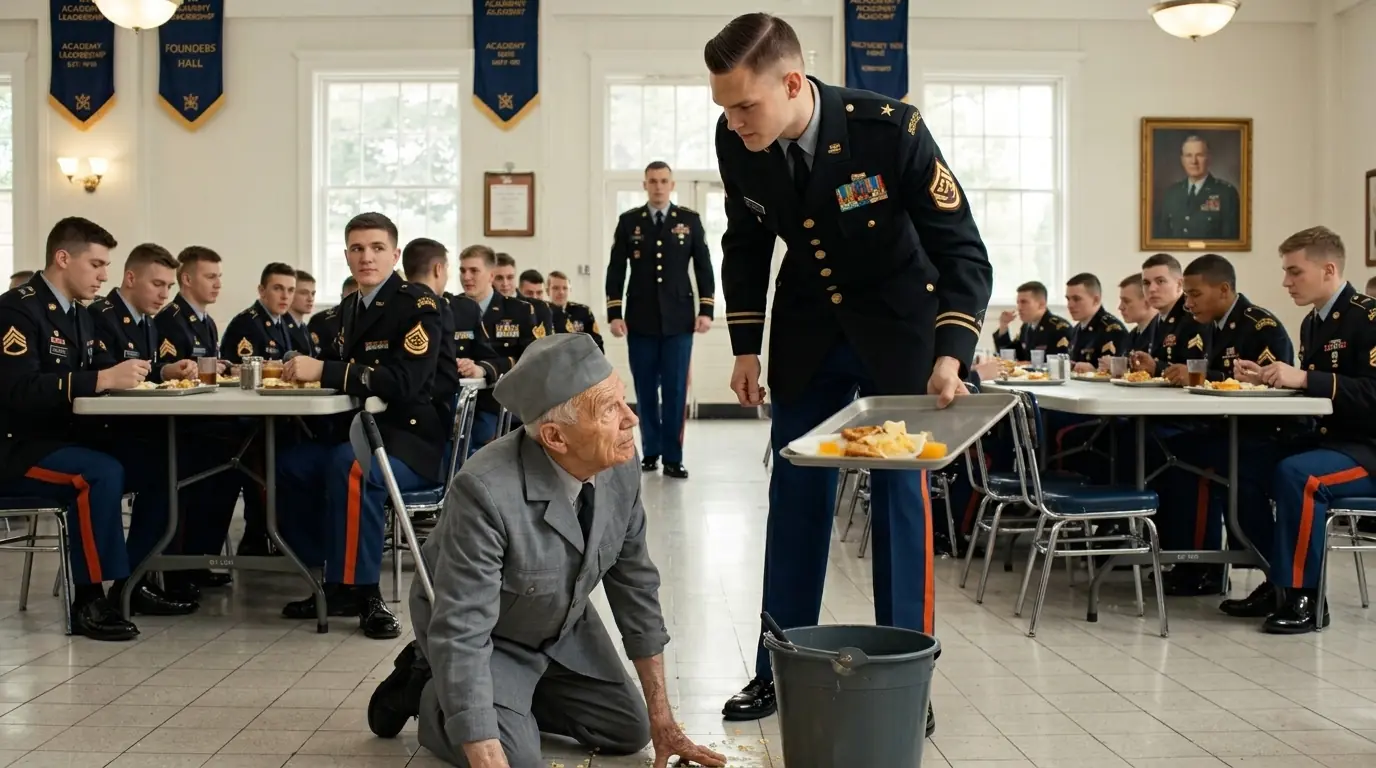
Before sunrise, when the academy still smelled of floor wax and cold coffee, the old man was already moving through the main hall with a mop bucket.
His name, at least the name stitched on the payroll sheet, was Samuel Boone. Most cadets did not know that. To them, he was just the janitor in the gray uniform, the slow old man who cleaned mud from the marble floors after morning drills and emptied trash cans full of energy drink bottles, protein bar wrappers, and half-finished ambition.
He wore no nametag.
Only a faded navy cap with the word Retired stitched across the front, above a small worn patch so old the thread had begun to fray. His back bent slightly when he walked, and his right leg dragged just enough for the rubber sole of his shoe to whisper against the floor. Every morning, that sound traveled through the corridors before reveille, soft, steady, almost invisible.
At Kingswell Military Leadership Academy, invisibility was easy to become.
The school sat on four hundred acres of polished stone, trimmed lawns, bronze statues, and old portraits of men and women who had once carried real responsibility through real danger. Cadets came from military families, political families, wealthy families, and the kind of suburbs where parents began building résumés before their children could drive. They wore pressed uniforms, shined boots, and expressions that said they were ready to lead before they had learned how to listen.
Samuel cleaned up behind them.
He scrubbed scuff marks from the hallway outside the tactics classroom. He mopped spills in the cafeteria. He replaced paper towels in the locker rooms after cadets complained about anything less than perfect while leaving sinks full of shaving cream and shoe polish.
Some cadets were polite.
A few even said good morning.
But enough of them treated him like furniture for the disrespect to settle into the building. They called him “Sergeant Mop.” They asked if he had been promoted to “general of garbage.” One first-year cadet saluted him with a toilet brush and laughed so hard he spilled coffee on his own sleeve.
Samuel never answered.
That made it worse.
Young men who needed reaction to feel powerful became annoyed when cruelty hit silence and fell flat. They wanted him to snap, to mumble, to complain, to reveal some small embarrassment they could pass around like a trophy. Instead, the old janitor kept working with the same calm rhythm, broom forward, bucket rolling, eyes lowered but never broken.
That silence was not shame.
It was discipline.
But the cadets did not know the difference.
The worst of them was Cadet Preston Vale, a second-year student with a senator for a father and a smile polished enough to hide how little kindness lived behind it. Preston was handsome, athletic, quick with jokes, and always surrounded by three or four cadets eager to laugh before deciding whether something was funny. He had never been ignored in his life, and that made Samuel’s quietness feel like an insult.
One Thursday morning, a week before the academy’s annual command symposium, Preston decided to make the cafeteria his stage.
The dining hall was crowded with cadets finishing breakfast before inspection. Trays clattered. Chairs scraped. Voices bounced off the high ceiling beneath banners listing the academy’s values: Honor, Discipline, Service, Humility. Samuel moved along the far aisle with his mop cart, collecting napkins and wiping spilled juice from the floor.
Preston watched him approach.
Then he placed his tray near the table edge.
The moment Samuel passed, Preston knocked it off with his elbow.
Scrambled eggs, toast, grits, and orange juice splattered across the tile. The tray hit the floor with a loud metallic slap, and half the room turned. Preston threw both hands up with fake surprise.
“Oops,” he said. “Looks like we’ve got a mission for Sergeant Mop.”
His friends laughed.
Someone at the next table muttered, “Cleanup on aisle command.”
Another cadet dropped a crumpled napkin onto the mess, as if contributing to the performance. A third tipped his coffee cup just enough for dark liquid to spread toward Samuel’s shoe. The laughter grew because the room had decided it was safe.
Samuel looked down at the mess.
Then he looked at Preston.
Only for a second.
There was no anger in his face. No wounded pride. No plea for decency. Just a quiet, distant look that made Preston’s grin falter before he forced it back into place.
Samuel bent slowly, picked up the tray, and began cleaning.
Not a word.
Not a sigh.
He worked with careful movements, scraping eggs into a dustpan, soaking up orange juice with paper towels, rinsing the mop, cleaning the tile until no stain remained. The cadets kept laughing for a while, but the sound changed as he worked. It thinned. It became less certain.
Because the old man’s silence did not make him smaller.
It made the room feel smaller.
Captain Elaine Porter stood near the cafeteria entrance with a clipboard in her hand. She had seen enough to know exactly what had happened. She also knew Preston’s father sat on the academy’s advisory board, and that the superintendent liked problems handled quietly before donors heard about them.
So she did what too many adults do when courage would be inconvenient.
She looked away.
Samuel noticed that too.
He noticed everything.
Awarded to Samuel Broom for excellence in tactical mopping and advanced trash warfare.
Someone had drawn a medal shaped like a toilet plunger beneath the words.
Samuel found it while restocking paper towels near the lecture hall. He read it once. Folded it neatly. Slipped it into his pocket. Then kept moving.
Later that night, when the cadets were asleep, he stopped in the west corridor beside the academy’s Wall of Honor.
The wall displayed portraits of generals, commanders, Medal of Honor recipients, and graduates who had become legends inside official history. Bronze plaques beneath each frame described missions in clean language: led under fire, saved his unit, coordinated evacuation, held the line. The words were true, but they had been polished until the blood no longer showed.
Samuel stood before one photograph longer than the others.
It showed a younger officer standing in a sandstorm beside a broken armored vehicle, his right arm in a sling, his face half-shadowed by blowing dust. The name beneath it was General Adrian Cross. The plaque said he had survived Operation Iron Harbor and later led campaigns across three continents.
Samuel stared at the portrait.
His breathing changed.
For a moment, the hallway disappeared.
There was only sand.
Wind.
Static in a headset.
Men shouting over the sound of engines that would not start.
A young captain named Adrian Cross bleeding through his sleeve while refusing evacuation until the last soldiers were out.
Samuel closed his eyes.
Then he opened them and moved on.
Nobody at Kingswell knew why the old janitor looked at that picture.
Nobody had ever asked.
The annual command symposium arrived the following Friday.
By seven in the morning, the entire academy had been polished into something near perfection. The grand assembly hall had been dressed with flags, cameras, rows of chairs, flowers at the podium, and a long blue carpet leading from the entrance to the stage. Cadets wore dress uniforms. Instructors wore medals. Administrators wore expressions of controlled panic.
The keynote speaker was the reason.
General Adrian Cross was coming.
Four stars.
Decorated commander.
One of the most respected military leaders of his generation.
A man whose name appeared in strategy books, leadership courses, documentaries, academy brochures, and speeches delivered by people who wanted to borrow greatness without paying its cost.
Cadets had spent weeks preparing questions they hoped would sound intelligent.
Preston Vale had rehearsed one in the mirror.
He planned to ask the general about courage under impossible pressure, then maybe shake his hand afterward if he could get close enough. His father had already told him that relationships made careers long before merit had time to prove anything. Preston believed that. He believed many things that had been handed to him.
Outside the assembly hall, Samuel moved slowly down the corridor with his cart.
He had been told to stay out of sight once the ceremony began.
“VIP day,” the facilities manager had said. “We don’t need custodial movement near the hall during photographs.”
Samuel had nodded.
He was used to being removed from rooms shortly before people began talking about service.
Still, he came to the corridor.
He adjusted the brim of his faded cap and looked once toward the open doors of the assembly hall. Rows of cadets sat inside, backs straight, chins lifted, all polished into the future officers they believed themselves to be. The academy band tuned softly near the stage.
Samuel stood beside his cart, one hand resting on the broom handle.
Inside, the double doors at the rear opened.
The room rose as one.
General Adrian Cross entered.
He was sixty-one, tall, broad-shouldered, with close-cut silver hair and a face that carried calm the way some men carry weapons. His dress uniform was immaculate. Four stars gleamed across each shoulder. Rows of ribbons sat above his heart like a compact history of places most people only understood as names on maps.
Salutes snapped across the hall.
Cameras clicked.
The superintendent stepped forward with both hands extended, smiling like a man receiving a gift from history itself.
General Cross nodded once.
He did not go to the podium.
He did not shake the superintendent’s hand.
He walked past him.
At first, people assumed he had misunderstood the staging.
Then they watched his eyes lock on the corridor outside the hall.
Every head turned.
The general walked straight down the center aisle, past cadets, faculty, senior officers, cameras, donors, and the polished blue carpet arranged for his entrance. He stepped out into the hallway where Samuel stood beside the janitor cart with a broom in one hand.
The old man did not move.
General Cross stopped three feet in front of him.
For several seconds, the academy became silent in a way no command had ever achieved.
Then the general came to attention.
His heels met.
His shoulders squared.
He raised his right hand in a full formal salute.
“Commander Ward,” he said, voice low but clear, “it is an honor to stand in front of you again.”
The words did not make sense to the cadets at first.
Commander.
Ward.
The janitor’s name was Samuel Boone.
Wasn’t it?
Samuel’s hand tightened on the broom handle.
His eyes moved over the general’s face, and something old passed between them. Not surprise. Not exactly. More like two men hearing a door open that both had tried to keep closed.
Slowly, Samuel straightened.
His back did not fully obey him anymore.
His right leg dragged.
His fingers trembled.
But when he returned the salute, it was precise enough to make every officer in the hallway feel the difference between ceremony and memory.
“At ease, Adrian,” Samuel said.
The general lowered his hand only after Samuel did.
A murmur broke inside the assembly hall.
Preston Vale stood frozen in the third row, his face losing color. Captain Porter lowered her clipboard. The superintendent looked as if someone had reached into the academy’s polished history and pulled out a page he had never seen.
General Cross turned toward the room.
“Before I deliver the speech you invited me to give,” he said, “this academy will first recognize the man it has failed to see.”
Nobody moved.
The general stepped slightly aside so the entire hall could see Samuel beside the janitor cart.
“You know him as a custodian. Some of you know him by names you should be ashamed to remember. I know him as Commander Nathaniel Ward, former special operations commander, field strategist, and the man who saved my life along with two hundred and nineteen others during Operation Iron Harbor.”
The air seemed to leave the room.
Operation Iron Harbor.
Every cadet knew the name.
Barely declassified. Heavily redacted. Taught only in fragments at the academy as a case study in failed intelligence, battlefield improvisation, and the evacuation of allied personnel from a collapsing desert city. The official lesson emphasized adaptability under pressure. The unofficial rumors spoke of a commander who stayed behind and disappeared from the record.
Preston’s mouth opened slightly.
Samuel Boone was not Samuel Boone.
The old janitor he had mocked in the cafeteria was the missing commander from the most studied operation in the academy’s modern curriculum.
General Cross faced the cadets fully.
“In 1998, a coalition support mission outside Dar Qadir collapsed after enemy forces breached the northern perimeter. Communications were failing. Evacuation routes were cut off. A sandstorm reduced air visibility to almost nothing. Command believed we had lost the eastern corridor.”
His voice remained steady.
“Commander Ward did not accept that assessment.”
Samuel looked down at the floor.
Cross continued.
“He organized a moving defense with fewer than thirty able-bodied soldiers, three damaged vehicles, and two medical teams operating under fire. He redirected civilians through the old aqueduct route after every official map marked it unusable. He held that route for eleven hours.”
A cadet in the back row whispered, “Eleven?”
The general heard it.
“Yes,” Cross said. “Eleven.”
No one whispered again.
“He carried wounded men when stretchers ran out. He ordered officers to evacuate before him and threatened to shoot the tires off any vehicle that returned without civilians. He stayed until the final convoy cleared the corridor.”
Samuel’s jaw tightened.
Cross’s voice softened.
“The last report listed him missing after the southern wall collapsed.”
The hall remained silent.
“History called him lost. Some called him dead. A few of us knew better, but the mission remained classified, and Commander Ward refused every attempt to bring him into public ceremony.”
Samuel looked at Cross then.
“You make me sound more useful than I was.”
“No, sir,” Cross said. “I make you sound less useful than you were because the full record still will not fit in this room.”
That sentence landed harder than applause could have.
The superintendent recovered enough to step forward.
“General, I must apologize. We were not aware that Mr. Boone was—”
Cross turned.
“Commander Ward.”
The correction struck like a gavel.
The superintendent swallowed.
“Commander Ward was connected to the operation.”
Samuel finally spoke.
“He was not aware because I did not want him aware.”
His voice was quiet, rough with age, but it carried through the hall.
“I asked to work here under another name. I wanted a quiet job. I wanted to stay near the thing I once believed in. That is all.”
General Cross looked at him.
“And did we give you that?”
Samuel’s eyes moved across the cadets.
Some looked down.
Some looked afraid.
Some looked ashamed.
His gaze paused briefly on Preston.
The young man felt it like a hand closing around his throat.
“No,” Samuel said. “Not always.”
The truth was more painful than anger would have been.
Cross looked toward the superintendent.
“I will still speak today. But the speech changes.”
He turned to Samuel.
“Sir, will you address them first?”
Samuel shook his head.
“I came to clean the floors.”
“Then teach them what a clean floor cannot.”
A few cadets would remember that line for the rest of their lives.
Samuel stood beside the cart, broom leaning against his shoulder like a staff. He looked uncomfortable in the attention, not humbled by it, but burdened. Praise, for men like him, was not a reward. It was another room full of ghosts asking why only one name had returned.
He stepped into the assembly hall.
The cadets parted without being told.
Samuel reached the front of the room slowly. General Cross offered an arm. Samuel ignored it, not rudely, simply because some distances needed to be crossed under one’s own remaining strength. When he reached the podium, he did not stand behind it.
He stood beside it.
“I will not tell you war stories to make myself larger,” Samuel said.
No microphone had been lowered for him yet.
It did not matter.
“You have enough people willing to turn suffering into legend. I have no use for that. The men and women I served with were not legends. They were tired, frightened, stubborn, young, brilliant, foolish, brave because they had to be, and human every second of it.”
The cadets listened.
This was not the voice of a motivational speaker.
It was not polished.
It did not rise and fall in rehearsed places.
It sounded like something dug from deep earth and set down carefully because mishandling it would be disrespectful.
“I have watched young leaders fail because they believed rank made them important,” Samuel said. “Rank makes you responsible. That is not the same thing.”
Preston stared at the floor.
Samuel continued.
“You shine boots. You memorize codes. You learn formations. You practice command voice until you can make a hallway jump. None of that means you are ready to lead. Leadership begins in the moments where no one is afraid to disobey you, and you still choose to treat them with dignity.”
Captain Porter lowered her eyes.
Samuel saw that too.
“Some of you have walked past me for months. Some of you were kind. Some were not. Some of you laughed when others were cruel because laughter felt safer than courage. That is not a cadet problem. That is a human problem.”
The room held still.
“Humility is not lowering yourself. It is seeing clearly. It is understanding that the person cleaning your floor may have carried more weight than you have yet been asked to imagine. It is also understanding that even if he had not, he still deserved your respect.”
General Cross watched from the side of the stage.
His face did not move, but his eyes had grown wet.
Samuel turned slightly toward the Wall of Honor visible through the open doors.
“My name is not on your wall. Many names are not. That does not trouble me as much as it once did. What troubles me is when institutions remember courage in bronze while forgetting it in practice.”
That sentence found every instructor in the room.
Samuel’s voice became quieter.
“I came here under another name because I was tired. Tired of ceremonies. Tired of being thanked by people who did not want the full story. Tired of waking up with the sound of Iron Harbor still in my chest. I thought if I stayed close to young people learning service, maybe I could make peace with what we lost.”
He looked across the cadets.
“Instead, I learned that some of you had been taught ambition without reverence.”
No one breathed loudly.
“That can be corrected. But only if you let shame do its proper work. Shame is useless when it becomes self-pity. It is useful when it becomes change.”
Then he stopped.
No grand ending.
No raised fist.
No story about one impossible hero surviving impossible odds.
Just silence.
The room did not know what to do with it.
Then Preston Vale stood.
His chair scraped loudly enough to make several cadets flinch.
His face was pale, and his mouth trembled. For the first time since arriving at Kingswell, he looked his age.
“Sir,” he said.
The word barely came out.
Samuel looked at him.
Preston swallowed.
“I knocked that tray down. I made people laugh at you. I called you Sergeant Mop.”
The room went rigid.
His friends stared at him as if confession were contagious.
Preston forced himself to continue.
“I didn’t know who you were.”
Samuel’s expression did not change.
Preston’s eyes filled.
“But I understand now that shouldn’t matter. I knew enough to know you were a man doing your job. I knew enough to know you didn’t deserve that. I did it anyway because I wanted to feel bigger in front of people.”
The sentence broke him.
“I am sorry, sir.”
Samuel watched him for a long moment.
Then he nodded once.
“Do not use me to feel better about apologizing.”
Preston flinched.
“Use this day to become harder to recognize tomorrow.”
The cadet nodded fast, tears running now.
“Yes, sir.”
Another cadet stood.
Then another.
Then the young woman who had lowered her eyes during the cafeteria incident stood with both hands trembling at her sides. Then the cadets near the back rose. Row by row, the entire assembly hall came to its feet.
No applause began.
No one wanted to cheapen the moment with noise.
Instead, more than two hundred cadets raised their hands in silent salute.
Instructors followed.
Then officers.
Then the superintendent, slower than he should have but eventually.
General Cross did not salute at first.
He watched Samuel.
Only when Samuel’s eyes moved to him did the general raise his hand too.
Samuel stood before them in a gray custodial uniform, old sneakers, a faded retired cap, and a body history had not treated gently. His eyes moved across the room once, not proudly, not triumphantly, but as if accepting responsibility for being seen after so many years of choosing not to be.
Then he returned the salute.
Not to the academy.
Not to the apology.
To the possibility that some of them might remember this when it mattered.
After the ceremony, the official symposium never fully recovered.
General Cross delivered his keynote, but no one remembered the title. They remembered when he spoke about humility and turned once toward Samuel’s empty place near the side door. They remembered when he said, “The test of leadership is not how loudly your subordinates answer you. It is whether the quietest person in the room still feels safe telling you the truth.”
The academy changed in ways both visible and uncomfortable.
The fake certificate disappeared from Samuel’s cart, but Samuel had already kept it. He later mailed it anonymously to Preston’s father with no note. No one ever proved that, though Preston believed it until the day he graduated.
The cafeteria staff received formal respect protocols.
Custodial, kitchen, maintenance, and administrative workers were invited to leadership ethics sessions, not as symbols, but as instructors. Cadets were required to spend one weekend each semester shadowing the people who kept the academy functioning before sunrise and after lights out.
Captain Porter requested to speak with Samuel two days later.
He was buffing the hallway near the Wall of Honor.
“I should have stopped them,” she said.
“Yes,” Samuel replied.
She winced.
“I was thinking about politics.”
“I know.”
“I was wrong.”
“Yes.”
She waited for more.
He gave her nothing else.
That was the punishment. Not anger. Accuracy.
Preston changed slowly.
At first, the change looked forced. He held doors too eagerly. He said sir to every staff member like he was trying to scrub guilt off his own face. Samuel ignored most of it because apology performed for the wounded is still self-centered.
But months passed.
Preston began arriving early to help set chairs before assemblies. He stopped laughing when others mocked weaker cadets. He corrected one of his friends sharply when the boy called a kitchen worker “lunch lady” instead of Mrs. Alvarez.
One evening, Samuel found Preston alone in the hallway staring at the photograph of General Cross.
The cadet did not hear him approach.
“He looks different now,” Preston said.
Samuel stopped beside him.
“Who?”
“General Cross. I used to look at that picture and see power.”
“And now?”
Preston looked at the sandstorm frozen behind the young officer.
“Now I wonder who isn’t in the photo.”
Samuel said nothing.
That was the first answer from Preston Vale that sounded like it might survive graduation.
Three months after the symposium, Kingswell unveiled a new addition to the Wall of Honor.
Samuel opposed it.
General Cross insisted.
The plaque did not carry a portrait at first because Samuel refused to pose. Instead, the academy displayed a declassified map of the eastern corridor at Dar Qadir, with the old aqueduct route marked in red. Beneath it, the inscription read:
COMMANDER NATHANIEL WARD
OPERATION IRON HARBOR
HE HELD THE WAY OPEN SO OTHERS COULD COME HOME.
Samuel stood at the back during the unveiling, arms folded, expression unreadable.
When the cloth came off, everyone looked at him.
He looked at the plaque.
Then at General Cross.
“You left out names.”
Cross nodded.
“We are adding them.”
Below the main inscription, a second bronze plate carried twenty-seven names.
Soldiers.
Medics.
Drivers.
Interpreters.
Two civilian engineers.
A communications specialist who kept broadcasting through the storm until the battery burned out.
Samuel read each one.
Only after the final name did he nod.
“That is better.”
The academy band played no music.
Samuel had requested that.
Some names deserved silence before they received sound.
Over the next year, the story spread beyond Kingswell.
Reporters wanted interviews.
Samuel refused them all.
Documentary producers sent letters. He ignored them. Veterans organizations asked him to speak at banquets. He declined politely when General Cross made him answer and impolitely when they kept asking.
He remained at the academy.
He still wore the gray custodial uniform.
He still pushed the mop cart before dawn.
But the halls were different now.
Cadets stepped aside without making a spectacle of it. They greeted him by name. Not Boone, but Commander Ward, until he told them enough times that Mr. Ward would do. Some still overdid it, snapping salutes in hallways until he finally told one squad leader, “If you salute me while I’m holding a trash bag again, I’ll make you carry it.”
After that, they learned normal respect.
The kind that does not need a drumroll.
On a cold morning near graduation, Preston found Samuel outside the academy chapel.
The sky was pale, and frost silvered the grass. Samuel was sweeping leaves from the stone steps, slowly, methodically, exactly as he had done before anyone knew his name.
Preston stood at the bottom step.
“I got my first assignment.”
Samuel kept sweeping.
“Good.”
“Logistics command.”
“Important work.”
“I used to think it sounded boring.”
“It is better to be bored with food, fuel, and medicine than heroic without them.”
Preston smiled faintly.
“I wanted to thank you.”
Samuel glanced at him.
“For what?”
“For not letting me off easy.”
Samuel returned to the leaves.
“Easy apologies grow nothing.”
Preston nodded.
“I wrote to my father about what happened.”
“That was brave of you.”
“He was angry.”
“That was predictable.”
“I told him he raised me to respect rank more than people.”
Samuel stopped sweeping.
For a moment, the only sound was the broom bristles against stone.
“What did he say?”
“He stopped paying my extra expenses for a month.”
Samuel looked at him.
Preston almost smiled.
“Then he called me and said maybe I was finally learning something.”
Samuel resumed sweeping.
“Then maybe he was too.”
Graduation came in June.
The ceremony took place on the parade field beneath a hard blue sky. Families filled the stands. Flags moved in a warm wind. Cadets stood in formation, faces serious, boots aligned, futures waiting just beyond the final command.
Samuel watched from the side, not with faculty, not with dignitaries, but near the maintenance entrance where he felt most comfortable.
Preston crossed the stage, received his commission, and saluted.
Then, against every instruction about ceremony timing, he stepped off the platform and walked directly across the edge of the field.
Whispers moved through the crowd.
Preston stopped in front of Samuel.
He did not salute.
He had learned.
Instead, he extended his hand.
“Mr. Ward.”
Samuel looked at the hand.
Then took it.
“Lieutenant Vale.”
Preston’s throat tightened.
“I’ll remember.”
Samuel held his gaze.
“Remember before someone has to bleed for it.”
“Yes, sir.”
This time, Samuel let the sir pass.
Years later, people at Kingswell would tell the story in simpler ways.
They would say cadets mocked an old janitor.
They would say a four-star general walked in and saluted him.
They would say the janitor turned out to be a legendary commander from a classified operation.
All of that was true.
But it was not the whole truth.
The real story was not that Samuel Ward had secretly been important.
The real story was that he had been worthy of respect before anyone knew he was important.
He had been worthy while mopping floors.
Worthy while emptying trash.
Worthy while bending painfully to clean eggs and orange juice from a cafeteria floor under the laughter of boys who wanted power before wisdom.
Rank did not create that worth.
History did not create it.
General Cross did not hand it to him with a salute.
It had been there the whole time.
Samuel stayed at Kingswell for two more years.
Then one morning, before sunrise, he placed his broom neatly against the custodial office wall, set his gray uniform shirt folded on the desk, and left a short note for Marty Alvarez, the facilities manager.
The floors are yours now. Keep them honest.
He did not attend the retirement ceremony the academy tried to organize.
General Cross laughed when he heard.
“That sounds like him.”
A month later, a package arrived at the academy.
Inside was Samuel’s faded retired cap.
No message.
The superintendent placed it in a glass case beside the Iron Harbor plaque. Beneath it, at Preston Vale’s suggestion, they added one final line.
REAL RANK IS REVEALED BY HOW A PERSON SERVES WHEN NO ONE IS APPLAUDING.
Cadets passed that case every day.
Some rushed by.
Some slowed.
A few stopped.
The best ones read the names beneath the map before looking at the cap.
That was how Samuel would have wanted it.
Because one man had never been the point.
The point was the lesson the academy almost learned too late.
You do not measure a life by the uniform a person is wearing when you meet them.
You measure your own character by how you treat them before you know what they once wore.