The first mistake came from behind white plantation blinds.
Marjorie Bell had been watching the house at 18 Willowmere Court for three days, ever since the moving trucks left and the new owners failed to introduce themselves properly. In Briarstone Ridge, introductions mattered. Lawns were trimmed like velvet, mailboxes matched, wreaths changed by season, and neighbors treated privacy like something suspicious unless it belonged to them.
That Saturday morning, Marjorie stood in her living room with a cup of lemon tea cooling in her hand.
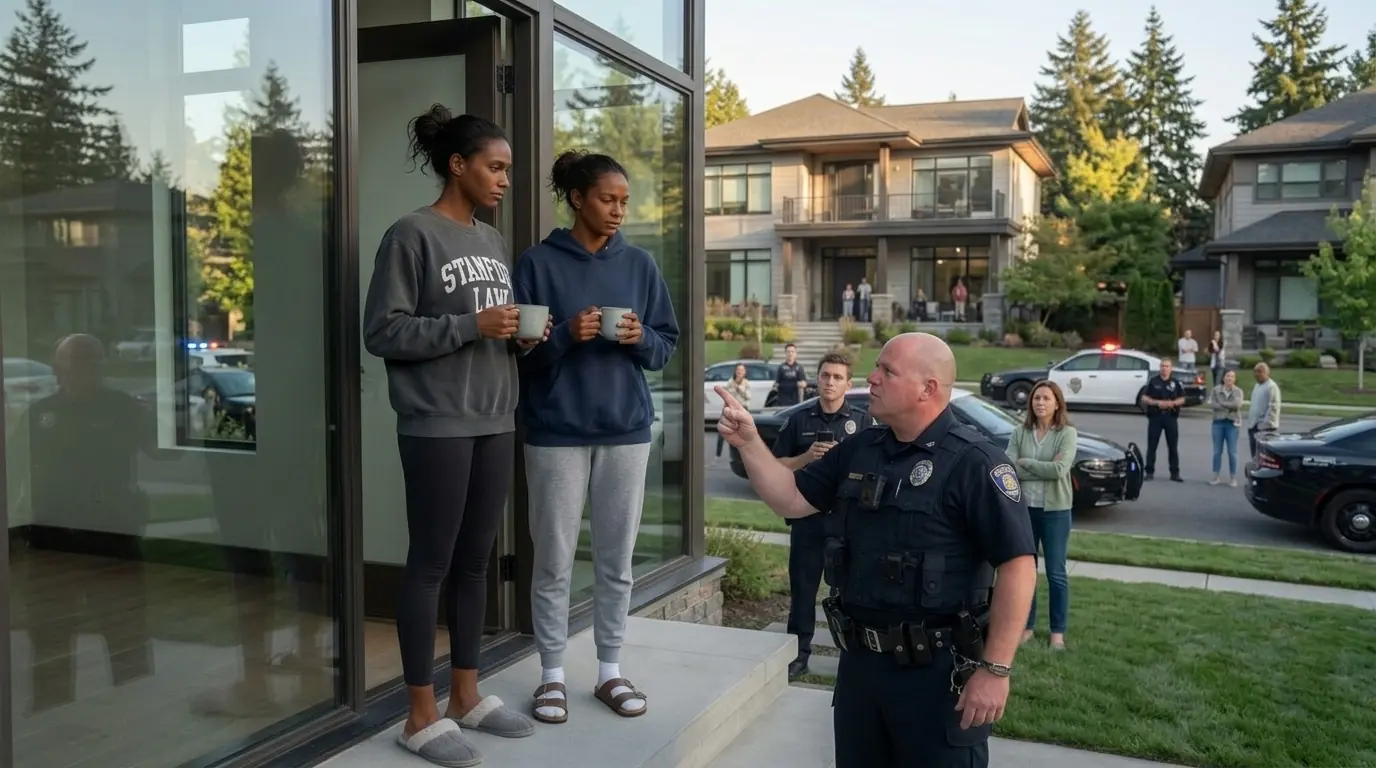
Across the street, two brown-skinned women stepped out onto the wide front porch of the newly sold house. They looked almost identical, both tall, both slender, both with dark hair pulled into loose buns and the same sharp cheekbones softened by sleepy morning faces. One wore a faded Stanford Law sweatshirt, black leggings, and fuzzy slippers. The other wore an oversized navy hoodie, gray joggers, and socks inside leather sandals.
They were laughing about something.
That irritated Marjorie more than she could explain.
The house had sold for nearly two million dollars. It was a stone-and-glass modern home with cedar beams, a long driveway, and a front porch big enough for furniture that cost more than Marjorie’s first car. People who lived in houses like that were supposed to look a certain way on Saturday mornings, even in casual clothes.
These women did not look like Marjorie’s idea of the owners.
They looked, in her mind, like cleaners who had gotten too comfortable.
Or sisters waiting for someone.
Or trouble that had learned how to smile.
She did not walk over.
She did not wave.
She did not ask their names.
Instead, she picked up her phone and dialed 911.
“Yes, I need police at 18 Willowmere Court immediately,” she said, pressing fear into her voice like icing on a cake. “There are two suspicious women on the front porch. They look completely out of place. I think they may be trying to break in or pretending to belong there.”
The dispatcher asked whether she had seen them force entry.
Marjorie glanced toward the house.
One of the women had gone back inside and returned carrying two mugs of coffee.
“Well, the door is open,” Marjorie said. “And they’re acting very comfortable. That’s what worries me.”
The dispatcher asked if Marjorie knew the residents.
“No,” Marjorie replied. “But I know who lives in this neighborhood. Those women are not the owners.”
That sentence was the first lie.
The second was the confidence with which she said it.
On the porch across the street, the twins had no idea their morning had just been handed to armed men.
Maya Ellison lifted her coffee and took a long breath of cool autumn air.
“This is the first quiet morning we’ve had in two months,” she said.
Her twin sister, Naomi, leaned against the porch railing and looked at the line of red maples along the street.
“That’s because you keep buying houses during federal trial season.”
“I bought one house.”
“You bought a house while indicting six people.”
Maya smiled.
“They were very organized defendants. I had free evenings.”
Naomi rolled her eyes.
The sisters had spent most of the previous week buried under work and moving boxes. Maya was the newly appointed United States Attorney for the district, the kind of woman whose calendar carried grand jury deadlines, press conferences, late-night calls from federal agents, and meetings with judges who somehow always wanted more paperwork by Monday. Naomi was a civil rights attorney with the Department of Justice, temporarily staying with Maya while preparing testimony for a police misconduct consent decree three states away.
On paper, they were terrifying.
On the porch, they looked like two tired women drinking coffee before unpacking the kitchen.
That was the version of themselves they had wanted that morning.
No suit jackets.
No press cameras.
No prosecutors whispering in courthouse hallways.
No officers standing when Maya entered a room.
No lawyers staring at Naomi like she had a subpoena hidden in her tote bag.
Just coffee, slippers, messy hair, and a house they had both planned to enjoy for exactly one uninterrupted hour.
Then the patrol cars came.
Two police cruisers turned sharply onto Willowmere Court and came in fast, too fast for a street where children rode bicycles and golden retrievers wore holiday bandanas. They did not use sirens, but their lights flashed red and blue against the glass front of Maya’s house. Tires chirped when the lead cruiser swung into the driveway, blocking the garage as if the women might flee in slippers.
Maya lowered her mug.
Naomi’s smile disappeared.
Both sisters knew that posture.
They had seen it in body-camera footage, complaint files, deposition transcripts, and courtroom exhibits. A car does not have to hit you to announce aggression. Sometimes it does that with the angle of its bumper.
The lead officer stepped out first.
He was broad, white, in his early forties, with a shaved head, a red neck, and the confident weight of a man who expected his voice to land before his words had earned anything. His nameplate read D. KELLER. His right hand rested near his service weapon, not gripping it, not yet, but close enough to make the message plain.
His partner, Officer Simon Reed, was younger and thinner, with nervous eyes that moved from the twins to the open front door to the neighbors gathering on lawns.
Keller pointed up at the porch.
“You two. Hands where I can see them.”
Maya slowly set her mug on the small table beside the porch swing.
Naomi did the same.
Neither woman raised her hands.
Maya looked down the steps.
“Good morning, Officer. What seems to be the problem?”
“Step away from the door,” Keller barked.
Naomi’s eyes narrowed.
“The door to our house?”
Keller ignored that.
“I said step away from the door. Now.”
Maya’s posture changed.
Not visibly enough for most people.
But Naomi saw it.
The sleepy sister disappeared, and the federal prosecutor stepped into her skin. Maya’s shoulders squared. Her face went still. Her voice lowered into the tone she used when a witness thought volume could defeat evidence.
“We are standing on the porch,” Maya said. “The door is behind us. Nothing about this situation requires you to shout.”
Keller took one step up the walkway.
“We received a call about a burglary in progress.”
Naomi looked at him.
“A burglary?”
“That’s right.”
Maya glanced at her slippers, then at her coffee, then back at the officer.
“Officer Keller, do you often find burglars drinking Ethiopian dark roast in matching house slippers?”
Simon Reed looked like he almost wanted to smile.
He did not.
Keller’s face reddened.
“I don’t need jokes. I need identification.”
Maya folded her arms.
“You have not articulated any reasonable suspicion that either of us committed a crime.”
Keller stopped at the bottom step.
“I said we got a call.”
“A phone call is not probable cause,” Naomi said.
Keller turned toward her.
“And you are?”
“The other suspicious woman on my own porch.”
A neighbor across the street gasped.
Several phones appeared.
Marjorie Bell had come out of her house now, wearing a pale green cardigan and the expression of someone waiting to be thanked for preventing civilization from collapsing. She stood near her driveway with one hand at her throat, watching the officers like a woman expecting applause.
Keller looked at both twins again.
The fact that there were two of them irritated him. It complicated the story he had already built. One suspicious person was easy. Two identical brown-skinned women looking at him like they understood every mistake he was about to make was much less comfortable.
“Both of you need to produce ID,” he said.
“No,” Maya replied.
The word was quiet.
Keller blinked.
“What did you say?”
“I said no. You may ask for identification during a consensual encounter. You may demand it only under lawful circumstances. You do not have those circumstances.”
His mouth tightened.
“You got a law degree with that coffee?”
Naomi smiled without warmth.
“Two, actually.”
Maya did not smile.
“Officer Keller, under the Fourth Amendment and under this state’s stop-and-identify rules, you need reasonable, articulable suspicion that we are involved in criminal activity before you can compel identification. Standing on a porch while brown is not criminal activity.”
The younger officer shifted his weight.
He knew enough to know she was not guessing.
Keller knew enough to hate that she was right.
“Listen,” he said, voice dropping. “I don’t know what kind of internet legal nonsense you’ve been reading, but I’m telling you right now, you don’t fit the description of the homeowners.”
Naomi’s eyebrows lifted.
“What description would that be?”
Keller hesitated.
Maya stepped down one stair.
Slowly.
Deliberately.
Her hands remained visible.
“Careful,” she said.
The word landed with warning.
Keller’s hand moved from near his gun to his handcuffs.
“Do not come down those stairs.”
Maya stopped.
Naomi stepped beside her.
Keller looked at them both.
“Turn around and put your hands behind your backs.”
The entire street went still.
A dog barked once and was quickly pulled inside.
Simon Reed turned pale.
“Officer Keller,” Maya said, each word exact, “if you put those cuffs on either of us, you will spend the rest of your career explaining why you thought two brown-skinned women drinking coffee at their own home justified an unlawful detention.”
Keller pointed at her.
“That sounds like a threat.”
“No,” Naomi said. “That sounds like a preview.”
Maya looked at Simon now.
“Officer Reed, you appear less committed to this mistake than your partner. I suggest you use your radio.”
Reed swallowed.
Keller snapped, “Don’t touch that radio.”
Naomi’s eyes flicked to the younger officer.
“Your senior officer is ordering you not to call a supervisor during a potential civil rights violation. Remember that later when someone asks whether you had a chance to stop this.”
Reed’s hand trembled.
Keller’s jaw clenched.
“You two think you’re above the law?”
Maya’s face remained calm.
“No. We think you are beneath your oath right now.”
That sentence cut deeper than shouting would have.
Keller took one step up onto the porch.
Naomi moved in front of Maya without thinking.
Maya quietly touched her sister’s elbow.
“I’ve got it.”
“No,” Naomi said softly. “We both do.”
For one second, the twins stood shoulder to shoulder, identical faces set in identical calm, two women who had spent their lives being told they looked the same while learning very different ways to survive the same world.
Keller seemed to realize the optics were worsening.
Two women.
No weapons.
Coffee mugs.
Open house.
Neighbors filming.
A rookie who looked ready to faint.
Still, pride had him by the throat.
“Last chance,” he said. “ID, now, or I take you in.”
Maya’s eyes sharpened.
“Call Captain Helena Brooks.”
Keller scoffed.
“I don’t call captains for routine trespassers.”
“I am not a trespasser.”
“Then prove it.”
Maya leaned slightly forward.
“I am Maya Ellison, the United States Attorney for this district. My sister is Naomi Ellison, senior counsel with the Civil Rights Division of the Department of Justice. You are standing on my property. And if you do not call Captain Brooks right now, I will call the police chief, the mayor, the federal monitor, and your union attorney can explain to you which apology to draft first.”
The silence changed shape.
Simon Reed looked like the words had physically hit him.
He knew the name Maya Ellison.
Every officer in the city did. A memo had gone out the week she was sworn in. Her office was leading a public corruption initiative and had already indicted two county officials before lunch on her first Monday.
Naomi’s name had appeared in training materials too, attached to a DOJ review that officers grumbled about during roll call and pretended not to read.
Keller stared at Maya’s hoodie, fuzzy slippers, messy bun, and calm brown face.
His brain rejected the information because accepting it meant accepting the career-ending size of the hole he had just dug.
“You’re lying,” he said.
Maya looked at him for a long moment.
Then she smiled.
Not kindly.
“Officer Reed, radio your captain.”
Reed did not look at Keller this time.
He pressed the mic on his shoulder.
“Dispatch, this is Unit Twelve. Requesting supervisor at 18 Willowmere Court. Code Four, but we need command response.”
The dispatcher answered.
“Copy, Unit Twelve. Captain Brooks is en route.”
Maya sat down on the porch chair.
Naomi sat beside her.
Keller remained standing on the porch steps, stranded between retreat and disaster.
Maya picked up her coffee.
It had gone lukewarm.
She drank it anyway.
The next nine minutes felt longer than the morning that had produced them.
Keller tried twice to explain himself, but each time Maya lifted one finger and said, “Save it for the statement.” Naomi pulled a small notebook from the pocket of her hoodie and began writing down times, words, positions, badge numbers, and names of neighbors holding phones.
That made Keller sweat.
Not openly at first.
Then visibly.
Marjorie Bell watched from across the street, her smugness slowly curdling into confusion. The officers were not arresting the women. The women were not crying. The captain had been called, and the entire street seemed less certain that Marjorie had saved the neighborhood from danger.
Captain Helena Brooks arrived in an unmarked black SUV.
She took the corner hard, parked behind the cruisers, and stepped out before the engine had fully settled. She was in her fifties, Black, silver threaded through a tight bun, with a command presence that made even the neighbors straighten without knowing why.
She assessed the scene in one sweep.
Two patrol officers.
Two brown-skinned women seated on the porch.
Hands visible.
No signs of forced entry.
Neighbors filming.
Marjorie Bell standing too close to satisfaction and too far from sense.
Then Captain Brooks recognized the twins.
All color left her face.
“Keller,” she barked. “Reed. Step off that porch. Now.”
Keller turned.
“Captain, we received a call about—”
“Now.”
The word cracked across the street.
Keller stepped down.
Reed nearly stumbled doing the same.
Captain Brooks removed her cap and walked up the driveway alone. Her expression had shifted from command to controlled horror.
“Madam U.S. Attorney,” she said, loud enough for the entire street to hear. “Counsel Ellison. I sincerely apologize for this incident.”
Marjorie’s mouth fell open.
Keller’s face went gray.
Reed closed his eyes.
Maya stood.
Naomi remained seated, still writing.
“Good morning, Captain Brooks,” Maya said. “I wish we were meeting under better circumstances.”
“So do I.”
“Your officers threatened to detain my sister and me for standing on my porch.”
Captain Brooks turned slowly toward Keller.
“Is that true?”
Keller started to speak.
Naomi answered without looking up from her notebook.
“He demanded ID without reasonable suspicion, stated we did not fit the description of homeowners, threatened cuffs, refused to call a supervisor, and stepped onto private property after being told he had no lawful basis.”
Captain Brooks looked at Reed.
The rookie swallowed.
“Yes, ma’am.”
The street heard it.
Keller glared at him.
Brooks saw that too.
“Officer Keller,” she said, “remove yourself from the property line.”
“Captain—”
“Do it.”
He stepped back.
Maya’s voice remained level.
“Captain, this is not merely a protocol issue.”
“No, ma’am,” Brooks said. “It is not.”
“I want body-camera footage preserved. Dash-camera footage preserved. Dispatch audio preserved. CAD notes preserved. I want the officers separated and interviewed before they coordinate memory. I want a supervisor’s report before the end of the day.”
“Yes, ma’am.”
Keller muttered, “We were dispatched.”
Maya turned toward him.
“You were dispatched to investigate. Not to become the caller’s prejudice in uniform.”
That silenced him.
Naomi closed her notebook.
“Captain, who made the call?”
Brooks’s face tightened.
“I can get the audio.”
“Get it now,” Maya said.
Captain Brooks pulled out her phone and contacted dispatch.
Within minutes, the recording came through. She placed it on speaker there on the sidewalk, and Marjorie Bell’s voice filled Willowmere Court.
“There are two suspicious women on the porch. They look completely out of place. I think they may be trying to break in. The new owners just bought it, and those women are definitely not them.”
The recording ended.
No one moved.
Maya looked across the street.
Marjorie’s face had turned the color of paper.
Naomi stood beside her sister.
“Let’s go introduce ourselves.”
Captain Brooks looked briefly pained.
Then she nodded.
The procession down Willowmere Court was slow and brutal.
Maya walked first in fuzzy slippers and a faded Stanford hoodie. Naomi walked beside her in socks and sandals, still holding the notebook. Captain Brooks followed, then Keller and Reed, though Keller looked like he would rather walk into traffic than toward Marjorie Bell’s driveway.
Neighbors watched from lawns, porches, and windows.
Some had the decency to look ashamed.
Most simply looked fascinated now that the entertainment had changed direction.
Marjorie tried to smile when they approached.
It failed.
“Officers,” she began. “I was only trying to protect the community.”
Maya stopped a few feet from her.
“Marjorie Bell?”
Marjorie blinked.
“How do you know my name?”
Naomi answered.
“Community app. Neighborhood watch president. Three posts this week about delivery drivers parking too long.”
Marjorie looked at the notebook and swallowed.
Maya’s voice was calm enough to frighten anyone with sense.
“My name is Maya Ellison. I own 18 Willowmere Court. My sister and I were having coffee on my porch when you called armed officers to my home and told them we were suspicious because we did not look like we belonged.”
Marjorie’s hands fluttered.
“I never said it was because of—”
“You said we looked out of place,” Naomi interrupted. “You stated as fact that we were not the owners, though you had never met the owners. You escalated a non-emergency into a police response based on a story you invented from your window.”
Marjorie turned toward Captain Brooks.
“I didn’t mean anything by it. I was concerned.”
Captain Brooks’s face did not soften.
“Concern describes what you feel. It does not excuse what you do.”
Maya stepped closer.
“You misused the 911 system. You made a false report without factual basis. And you placed two women at risk because you needed the police to validate your assumption.”
Marjorie’s eyes filled.
“I didn’t know who you were.”
Maya let that sentence hang.
Then she said, “That is the second time someone has offered that explanation this morning.”
Naomi looked at Marjorie.
“It keeps revealing the same thing.”
Marjorie’s voice shrank.
“I made a mistake.”
“No,” Maya said. “You made a decision. Then the officers made theirs. Now we make ours.”
A tear slid down Marjorie’s face.
The neighborhood watch president was being undone on the lawn she had once used as her stage.
Maya turned to Captain Brooks.
“I am filing a formal complaint regarding the 911 call. I want a detective assigned. If the facts support misuse of emergency services or false reporting, I expect it referred appropriately.”
“Yes, ma’am,” Brooks said.
Naomi added, “I also want the department’s response to suspicious-person calls in affluent neighborhoods reviewed. The dispatch language, officer approach, escalation pattern, and racialized assumptions need to be examined.”
Keller stared at the ground.
Reed looked at Naomi as if she had just opened the door to a building he had not known he was inside.
Marjorie whispered, “This will ruin me.”
Maya looked at her.
“No. This will reveal you. What happens after that depends on whether you learn anything from being seen clearly.”
The words struck harder than anger.
For a moment, Marjorie seemed smaller than the woman who had called 911 in a breathless voice from behind the blinds.
But Maya did not comfort her.
Not every humiliation is injustice.
Some are consequence finally arriving in daylight.
Back at the house, Maya and Naomi stood on the porch while Captain Brooks took control of the scene.
Keller and Reed surrendered their body cameras. Keller’s badge was not taken on the lawn, but Brooks informed him he was suspended pending investigation. Reed was placed on administrative duty and ordered to submit a separate written statement before speaking with Keller again.
Reed approached the porch before leaving.
“Ma’am,” he said, voice shaking.
Maya looked at him.
Naomi did too.
That made him more nervous.
“I’m sorry,” he said. “I knew it was wrong. I just didn’t want to go against my training officer.”
Naomi closed her notebook.
“That is exactly when courage is required.”
He nodded, eyes wet.
“Yes, ma’am.”
Maya studied him.
“You are young enough for this to become the worst thing you participated in, instead of the first thing you learned to justify.”
Reed swallowed.
“I understand.”
“No,” Naomi said. “You don’t yet. But you can.”
He nodded again.
This time, not quickly.
Seriously.
Keller offered no apology.
That told Maya more than an apology would have.
Captain Brooks remained after the cruisers left.
“I will not insult you by saying this department is better than what you saw today,” she said.
Maya leaned against the porch railing.
“Good.”
Brooks nodded once.
“I will say this: I know the difference between embarrassment and accountability. Embarrassment is already happening. Accountability starts after the phones stop recording.”
Naomi studied her.
“That’s a better sentence than most captains give.”
“I’ve had practice failing before learning.”
Maya almost smiled.
“Then make the learning expensive enough that your department remembers.”
Brooks looked toward the quiet street.
“I will.”
The footage spread by nightfall.
Of course it did.
The first clip showed Keller ordering the twins to step away from the door. The second showed Maya explaining reasonable suspicion in fuzzy slippers. The third showed Captain Brooks arriving and calling her Madam U.S. Attorney loud enough to make every neighbor on Willowmere Court understand exactly what had happened.
By Monday morning, the city knew.
By Tuesday, the department announced an internal affairs investigation.
By Wednesday, the mayor called Maya personally and made the mistake of beginning with “unfortunate misunderstanding.”
Maya let him talk for sixteen seconds.
Then she said, “Mayor, if a woman calling 911 because brown-skinned homeowners did not fit her imagination of wealth is a misunderstanding, then your city has misunderstood the Constitution.”
The mayor began again.
This time better.
Naomi’s office requested data on suspicious-person calls in the city’s wealthiest neighborhoods over the previous five years. The patterns were exactly what she expected and worse than officials wanted to admit. Calls described Black, brown, and immigrant residents as “out of place,” “not from around here,” “looking around too much,” “walking slowly,” “sitting in cars,” “standing near doors,” and “not matching the neighborhood.”
The department claimed these calls were individual events.
Naomi called them a system with caller ID.
Maya’s office did not prosecute Marjorie immediately.
That surprised people.
Instead, investigators interviewed her under caution, reviewed the call history, collected neighborhood app posts, and discovered that she had made four similar reports in two years. A Black delivery driver accused of stealing packages. A Latino teenage tutor waiting outside the wrong house. An Indian physician checking on a neighbor’s dog. A Filipino nurse sitting in her parked car after a night shift because she was too tired to drive home.
None had been charged.
All had been frightened.
One had moved out of the neighborhood.
That changed the story.
Marjorie was no longer a nervous woman who made one bad call.
She was a pattern with a cardigan.
At the public safety committee hearing, Maya did not sit at the witness table.
Naomi did.
She wore a dark suit and spoke in the steady tone that had made police chiefs across the country sit straighter.
“My sister and I were not harmed because we were powerless,” she said. “We were almost harmed because officers assumed we were. Our titles interrupted the escalation. Most people do not have titles that arrive in time.”
The room went quiet.
She continued.
“The question is not why two federal attorneys were treated this way. The question is why the treatment changed once our authority was recognized.”
Maya watched from the back row.
She did not need to speak.
Naomi had always been better at making a room sit with itself.
The city adopted new dispatch protocols within three months.
Call takers were required to ask behavior-based questions before labeling a person suspicious. What crime are you witnessing? Is there forced entry? Is the person armed? Do you know whether they live there? What specific action makes this an emergency?
Officers responding to property-related suspicion calls were required to begin with a consensual contact unless immediate danger was observed.
Supervisors had to review calls involving “out of place” language.
Body cameras had to activate before contact.
Failure to intervene became its own disciplinary violation.
Keller resigned before termination.
He said the political climate made policing impossible.
Naomi read the statement once and deleted it.
Officer Reed stayed.
Not easily.
He entered mandatory retraining, then requested a transfer into a community liaison unit where he spent six months listening to people describe fear caused by uniforms like his. Some people refused to accept his apology. Some told him stories anyway. He learned both things without asking to be praised for surviving discomfort.
Marjorie Bell lost her neighborhood watch position.
At first, she blamed public pressure.
Then lawsuits.
Then “the media.”
Only after the Indian physician she had once called police on spoke at the committee hearing did something in her finally crack.
His name was Dr. Ravi Menon.
He described standing with his hands on his head in front of a house where he had been invited to feed a sick neighbor’s cat. His daughter had seen the video on social media at school. For months afterward, she asked whether doctors could still be arrested for being in nice neighborhoods.
Marjorie cried during his testimony.
Maya did not know if the tears were for him or for herself.
That difference mattered.
Six months after the incident, Maya hosted a small gathering at 18 Willowmere Court.
Not a neighborhood party.
She was not interested in pretending everything was healed because people brought pasta salad.
It was a front-porch coffee morning for people who had been stopped, questioned, reported, or treated as intruders in places they belonged. Naomi helped set up folding chairs. Maya made too much coffee. Dr. Menon brought cardamom tea. The nurse, Lila Santos, brought sweet rolls from a bakery across town.
At first, the conversation was careful.
Then honest.
Then louder.
People told stories that had been waiting for a room.
A Black architect described being questioned outside a house he had designed. A Mexican American college student described police stopping him while visiting his girlfriend’s parents. A Somali mother described neighbors photographing her family’s car every time relatives visited.
Maya listened from the porch steps.
Naomi sat beside her.
“Your house is officially a complaint intake center,” Naomi said.
Maya sighed.
“I wanted a peaceful porch.”
“You got a constitutional porch.”
“That sounds less relaxing.”
Naomi smiled.
“Runs in the family.”
As the morning settled into something almost warm, Captain Brooks arrived.
She had not come in uniform.
Maya respected that.
Brooks stood near the walkway for a moment before Maya waved her up.
“I brought the revised policy draft,” Brooks said.
Naomi looked at her.
“To a porch coffee?”
“I heard this porch has jurisdiction.”
Maya laughed despite herself.
It was the first time she laughed about any of it.
Not because it was funny.
Because the porch had survived becoming evidence and was learning to become something else.
That afternoon, Marjorie Bell approached from across the street.
Conversations quieted when people saw her.
She carried nothing.
No casserole.
No flowers.
No performance.
She stopped at the bottom of Maya’s walkway.
Maya watched her.
Naomi stood, but Maya touched her arm.
Marjorie’s face was pale.
“I don’t expect you to invite me up.”
“No,” Maya said. “You shouldn’t.”
Marjorie nodded.
“I wanted to say I’m sorry without asking you to make me feel better.”
That was the first useful sentence Maya had heard from her.
Marjorie continued.
“I thought this neighborhood was mine to protect. I did not understand that I was protecting an image of it that never included people who looked like you.”
Naomi’s eyes narrowed slightly.
“And now?”
“Now I’m trying to understand why I thought discomfort was danger.”
Maya let the silence stand for a moment.
“You called armed men to my house.”
“I know.”
“You could have gotten us hurt.”
“I know.”
“You do not get to repair that with one apology.”
“I know.”
That was all Marjorie said.
For once, she did not fill the space with defense.
Maya looked at her for a long time.
“Then keep knowing,” she said.
Marjorie nodded and walked back across the street.
No one clapped.
No one praised her.
Growth, Maya thought, did not deserve applause before it had roots.
A year later, 18 Willowmere Court no longer felt like a crime scene.
The porch had plants now.
Naomi had moved out but still spent most Sunday mornings there, usually claiming she came for coffee when both sisters knew she came because some mornings needed a witness. Maya had finally unpacked the library. The fuzzy slippers survived the incident and became a private family joke, though Naomi insisted they should be entered into evidence.
The neighborhood changed in uneven ways.
Some people avoided Maya because accountability made them uncomfortable.
Others introduced themselves awkwardly and tried too hard.
A few became real neighbors.
Dr. Menon’s daughter sometimes came over to borrow books from Maya’s library. Lila Santos stopped by after night shifts when she was too tired to drive and wanted strong coffee before heading home. Captain Brooks held quarterly community meetings in the subdivision clubhouse, which Marjorie attended silently from the back row.
Willowmere Court was not transformed into paradise.
No street is.
But it became harder for people to call fear by another name without someone asking what crime they had actually seen.
That mattered.
One Sunday morning, Maya and Naomi sat on the porch with coffee, looking across the street at Marjorie’s closed blinds.
Naomi said, “You ever think about what would have happened if we weren’t us?”
Maya looked at her.
“Every day.”
“If you weren’t U.S. Attorney.”
“If you weren’t DOJ.”
“If Reed had been more afraid.”
“If Keller had been more reckless.”
“If one of us reached for ID too fast.”
Maya’s hand tightened around the mug.
“That’s the part people want to skip.”
Naomi nodded.
“They like the twist.”
“The reveal.”
“The captain’s face.”
“The neighbor crying.”
Maya looked out at the quiet street.
“But the story started before they knew who we were.”
“Yes,” Naomi said. “And that’s the only part that matters.”
A breeze moved through the maple trees.
The morning smelled like coffee, wet grass, and the faint beginning of autumn.
Maya thought about that first day, how quickly a peaceful porch had become a test of citizenship. How fast a neighbor’s imagination had become a police response. How easily a hoodie and slippers had turned into suspicion because some people believed ownership had a color, comfort had a class, and belonging required permission from a window across the street.
She looked at Naomi.
Her twin.
Her mirror.
Her witness.
“Do you ever get tired of proving we belong?”
Naomi smiled sadly.
“I stopped trying.”
Maya raised an eyebrow.
Naomi leaned back in the chair.
“I don’t prove I belong. I make systems explain why they thought I didn’t.”
Maya laughed softly.
“That is such a Naomi answer.”
“It’s a good answer.”
“It is.”
Across the street, Marjorie opened her front door and stepped outside with a watering can. She looked toward the twins, hesitated, then lifted one hand in a small, uncertain wave.
Maya did not wave back immediately.
Neither did Naomi.
Then Maya lifted her mug.
Not forgiveness.
Not friendship.
Acknowledgment.
For now, that was enough.
Years later, people would tell the story as if the twist was that two brown-skinned women in hoodies turned out to be powerful federal lawyers.
They would say the neighbor called the cops on the wrong twins.
Maya hated that phrase.
Naomi hated it more.
There were no right twins to call the police on for drinking coffee at home.
No right homeowner to treat like a burglar.
No right teenager, nurse, doctor, tutor, delivery driver, architect, father, auntie, or exhausted night-shift worker to turn into a threat because they did not match the picture in someone else’s head.
The twins’ titles did not create their dignity.
The captain’s apology did not restore it.
The neighborhood’s embarrassment did not prove it.
It had been there from the beginning.
On the porch.
In the slippers.
In the messy buns.
In the calm refusal to obey unlawful fear.
That was the lesson Willowmere Court learned the hard way.
Belonging is not granted by neighbors peering through blinds.
It is not confirmed by police radios.
It is not earned by job titles impressive enough to make officers step back.
A person belongs in their own life before anyone else recognizes the address.
And on quiet mornings after that, when Maya and Naomi sat together on the porch with coffee cooling in their hands, nobody on Willowmere Court had to wonder whether the twin sisters belonged there.
The house answered for itself.
So did they.