The first note Lord Daniel Ashbury heard in six years did not enter through his ears. It traveled through a curved plate of black rubber into his teeth, along the bones of his skull, and into the part of him every famous physician in England had declared unreachable.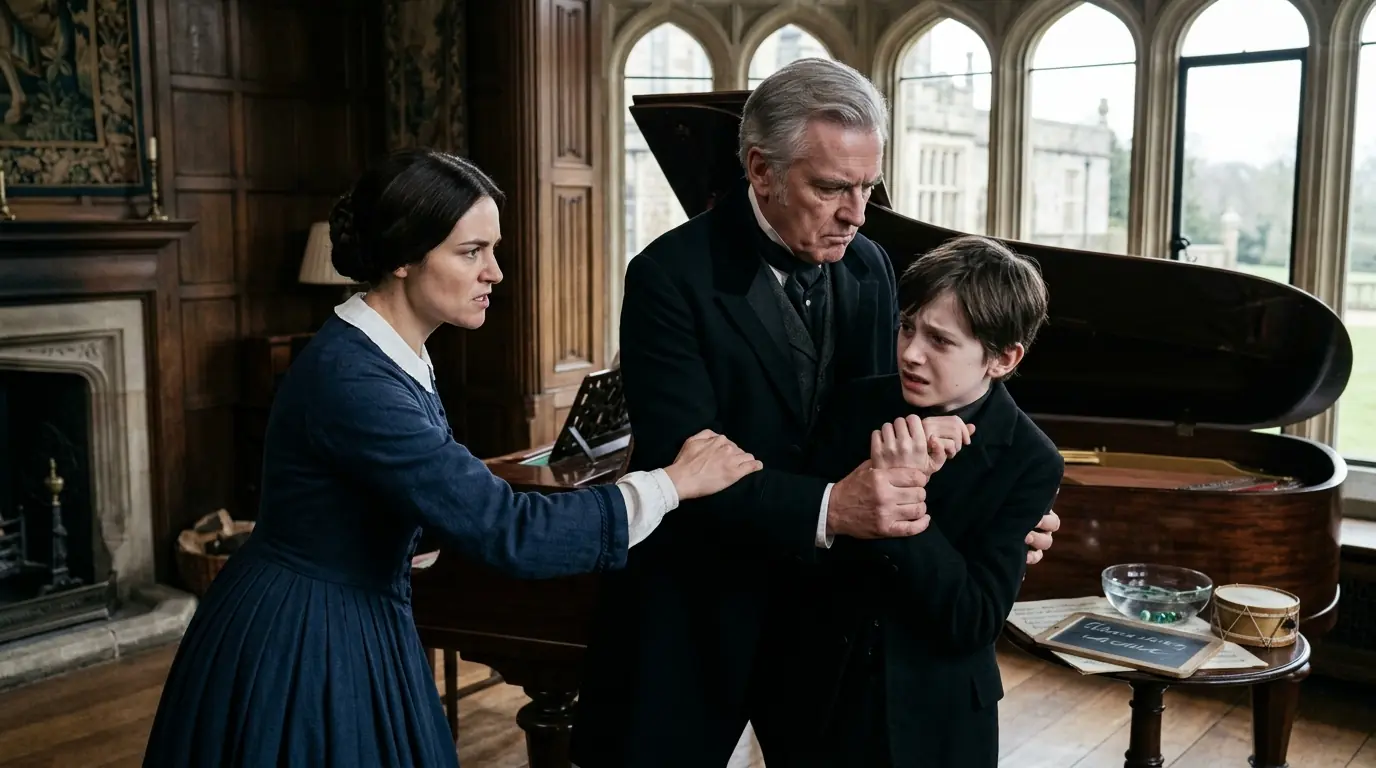
Two hundred guests watched the thirteen-year-old boy stop breathing; his fingers tightened around the arm of his chair. His gray eyes flew toward the piano. Across the crowded ballroom, Miss Eleanor Reed lifted her hands from the keys.
Three days earlier, the Viscount had dismissed her from his household. That evening, she had returned without permission.
Dr. Marcus Vane stepped forward, his face red with anger. "This is a cheap performance," he said. "The boy felt a vibration, nothing more."
Eleanor looked at Daniel. She did not ask him what he had heard. She did not ask him to speak. She simply raised her hands.
Daniel answered in sign language: Again.
A murmur passed through the ballroom. Eleanor played the same low note. Daniel closed his eyes. For the first time since the fever had taken his hearing, something resembling sound reached him. Then Eleanor played four more notes. They formed the beginning of a lullaby his mother had once played during thunderstorms.
Daniel opened his eyes. There were tears in them now. He signed a single word: Mother.
At the edge of the platform, Viscount Ashbury stared at his son as if seeing him for the first time.
But the miracle in that ballroom was not that a deaf boy had heard a few notes. The true miracle was that after six years of demanding that Daniel listen to them, the people of Ashbury Hall were finally about to listen to him.
Eight weeks earlier, Eleanor Reed had arrived at the estate in a hired carriage with one small case, twelve shillings in her purse, and a dismissal letter folded inside her coat. Rain covered the windows of Ashbury Hall like a gray curtain. The house stood above the Yorkshire Moors, built from dark stone and older grief. Its towers disappeared into the mist. Half the windows were shuttered, though it was not yet evening.
Mrs. Finch, the housekeeper, met Eleanor beneath the entrance arch. "You understand that his lordship requires a music teacher, not a governess," she said as they crossed the great hall.
"I understand."
"And you are not to interfere with the boy's medical instruction."
Eleanor slowed. "What sort of instruction?"
Mrs. Finch lowered her voice. "Dr. Vane says the young master must learn to speak again. No gestures are permitted in his presence. They encourage laziness."
Eleanor looked toward a staircase lined with portraits. At the top stood a thin boy in a black coat. He had pale skin, dark brown hair, and the stillness of someone accustomed to being discussed as if he were furniture.
"That is Lord Daniel," Mrs. Finch whispered. "Do not expect him to acknowledge you."
Daniel looked directly at Eleanor. Then he looked at Mrs. Finch's lips. Eleanor understood: he had not ignored them; he had simply missed everything said while their faces were turned away.
Viscount Jonathan Ashbury received Eleanor in the library. He was forty-two, tall and severe, with weariness carved around his eyes. A portrait of his late wife hung above the fireplace.
"I have read the letter from St. Cecilia's Academy," he said.
Eleanor sat across from him. "Then you know why I was dismissed."
"You allowed a deaf laundry girl to attend your music lesson."
"I allowed her to sit beside the piano and feel the rhythm through its wooden frame. The headmistress called it an undignified spectacle."
"The headmistress was more disturbed by the girl's apron than by her deafness." Something almost like amusement touched the Viscount's face, then vanished. "Why did you defy her?"
"Because the girl understood rhythm. And because humiliation is not a teaching method."
His expression hardened. "Dr. Vane is England's foremost authority on diseases of the ear. You will not contradict him in front of my son."
"I am a music teacher, my lord. I make no claim to be a physician."
"Good." He placed a contract on the desk. "You will prepare the household musicians for our winter charity concert. Daniel may attend your lessons if he chooses. Do not fill his mind with false promises."
Eleanor signed the contract. But before leaving, she looked at the portrait above the fire. Lady Isabelle Ashbury was seated at a piano, one hand resting on the keys; the other hand was raised, two fingers extended in what looked like the beginning of a sign.
Eleanor met Daniel the following morning. He stood alone in the music room with one palm pressed against the side of the grand piano. Eleanor approached from the front so he could see her.
"Good morning," she said slowly.
Daniel watched her lips, but gave no response. She sat at the piano and played a scale. He did not move. Then she played a low chord. His fingertips shifted against the wood. Eleanor played it again. This time, Daniel looked at her.
She tapped a simple rhythm on the piano lid: three taps, a pause, two taps. Daniel stared at her hand. Then he answered: three taps, a pause, two taps. Eleanor changed the pattern; Daniel repeated it perfectly.
She took a slate from the music stand and wrote: My name is Eleanor.
He took the chalk: I know.
She smiled. Do you like music?
Daniel placed his hand against the piano again. Then he made a careful movement with his fingers. Eleanor recognized it from the deaf girl at St. Cecilia's.
"Music," she answered with the same sign.
Daniel's eyes widened. Eleanor knew only a little sign language, but it was enough to ask his name. Daniel signed it. Then his hands moved more quickly: The floor sings when you play.
Eleanor felt something tighten in her chest. The boy had not been silent; the house had simply refused to learn his language.
During the following days, Eleanor changed the music room. She placed grains of rice on the surface of a drum and struck it softly; Daniel watched the grains leap. She filled a shallow glass bowl with water and set it on the piano; when she played a low chord, ripples crossed the surface. She taught him rhythm through light, movement, and touch.
Daniel learned faster than any student she had ever taught. He could reproduce a complicated rhythm after seeing it once. He understood fractions through musical time. He began arranging colored cards into patterns that Eleanor translated into percussion and piano.
One afternoon, he placed blue cards in a slow sequence, then scattered gray cards between them.
"What is this?" Eleanor asked in sign.
"Rain on the roof," he answered.
She played what he had written. Daniel pressed both hands to the piano and smiled. It was the first time Eleanor had seen him smile. A servant watching from the doorway crossed herself. By dinner, the story had spread through the house: the "soulless heir" had laughed.